Codeium as an AI Coding Tool
The AI coding tool that built its own IDE to escape the limits of being a plugin.
Codeium started as a code completion tool. That sounds boring, and it mostly was, until you got into the details.
The real differentiator was scope. Most tools could suggest the next line or finish a function signature. Codeium had what it called Supercomplete, which read ahead more like a few paragraphs than a few words. Full logical blocks. Entire classes. Utility functions generated from context, not just syntax.
It supported 70+ programming languages and plugged into 40+ editors. That second number got underrated constantly. Most AI coding tools quietly assumed you lived in VS Code. Codeium didn't make that assumption.
The in-editor chat let you explain code, draft tests, request refactors without switching windows. And it indexed your local repository, which meant it wasn't just reading whatever file you had open. It understood your directory structure, your imported modules, the patterns your codebase had already settled into.
That's a meaningfully different experience than a tool that only sees what you've pasted into a chat box.
So why wasn't any of that enough, and why build an entire IDE from scratch?
The ceiling is architectural, and once you see it, you can't unsee it. A plugin lives inside someone else's house. It only knows what the host IDE decides to share. If you want an AI to write code, then run it, then fix what broke, then write a test, those steps cross tool boundaries the plugin doesn't control. Codeium hit that ceiling and decided to stop being a tenant.
How Cascade changed what "AI coding assistant" means in practice
Here's what most people get wrong about "agentic" coding features: the majority of them are still chat windows with extra steps. You write a prompt, the model writes code, you copy it somewhere, maybe there's a button.
Cascade was different. It's a persistent agent that operates inside the editor environment. It reads your codebase, builds a working model of how your project is actually structured, and executes multi-step plans without being walked through each one. You describe what you want. Cascade figures out the path. It creates files, edits existing ones, runs terminal commands, and then — here's the part that actually matters — it looks at its own output and iterates.
That last capability is what separates an agent from a very fast typist.
The Flows model was Codeium's answer to a tension that nobody had solved cleanly. Full autonomy is powerful and terrifying at the same time. Pure copilot mode is safe but slow. Cascade moved between those modes based on what the task needed, reading the situation rather than waiting for you to configure it.
A few things that made this useful in practice rather than just interesting on paper:
- Real-time awareness. Cascade tracked what you were doing in the editor and adjusted to it, not just what you'd asked twenty seconds ago.
- Linter integration. Errors weren't just things you saw in a red squiggle. They were signals the agent acted on.
- Checkpoints. When Cascade made multi-file changes, you could roll them back. This sounds like table stakes, but it wasn't. Autonomous edits across a dozen files are only useful if you can undo them when the agent gets confident and wrong simultaneously.
Why does this look different from a VS Code extension calling GPT-4 through an API? Because the editor exposes internal state that a plugin never sees. Tool calling is native. Context is continuous across a session instead of rebuilt from scratch every time you send a message.
The difference is real. Think less "contractor who gets a blueprint once" and more "contractor who has been on the job site every day and actually knows where the weird load-bearing wall is."
Workflows, Memory, and parallel agents — the 2026 feature surface
By 2026, the product had grown in a direction that made the strategy pretty legible: stop competing on single-task performance and start competing on how much of the development lifecycle the tool could own outright.
Workflows are saved procedures. Name them, describe them, give them a structured prompt template, and Cascade runs them on demand. Test generation, dependency upgrades, framework migrations, boilerplate refactors. The repeatable 80% of work that nobody loves but everyone has to do. Think runbooks that an autonomous agent can follow without being re-prompted at every step.
Memory solves the cold-start problem. The agent doesn't reset every time you reopen a project. It remembers, and context persists across sessions. That sounds like a small thing, but in practice it shifts the relationship from "tool I use occasionally" to "thing that already knows the codebase when I sit down in the morning."
Then there's the Devin integration, which arrived after Cognition's acquisition. Devin is a cloud agent that spins up its own machine. While you're coding locally, Devin handles debugging, testing, and deployment in parallel. Not sequentially. You keep working instead of handing off and waiting.
The Agent Command Center manages both local Cascade sessions and cloud Devin sessions in a single Kanban-style dashboard.
In February 2026, Windsurf shipped five parallel agents in the same two-week window that saw other major players launching their own multi-agent features. The race had explicitly shifted from "how fast can the AI complete a line" to "how many things can the AI coordinate at once." The SWE-1 model family, released in May 2025, was three proprietary models built specifically for the full software engineering workflow rather than general code generation. Owning the model stack means the editor and the agent can be optimized together. When you're adapting to a third-party API, you're always fitting a square peg into something that wasn't designed for it.
What the productivity evidence actually shows about tools like Codeium
The adoption numbers are not in dispute. Per JetBrains' 2025 survey of over 24,000 developers, 85% regularly use AI coding tools. AI-authored code makes up roughly 27% of production code tracked across millions of developers.
The productivity numbers are messier, and that's where it gets interesting.
Across 135,000+ developers in one analysis, the average was about 3.6 hours per week saved. Daily users merged roughly 60% more PRs. Nearly nine in ten developers in the JetBrains survey saved at least one hour per week. One in five saved eight or more hours.
Those are real numbers, and then there's the METR randomized controlled trial.
Sixteen experienced open-source developers. 246 real issues. The result: AI tools made them 19% slower. Those same developers estimated they were 20% faster. Subjective experience and measured reality diverged by almost 40 percentage points.
That's not measurement noise. That's worth sitting with for a minute.
The same METR cohort in February 2026 showed an 18% speedup. The tools improved. But so did the developers' judgment about when to use them and, critically, when to set them aside. That's a skill that has to be developed. Surveys measuring self-reported experience will systematically miss the period where people are confidently slower.
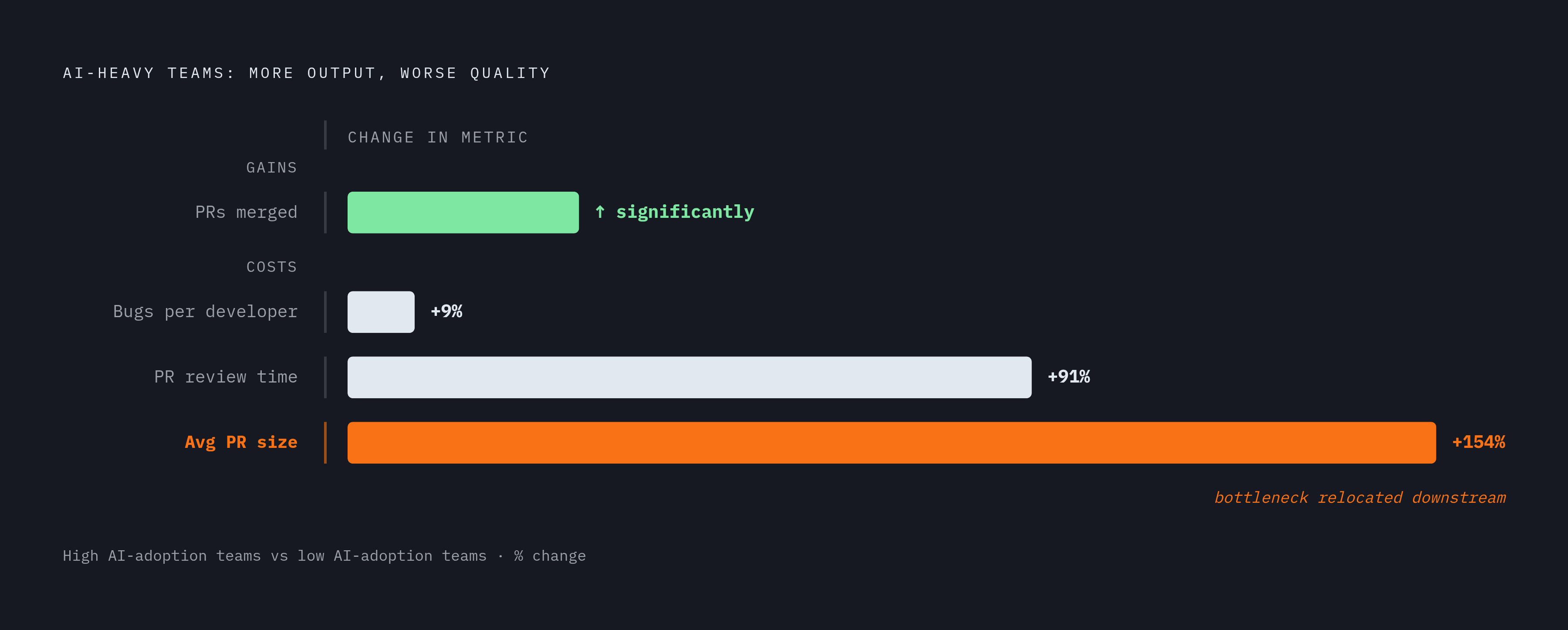
A Faros AI analysis of over 10,000 developers across more than 1,200 teams found something that probably shouldn't have been surprising but was: high AI adoption teams completed more tasks and merged significantly more PRs, but PR review time increased by 91%, average PR size grew by 154%, and bugs per developer were up 9%.
More output, more review time. The bottleneck didn't disappear. It relocated downstream.
A 2026 research finding captures the plateau pretty directly: productivity gains had leveled off at roughly 10% even as the vast majority of developers reached for AI tools daily. The ceiling is real. It's just lower than the marketing suggests.
How Codeium and Windsurf compare to the other major tools developers are choosing between
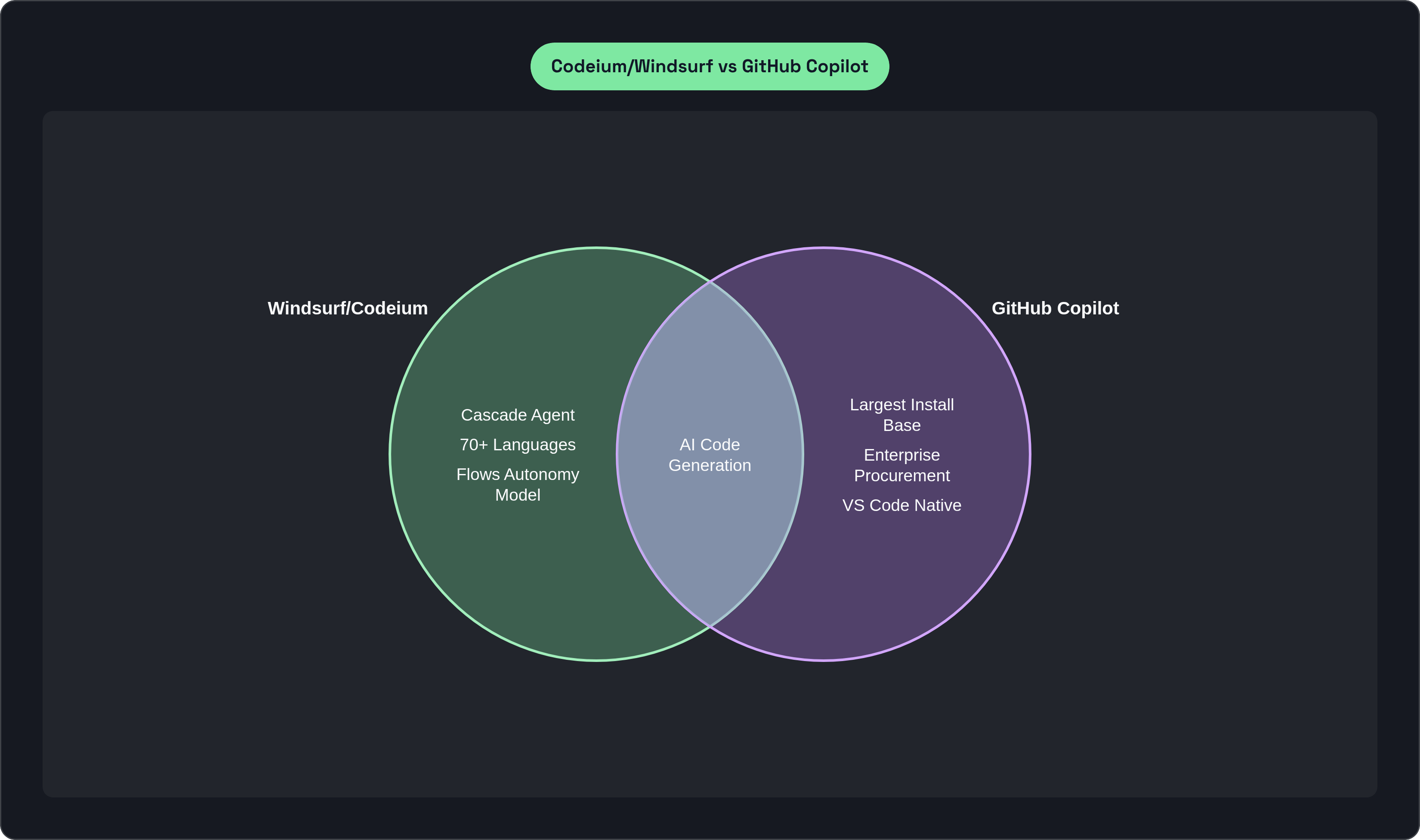
In 2025 and 2026, most developers comparing AI coding tools landed on one of three: GitHub Copilot, Cursor, or Windsurf.
GitHub Copilot has the largest install base and the deepest enterprise procurement integration. It runs as an extension inside VS Code and JetBrains editors and is, by design, additive to your existing setup. The tradeoff is exactly what we covered earlier: a plugin works within limits it doesn't control. The Microsoft IP dispute that ultimately blocked the OpenAI acquisition of Windsurf is worth noting here. The architecture was considered threatening enough to Copilot that it stopped a multi-billion dollar deal. That tells you something about where the real competition is.
Cursor is probably the closest analog to Windsurf. Both are VS Code forks. Both have agentic ambitions built into the editor rather than bolted onto the side. Cursor used an autonomy slider. Windsurf used Cascade's Flows. Different philosophies for the same problem: how much do you let the agent run without checking in? Both support multiple model providers. Neither locks you to one.
Windsurf/Codeium historically differentiated on a few things that mattered to different audiences:
- A meaningful free tier that actually lowered the barrier for individual developers
- 40+ editor integrations before the Windsurf pivot, broader than anyone else at the time
- 70+ language support without falling apart on less-common languages
- And Cascade, which was an architectural bet, not a feature addition
Enterprise adoption was real before the acquisition. 350+ enterprise customers including JPMorgan Chase and Dell. $82 million in ARR. That's not a pilot program. That's production deployment at scale.
One number worth keeping in mind as you compare options: AI-coauthored pull requests show approximately 1.7 times more issues than human-only PRs per independent analysis. That's a category-wide baseline, not a Windsurf-specific problem. Whatever tool you pick, that math comes with it.
What evaluating Codeium today actually means given its current state
Codeium as a standalone product no longer exists. Windsurf became Devin Desktop on June 2, 2026. Existing installs updated automatically. Plans, settings, and the underlying Cascade architecture carried over.
What changed was ownership, strategic direction, and what the product is ultimately trying to be. Cognition acquired the Windsurf business. The founding team went to Google in a separate deal. The product is now a surface within a broader autonomous agent platform, rather than an IDE that happens to have agentic features. That's a real distinction, not just a branding update.
Cognition raised at a $26 billion valuation in May 2026 with over $490 million in annual revenue run rate, but roadmap authority changed. The people who built Cascade are at Google now.
That raises a question that matters differently depending on who's asking. For individual developers, the continuity is probably fine. For organizations with long procurement cycles and long-term toolchain commitments, the ownership change is something to evaluate seriously, not assume away.
A few questions worth actually answering before committing:
- Does Cascade's fluid autonomy model match how your team wants to work? Or do you want more deliberate human-in-the-loop control points?
- Has the pricing architecture shifted post-acquisition? The free tier that made Codeium attractive to individuals may not look the same.
- Does your workflow actually benefit from local Cascade plus cloud Devin running in parallel? Or is that overhead for a problem you don't have?
Codeium's trajectory from autocomplete extension to agentic IDE to cloud agent platform tracks the direction of the whole category. The AI code tools market hit $8.5 billion in 2026. Agentic tools are not coming. They're here, they're messy, and they're improving faster than most teams are adapting to them.
The real question isn't which tool is best. It's whether you want to be optimizing for the leading edge of that curve right now, with all the churn and re-evaluation that involves, or whether waiting for the consolidation dust to settle is the smarter use of your team's time. Pick a direction, but make sure you know which one you're actually picking.