LangGraph vs LangChain for Agentic Coding Pipelines
LangGraph's stateful graphs and retry logic outperform LangChain for complex agentic pipelines.
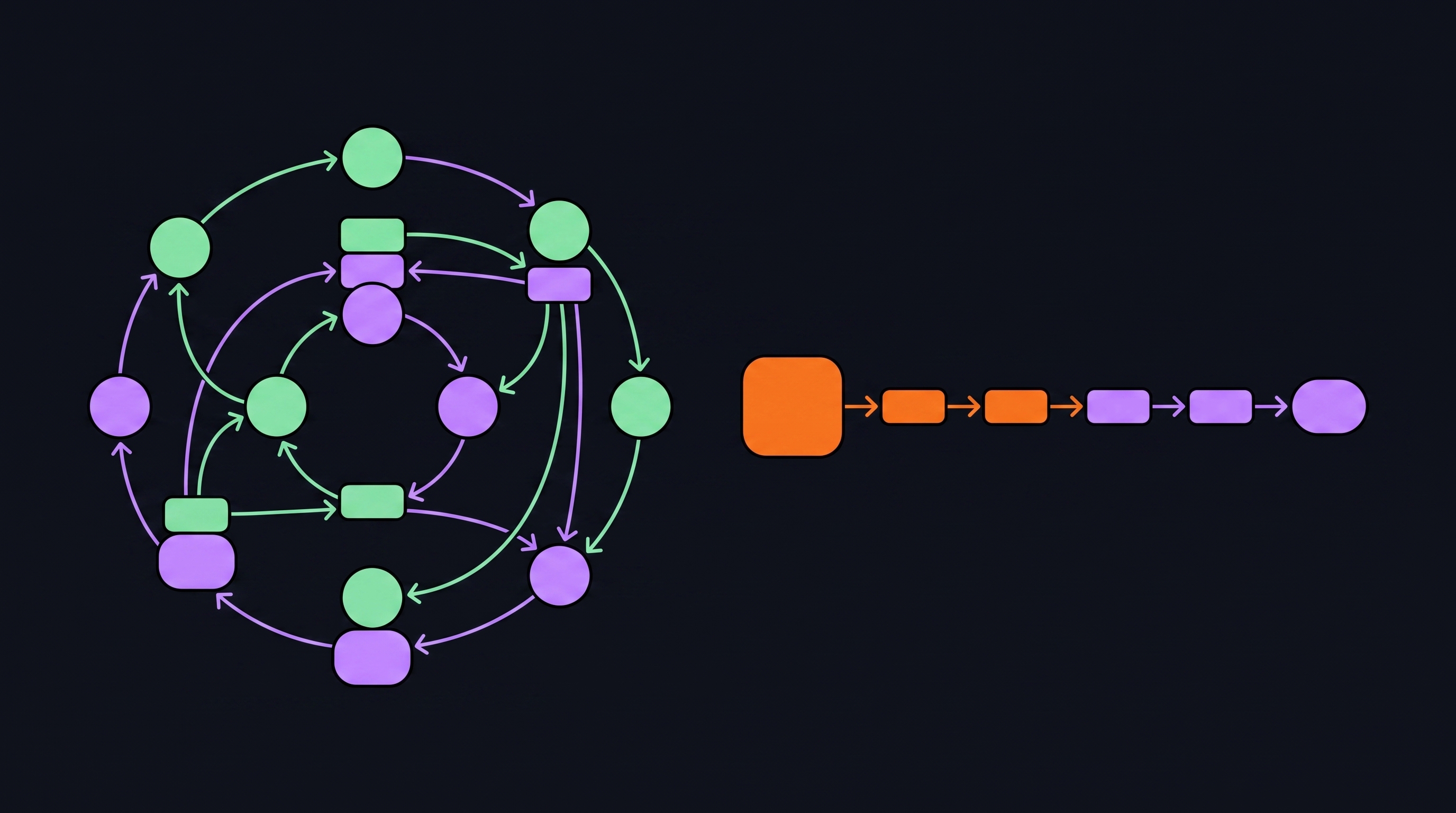
Picture the simplest possible coding assistant. You send a prompt, it retrieves some relevant docs, it generates code, it returns output. Done. No decisions, no retries, no memory of what happened last time. It runs once and stops.
That is a linear pipeline. LangChain handles it well. Clean abstractions, minimal overhead, fast to build.
Now picture something slightly more ambitious. An agent that writes a function, runs the tests, sees three failures, reads the error output, decides whether to fix the code or escalate to a human reviewer, tries again, and eventually either succeeds or gives up cleanly. Same general idea as the first pipeline. Completely different shape.
That second pipeline has a handful of properties that change everything:
- Statefulness. Does it remember what happened in step two when it reaches step seven?
- Cycles. Can it loop back to an earlier step based on what it observed?
- Branching. Does the path it takes depend on runtime conditions, not a fixed sequence?
- Duration. Does it need to survive a process crash and pick up where it left off?
- Multi-agent coordination. Do multiple specialized agents need to hand work to each other?
LangChain handles the low end of each of those dimensions reasonably well. LangGraph is built for the high end. The question was never which framework is better. It was always which class of problem you are actually solving.
One more thing before we go further: the low end of this spectrum is shrinking. Better base models, native tool calling, and expanded context windows have quietly eaten a lot of the scaffolding LangChain was originally built to provide. For truly simple workflows, the honest question today might be whether you need any framework at all. We will get to that.
What LangChain does well in coding pipelines and where it runs out of road
LangChain launched in late 2022 as an open-source project. The core idea was reusable abstractions: chains, prompts, memory, tool integrations. Wire together LLM calls into sequential pipelines. It became the default framework for composing LLM applications almost immediately, and for good reason.
For coding pipelines specifically, it fits well in a few places:
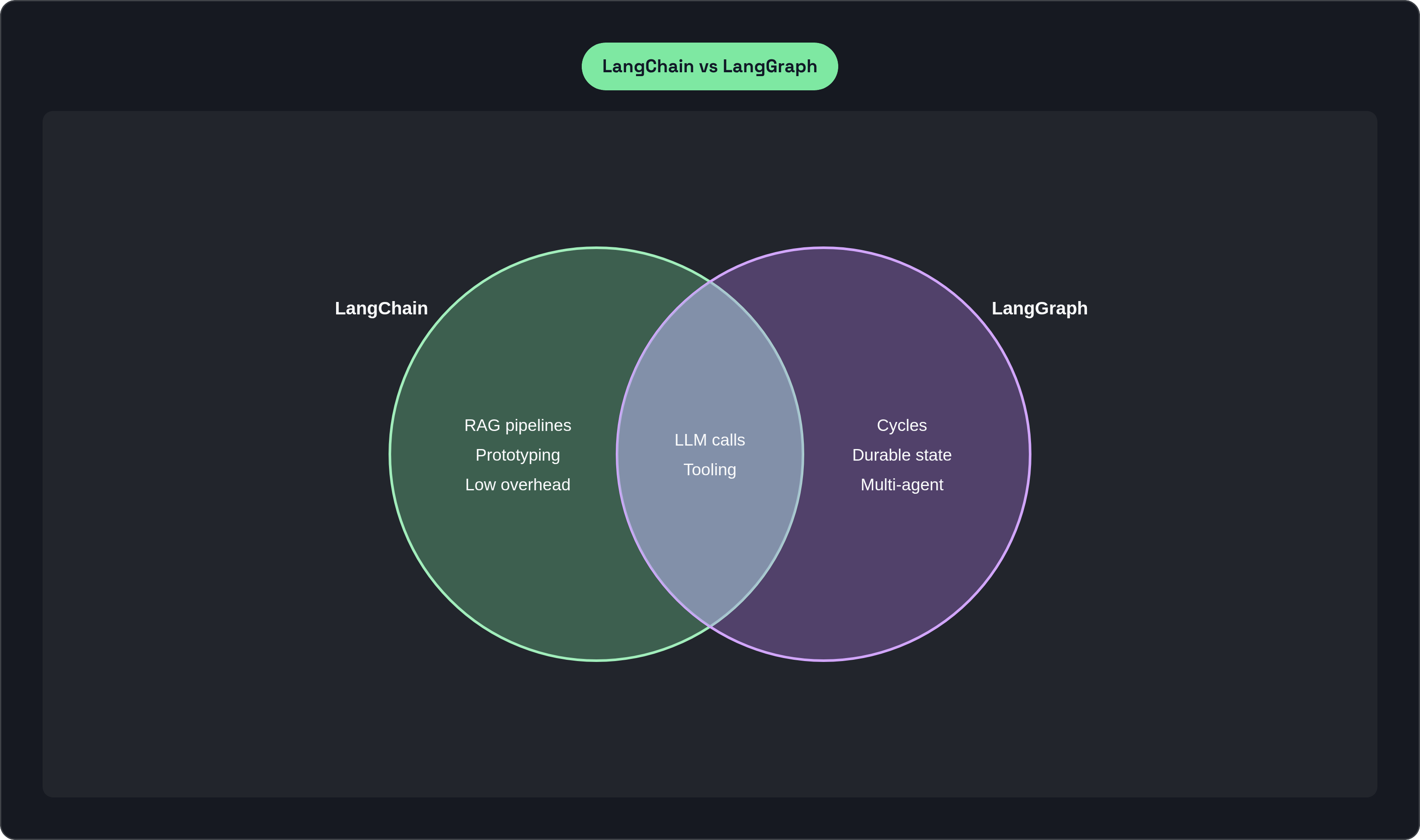
- RAG-based code search and documentation retrieval
- Single-turn code generation with a fixed tool set
- Conversational coding assistants with shallow, sequential memory
- Rapid prototyping, where the fastest path from idea to demo matters most
The latency advantage is real. Linear flows carry minimal orchestration overhead. The ecosystem is large, with hundreds of integrations for LLM providers, vector stores, and tools. MCP's arrival has reduced that edge somewhat, but not eliminated it.
Where does it run out of road? The same few places come up over and over:
- Pipelines that need to retry a failed step without re-running the whole chain
- Agents that need to decide at runtime whether to loop or exit
- Any workflow that must survive a crash and resume from state
- Multi-agent setups where one agent's output routes to a specialist sub-agent
The clearest signal came from LangChain's own team, which deprecated the AgentExecutor in favor of LangGraph for any new agent work. When the people who built a tool draw that line publicly, it tells you something real about where it was always going to hit its ceiling.
Think of LangChain as the on-ramp, not the highway. Use it when the pipeline is stable, linear, and the prototype is essentially the destination. If the pipeline is going to grow — or if it already has any of those complexity dimensions listed above — the on-ramp will dead-end on you.
What LangGraph adds — state, cycles, and durable execution
LangGraph came out of the same team at LangChain in 2024. It was a direct response to what chains couldn't do. The model is different at its core: the application is a directed graph where nodes are functions or tools and edges define how data and control flow between them. Those edges can loop. The graph is cyclic, not strictly sequential.
Three things matter most for coding pipelines:
- Nodes. Discrete functions or tool calls. Run the tests. Read the file. Call the LLM.
- Edges. Conditional transitions. Route to the next node based on what the previous one returned.
- State. A persistent object threaded through the entire graph. Every node can read it and write to it.
The state object is the piece that changes everything in practice. It is why an agent can fail mid-pipeline, restart, and not lose its context. It is also why a partial failure re-runs only the failed node instead of the whole graph — which has real token-cost implications for anything running long.
The human-in-the-loop capability sounds abstract until you see it in an actual engineering workflow. Execution can pause at any node for human inspection or approval, then resume. That is a code review gate. That is a security scan checkpoint before deployment, built into the graph structure rather than bolted on afterward. It is not a conceptual feature; it is a structural one.
Observability improves qualitatively too. When something goes wrong in a chain, debugging often means reading logs and guessing at what happened. In a LangGraph pipeline, you can visualize the graph, see exactly which node produced the bad output, and re-run just that node. If you have ever spent two hours bisecting a broken pipeline, you know immediately why that matters.
Both LangChain and LangGraph hit stable v1.0 in October 2025. LangGraph is at v1.2.7 as of June 2026. These are not experimental tools anymore.
Multi-agent coding architectures that LangGraph supports natively
This is where things get genuinely interesting, and also where what Addy Osmani calls the "80% problem" becomes most visible. Agents complete most of a task while the remaining portion quietly compounds hidden costs. Stateful graphs with human-in-the-loop checkpoints are the structural answer to that problem. Keep that in mind as we walk through the patterns.
LangGraph supports three idiomatic multi-agent architectures:
Supervisor graph. A router agent receives a task and delegates to specialist sub-agents. In a coding pipeline: planner agent receives a product requirement, dispatches to a code-writing agent, which hands off to a test-running agent. Clear hierarchy. Explicit handoffs.
Swarm. Agents hand off to each other dynamically based on task state, without a fixed supervisor. More flexible, harder to reason about when something breaks.
Hierarchical graphs. Supervisors nested inside supervisors. This is the pattern for large-scale architectures with parallel workstreams across teams.
Klarna, Replit, and Elastic are running LangGraph in production. That is not prototype viability. That is real operational trust at scale.
Two more things here. Agents in these graphs can build long-term memory across sessions through LangMem integration. For a coding agent working on the same codebase repeatedly over weeks, that compounds meaningfully. And LangSmith sits alongside LangGraph as the observability layer, which matters a lot when you are trying to understand what a multi-agent graph is actually doing inside a CI/CD pipeline.
The real-world performance gap between autonomous agents and engineering team expectations
There is a gap between what teams expect from agentic coding and what actually shows up in the data. It is bigger than most people want to admit.
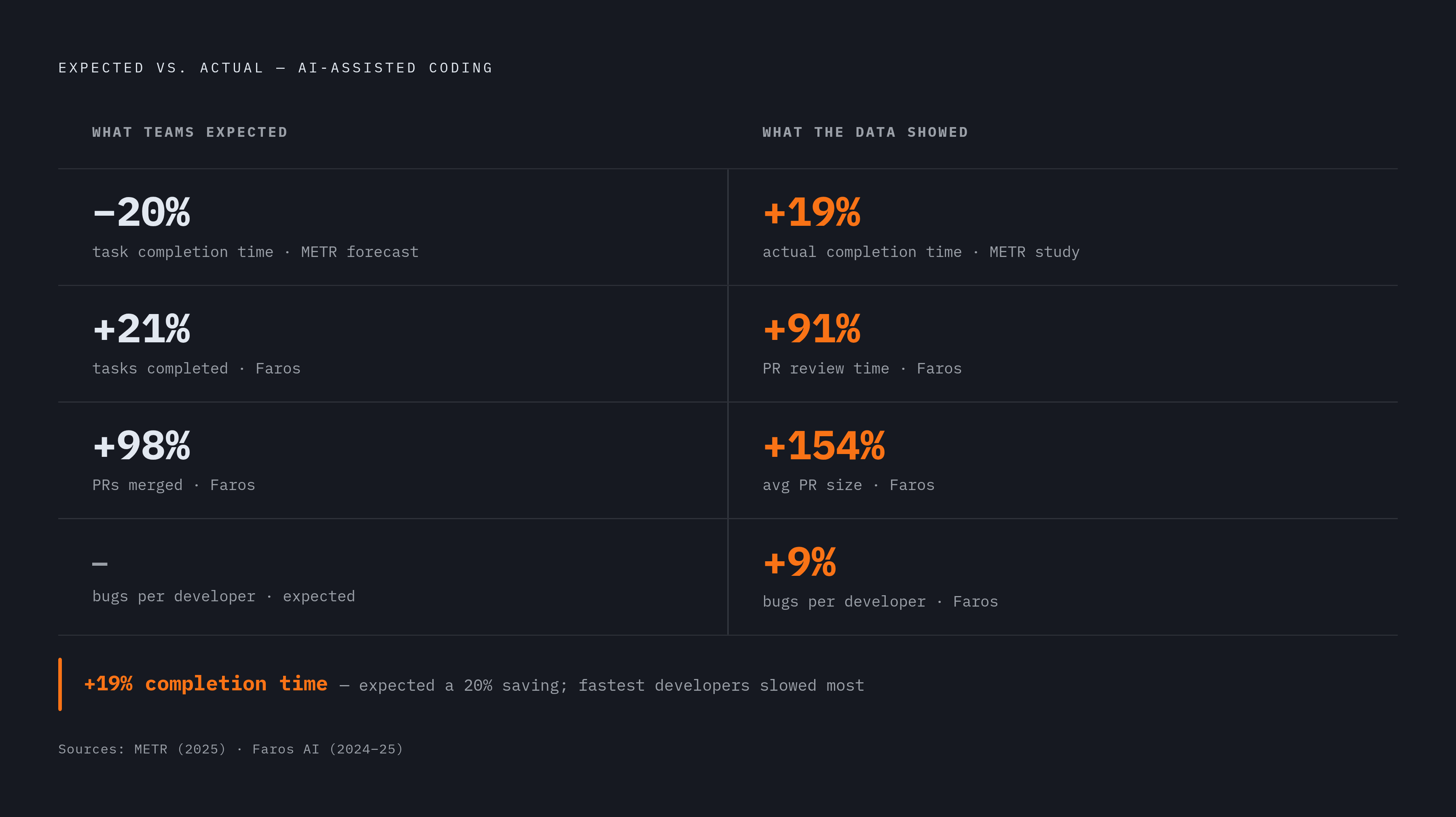
A randomized controlled trial published in July 2025 by METR studied 16 experienced open-source developers across 246 tasks on mature codebases averaging roughly a million lines of code. Before the study, developers forecasted a significant reduction in completion time from AI tools. After using them, they estimated about a 20% reduction. The actual result: completion time increased by 19%.
Experienced developers. Mature codebases. Real tasks. The subjective sense of going faster and the objective outcome were pointing in opposite directions. That is a strange thing to sit with.
Data from Faros, covering over 10,000 developers across more than 1,200 teams, fills in a different part of the picture. Developers on high AI-adoption teams completed 21% more tasks and merged 98% more pull requests. But PR review time increased 91%. The bottleneck shifted from writing to reviewing. Volume went up. So did the surface area for error, with a 9% increase in bugs per developer and a 154% increase in average PR size.
Security is its own layer of this. A significant portion of AI-generated code contains security vulnerabilities, and most companies planning to deploy AI agents found their traditional security tools were not designed for autonomous code execution.
So why does any of this matter for the LangChain versus LangGraph question? Because the specific failure modes of autonomous agents — silent loops, oversized PRs, security gaps, review bottlenecks — are exactly what LangGraph's durable execution, state visibility, and human-in-the-loop checkpoints are built to contain. The framework choice is not just about orchestration complexity. It is about what breaks, and how badly, when things go sideways.
This is not a case against agentic coding. The same evidence shows real gains in onboarding speed, volume tasks, and well-scoped work. The problem is task selection and pipeline design, not the general approach.
A decision framework for choosing between LangChain, LangGraph, and no framework at all
The third option deserves a real seat at the table. Better base models with native tool calling, expanded context windows, and improved instruction following have made a lot of framework abstractions unnecessary. "Do I even need a framework?" is a legitimate question now, not a cop-out.
Reach for LangChain when:
- You have a prototype or proof-of-concept with a deadline
- The pipeline is RAG, document Q&A, or single-tool code generation
- Your team has no prior LangGraph experience and the workflow is unlikely to grow non-linear
- LangChain 1.0's
create_agentis fine for your needs, since it runs on LangGraph under the hood anyway, which keeps the migration path short when you need it
Reach for LangGraph when:
- The pipeline needs to loop: test, observe, retry, decide, not run once and stop
- The workflow must survive process crashes and resume from state
- Human approval gates are required at specific steps — code review, security scan, deployment confirmation
- Multiple specialist agents need to coordinate
- The pipeline will run for minutes or hours, not seconds
- Debugging and observability are production requirements, not nice-to-haves
Skip both and use a minimal agent SDK or direct API when:
- The workflow is a single-step tool call or a short two-step chain
- Debugging framework internals costs more than the abstraction is worth
- MCP-native tooling already covers your integration surface
The phased approach is often the right call. Start with LangChain for experimentation. Migrate to LangGraph as reliability, traceability, and multi-agent coordination become real requirements. Both frameworks share the same runtime now, so the migration is incremental, not a rewrite.
How a fully integrated coding environment changes what these frameworks need to do
The whole framework question assumes a gap: developers manually stitching together agents, tools, and pipelines because their environment does not do it natively. That assumption is aging fast.
Tools like Cursor already integrate the IDE, terminal, and GitHub PR review into a single environment where agents operate across the full development loop. Plan, write, test, deploy, review. The gap the frameworks were built to fill is narrowing from one direction, while the complexity of what teams want to do keeps growing from the other.
But what does that actually mean for LangGraph? The stateful, durable, multi-agent patterns it provides are most valuable inside an environment that already understands the structure of a codebase, CI state, and review workflow. Not as a standalone orchestration layer bolted on from outside. The frameworks become infrastructure inside the environment rather than infrastructure instead of it. That is a meaningful shift in where they live.
There is also a behavioral pattern worth observing: developers tend to build intuitions for AI delegation over time. They hand off tasks that are easily verifiable or low-stakes. They hold onto work that is conceptually difficult or design-dependent. LangGraph's checkpoint and state model is exactly the infrastructure that makes that delegation boundary explicit and enforceable. You can dial how much independence an agent has at any step, from a targeted single-node edit to a full autonomous run.
The AI agents market is expanding fast, and the framework decisions being made right now will shape how teams build for the next several years. That is not a reason to overcomplicate your first pipeline. It is a reason to understand the spectrum you are building on, and to pick the tool that fits the actual shape of your problem today.