AI Coding Agent Role in Pull Request Workflows
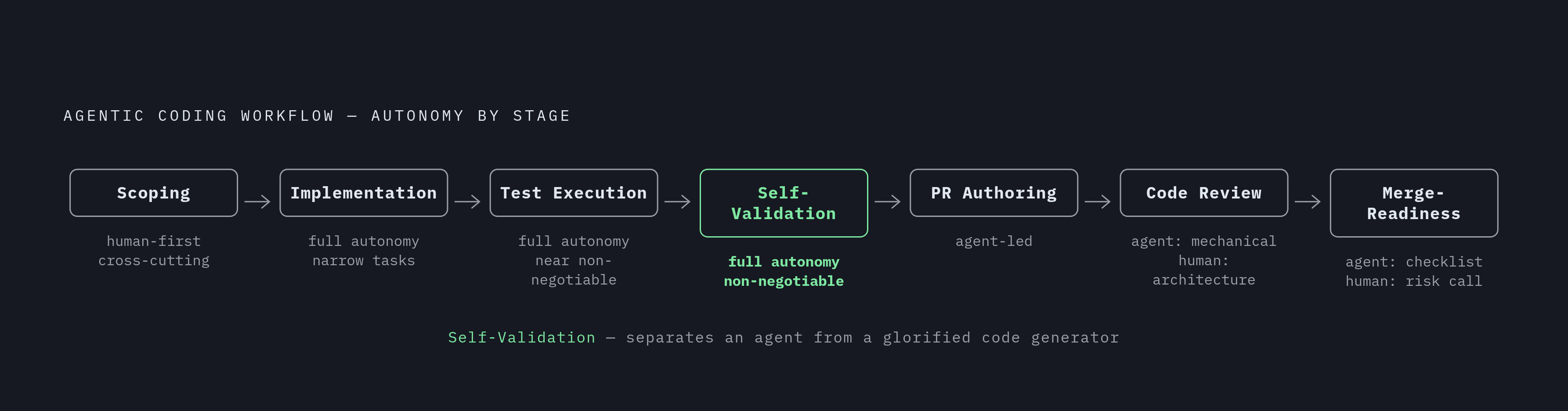
Map it out: scoping → implementation → test execution → self-validation → PR authoring → code review → merge-readiness checks.
Seven stages. Each one can be owned separately by an agent. That separation is the whole point.
Most conversations about AI coding tools collapse this into one lazy question: "Should I use AI to help me code?" Which is kind of like asking whether you should use electricity. The more useful question is which specific stage actually benefits from handing off to an agent. Not globally. Stage by stage.
There's a distinction worth making early, because people mix these up constantly. A code assistant is reactive. It fills in the next line when you pause, like a smarter autocomplete. A coding agent plans, executes, validates, and iterates without you prompting each step. That shift from reactive to proactive is what makes full lifecycle ownership possible.
Autonomy isn't a switch you flip either. The spectrum runs from "agent drafts a PR description for a human to approve" all the way to "agent submits, validates, and merges with no human touchpoint." Most teams will, and probably should, live somewhere in the middle.
The MSR '26 AIDev dataset gives us something concrete: over 932,000 agentic PRs across more than 116,000 repositories. Agentic PRs differ most in commit structure and the breadth of files touched. Like a wide net across a codebase rather than a single targeted hook. Line-count differences are smaller than you'd expect. Agentic PRs also show slightly stronger alignment between the PR description and what the code actually does. Whether that means they're better, or just more literal, is a question worth sitting with longer than most teams do.
Scoping and implementation: what agents do before a PR exists
The canonical handoff looks like this. You say: "Add rate limiting to our API gateway." The agent reads the codebase, identifies the relevant files, and implements across modules. No step-by-step instructions. It just goes.
Background agents run asynchronously, outside the editor, in an isolated environment. You assign a task, they work, they deliver. These things can now run for minutes or hours on a single task, which sounds impressive until you realize the failure modes scale accordingly.
During this phase the agent is doing several things at once:
- Reading context: existing code, related tests, documentation, past PRs on similar changes
- Scoping the change across files and dependencies
- Implementing across multiple modules simultaneously
- Writing tests as part of the same work unit rather than bolting them on afterward
What trips people up is this: agents don't freeze when requirements are unclear. They pick something and implement it. So the human's job isn't just reviewing whether the code is correct. It's deciding whether the choice the agent made was the right one to begin with. That's a different cognitive task than most engineers are used to, and it takes some adjustment.
Architectural decisions that aren't legible from the code alone still need human judgment. So do tradeoffs involving product direction. An agent can tell you whether the implementation is internally consistent. It cannot tell you whether it serves the user.
The MSR '26 data shows Claude Code leads on feature implementation tasks while Cursor leads on fix tasks. Different agents perform differently across different task types. That alone should give teams pause before picking one tool and deploying it everywhere.
Test execution and self-validation before the PR opens
Self-validation is what separates an agent from a glorified code generator. The agent checks its own output using the same toolchain human engineers use, before anyone else sees it.
A well-designed validation loop covers:
- Running the test suite and iterating on failures
- Checking CI/CD pipeline status
- Querying observability tools for regressions
- Doing visual verification of frontend changes in a real browser
Ramp's Inspect agent does exactly this. Runs tests, checks CI, inspects observability dashboards, confirms frontend changes, then opens the PR. Approximately 30% of PRs across Ramp's frontend and backend repos go through this process. Not a pilot. Sustained production.
Uber's FlakyGuard is a useful counterpoint. Over six months of daily autonomous operation, it processed over 1,100 flaky tests and produced nearly 200 merged fixes without human task assignment. The scope was deliberately narrow: repeated execution, measurable throughput on work senior engineers actively avoid. That constraint is not a limitation. It's the strategy.
When self-validation passes, the agent opens a PR that includes the evidence. Test results, CI status, monitoring checks. Not just a diff. That actually changes what reviewers are being asked to do. The question shifts from "does this work?" to "is this the right thing to do?" Those are very different conversations to walk into.
Why AI-generated PRs are creating a review bottleneck
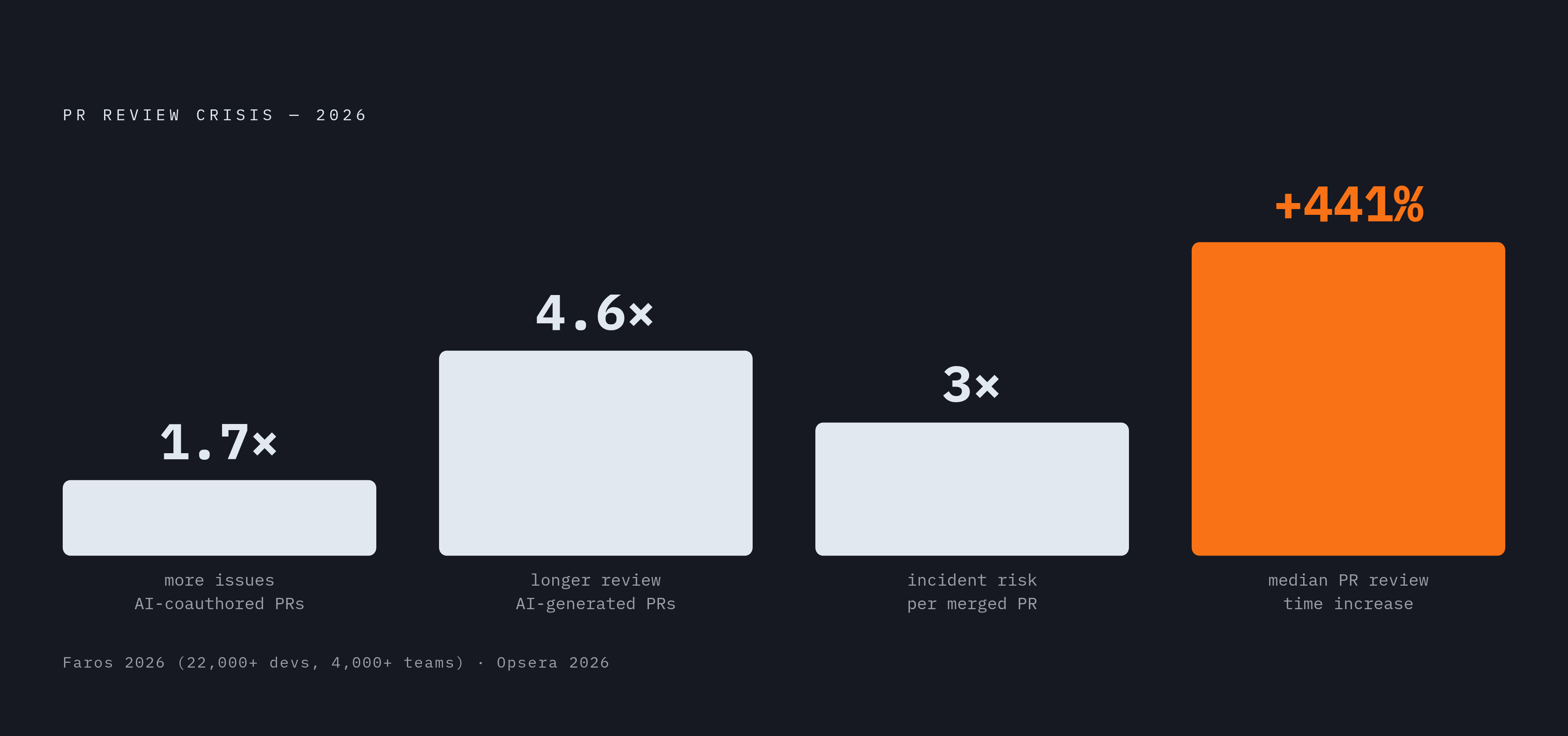
AI-authored code now makes up roughly 26.9% of all production code, measured across approximately 4.2 million developers from late 2025 into early 2026. Up from around 22% the prior quarter.
Review capacity is not keeping up. Faros 2026 data, covering over 22,000 developers across more than 4,000 teams, shows median time in PR review is up 441%. And 31% more PRs are merging with no review at all. Not by policy. Because reviewers cannot keep pace.
The quality signal underneath that volume problem is uncomfortable. AI-coauthored PRs show roughly 1.7 times more issues than human-only PRs. Opsera 2026 data shows AI-generated PRs take 4.6 times longer to review and contain meaningfully more security vulnerabilities. Per Faros 2026, for every PR merged, the probability of a production incident has more than tripled. Bugs per developer are up over 50%.
But what if the volume isn't the core problem? DORA 2025, which surveyed nearly 5,000 technology professionals, found that AI amplifies what already exists. Solid teams get faster. Broken processes get more broken. Which means a lot of teams are now feeding a review process they hadn't fixed before the volume arrived. Adding agents to a broken review workflow doesn't fix it. It accelerates it.
Review is the chokepoint the rest of the lifecycle feeds into. That's exactly why agent-assisted review is worth understanding carefully rather than just adopting because it's available.
What AI code review agents actually do during review
Review is the stage most teams deploy agents on first. Partly because it requires no autonomy over code authorship. The agent reads and comments. Humans decide.
A review agent looks at:
- Correctness and logic: off-by-one errors, wrong assumptions about state, misused APIs
- Security risks: injection vulnerabilities, exposed credentials, unsafe dependencies
- Style and consistency
- Test coverage gaps
- Semantic alignment between the PR description and what the diff actually does
That last one matters more than it sounds, especially for agentic PRs. If the agent that wrote the code also wrote the PR description, those two things might agree perfectly and still be wrong about what the feature was supposed to do. A review agent can at least flag when that alignment breaks down. It's not foolproof, but it catches the obvious drift.
The scale here is real. Microsoft's AI code review assistant now supports over 90% of PRs across the company, impacting more than 600,000 pull requests per month. GitHub Copilot for PR Reviews reached general availability in April 2025 and has processed over 60 million reviews, growing tenfold in under a year.
What AI review agents don't replace: judgment about whether a feature should exist, architecture-level feedback that requires knowing the roadmap, and the interpersonal context about who owns an area, what was agreed in a prior discussion, or why a particular tradeoff was made and never written down anywhere. That last category is bigger than most people admit.
The agent handles the mechanical and pattern-matching layer. The human reviewer focuses on decisions that require context the agent simply doesn't have.
Merge-readiness checks and the final gate before production
Merge-readiness is distinct from code review. It's the checklist of conditions that must be true before merging is safe, regardless of whether the code logic is correct.
Agents check things like:
- All required CI checks are green
- Required reviewers have approved, and they're the right reviewers given what changed
- No merge conflicts with main
- Branch is up to date
- PR description meets team standards: linked issue, changelog entry, deploy notes
- No open threads waiting for resolution
With a significant and growing share of PRs merging without any human review, an automated gate at merge is not a convenience feature. It's a last line of defense.
One risk that tends to get glossed over: an agent that merges on green CI alone, without semantic checks, can ship broken or insecure code at high velocity. Faster throughput on bad outputs is not a win. It just means you find out what went wrong in production instead of in review.
Deciding where in the lifecycle to grant agents autonomy
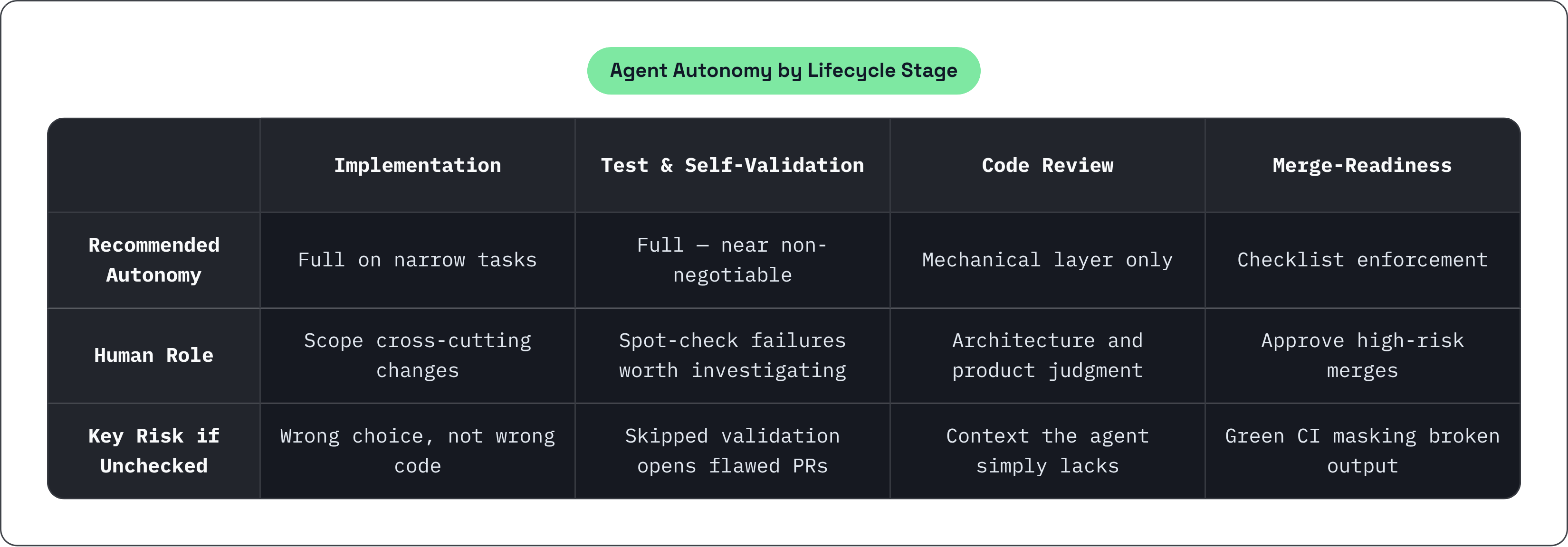
The autonomy question is not global. The right answer differs by stage, by task type, and by how mature a team's existing processes already are.
Some rough guidelines that seem to hold up in practice:
- Implementation: Full agent autonomy is reasonable on narrowly scoped, well-defined tasks. Bug fixes, test additions, documentation updates. Cross-cutting changes need human scoping first.
- Test execution and self-validation: Full autonomy should be the default goal. Agents should run their own tests before opening a PR. This one's close to non-negotiable.
- Review: Agent autonomy on the mechanical layer makes sense. Human review is reserved for architecture and product-level concerns.
- Merge-readiness: Agents enforce the checklist. Humans approve the merge when the PR carries meaningful risk.
METR ran a randomized controlled study in 2025 and found developers using AI tools took 19% longer than those without. A follow-up in early 2026 showed an 18% speedup. The tools improved, yes. But developers also learned when to use them and when to set them aside. That second part doesn't get enough credit.
Bounded-scope agents outperform general-purpose autonomy in practice. FlakyGuard's merged fixes and Ramp's 30% PR share both come from narrow, well-defined task scopes. The temptation is to expand scope once things are working. Usually that's where it gets messy.
MSR '26 data reinforces this: no single model or agent is best across all stages. Claude Code leads on documentation and feature tasks. Cursor leads on fixes. Mature teams match the agent to the task type rather than picking one tool and forcing it to fit every workflow.
The developer's role shifts here, but it doesn't shrink. Less execution. More judgment about which tasks to assign, which outputs to trust, and which failures are worth investigating yourself. That last one is harder than it sounds.