Assertion Strategies in AI-Generated Test Suites
AI-generated tests need assertions that catch real bugs, not just pass silently.

There is a version of a passing test suite that means nothing. Every test is green, coverage looks healthy, the CI pipeline is happy. And the code is quietly broken. Not broken in a way that crashes the build. Broken in a way that only shows up in production, three weeks later, in a bug report you have to trace back to a test that never actually verified the right thing. If you have spent enough time in software, you have lived this. And if you have started using AI to generate your tests, you are going to live it again, faster and at higher volume, unless you treat assertion quality as a first-class concern.
That is what this piece is about. Not whether AI test generation is good or bad. It is a productivity force multiplier and most teams are already using it. The question is whether you are getting tests that catch real defects, or tests that give you a green dashboard and a false sense of security.
Let's walk through why this happens and what you can actually do about it.
What makes an assertion meaningful versus decorative
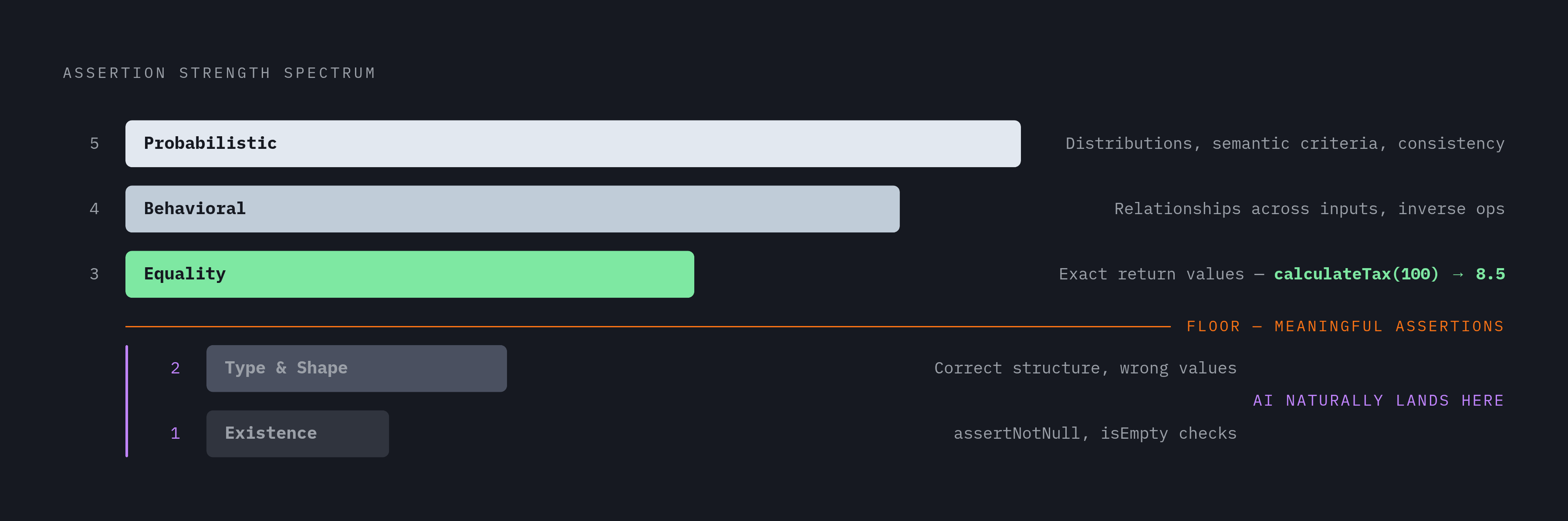
Think of assertions on a spectrum from weakest to strongest.
At the weakest end, you have existence checks: assertNotNull(result), assertFalse(list.isEmpty()). These confirm the system returned something. They say nothing about what that something is. If your function is supposed to return a user's account balance and instead returns a random integer, an existence check passes every time.
One level up: type and shape assertions. Confirms the structure. Still nothing about the meaning. You get back an object with the right fields and the test is happy, even if every field has the wrong value.
Then you have equality assertions on specific values. This is where tests start earning their keep. You assert that calculateTax(100.0) returns 8.5, not just that it returns something non-null. For deterministic functions with known inputs and outputs, this is the floor for a meaningful assertion.
Above that: behavioral and invariant assertions. These verify relationships across inputs, not just one case. If you increase the input, does the output increase proportionally? If you apply an operation and its inverse, do you get back to the start? These catch whole classes of bugs that equality assertions on single cases miss.
At the emerging frontier: probabilistic assertions. These matter most when you are testing AI-driven components or any non-deterministic behavior. You are not asserting that a single input produces a single exact string. You are asserting that outputs fall within expected distributions, pass semantic criteria across varied inputs, and behave consistently under repeated queries.
Here is the practical problem. AI systems, by default, land on the weakest assertion types. They check for non-null. They confirm structure. They rarely, without guidance, reach for equality assertions on specific values, let alone invariant or probabilistic ones. A test that only checks non-null will pass even if the function returns completely wrong data. It detects nothing except total failure, and by the time you have total failure, you probably already know.
A meaningful assertion requires three things: specificity (a value, a relationship, a constraint), derivation from the actual code under test, and failure behavior that distinguishes a correct from an incorrect implementation. If the assertion passes for a broken implementation, it is not an assertion. It is decoration.
How hallucination in LLMs produces structurally wrong assertions
There is a difference between a weak assertion and a hallucinated one. A weak assertion is too vague to fail. A hallucinated assertion is confidently wrong.
A study of thousands of test generation tasks found LLMs asserting against their pre-training knowledge rather than actual code behavior. One generated test explicitly asserted that the program would output 10. Not because running the code produced 10. Because the model had seen that value in training data and predicted it as plausible. The test passed whenever the code happened to return 10 and failed for reasons that had nothing to do with whether the implementation was correct.
That is the structural root of the problem. A language model predicts plausible-looking test code based on patterns it has seen. It does not run the code under test, observe its behavior, and derive expected values from that observation. It infers. And when it infers a specific expected value, that value comes from its training distribution, not from your codebase.
Research using computability theory has established that this is not a bug that gets fixed with a better model. LLMs cannot learn all computable functions. They will produce false outputs when pushed beyond their training distribution. In test generation, this surfaces as fabricated expected values, assertions against behaviors the code does not have, and invented method signatures.
Non-determinism makes this worse. Even at the lowest temperature settings, research has documented inconsistent outputs across repeated queries. The same prompt can produce different, contradictory assertions on different runs. Which means you cannot assume a generated assertion is correct just because it compiles and the test passes. The assertion itself requires verification.
Two approaches from recent research address this directly. MetaQA uses metamorphic prompt mutations to detect hallucinations in closed-source models without accessing internal model probabilities, making it viable for black-box production environments. CLAP (Cross-Layer Attention Probing) trains lightweight classifiers on a model's own attention activations to flag likely hallucinations in real time. These are not just relevant to AI product features. They apply directly to the test generation pipeline.
The implication is uncomfortable but important. If hallucinated assertions are a structural property of how these models work, then every AI-generated assertion is a candidate for scrutiny, not just the ones that look suspicious.
Prompting strategies that produce stronger assertions
The good news about this problem is that the lowest-friction lever to improve assertion quality is also the most accessible one: how you prompt.
The default prompt produces the weakest assertion pattern. "Write tests for this function" gets you existence checks and happy-path equality assertions at best. The model fills in what it does not know with what seems plausible.
Make the expected behavior explicit in the prompt. Do not say "test this function." Say "assert that calculateTax(100.0) returns 8.5 and that the function raises ValueError when input is negative." When you supply the expected value and the failure case, the model is not inferring them from training data. It is encoding what you told it.
Steer the assertion type directly. Tell the agent "use equality assertions, not null checks." Tell it why if that helps. Models respond to explicit instruction about assertion level, but only if you give it.
Frame the task as adversarial, not confirmatory. Prompting the agent to "write tests that would catch an off-by-one error in the return value" changes the output. You are asking it to imagine a broken implementation and write the assertion that would expose it, rather than asking it to confirm that the code works. That framing shift produces stronger assertions.
Provide diff and intent context. Meta's production deployment found that giving the model diff context and intent significantly increased the detection of weak assertions. The model can target assertions at what actually changed rather than the whole function surface. Targeted assertions catch more real defects.
Use multi-shot examples. Seed the prompt with one example of a weak assertion and one example of a strong one, and explain the difference. The model's in-context behavior shifts toward the pattern you demonstrate. This is not magic. It is just showing the model what you want instead of hoping it guesses.
In agentic environments, define assertion standards as persistent rules. In some agentic environments, you can configure agent rules that apply across every test generation task. Define your assertion standards there, once, so you are not re-prompting every session. This is the agent-level equivalent of a team style guide, and it is one of the most underused levers available.
One honest constraint to name: prompting improves assertion structure but not the correctness of expected values when those values have to come from the model. If the model does not know what your function should return, better prompting will not fix that. It will produce a well-structured assertion against the wrong value. That is where the validation techniques below matter.
Using mutation testing to measure and drive assertion quality
You cannot improve what you cannot measure. And coverage cannot measure assertion quality. Line and branch coverage measure execution. They tell you which code ran during testing. They say nothing about whether any assertion would have caught a fault in that code. A test can execute every line and still verify nothing.
Mutation testing is the instrument that makes assertion quality visible. The idea is straightforward: introduce small, deliberate faults into the code (flip an operator, change a boundary value, remove a condition), run the test suite, and measure how many of those faults the tests detect. A test that catches the fault "kills" the mutant. A test that passes anyway is a test that would also pass if the real code had that bug.
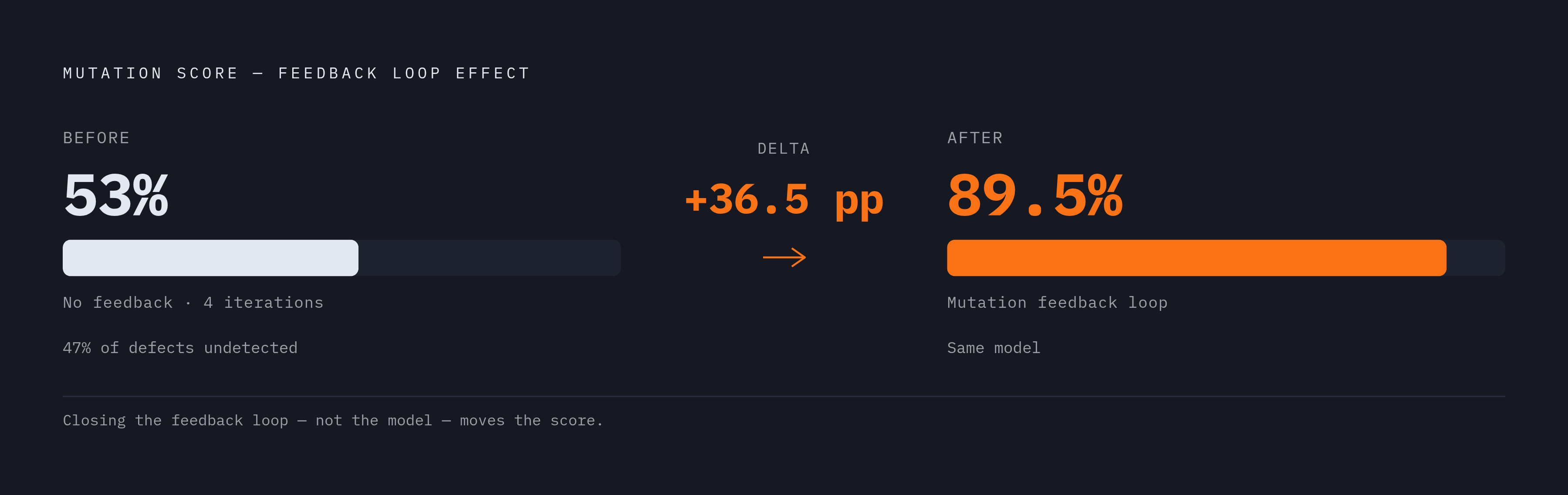
The results from applying this to AI-generated tests are striking. A standard LLM prompt held at a 53% mutation score across four iterations with no feedback. That means more than half of injected defects went undetected. Adding mutation feedback to the generation loop drove that score to 89.5%. Same model. The difference was closing the feedback loop.
The mechanism matters. Mutation feedback tells the agent exactly which assertion failed to catch a specific injected fault. That is actionable signal. The agent knows what to fix and why, not just that something is wrong in general. More tests without that signal add coverage without adding detection.
Meta's production deployment of LLM-based mutation testing across major consumer applications validates this at scale. Privacy engineers accepted 73% of generated tests. Combining LLM-based and rule-based assessors reduced human review load by 70%. Mutation testing is not a niche academic technique. It is in production at scale.
Two practical applications for teams.
First, at generation time: feed mutation results back to the agent as part of the iterative loop. Let the agent see which mutations it missed and regenerate or strengthen assertions targeting those gaps.
Second, at review time: use mutation score as a gate on AI-generated test pull requests. Not coverage. Mutation score. If the generated tests do not kill a reasonable threshold of mutants, they do not merge. The gate measures verification, not execution.
One real constraint: mutation testing is computationally expensive. Running it across an entire codebase on every CI run is not practical for most teams. The answer is to apply it selectively. High-risk modules. AI-generated test batches. Places where the cost of weak assertions is high.
The team implication is worth naming explicitly. If your dashboards only show coverage, developers optimize for coverage. If you add mutation score, teams start asking whether their assertions actually catch anything. The metric shapes the behavior.
Hybrid generation approaches that structurally improve assertion diversity
LLMs alone tend to produce homogeneous tests. Similar assertion patterns, similar input ranges, similar happy-path orientation. They are good at reasoning about expected behavior in natural language and translating that into structured test code. They are not naturally inclined to explore edge cases, adversarial inputs, or boundary conditions that the prompt does not hint at.
Hybrid approaches pair LLM generation with methods that systematically explore the input space. EvoGPT combines LLM-generated test cases with genetic algorithms that iteratively mutate and select based on fitness metrics. The result is demonstrably better structural coverage and defect-detecting ability than either approach achieves on its own. The LLM reasons about what the code should do. The evolutionary mechanism explores what the code actually does under conditions the LLM would not generate unprompted.
The complementary pairing has a clean logic to it. LLM-generated equality assertions work well for happy-path cases where expected values are known and deterministic. Property-based or fuzzing-derived assertions work well for boundary and adversarial cases where the goal is to find inputs that break invariants, not confirm known outputs. These are not competing approaches. They cover different parts of the defect space.
For AI-driven components specifically, the assertion strategy has to match the nature of the output. A language model feature that generates summaries does not have a single correct output for a given input. Asserting exact string equality is not a meaningful test. What you can assert is that outputs across varied inputs fall within expected distributions, pass semantic criteria, and do not exhibit instability or bias across similar inputs. Scenario-based validation structures this: define the scenarios the feature must handle, generate assertions per scenario, and let the scenario structure guarantee that assertion coverage is intentional rather than accidental.
Agentic environments can operationalize this loop. An agent tasked with generating tests per scenario, running them, diagnosing failures, and iterating is doing something genuinely useful. The question is where you set the autonomy threshold, and that brings us to the next section.
What agentic test generation gets right and where it still breaks
Current agentic systems can analyze a codebase, generate tests, execute them, diagnose failures, self-heal flaky tests, and integrate into CI/CD without a human in the loop at every step. That is a real capability shift. It is not a roadmap item. It is available now in production tools.
Forrester formally renamed its testing category from "Continuous Automation Testing Platforms" to "Autonomous Testing Platforms" in 2025, which is the kind of institutional signal that marks when a category has genuinely changed. The broader context: the industry has plateaued at roughly 25% automated test coverage for years, and agentic AI is the expected mechanism to push through that ceiling.
But here is the empirical counterweight, and it is worth sitting with.
A 2026 analysis of agent trajectories across six state-of-the-art LLMs on a standard software engineering benchmark found that test-writing frequency is similar for resolved and unresolved tasks. Agents write tests regardless of whether they actually understand the problem they are solving. That is a significant finding. It means you cannot interpret test count, or even coverage achieved by an autonomous agent, as evidence that the agent solved the problem correctly. The agent wrote tests. That is not the same thing as the agent understood what the code should do.
This creates a specific calibration problem for assertions. The more autonomously an agent runs, the more critical it is to have assertion quality gates that are independent of the agent's own judgment. An agent that evaluates its own test quality is grading its own homework. The grade is not reliable.
The practical stance is this. Use agents for the generation throughput they provide. They are genuinely faster than humans at producing test scaffolding, exploring surface area, and iterating on failures. Do not delegate the judgment about assertion quality back to the same agent that produced the tests. That judgment needs to sit outside the generation loop, in validation tooling and human review.
Gartner forecasts a dramatic increase in the share of enterprise applications featuring task-specific AI agents by end of 2026. The scale at which weak assertion patterns can propagate will grow sharply. If you do not address assertion quality at the workflow level now, you will address it after the fact in production defects.
Validating AI-generated assertions before they enter the codebase
The core principle here is simple and easy to forget under deadline pressure. The agent that generated the assertion should not be the sole judge of whether that assertion is correct.
LLM-as-judge is a tempting solution when you are operating at the volume that AI-generated tests produce. And it is not useless. Meta's approach combined LLM-based and rule-based assessors, and that combination achieved strong agreement with human labels. The key word is "combination." An uncalibrated LLM judge silently encodes its own biases into what it considers a valid assertion. If you use an LLM as a judge, validate it against a human-labeled calibration set before letting it gate any release decision. That is the minimum bar for trusting the pipeline.
Not every generated assertion needs human review. But some do. Assertions on critical paths, security-relevant code, and genuinely novel features warrant a human eye. The autonomy slider applies to validation the same way it applies to generation.
Diff-aware review makes human attention more efficient. Focus on assertions that cover changed code. If a generated assertion covers a function that did not change and has existing test coverage, the marginal value of human review is lower. If it covers code introduced in this PR, the risk of a hallucinated expected value is higher and the review is more valuable.
When you are reviewing a generated assertion, run through these questions.
- Does the expected value come from the code under test, or from a plausible-looking constant the model might have seen in training?
- Would this assertion pass if the function returned a completely different but non-null value?
- Does the assertion cover the behavior described in the commit, or something adjacent that the model found more natural to assert?
- Would killing a simple mutation (off-by-one, wrong operator) cause this assertion to fail?
If the answer to that last question is "no," the assertion is not doing useful work.
At the pipeline level: gate merging of AI-generated test batches on mutation score, not coverage. Configure this as a CI step. In agentic development environments, this can be set as a persistent rule so it applies without manual intervention. Make validation a property of the workflow, not a discipline that depends on whoever happens to be reviewing on a given day.
Building a team practice around assertion quality in AI-assisted development
Individual techniques degrade at team scale without shared standards. If assertion quality is an individual judgment call, it will vary by reviewer, by time pressure, and by how much coffee was consumed before the pull request arrived. The standard needs to exist independently of any one person.
The productivity context makes this urgent. A large and growing share of code entering codebases is AI-generated, and that share is still growing. Research consistently associates AI coding tool adoption with an increase in bugs per developer and a significant increase in average PR size. Weak assertions in AI-generated tests directly contribute to both of those trends. The tests exist. They pass. The bugs ship anyway.
Three practices that hold at team scale.
Define what constitutes a meaningful assertion in your codebase, in writing, by tier. Not "write good assertions." Write down what a tier-one assertion looks like versus a tier-two assertion versus an existence check. Give examples. Make the standard something a reviewer can point to, not something they have to argue from first principles every time.
Replace or supplement coverage targets with mutation score targets for AI-generated test batches. This is the single highest-leverage change a team can make. Coverage targets incentivize generating tests that execute code. Mutation score targets incentivize generating tests that verify behavior. Those are different goals, and the metric you track is the goal you get.
Treat assertion prompts and agent rules as owned artifacts, not throwaway inputs. The prompts that produce strong assertions, the agent rules that enforce assertion standards, the calibration sets that validate your LLM judge: these are engineering assets. They should be version-controlled, reviewed, and maintained like any other part of the testing infrastructure. When they improve, the whole team benefits. When they drift, assertion quality drifts with them.
The underlying shift this requires is treating assertion quality as a defined property of your test suite rather than a hopeful side effect of generating enough tests. AI tools are genuinely good at generating tests. They are not good at deciding whether those tests prove anything. That judgment still belongs to the team. The discipline is making sure the team is actually exercising it.