Pull Request Workflow with AI Review Agents
Agent-generated code is flooding review queues faster than teams can evaluate it safely.
The traditional pull request workflow was built on a quiet assumption: that writing code and reviewing it would stay roughly in sync. Agentic development broke that assumption. Nobody sent a memo.
One developer can now kick off a dozen parallel agent sessions before lunch. Each one plans, writes, tests, and iterates on its own. Each one surfaces a PR. All of those land in the same review queue that was sized for a world where a human was doing the typing.
GitHub Copilot Code Review has processed over 60 million reviews, growing roughly 10x in under a year. More than one in five code reviews on GitHub now involves an agent. The bottleneck didn't disappear. It moved downstream, where it's harder to see and harder to blame on any single decision.
To understand the review problem, you have to understand what agentic development actually produces. This isn't "AI-assisted" code where a developer accepted a few autocomplete suggestions. Agentic development means a developer describes an outcome, and an agent plans, writes, tests, and iterates in a loop, running autonomously across many steps before surfacing any output. The PR is its terminal deliverable.
A few things shape what ends up in that diff:
- Persistent context. Agents maintain memory of goals, conventions, and architecture through files like AGENTS.md or CLAUDE.md. They're not flying blind. But they're reasoning from a snapshot of intent, not lived ownership of the code.
- Long-running execution loops. This isn't one prompt, one response. Agents chain tool calls across the repo: shell commands, test runners, code search, version control. The final diff is assembled from many sources.
- No line-by-line authorship awareness. A human developer who wrote a function can usually tell you why they made each choice. An agent often cannot. The code is coherent. The reasoning behind it may not be fully reconstructable.
A 2025 analysis of hundreds of thousands of PRs from major agentic tools found faster submission rates but lower acceptance rates compared to human-written PRs. Prolific output. Not uniformly mergeable.
There's also a subtler problem that's easy to miss until you've seen it play out a few times. A January 2026 study found that agent-generated code introduces more redundancy and more quiet technical debt per change than human-written code. And reviewers tend to feel more confident approving it, not less. The surface looks clean. The debt is invisible. That's why throwing more senior engineers at the queue isn't the answer. You're solving a visibility problem, not a staffing problem.
Why the Review Gap Compounds as Agentic Adoption Grows
More agents means more PRs per engineer. More PRs per engineer means the review queue grows faster than any team can hire to match. And it doesn't self-correct.
Organizations with high AI adoption merge roughly twice as many PRs per engineer compared to teams with no AI adoption. That gap in review demand is structural. It's not a temporary scaling pain. It's what the new baseline looks like.
Code review was already consuming a large share of senior developers' time before agentic tools existed. As PR volume climbs, so does that cost. And so does the quality risk:
- AI-coauthored PRs carry meaningfully more issues than human-written PRs. Logic and correctness problems are disproportionately common.
- Security issues are elevated in agent-generated code, per CodeRabbit's December 2025 analysis.
- Code churn has climbed steadily since AI tooling became widespread.
Faros's 2026 data shows that median time in PR review has grown sharply, and a meaningful share of code is reaching production with no review at all.
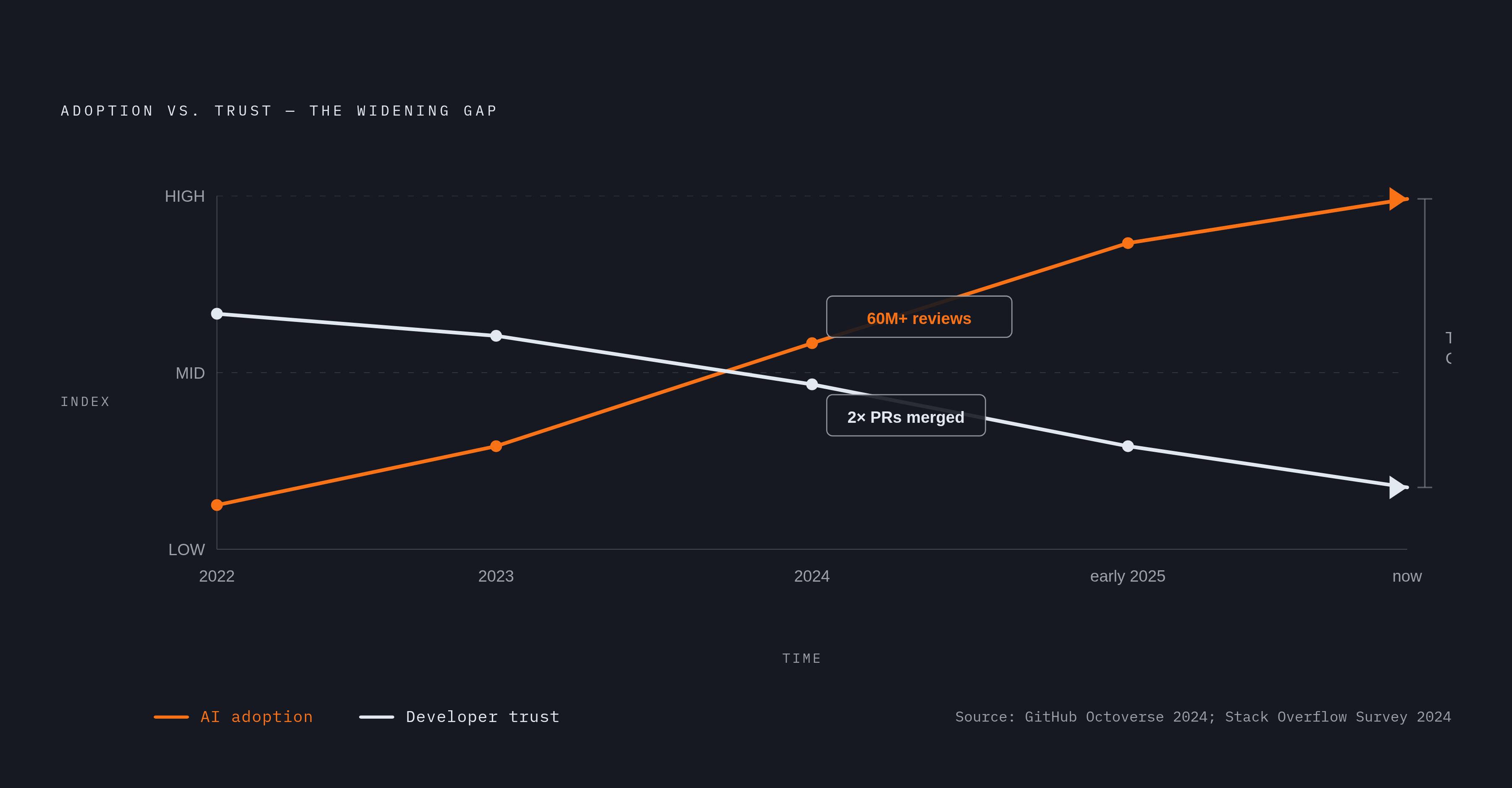
That raises an interesting tension worth sitting with. Developer adoption of AI tools is now near-universal. But reported trust in AI output has actually fallen. People are using the tools more and trusting them less. That's understandable. It reflects real experience with what comes out. A well-designed review layer is one of the cleaner ways to close that gap, because it creates a consistent signal that something beyond the author has checked the work.
For engineering leadership, the uncomfortable implication is this: without a review strategy that scales with generation speed, faster code production becomes a liability. You're not shipping faster. You're accumulating risk faster. Those feel identical until they don't.
What AI Review Agents Actually Do Inside a Pull Request
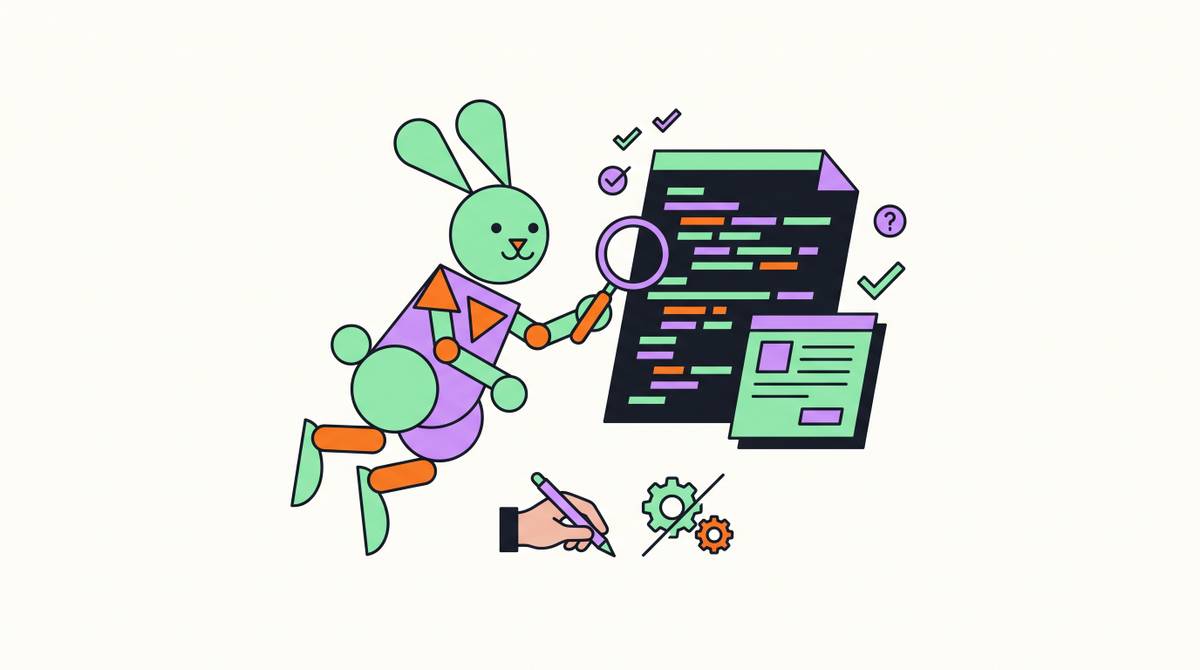
An AI review agent reads the full diff, gathers repository context, and posts inline comments before a human reviewer ever opens the PR. That's the core capability. But calling it a smarter linter misses what makes it actually useful.
A linter checks syntax. It doesn't understand intent. An AI review agent can reason about whether the change does what the PR description claims. It draws on codebase-wide context, not just the changed file. It can summarize the PR in plain language, suggest tests, flag logic gaps, and explain tradeoffs. That's a different category of tool.
GitHub Copilot's review agent runs on GitHub Actions and gathers full repository context before posting comments. Roughly 67% of its reviews surface actionable feedback. The rest stay silent. That restraint is a deliberate design choice, and it's one of the more underrated features in the space. A tool that knows when to stay quiet is more valuable than one that always has something to say.
Across tools, the common capabilities look like this:
- Auto-generated PR summaries and changelogs
- Inline comments on logic, style, security, and test coverage
- Suggested code fixes, not just flags
- Configurable rules so teams enforce their own standards
- CI/CD integration so review runs in parallel with tests
The autonomy spectrum is worth understanding before you pick a tool. Some agents post suggestions and wait for a human decision. Others can push commits, request re-runs, or iterate until a condition is met. The right level of autonomy depends on how much your team trusts the tool. That trust should be earned incrementally, not assumed from day one.
One architectural limit worth knowing: model context windows are large but not unlimited in practice. Models reliably use only a fraction of their advertised context at full performance. For very large PRs touching many files, the agent may not be reasoning over everything it looks like it's reasoning over. That's worth keeping in mind. It is a reason to think carefully about which PRs get routed where.
The Tools Engineering Teams Are Using for AI PR Review in 2025–2026
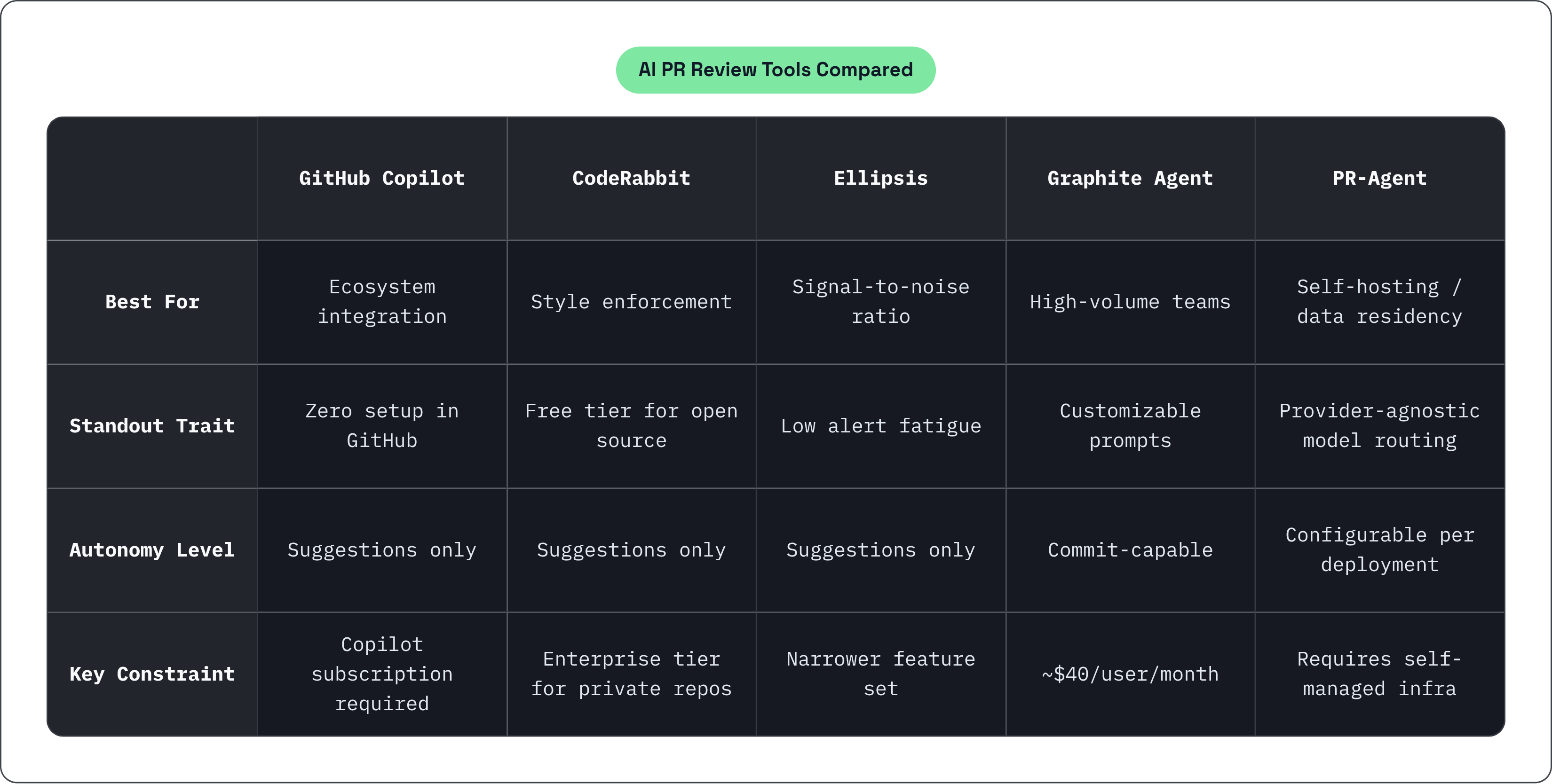
No single tool wins every scenario. The right choice depends on whether your team needs deep bug detection, standards enforcement, lightweight summaries, or the flexibility to self-host.
GitHub Copilot Code Review has been generally available since early 2025. If your team is already in the GitHub ecosystem and subscribed to Copilot, setup friction is essentially zero. It's strongest for PR summaries and integrates natively with the workflow most teams already have.
CodeRabbit stands out for style and standards enforcement. Its free tier for open-source projects makes it accessible for individual contributors and smaller teams who can't justify an enterprise contract.
Ellipsis has a notably strong signal-to-noise ratio. Fewer low-value comments. Alert fatigue is real, and a tool that flags minor style nits on every PR trains developers to ignore everything, including the valid warnings.
Graphite Agent offers real-time feedback with customizable prompts. Teams report a 67% implementation rate on suggested changes and a 96% positive feedback rate. It runs around $40 per user per month with unlimited reviews, which is cost-effective for high-volume teams.
Qodo (formerly CodiumAI) emphasizes comprehensive code quality analysis and competes well for teams that need deeper inspection beyond summary-level review.
PR-Agent is the open-source option. It's provider-agnostic, supporting OpenAI, Anthropic, Google Gemini, DeepSeek, Mistral, and any model reachable via LiteLLM, including Azure, Bedrock, Vertex, and self-hosted endpoints. For enterprises with data residency requirements or confidentiality constraints, this is the serious option. Full control, no SaaS dependency.
Cursor is worth separating out because its PR review capability isn't an add-on. It's native to the environment where the code was written. The agent that helped author the code can help review it with full project awareness. For teams using Cursor for agentic development end-to-end, the review step stays inside the same IDE and GitHub workflow rather than introducing another tool to manage.
Choosing the Right Model for AI-Assisted Code Review
SWE-bench Verified is the most relevant benchmark here. It tests whether a model can identify and fix real GitHub issues, which is close to what a review agent actually does in practice.
As of mid-2026, the top of the leaderboard is competitive. Claude Opus 4.7 leads, with GPT-5.5 Pro and Gemini 3.1 Pro close behind. The margins between top models are narrow enough that task fit and prompt quality often matter more than raw model rank. Pick the leaderboard winner, misconfigure your prompts, and you'll get worse results than a slightly lower-ranked model that's been tuned carefully.
A few benchmark caveats worth knowing before any model selection conversation:
- SWE-bench scores shift with harness details. Only compare scores run under the same harness.
- SWE-bench Pro, which uses harder, private repos, shows sharper drops across all models. Real-world performance on proprietary codebases is likely closer to Pro numbers than Verified.
- Older benchmarks like HumanEval are saturated. They no longer differentiate frontier models in any meaningful way.
The context window reality applies here too. Models reliably use only a portion of their advertised context at full performance. That matters for large PRs touching many files. Plan for it rather than assuming the headline number.
A practical routing approach: use a fast, lower-cost model for summary and style checks on every PR. Route complex diffs with security implications or architectural changes to the most capable frontier model. Running Opus 4.7 on every three-line change produces returns that aren't there. The effort goes elsewhere.
For teams with self-hosting requirements, DeepSeek V4-Pro ranks among the top local models on SWE-bench and is MIT-licensed. PR-Agent's LiteLLM routing layer makes a multi-model strategy operationally straightforward without custom infrastructure.
Configuring AI Review Agents to Work With Your Team's Standards, Not Against Them
The biggest failure mode isn't a tool that misses bugs. It's a tool that posts high-volume, low-relevance comments until developers start ignoring everything, including the valid flags. At that point the tool is actively making things worse.
Signal quality matters more than comment volume. GitHub Copilot's choice to stay silent on a meaningful share of reviews is worth studying. Restraint is a feature, not a limitation.
Configuration basics that actually matter:
- Define scope explicitly. Tell the agent what to flag and what to leave alone. Style nits, logic errors, and security issues should have different handling, not one undifferentiated comment stream.
- Use AGENTS.md or equivalent context files. Give the agent your team's actual conventions, not generic best practices from a training corpus that doesn't know your codebase.
- Set severity thresholds. Blocking comments, suggestions, and informational notes should be distinct categories. Merging them destroys signal.
On workflow integration: trigger review on PR open via GitHub Actions or a CI step. Avoid creating a separate portal the developer has to remember to check. Surface review summaries in Slack, where the team already communicates. Connect review agent output to CI/CD gates so high-severity flags block merge while lower-severity comments don't.
One compliance consideration worth raising before it becomes a problem: research has found that a significant share of employees have shared confidential data with unapproved AI systems. A self-hosted or enterprise-tier agent with clear data handling policies addresses this before someone has to explain it to legal.
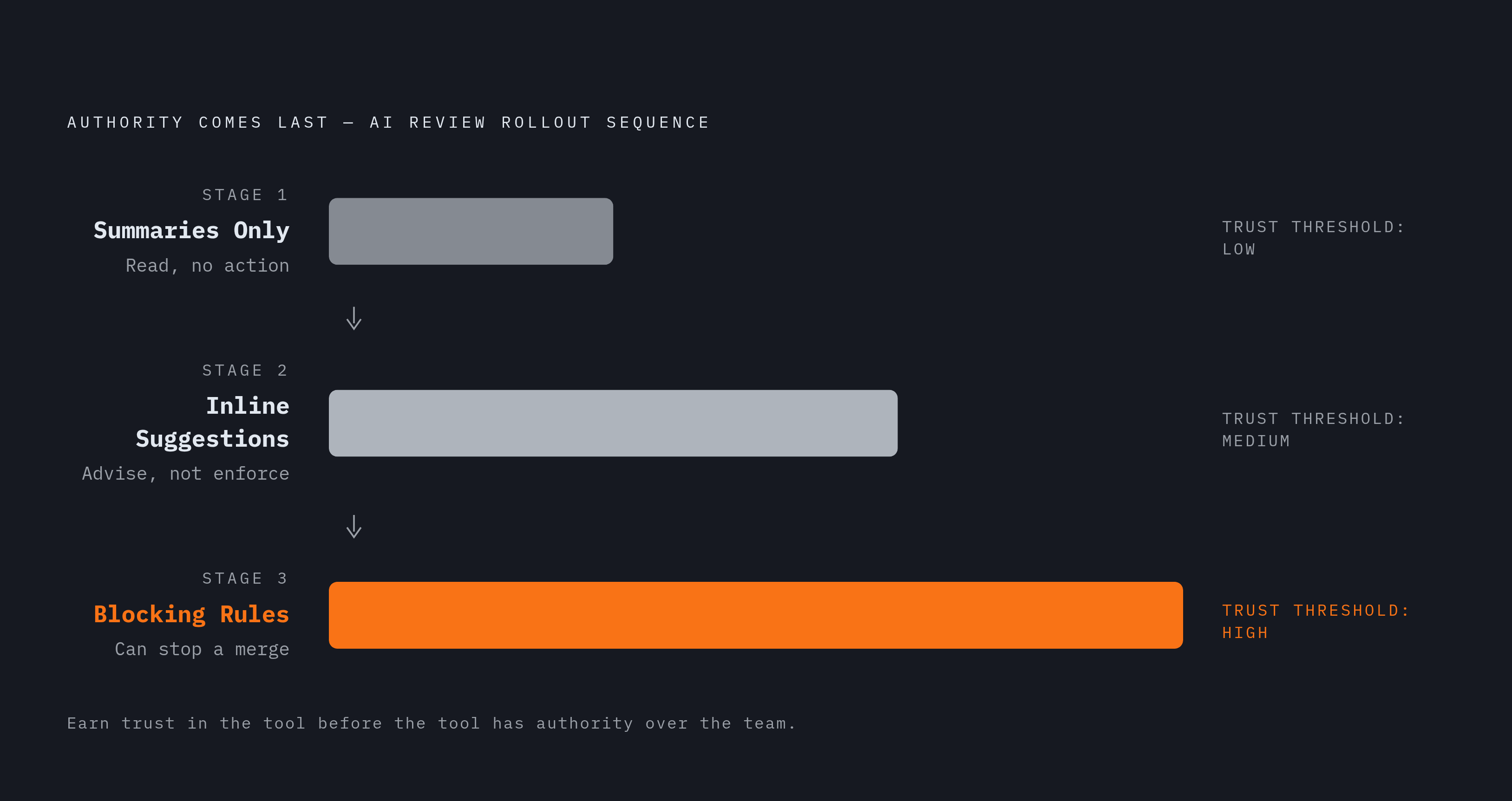
On rollout, the instinct is usually to enable everything at once. Resist it. Start with summaries only. Low friction, immediate value. Then enable inline suggestions. Then enable blocking rules. Let the team build trust in the tool before the tool has authority to stop a merge. That sequence matters more than most teams expect.
What Human Reviewers Should Focus on Once AI Handles the Routine Work
Once an AI review layer is handling syntax, style consistency, obvious logic errors, test coverage gaps, and security anti-patterns that match known signatures, what's left for humans?
Quite a lot. Just different things.
- Architectural judgment. Does this change belong here? Does it create a dependency that makes the system harder to reason about six months from now? The agent doesn't know what you're planning to build next quarter.
- Product intent. Does the code do what the ticket actually asked? Not just what the PR description says, but what the product team meant when they wrote the spec. Those are often different things.
- Organizational context. Does this conflict with a decision another team made in a sprint the agent has no visibility into? Cross-team awareness is invisible to the model.
- Skepticism exactly where the code looks cleanest. This one runs against instinct. The "More Code, Less Reuse" finding from the 2026 research is a real signal: agent-generated code introduces quiet technical debt precisely where it looks polished. Human reviewers need to be most skeptical where the AI reviewer seemed most satisfied. That's a habit worth building deliberately.
Senior developer time is the scarcest resource in most engineering organizations. AI review frees it for judgment calls that require context the model doesn't have. That's a trade worth making, as long as teams are honest about what the model actually can and can't see.
Junior developers deserve a mention here too. They see the largest productivity gains from AI tools, but also the largest quality risk gap. AI review is particularly valuable as a learning signal for junior developers, not just as a merge gate. An inline comment explaining why something is a logic error is a teaching moment. A CI failure is not.
Measuring Whether AI Review Is Actually Closing the Gap
The risk of measuring the wrong thing here is real. PR merge rate and review turnaround look great as AI review speeds them up. But faster merges with more production incidents is not progress. It's faster failure, which is arguably worse because it's harder to trace back to the cause.
The metrics that actually tell you whether the review layer is working:
- Post-merge defect rate. Are issues that should have been caught in review showing up in production? Track this before and after deploying AI review.
- Review comment resolution rate. Are developers acting on AI review comments, or ignoring them? Low resolution rates signal that the tool is posting noise.
- Code churn rate. How often is recently merged code being rewritten or reverted? Churn is one of the cleaner proxies for review quality.
- Time to meaningful review. Not just time to first comment. Time to a comment that a developer actually found useful. These are different numbers, and teams almost never track the second one.
- Security findings per release cycle. If AI review is flagging security issues earlier, you should see fewer surprises at the security audit stage.
Track separately: senior developer time freed from routine review. If your most experienced engineers are still spending the same amount of time on style corrections and obvious logic errors, something in the configuration needs to change.
But here's the question that actually matters, and most teams never ask it directly. Are velocity metrics and quality metrics moving in the same direction? They should be. If your team is merging more PRs faster but also seeing more incidents, more churn, and more time spent on post-merge fixes, then agentic development is generating speed at one point in the pipeline and absorbing it at another. You're not moving faster. You're just moving the slowdown somewhere less visible.
That's a different problem. And a harder one to fix than it looks.