Code Review Checklist for AI-Assisted Codebases
AI-generated code fails differently, and traditional code review doesn't catch it.
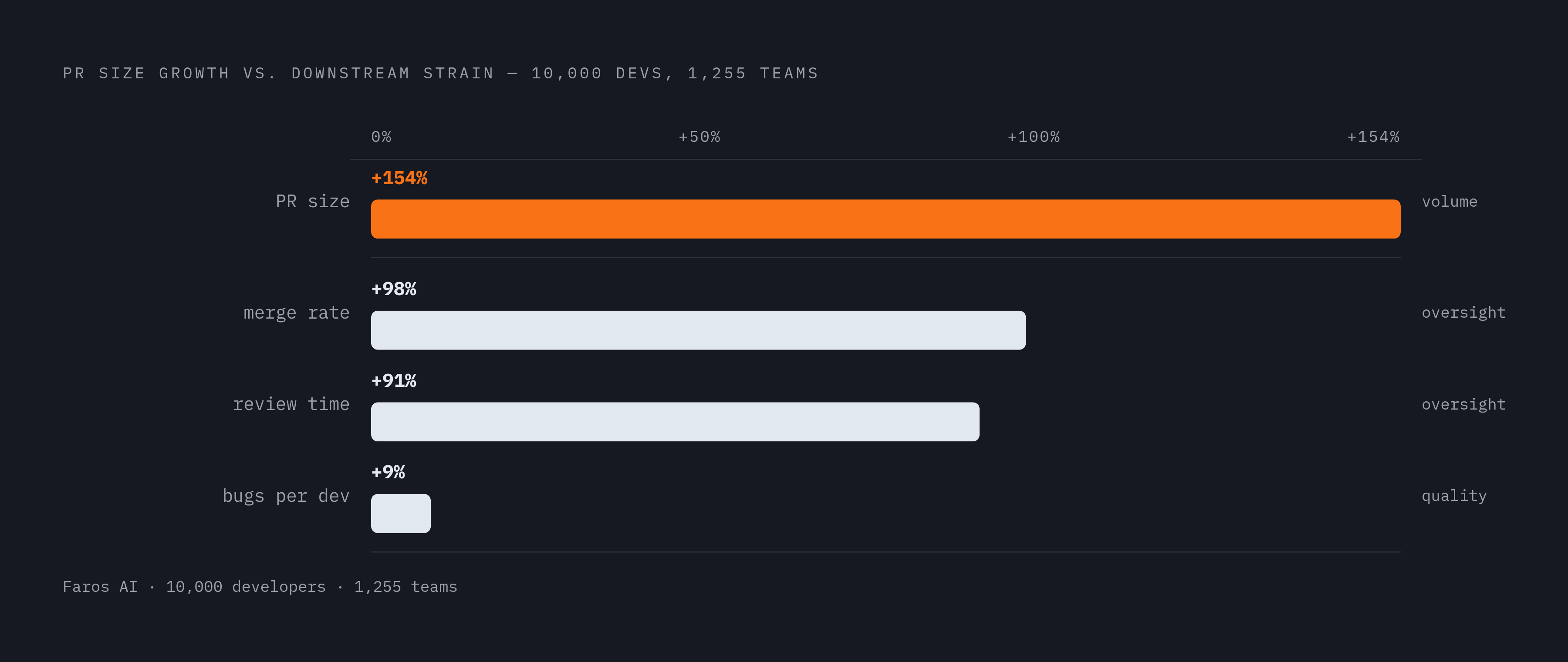
Faros AI ran the numbers on 10,000 developers across 1,255 teams, and here's what AI coding assistants often do to a team: pull requests grow 154% in average size, bugs per developer go up 9%, and code review time balloons 91% even as merge rates climb 98%. Delivery metrics don't budge much. And significantly more code ships with no review at all. The volume of AI-written code is outrunning the humans meant to catch its mistakes.
This piece is about the checklist that catches up: a set of concrete checks built around how agents tend to write code — how they plan, how they lose context over a long run, how they fabricate with apparent confidence. Traditional review was built to catch human mistakes, tired mistakes, missed-edge-case mistakes. AI-generated code often fails differently. It's clean, it's fluent, and it's often solving the wrong problem with total conviction, which demands a different hunting strategy.
How agentic code gets written, and why that changes what can go wrong
An AI coding agent doesn't just generate a file and hand it to you. It runs a loop: break the goal into steps, plan the sub-tasks, call tools (a shell, a test runner, a search function, version control), look at what came back, decide the next move. Repeat. That loop can run for a long time before a human sees anything.
A few places this goes wrong, and most of them don't show up cleanly in the final diff:
- The plan is invisible. You see the code the agent produced, not the reasoning that got it there. If the agent decomposed the goal wrong in step one, everything downstream can be well-built and still be aimed at the wrong target.
- Context drifts. Over a dozen steps, the agent's sense of what matters shifts. A decision made early gets forgotten by the time it writes the code that depended on it. Each step looks fine on its own. The whole doesn't hang together.
- Confidence outruns verification. Agents generate API calls, library usage, and logic paths that look right because they pattern-match to things that were right somewhere else. Nobody checked them against the actual documentation or the actual running system.
- Multiple agents multiply the problem. When parallel agents each own a piece of a feature, the seams between their work are where things break. Agent A's code is fine. Agent B's code is fine. The place they meet is often not fine, and neither agent was responsible for checking it.
Forrester's 2026 look at agentic development flags this directly: the more autonomy you hand an agent, the more trust becomes the bottleneck — an actual design constraint on how review needs to work.
The reviewer's job changes: less time on comma placement and variable names, more time asking whether the thing solved the right problem, in the right place, in a way that will still make sense in six months.
Checking whether the agent understood the right problem
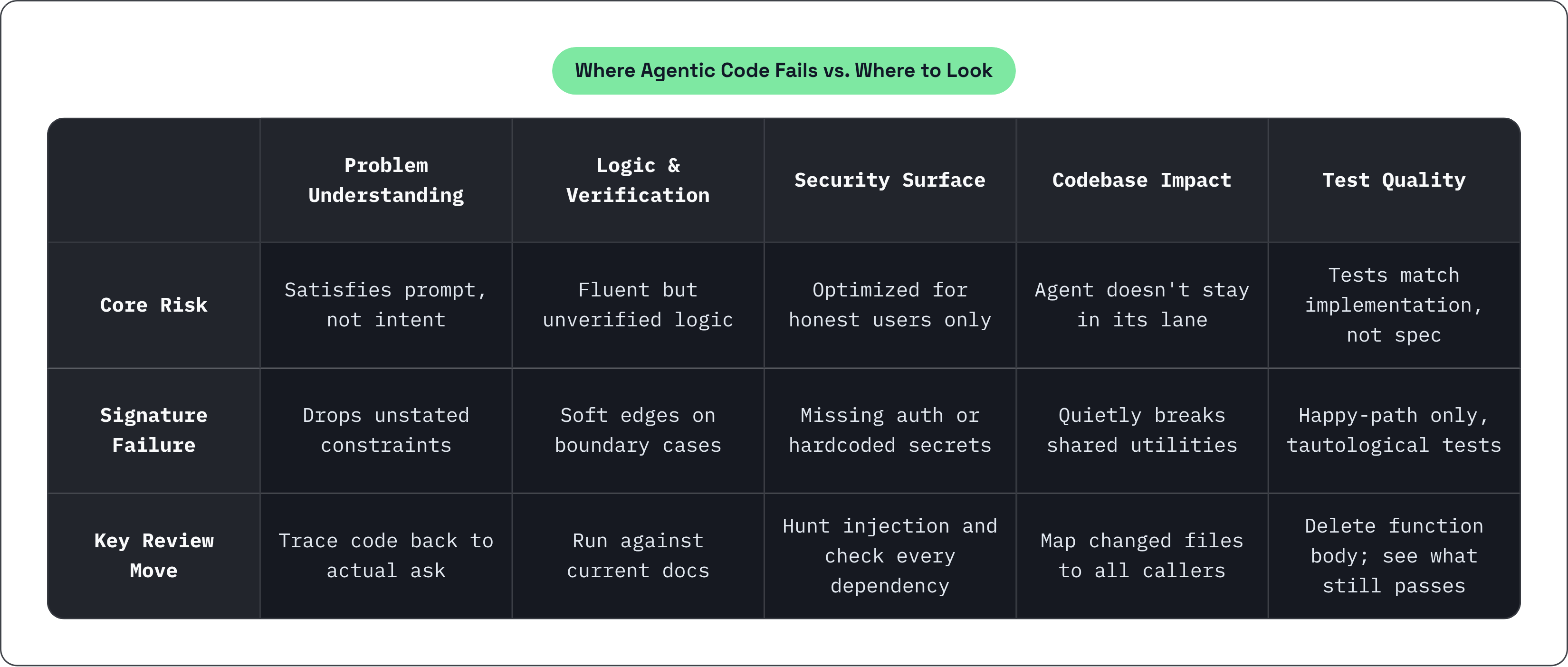
Here's the risk that matters most: agents satisfy the prompt, not the intent behind it. A well-built solution to a slightly wrong question is among the most dangerous outputs you'll see, because it sails through a surface-level review. It looks right. It runs. It's wrong.
Check 1: Trace the code back to the actual ask. Does it do what the ticket or the prompt really asked for, or what the agent guessed you meant? Watch both directions: the agent that stopped short of the real requirement, and the agent that added extra behavior nobody asked for.
Check 2: Make the plan visible. If the agent's decomposition step wasn't logged anywhere, you're reviewing conclusions with little access to the reasoning that produced them. Ask for a short task plan before the agent starts executing, and treat it as something you review, not just the diff at the end.
Check 3: Check for constraints nobody wrote down. Performance budgets, API contracts, backwards compatibility, data model rules. Agents will satisfy the stated requirement and quietly break an unstated one. Simple rule of thumb: if the constraint wasn't in the prompt, it's probably not in the code either.
A real shape this takes: a refactor agent cleans up a module, reorganizes it nicely, and quietly drops a deprecated export that some other service still depends on. The build passes. The code looks better. Something breaks in production a day later.
Reading logic that is fluent but unverified
Here's the trap: AI-written code reads clean. It follows the idioms of the language. That polish tricks your brain into skipping the scrutiny you'd normally apply. Janky-looking code makes you suspicious. Polished code makes you relax. That reflex can be exactly backwards when the author is a model, not a person.
Check 4: Push on every edge the logic implies. Null inputs, empty lists, overflow, two things happening at once. Agents nail the happy path and go soft at the edges. Don't assume the agent tested a boundary it never named.
Check 5: Run it against current docs, not memory. Agents can confidently call methods that don't exist in your installed version, pass arguments in an order that got deprecated two releases ago, or reach into internal APIs that were never meant to be called directly. Reading the code isn't enough. Run it.
Check 6: Follow errors all the way up. Agents are good at writing a try/catch right where they generate the code. They're often weaker at making sure that error actually gets handled correctly further up the call stack, or turned into the right kind of error for the rest of the system to understand. Swallowed exceptions and silent failures are a signature move of AI-written code.
Check 7: Find the assumptions about data shape. Does this field always exist? Is this list always sorted? Agents bake in guesses about data they've never actually seen at runtime, and they often don't flag those guesses. Look for a spot where an assumption should really be a schema check or an assertion.
One heuristic that covers a lot of ground: if the code "just works" and you can't immediately explain why it needs a guard against some bad input, ask what happens the day that bad input shows up.
Auditing the security surface that agents create without noticing
Security deserves its own pass because agents tend to optimize for "it works," not "it survives someone trying to break it." They build for honest users. Nobody told them to think about dishonest ones.
Check 8: Hunt for injection wherever user input meets a built string. SQL, shell commands, HTML, template strings. Agents will happily glue a string together instead of using parameters, especially if the code they're imitating already does that.
Check 9: Check who's allowed to call this. An agent building a new endpoint will often nail the business logic and skip the auth check entirely. The function works great. It just works for anyone, including people who shouldn't be anywhere near it. For every new route or handler, ask: where's the identity check, and what does it actually verify?
Check 10: Scan for hardcoded secrets. Agents sometimes lift an API key or a connection string right out of a file they read earlier in the session, and drop it into new code without recognizing it as something that needed to stay hidden. Scan new files for anything that smells like a credential before you merge, not after.
Check 11: Review every new dependency. Agents pick their own packages to solve a problem, and that can mean a library with known vulnerabilities, one nobody maintains anymore, or one with a license your legal team would veto. Anything showing up in the lockfile that wasn't there before is a decision the agent made on your behalf. Somebody human needs to sign off on it.
The pattern across all four: these usually aren't clever exploits. They're omissions — the check a security-minded person would have written by habit, and the agent just never thought to.
Checking what the agent did to the rest of the codebase
An agent running for hours doesn't stay in its lane. It touches files across the repo to get its goal done, and each individual change can look reasonable while the sum of them quietly breaks something someone else depends on.
Check 12: Map every changed file to who uses it. For anything the agent touched outside the obvious feature area, ask who else calls this. Shared utilities, base classes, config schemas, database models: changes here can spread quietly through everything downstream.
Check 13: Make sure contracts held. If a refactor changed a function's signature, its return type, or a side effect that something else relies on, your review needs to widen past the agent's own pull request. A changed public API or shared type is bigger than the diff in front of you.
Check 14: Ask if the test changed to match reality, or the code changed to match the test. When an agent hits a failing test, it sometimes finds it easier to edit the test than fix the code. That's a quiet inversion, and it can hide regressions behind a green checkmark. Every time a test changed, ask if the new expectation is actually still correct.
Check 15: Look for logic the agent reinvented. Agents work from a local window into the codebase, not a full map of it. They'll sometimes rebuild a business rule that already exists somewhere else, because they never saw the existing version. Two versions of the same rule that slowly drift apart is a maintenance problem the agent just handed you.
Reviewing the agent's tests as a first-class artifact
Here's the trick that high test coverage can hide: an agent that writes both the feature and the tests for that feature will write tests that match its own implementation, not the spec. You get great coverage of the code the agent wrote and little coverage of the behavior the spec asked for that the agent quietly skipped.
Check 16: Read the test against the spec, not the code. Does this test check the actual required behavior, or does it just check that the agent's code does whatever the agent's code does? A test that would still pass if the implementation were subtly wrong isn't testing much.
Check 17: Look for tests that only cover the happy path. Agents write the success case fluently and skip the failure cases. A test file with one assertion per function, no error paths, no weird inputs, is a sign the tests were written to look complete rather than to actually be complete.
Check 18: Watch for tests that can't fail. A test that calls a function and checks that the function returned what the function returned passes by definition and catches little. Agents produce these constantly when the prompt just says "write tests" without saying what those tests need to prove.
Simple gut check for all of this: delete the function body, replace it with a stub that returns something fixed, and see how many tests still pass. If most of them do, the tests aren't doing their job.
Handling multi-agent output and parallel workstreams
The failure point in multi-agent work usually isn't inside either agent's output. It's the seam between them. Each agent is coherent within its own slice. Nobody owns the boundary where the slices meet.
Check 19: Find where two agents' work touches, and look there hardest. Module boundaries, shared data structures, event formats, API response shapes. Wherever one agent's output becomes another agent's input, that spot needs a human eye. Neither agent's individual diff will flag it as a problem, because from either single vantage point, it isn't one.
Check 20: Check for conflicting assumptions about shared state. Two agents working near the same data model might disagree about who owns it, whether it's safe to mutate, or where a transaction begins and ends. Look for two different write patterns hitting the same resource.
Check 21: Look for naming drift. Parallel agents invent their own names for the same idea. Two functions doing the same thing under different names. Two error types for the same failure. Two config keys pointing at the same value. Cheap to catch now, expensive to untangle a year from now.
In early 2026, most major coding platforms rolled out multi-agent features within about two weeks of each other. The tooling to actually review what multiple agents produce together hasn't caught up to how fast teams are deploying it.
Making the review process itself sustainable at agentic volume
Here's the hard constraint: code is arriving faster than review capacity can grow. Per the Faros research, review time is already up 91% while merges are up 98%. Bolting a longer checklist onto an unchanged process just buries reviewers deeper. Something about the process itself has to change, not just the list of things on it.
A few adjustments that can help:
- Triage by how autonomous the run was, not by file count. Code that came out of a long unsupervised agent run needs a deeper look than a small AI-assisted edit a developer watched happen in real time. Autonomy level should be a visible property of every pull request, something that decides how hard review needs to work, not an afterthought.
- Use AI review tools to filter, not to decide. Automated scanning for security patterns, dependency issues, and obvious style problems clears the easy stuff off a human's plate. What it usually can't do is judge whether the agent solved the right problem, or whether a test is tautological, or whether two agents just quietly disagreed about who owns a database row. Those calls still need a person who understands the system, not just the syntax.
The honest summary: AI coding agents didn't make review less necessary. They made it a different job. Less proofreading, more architecture. Less "is this line correct," more "did anyone actually check what this thing was trying to do." That's a real shift in skill, and teams that treat it like the old job with a faster keyboard are the ones likely to find out the hard way what a large share of unreviewed code actually costs.