Autonomy Levels in AI Coding Agents
Five autonomy levels define how AI coding agents work and what they require from your team.
Most developers I talk to think of "AI coding tools" as a single category. Like, there's the thing that finishes your line of code, and then there's the more powerful version of that thing. Same animal, different size.
That mental model is costing teams real money and real time. When you treat all AI coding tools as one category, you either give them too much rope or not enough. Then something breaks, or nothing improves, and you draw the wrong lesson entirely.
An inline suggestion you accept or reject is one thing. An agent that clones your repo, runs CI, writes tests, and opens a draft PR while you're asleep is something else entirely. These are not the same tool operating at different intensities. They're different tools that require different things from you, your team, and your infrastructure.
What follows is a map. Five discrete levels, what each looks like in practice, and what it actually takes to move between them deliberately.
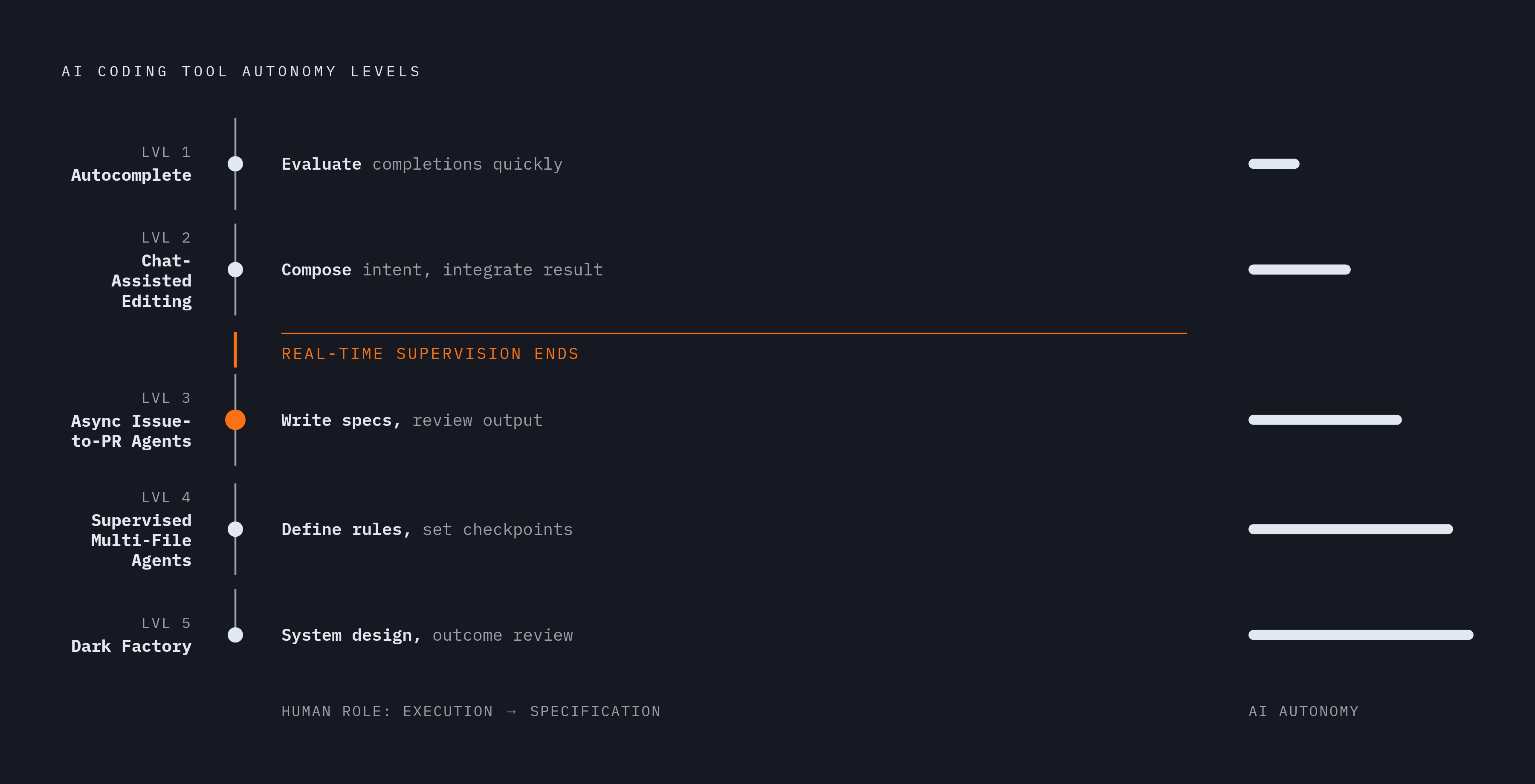
The Five Levels, Defined Without the Hype
Level 1. Autocomplete
Single-line or block suggestion. You accept it or you don't. The model has no memory of what you were doing ten minutes ago. This was the dominant paradigm before roughly 2024, and it still defines the experience for a huge slice of developers today.
The human job here: evaluate completions quickly and accurately.
Level 2. Chat-Assisted Editing
You describe what you want. The AI generates or rewrites a function, a file, maybe a module. You take that output and integrate it yourself. The human is still fully in the driver's seat. The AI is a very fast junior developer who never gets tired and has no feelings about your feedback.
The human job here: compose intent clearly in language, then integrate the result.
Level 3. Async Issue-to-PR Agents
This is where the game actually changes. The agent clones the repo, works in an isolated environment, runs CI, and opens a draft PR. Then it waits. You review when you're ready.
The defining feature isn't capability. It's asynchrony. You fire off a task and context-switch away. You're not watching. The barrier to getting something started drops dramatically. That's an ergonomic shift, not just a capability one. And ergonomic shifts compound.
The human job here: write clear task specs, trust CI as a safety net, review the output.
Level 4. Supervised Multi-File Autonomous Agents
Now the agent is touching code you didn't write and don't fully hold in memory. Cross-module feature work. Dependency management. Test generation. The agent proposes. You approve before anything merges. Human review gates remain on the critical paths, but the agent owns the work between those gates.
This level requires real investment in scaffolding. Clear architectural documentation. Defined module boundaries. Test coverage that can actually catch cross-module regressions. Explicit rules about what the agent can and cannot touch without asking.
The human job here: define the rules, set the checkpoints, review the outcomes.
Level 5. The Dark Factory
The developer is no longer reviewing individual PRs. The developer is maintaining the system that writes, tests, and ships code. Specialized agents coordinate as teams, mirroring a human engineering org structure. The human sets objectives, defines constraints, and reviews aggregate outcomes.
This level exists. It is being used selectively. But "selectively" is doing a lot of work in that sentence.
The human job here: system design, constraint definition, outcome review. Execution has left the building.
Each level changes the nature of your job. That's the thing worth sitting with before we go further.
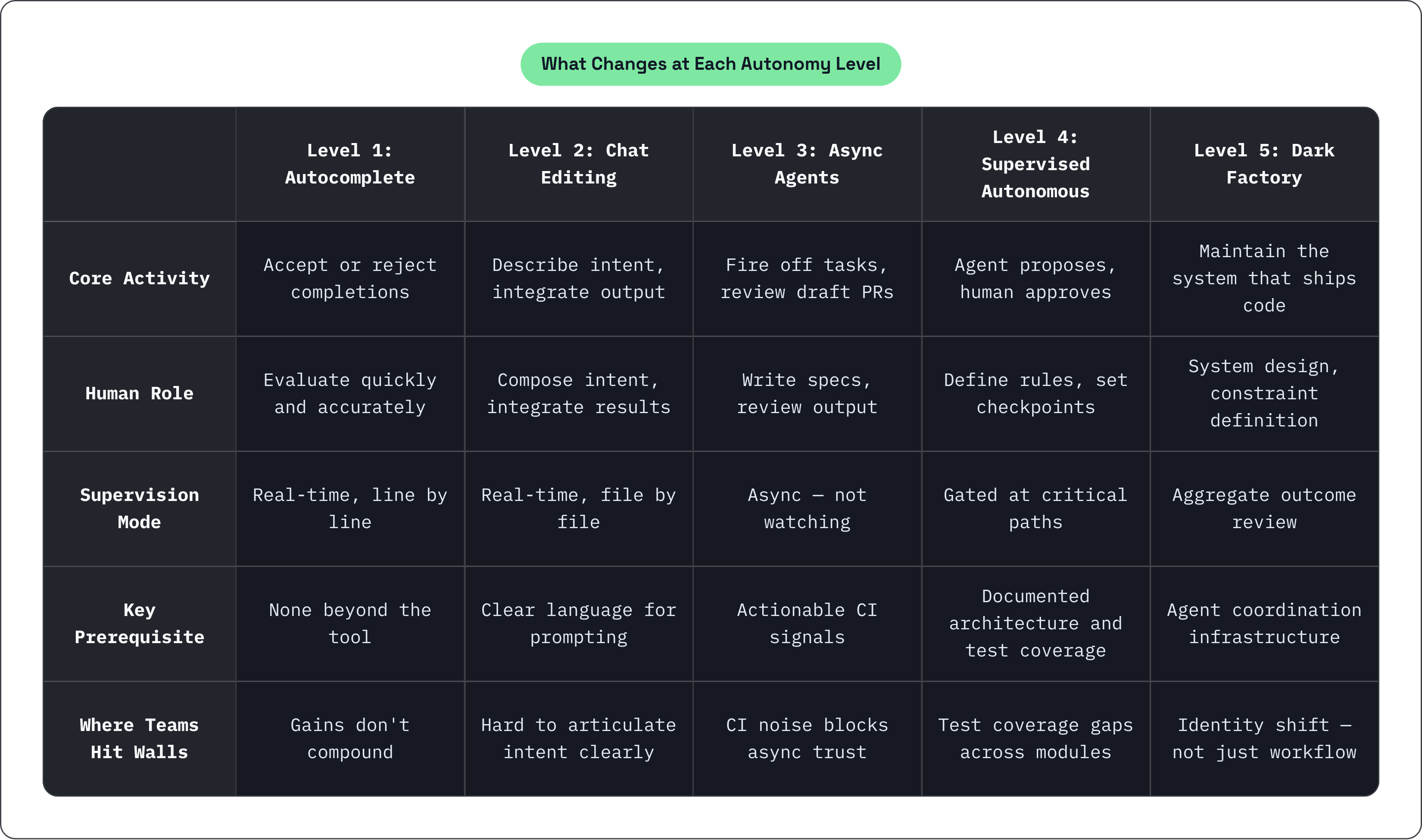
Where Most Teams Actually Sit in 2026, and Why
Baseline: the majority of production teams in 2026 are operating somewhere between Level 3 and Level 4. Level 5 is real, but it's applied narrowly, to specific task types, by teams that have built serious infrastructure around it.
Solo builders and indie developers. Level 3 is the sweet spot. One developer working at Level 3 can move faster than a small team stuck at Level 1. Shipping full-stack applications solo is now viable in a way it wasn't two years ago. The math has changed.
Product teams with existing codebases. Level 4 is the target, but getting there requires investing in the harness first. Define which task types agents handle reliably. Build test coverage that can hold up. Put review gates on the paths that matter most.
Enterprises with strong CI/CD. Selective Level 5 is viable, but only for low-risk, high-volume tasks. Dependency updates. Test generation. Documentation. These are the places where the dark factory model starts to make sense, because the blast radius of a bad output is manageable.
The biggest architectural shift separating the lower levels from the upper ones is this: agents can now run for minutes or hours. Not just respond to a prompt. That changes a great deal about how you design the workflow around them, how you think about review, and how you think about trust.
What Changes at Each Level Boundary, For Your Actual Job
The transitions between levels are not smooth upgrades. They're threshold crossings — like a series of doors, each one heavier than the last. Each one changes what you're responsible for.
Level 1 to 2. You stop evaluating completions and start composing intent in language. Sounds small. It isn't. Writing a clear prompt that produces useful output is a skill. It takes practice. The developers who stall here are often not struggling with the technology. They're struggling with articulating what they actually want.
Level 2 to 3. This is the critical threshold. You give up real-time supervision. The agent is working while you're not watching. This requires two things: trust in your CI pipeline as a genuine safety net, and personal comfort with async workflows. A lot of teams have CI. Fewer teams have CI that produces clear, actionable signals rather than a wall of noise.
Level 3 to 4. The agent starts touching code you didn't write and don't fully have in your head. This is where it gets demanding. You need documented architecture the agent can navigate. You need test coverage that catches regressions across modules. You need explicit checkpoints. Not "review everything" because that collapses into reviewing nothing consistently. Specific checkpoints for specific risk surfaces.
Level 4 to 5. You stop reviewing individual changes and start maintaining the system that generates them. One writer I find useful on this framing describes the shift as moving from "conductor" (directing AI in real time) to "orchestrator" (setting objectives and reviewing outcomes). That captures it well. This is an identity shift, not just a workflow adjustment.
The consistent thread across all four transitions: your leverage moves from execution to specification. Clarity of intent becomes the primary skill. This is counterintuitive for developers who were trained on the idea that the skill is in the doing.
The Trust Gap That Holds Teams at Lower Levels Than Their Tools Can Handle
Around 84% of developers use or plan to use AI coding tools (Stack Overflow, 2025, n=49,000+). Only 29% trust the output. That trust figure was 40% the year before. Trust is declining as adoption rises.
More people are using these tools. Fewer people are confident in what they produce. That tension is exactly what keeps capable teams operating at Level 2 when Level 3 or 4 is within reach.
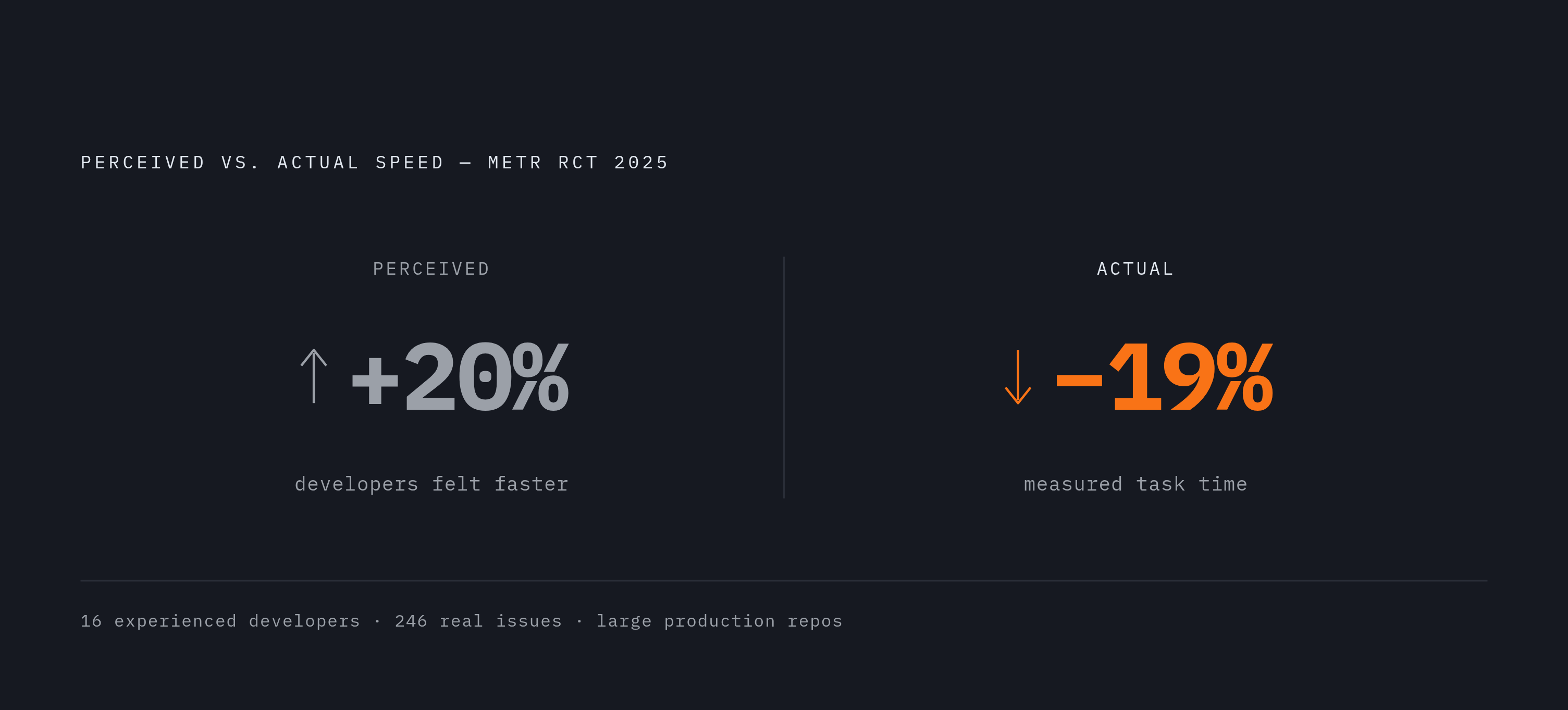
But there's something more uncomfortable underneath that number. A 2025 randomized controlled trial (METR, 16 experienced developers, 246 real issues from large production repositories) found that developers using AI tools took 19% longer than those without. And those same developers estimated they were 20% faster.
The perception gap is as important as the performance gap. Experienced developers, on complex real-world codebases, were slower with the tools than without. And they had no idea.
Why exactly does this happen? Because at lower autonomy levels, AI can add overhead rather than remove it. You're prompting, evaluating, integrating, verifying, re-prompting. The integration work lands on the human. The gains that people talk about appear at higher levels, where the agent handles tasks end-to-end and the human reviews the result rather than assembling it.
Median time in PR review rose dramatically year-over-year in 2026 tracking data (Faros, 2026 AI Engineering Report). At the same time, a significant share of PRs are merging with no review at all. AI is generating more code than review processes can absorb.
More review slows delivery. Less review degrades quality. Teams get stuck with no model upgrade to rescue them.
The resolution is not sentiment. It's structure. Trust at higher autonomy levels comes from the harness, not from the model. CI that works, test coverage that holds, defined review gates, clear task boundaries. These are what make Level 4 safe. A more capable model alone does not.
What a Working Level 3 and Level 4 Setup Actually Requires
Let's get specific, because "invest in infrastructure" is advice that costs nothing to give and nothing to act on.
Level 3 Prerequisites
CI that produces actionable signals. Not just "CI exists." The agent needs to read a failure and know what it means. If your CI output is 800 lines of logs where the actual error is buried on line 437, that's not a signal. That's noise. Fix that first.
Isolated execution environment. The agent works in a sandboxed clone. Not on main. Not anywhere near production. This is non-negotiable.
Task decomposition. Issues written with enough specificity that scope is unambiguous. The agent should have no need to ask clarifying questions to understand what it's supposed to do. If your issues read like "fix the auth thing," you're not ready for Level 3.
Draft PR as the output artifact. The human reviews before anything merges. The async loop closes at review, not at merge. This is what keeps Level 3 from being reckless.
Level 4 Additional Requirements
Documented module boundaries. The agent needs to know what it can touch autonomously and what requires a human in the loop. This documentation has to actually exist. Not in someone's head. Written down, accessible, maintained.
Test coverage that catches cross-module regressions. Unit tests alone are insufficient here. If the agent touches the payment module and something breaks in the notification service, your tests need to find that before it merges.
Defined autonomy scope per task type. The agent can own test generation and documentation fully. It touches authentication or payments only with explicit sign-off. Write these rules down. Put them somewhere the agent and the team can both reference.
Rules or context configuration files. Architectural constraints the agent should not violate, encoded and enforced. Not communicated once in a meeting and forgotten.
One piece of data worth taking seriously: enterprises are reporting tens of thousands of new security findings per month attributable to AI-generated code. That's what Level 4 volume looks like without Level 4 harness. The harness is not optional. It's the thing that makes the level work.
Practical implication. Teams that feel stuck at Level 2 are usually model-capable but harness-limited. The investment required is in CI, test infrastructure, and task specification. Not in a better model.
How Model Choice Interacts With Autonomy Level
The wrong question is "which model should we use?" That question assumes one model for all tasks, which is how almost no serious team operates in 2026.
The right question is "which model for which task?"
At Levels 1 and 2, smaller fine-tuned models are usually sufficient. Speed and cost matter more than deep reasoning. You're generating completions and rewriting functions, not planning multi-step changes across a codebase.
At Levels 3 and 4, frontier reasoning models start earning their cost. The task requires multi-step planning, not just generation. The benchmark that matters most for agentic coding work is SWE-bench Verified, which measures performance on real GitHub issues in real codebases. The leading models cluster around 80% on that benchmark as of 2026. The differences between them at the top are real but not enormous.
The same model family can score 52% or 69% depending on the agent scaffold around it. That's a 17-point spread from harness quality alone, not from the model itself. Upgrading the model without improving the scaffold returns less than the reverse. Consistently.
On cost. Agentic tools running frontier models can run $200 to $2,000 or more per engineer per month in token spend at higher autonomy levels. That is not the $30 seat license that earlier estimates assumed. API costs for frontier-quality models fell dramatically between 2025 and early 2026, which changes the economics considerably. But you still need to run the actual numbers for your team's usage patterns, not the vendor's sample scenario.
One benchmark caution. Vendor-reported SWE-bench scores should be compared only on standardized harnesses. Training data contamination is a real concern that has been flagged publicly. SWE-bench Pro is emerging as a more reliable proxy for production agent work precisely because it's harder to game. When a vendor publishes a headline number, ask which harness they used.
Practical takeaway: model selection at Level 3 and 4 matters. It's just the second investment to make. Harness quality is the first.
The Productivity Reality Across Autonomy Levels, What the Data Actually Shows
Vendors claim 30 to 55% productivity improvements. What does actual tracking data show?
Organizations tracked over 14 months show a median PR throughput gain in the single digits. Most teams land somewhere between 5 and 15%.
The organizational picture is more interesting than the individual speed numbers.
Faros telemetry across tens of thousands of developers shows significantly more tasks completed and dramatically more PRs merged. Organizational delivery metrics, however, stayed roughly flat in 2025 data. More code shipped, but roadmaps didn't move faster. Then 2026 data shows epics completed per developer up more than 60%. AI is now moving roadmaps. That likely reflects teams that have moved from Level 2 toward Level 3 and 4.
The J-curve is real. First-year adoption typically produces a productivity dip before a rise — like learning to drive a manual transmission: slower and jerkier before it becomes second nature. Learning curve, extra verification work, integration friction. Plan three to six months before agentic workflows stabilize. Plan six to twelve months before you see sustained throughput improvement. This is not a reason to avoid it. It's a reason to plan for it.
A significant share of companies that launched AI initiatives in 2025 had abandoned most of them by year's end. The abandonment rate suggests many teams got stuck in the J-curve trough and drew the wrong conclusion. They assumed the tool didn't work, rather than recognizing they hadn't built the infrastructure to make it work at the level that actually compounds.
Healthy ROI when it does compound runs at roughly 2.5 to 3.5x on average, with top quartile organizations seeing more. But only when the cost denominator includes actual token and usage-based costs, not just seat licenses. The math changes when you count everything.
The pattern is consistent. Teams at Level 1 and 2 see individual speed bumps that don't compound into delivery gains. Teams that invest in Level 3 and 4 infrastructure see roadmap-level improvements. The productivity unlock is not in the model. It's in the autonomy level.
How to Assess Which Level Your Team Is Ready for Right Now
Not where you want to be. Where you're actually ready to operate, given what you have today.
Work through these questions.
Can your CI pipeline produce actionable pass/fail signals that an agent can interpret without human translation? If your CI output requires a senior engineer to decode it, an agent cannot use it. That's the Level 3 gate.
Do you have test coverage sufficient to catch cross-module regressions without reviewing every line manually? If the answer is "we mostly have unit tests and then we check manually," you're not ready for Level 4. That's not a judgment. It's just the gate.
Are your task specifications written with enough specificity that scope is unambiguous? Pull up your last five issues. If any of them require a conversation to interpret, you have a Level 3 prerequisite gap.
Have you defined which task types agents can own fully, and which require explicit human sign-off? If this isn't written down somewhere, you're at Level 4 in ambition and Level 2 in practice.
Is your team comfortable reviewing outcomes rather than supervising execution? This one is less about process and more about culture. Some teams find async agent work freeing. Others find it deeply uncomfortable. Both reactions are valid. The discomfort doesn't have to stop you, but it does have to be named.
The assessment usually produces one of two answers. Either "we're closer to Level 3 than we thought, and what's stopping us is task spec quality," or "we're targeting Level 4 but our test coverage isn't there yet." Both are fixable. Neither is fixed by switching models.
Start with the gate you're actually stuck at. Not the one that sounds most impressive to fix.