Behavior-Driven Development in AI-Assisted Codebases
BDD bridges the gap between AI-generated code and business requirements.
AI coding assistants write faster than any human team ever has. That part is settled. What's less settled, and far more interesting, is what happens after the code ships. A multivocal systematic literature review has given this problem a name: the Productivity-Reliability Paradox (PRP), defined as the mismatch between non-deterministic code generation and the deterministic requirements of software that actually has to work. The model guesses. The system still needs to behave the same way every single time.
Three things decide which side of that paradox a team ends up on. The first is how abstract the task is: AI handles syntax well but stumbles on architectural decisions, the kind of judgment calls that span a whole system rather than a single function. The second is how mature the codebase already is. Greenfield projects soak up AI help easily, but mature, tangled production systems make every generated change expensive to verify. The third is who's doing the work. Junior developers tend to speed up. Senior developers often pay what amounts to a verification tax, spending the time they saved on generation back on checking.
None of this is theoretical. A large-scale empirical study, revised in April 2026, tracked hundreds of thousands of AI-introduced issues across thousands of GitHub repositories and found that 22.7% were still sitting in each repository's latest version, unresolved, as of February 2026, and these aren't typos. Unit tests are built to check whether a function does what it claims, one function at a time. Unit tests were never built to catch an architectural violation, a drifting API contract between two services, or a security anti-pattern that only shows up when two pieces of a system interact. Those defect classes live at the seams, and function-level tests don't look there.
The gap isn't about whether code runs; it's about whether code behaves the way the business actually needs it to behave, across boundaries no single test file can see. To close that gap, you need a layer of specification that sits above the code and below the product requirements, one that can describe cross-functional behavior in a form both humans and machines can check against. A specification-first development methodology was built to fill that gap, long before anyone was writing code with an AI agent.
What makes BDD different from other specification approaches in an AI-assisted codebase
Behavior-Driven Development grew out of Test-Driven Development to solve a specific communication problem: technical and non-technical stakeholders kept talking past each other. BDD's answer was the Given/When/Then scenario, written in plain language, structured around three activities: discovery, where teams hash out what a feature should actually do through conversation; formulation, where that conversation gets translated into Gherkin scenarios; and automation, where those scenarios become executable tests.
Compare that to the two methodologies it sits beside. TDD's main artifact is the unit test, scoped to whether an individual function does the right thing, validated by an automated test suite. Spec-driven development works at a different altitude entirely: its artifact is the executable specification, scoped to system-wide architectural contracts, and when a build diverges from that spec, the build fails. BDD occupies the middle ground between them. Its artifact is the Given/When/Then scenario, its scope is cross-functional behavior, and it's validated by documentation that a human can actually read and sign off on.
That middle position is what makes BDD useful rather than redundant. TDD and BDD aren't competing for the same job. TDD drives how an interface gets built at the unit level. BDD governs how a feature behaves at the boundary between components, teams, and stakeholders. Run them together and they cover defect classes that neither one catches alone: TDD misses cross-functional drift, and BDD on its own has no opinion about how a function should be shaped internally.
BDD scenarios are already written in a form that's both human-readable and machine-executable. A product manager can read a Given/When/Then scenario and understand it. A test runner can execute that same scenario and get a pass or fail. No other specification format splits that difference as cleanly, and that dual nature turns out to matter a great deal once the "machine" reading the scenario is an autonomous coding agent rather than a test runner.
How LLMs are automating Gherkin formulation
Writing Gherkin scenarios by hand has always been slow. Someone has to sit down, think through every edge case, and translate a conversation into structured Given/When/Then statements, one scenario at a time. That's the bottleneck LLMs are now closing. Large language models can generate Gherkin acceptance criteria directly, and early evaluation of LLMs on this task shows the structural results are already solid: well-formed scenarios, correct syntax, logical step sequences.
Structure isn't the same as substance, though. These models generate scenarios from patterns they saw during training, and that training data reflects common, well-documented behaviors. It does not reflect the specific, weird, domain-particular edge case that appears in one company's billing system or one hospital's scheduling logic. That's exactly where production systems break. A scenario can be syntactically perfect and structurally complete and still miss the one condition that matters most for a given business, which makes this a harder problem to catch than a missing unit test. Nobody gets a red X in a dashboard when a Gherkin scenario is merely incomplete in a way nobody noticed yet.
Call it specification debt. It accumulates quietly, because the artifact looks finished. The fix is pairing that automation with a domain expert checking the scenario itself, not the code that comes later. AI-assisted Gherkin formulation pays off as a productivity multiplier only when someone with real domain knowledge reviews the scenario before it becomes a contract. Practically, this means the review burden doesn't disappear. It moves earlier. Teams need to catch a bad assumption in the scenario itself, before any code gets generated against it, not in a pull request three weeks later. That shift, from reviewing code to reviewing specifications, becomes the whole argument for everything that follows.
How agentic systems close the full BDD loop from scenario to running code
Agentic systems don't just respond to one prompt and hand back a function. They read a specification, plan a multistep approach to implementing it, write code, run tests against that code, look at what failed, and try again, on their own, in a loop. Gartner's definition of an enterprise AI coding agent captures the distinction precisely: autonomous or semiautonomous software engineering systems that discover and use relevant context, translate human intent into multistep plans, and execute and verify those steps across code, tests, and related engineering artifacts. Four capabilities separate an agent from a simple code-completion tool: autonomy, context selection, execution, and verification.
A copilot-style assistant answers the question in front of it. An agentic system closes a loop: interpret the task, plan the approach, generate the code, run the tests, diagnose what broke, and iterate until the result holds up. That loop needs something to interpret in the first place, something structured enough for a machine to act on but still written in terms a human defined. That's exactly the shape of a Gherkin scenario.
The Test-Driven AI Agent Definition paper (arXiv:2603.08806) spells out this connection. It formalizes behavioral specifications, expressed as YAML-based product specs containing tools, policies, and decision trees, as the source material from which agent prompts are compiled. Those specs function as executable contracts: they drive automated test generation and they drive how the agent refines its own prompts when something fails.
This is the turn in the argument. A Given/When/Then scenario used to be a document a human read to confirm a feature was built correctly. Now it can be the thing an agent reads to know what to build in the first place, what to test against, and what counts as success or failure. BDD shifts from a communication tool for people to the operational interface between what a person wants and what an autonomous system does, so the scenario no longer describes the system but drives it.
What the AI Codebase Maturity Model reveals about when BDD becomes load-bearing
Plenty of teams get an AI coding assistant, start prompting it, review what comes back, and then just stay there. That plateau reflects a maturity level where behavioral specifications are optional context rather than something the system is actually built to enforce.
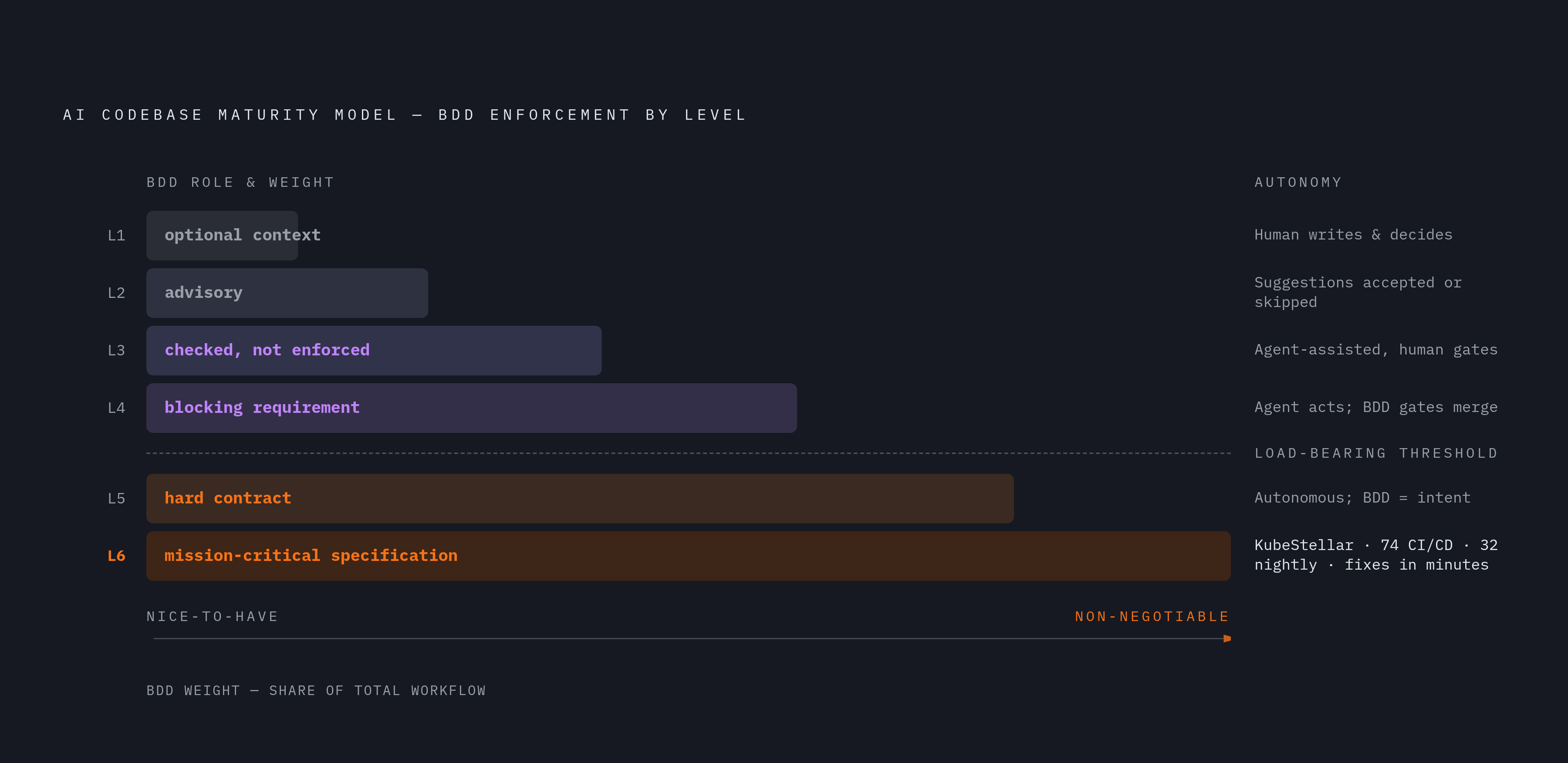
The AI Codebase Maturity Model (ACMM) lays out why that changes as autonomy increases. Its central claim is that the intelligence of an AI-driven development system doesn't live in the model itself. It lives in the infrastructure wrapped around the model: the instructions, the tests, the metrics, the feedback loops that catch what the model gets wrong. The ACMM describes six levels, and the levels can't be skipped. Each one depends on infrastructure the previous level built.
At the lower levels, a BDD scenario is a nice-to-have. Someone writes it, a human reads it, work proceeds whether or not the scenario was airtight. At the higher levels, where agents are operating with real autonomy across long stretches of time without a human checking every step, that same scenario becomes the primary thing standing between what a person actually wanted and what the agent ends up building on its own. The KubeStellar/Hive production deployment, at Level 6 (full autonomy) in the ACMM, runs 74 CI/CD workflows and 32 nightly test suites with high code coverage, and it fixes bugs around the clock on a turnaround measured in minutes. None of that happens because the underlying model got smarter. It happens because of the feedback loop infrastructure built around it.
A team should figure out where the codebase actually sits on that curve before deciding how strictly to enforce BDD as a hard contract. A team running a Level 2 workflow doesn't need the same specification rigor as a team running Level 6 autonomous agents overnight. The investment in behavioral specification should scale with how much autonomy the team is actually handing over, not with how fashionable BDD happens to be this year.
Why high-maturity teams with mandatory BDD largely neutralize the quality penalty of AI-generated code
The productivity-reliability paradox describes what happens when AI generates code faster than an organization can verify it. Teams that pair high maturity with mandatory, enforced BDD discipline capture most of the speed gain while avoiding most of the quality cost.
Moving the checkpoint earlier, rather than tightening human review, is what closes the gap. When a behavioral specification is an executable contract, the build fails the moment generated code diverges from it, so defects get caught at the specification boundary instead of surfacing three steps later in a pull request. That single shift resolves one of the two amplifying mechanisms the PRP identifies directly: review burden climbs when AI-generated code lands in front of a human reviewer with no specification-level check behind it, and it drops once a specification gate filters that code before a human ever sees it.
The PRP names a second amplifying mechanism too: the context window constraint, the problem of an agent losing track of intent across a long session or forgetting what mattered three prompts ago. Encoding behavioral specifications as persistent, structured context that an agent can reference across sessions addresses part of that problem. The specification is in the repository, stable and checkable, so a developer never has to re-explain the same requirement every time a new session starts, and the agent reads it fresh each time rather than relying on what survived in a shrinking context window.
Put those two together and the paradox stops looking like a fixed trade-off between speed and quality. It looks like a question of where verification happens. Verify late, in code review, and the cost is high and the bottleneck is human attention. Verify early, at the specification boundary, and the cost drops because a failing build is cheaper to produce and cheaper to fix than a flawed pull request that already ate someone's afternoon.
How AGENTS.md and context engineering connect BDD specifications to agent behavior in practice
All of this needs a concrete home in the repository, and that home is context engineering: writing behavioral specifications once, as persistent, versioned files the agent can pull from, instead of re-explaining the same intent in a new prompt every single time.
Mature teams build this out in layers. Rules files set ground rules for how an agent should behave. Memory files carry context across sessions. Subagents handle specialized subtasks. Reusable skills package up common operations. System prompt overrides adjust behavior for a specific repository or team. None of these are exotic. You need them most in large codebases, legacy systems, and anywhere a change carries real consequences if it goes wrong.
BDD scenarios slot into this layering with almost no friction. A Given/When/Then scenario written during a discovery conversation with stakeholders can be saved directly into repository context, read by an agent during implementation, run automatically as a test, and updated later as behavior changes. The three BDD activities, discovery, formulation, and automation, stop being a one-time sequence a team walks through once per feature. They become a loop that keeps running, with the scenario as the thing that persists.
Developers write out detailed behavioral specifications and architecture notes, so agents can reference those notes during implementation instead of guessing at intent from a short prompt. Those specs become part of what the agent treats as settled fact about the system, so nobody has to re-establish context by hand every time work resumes. The skill that matters most in working with a coding agent is structuring the specification environment well enough that the agent behaves consistently without needing a human to keep steering it back on course.
Where behavioral specification governance fits in existing engineering workflows (terminal, CI/CD, and PR review)
None of this requires bolting a new process onto how teams already work. Behavioral specification governance earns its keep by plugging directly into the pipelines, review gates, and command-line environments engineers are already using every day.
Agentic workflows today run across the IDE, the CLI, Slack, and GitHub, often in the same task. A specification embedded properly governs agent behavior at every one of those points, not just when a test suite happens to run. GitHub Agentic Workflows, which entered technical preview on February 13, 2026 and moved to public preview on June 11, 2026, let developers describe automation goals in plain Markdown instead of dense YAML, while AI agents handle execution inside sandboxed environments. A BDD scenario written in natural language slots into that interface almost without translation, since it was already written for a human to read in the first place.
CI/CD is where the specification gate actually bites. When an agent's output diverges from the behavioral specification backing it, the pipeline fails before that change reaches a human reviewer. Defect detection moves from the review queue, where a person has to notice something is wrong, to the specification boundary, where a failing build notices it automatically.
PR review closes the loop. Administrators can now configure whether AI code review is allowed to approve pull requests outright. When the review criteria behind that approval are behavioral specifications, not a reviewer's general impression, an approval stops being a subjective judgment call. It becomes a checked assertion against a contract that was written down, versioned, and agreed to before a single line of code was generated.
Sources
- The Productivity-Reliability Paradox: Specification-Driven Governance for AI-Augmented Software Development
- The AI Codebase Maturity Model: From Assisted Coding to Fully Autonomous Systems
- Bridging Behavior and Implementation: Automated Java Glue Code Generation for Behavior-Driven Development
- Spec-Driven Development for Agentic Software Engineering: Harnessing Human-Agent Teamwork