CodeRabbit Pricing and Plan Comparison
A tier-by-tier breakdown of CodeRabbit's pricing and what each plan actually unlocks.

This article is a straight-up pricing breakdown of CodeRabbit, the AI code review tool: four tiers (Free, Pro, Pro Plus, Enterprise) plus two add-ons, and what each one actually buys you. The goal is simple: by the end, you should know which plan fits your team, and why paying double for the next tier up is or isn't worth it.
AI code review stopped being a nice-to-have a while back. It's infrastructure now, the same way CI/CD or a linter is infrastructure. You don't debate whether to have it. You debate which one, and how much to pay for it.
CodeRabbit's numbers give you a sense of why this decision matters. The platform runs reviews on 2 million repositories, has processed more than 13 million pull requests, and counts over 17,000 customers, including Adyen, BMW, Indeed, and NVIDIA. That's not a niche tool anymore. That's a category with real money and real workflows riding on it.
Here's the part that makes pricing worth understanding, though, rather than something you skim past: CodeRabbit doesn't just review code. It summarizes PRs, does security scanning, and now handles agentic planning, meaning it can help plan out an issue before anyone writes a line of code. Different tiers unlock different capabilities, not just higher usage caps. That changes the question from "how much can I afford" to "what am I actually trying to do."
So let's map it. Four named tiers: Free, Pro, Pro Plus, Enterprise. Two add-ons that sit outside all of them: a Security Agent and agentic CLI usage. If you're an individual developer wondering whether to upgrade, a team lead stuck between Pro and Pro+, or an engineering manager trying to size an enterprise deal, this is built for you.
The Free plan: what it actually covers and where it stops
Free is actually free. No credit card, unlimited public and private repos, unlimited team members. That's generous, and it's worth taking at face value.
What you get:
- PR summaries
- AI review comments
- IDE and CLI reviews across every supported Git platform
That's a real, usable product. Not a stripped-down demo.
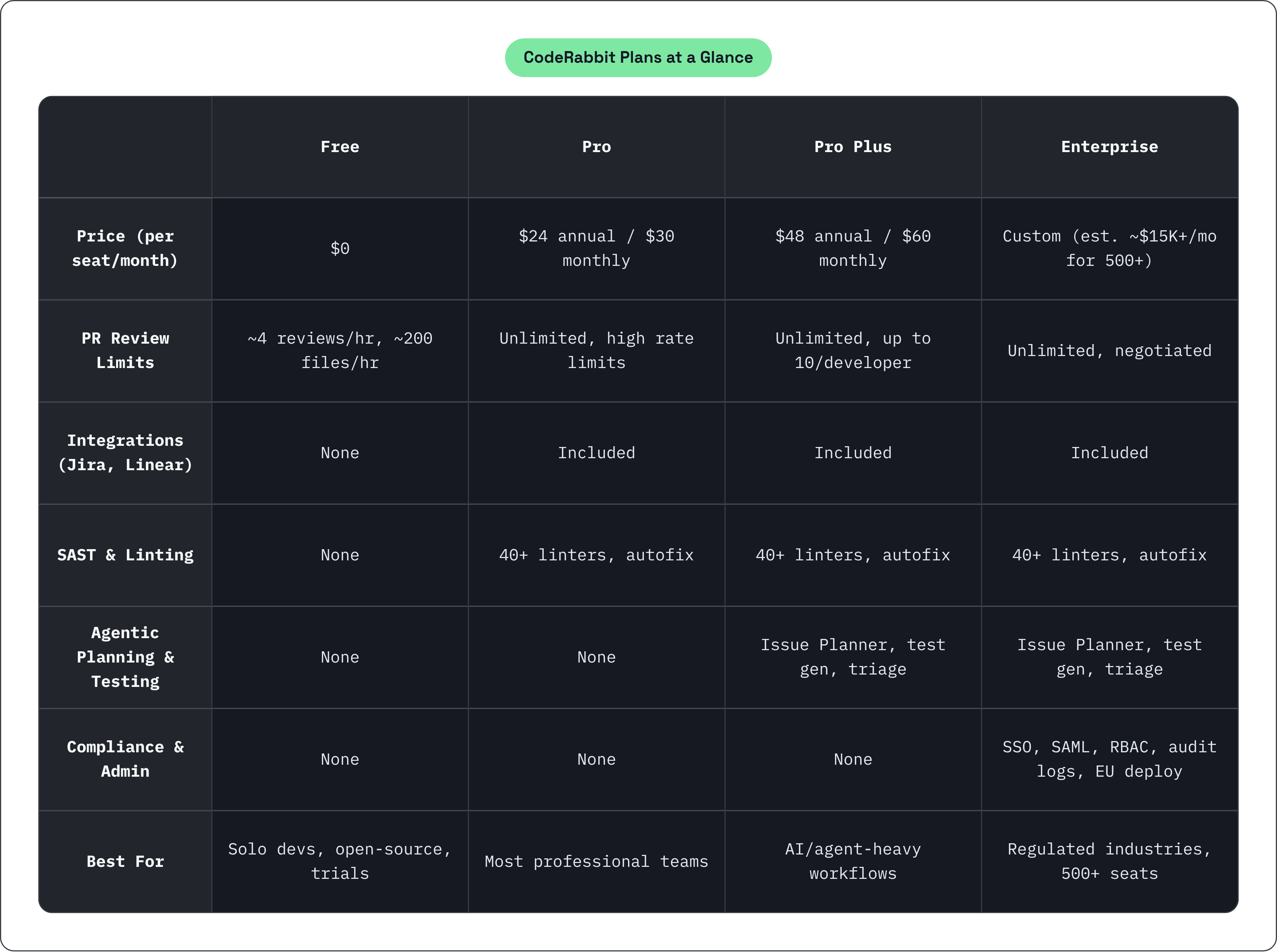
But here's the catch, and it's a big one: rate limits. You're capped at roughly 200 files per hour and 4 pull request reviews per hour. For a solo developer pushing a few PRs a day, you'll likely never notice. For an actual team shipping code all day, you'll hit that ceiling fast, and it'll feel like the tool just... stops working when you need it most.
A couple of notable carve-outs, though. New accounts get a 14-day trial of Pro+ before they have to pick a tier. And open-source projects get Pro+ features permanently, free. Over 150,000 open-source projects are already on this deal, which is a pretty clear signal about where CodeRabbit wants to plant its flag in that community.
What's missing at Free is where things get clear. No Jira or Linear integration. No SAST or linter support. No analytics. No agentic tasks: no planning, no test generation, no merge conflict resolution. These aren't small gaps. They're the exact features that turn code review from "a bot leaves comments" into "a system that fits into how your team actually works."
Practical read: Free is great for solo developers on side projects, or for kicking the tires before you buy. It is not built to survive contact with an active team's PR volume. That's not a knock. That's just what the rate limit is there to tell you.
Pro at $24/month per developer: the core paid tier unpacked
Pro costs $24 per developer per month if you pay annually, or $30/month if you pay month-to-month. That's a 20% discount for committing upfront, or $6 saved per seat per month. Small number per seat, but it adds up once you're talking about a real team (more on that below).
What you actually get for the upgrade:
- Unlimited PR reviews with much higher rate limits
- 40+ linters and SAST scanning, plus autofix suggestions
- Custom review instructions (tell it how your team likes to review code)
- Jira and Linear integrations
- Agentic chat right inside the review interface
- Analytics dashboards and custom reports
- Knowledge base access
One detail that matters more than it sounds like it should: only developers who author pull requests use up a seat. Someone who only reads and comments doesn't count against your bill. Organizations can also manually assign seats to specific people. That means your actual cost tracks your active contributors, not your headcount.
Let's put real numbers on it, because "per seat" pricing means little until you multiply it out:
- 10 active PR authors: $240/month. That's roughly what one senior developer costs for an hour of their time, per month, for the whole tool.
- 50 developers: $14,400 to $18,000 a year, depending on whether you go annual or monthly.
- 100 developers: $28,800 to $36,000 a year. Switching to annual billing at that size alone saves you $7,200 a year. That's not a rounding error. That's a decision someone in finance should be involved in.
Also worth knowing: there are no per-repo or per-PR caps on any paid plan. Your cost is predictable even as your PR volume climbs, which is exactly what you want from a budgeting standpoint.
On sentiment: G2 reviewers give CodeRabbit an average of highly rated. But some solo developers flag that $24/month feels steep when you're not splitting the cost across a team. That's a fair point, and it's worth sitting with. The value math can change quite a bit depending on whether you're one person or one of fifty.
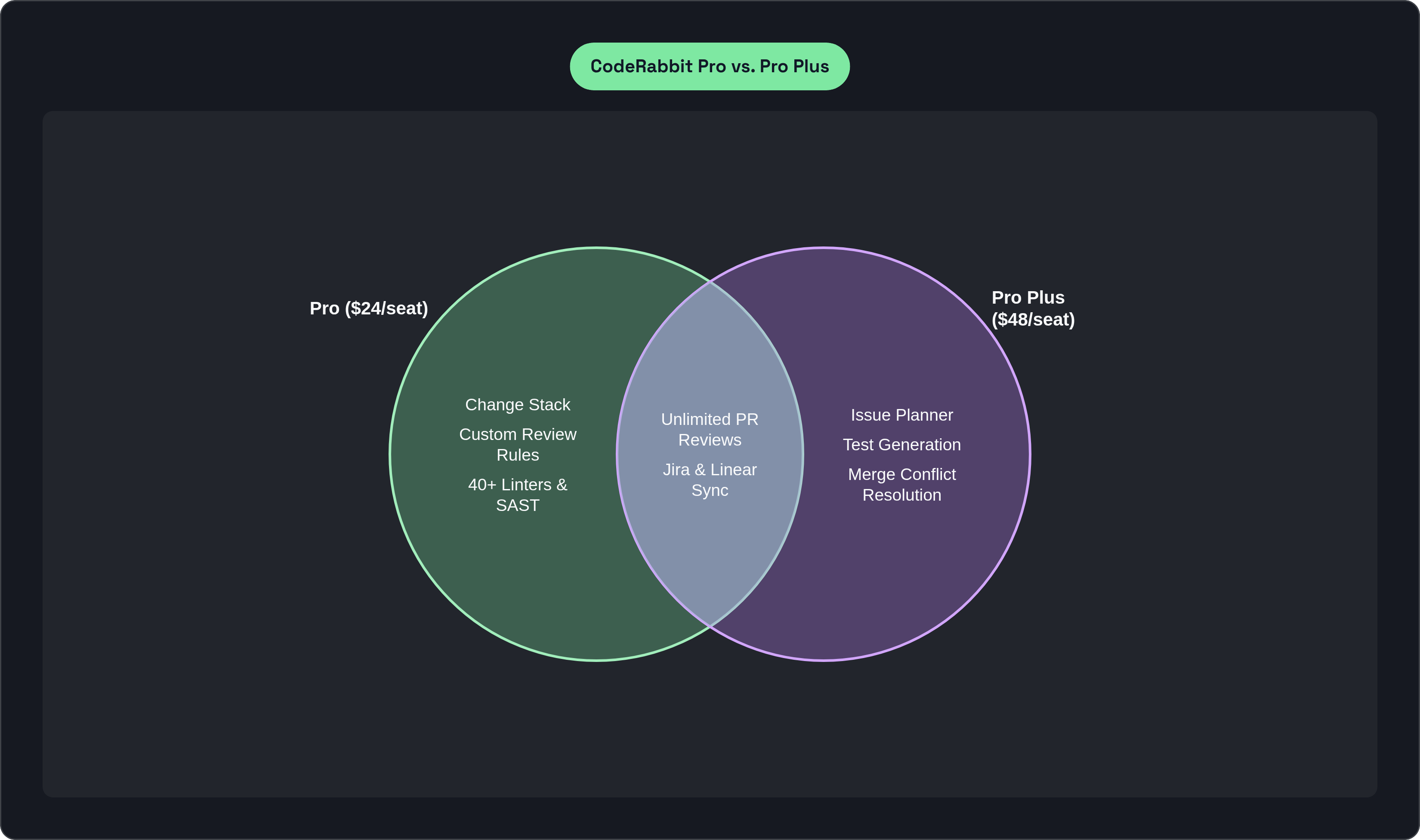
One more thing worth flagging explicitly: Change Stack, a genuinely useful feature, currently lives on Pro, not Pro+. That's a little counterintuitive if you assume a higher tier means more features across the board. Worth checking before you assume upgrading gets you everything Pro has, plus more.
Pro Plus at $48/month per developer: when the review layer extends into planning and testing
Pro Plus runs $48/developer/month annually, or $60/month if billed monthly. Notice that's exactly double the Pro annual price. Not a coincidence. That doubling is the number you should hold onto as you decide whether this tier is worth it.
Everything in Pro carries over, plus:
- CodeRabbit Plan (the Issue Planner): plans out issues before code gets written
- Unit test generation
- Merge conflict resolution
- Other pre- and post-merge agentic actions
- Higher rate limits, up to 10 reviews per developer
The Issue Planner is the headline feature here, and it launched in public beta in February 2026, integrating with Linear, Jira, GitHub Issues, and GitLab. Here's how it works: you create an issue, and CodeRabbit looks at your existing codebase and generates a coding plan (specific files, functions, interfaces to touch). That plan can go straight to an AI coding agent. Essentially, it's doing pre-work that used to sit entirely on a human's plate.
But let's not oversell it. The Issue Planner's quality gets inconsistent once you're dealing with complex, cross-repo planning. It can get very detailed about implementation while missing the actual business logic behind why the issue exists in the first place. Useful tool. Not a replacement for a tech lead thinking it through.
Pro+ (and Enterprise) also get Triage: a scoring system that looks at incoming PRs across value, urgency, risk, dependencies, readiness, and reviewer fit, then routes low-risk changes to automated workflows while sending the higher-stakes stuff to human reviewers.
So who's this actually for? Teams running a lot of AI-generated code, vibe-coding workflows, agent-generated PRs at volume. In that world, pre-review triage and planning scaffolding save real reviewer hours. That's where the extra $24/seat/month earns its keep.
But here's the practical caveat: if your team mainly wants better review quality, and isn't leaning on agentic planning or test generation day to day, Pro probably covers you fine. Paying double only makes sense if you're actually going to use the upstream stuff. Don't upgrade because it sounds more advanced. Upgrade because you'll use what it adds.
Enterprise: what custom pricing covers and what teams should expect to negotiate
Enterprise builds on everything in Pro+ and adds the stuff that compliance and infrastructure teams start asking for once you cross a certain size:
- Self-hosting (available for 500+ seat deployments)
- Multi-organization support
- SSO and SAML
- Custom RBAC and audit logging
- API access
- EU deployment option
- AWS and GCP Marketplace billing
- A dedicated Customer Success Manager and SLA support
There's no published list price here, and that's normal for enterprise software at this scale. One third-party estimate puts the floor around $15,000/month for 500+ users. Treat that as a ballpark, not a quote. Real numbers come from a sales conversation, and they'll depend heavily on your seat count and what you negotiate.
If you go self-hosted, budget for infrastructure separately. AWS costs for a self-hosted Enterprise deployment run anywhere from $500 to $8,000+ a month depending on scale. Cloud-hosted Enterprise doesn't carry that extra line item. Implementation for cloud-hosted setups is fairly light, typically 8 to 18 hours of internal labor spread across one to two weeks.
Who actually needs this tier? Compliance-driven industries: financial services, healthcare, anything regulated. The SSO, RBAC, audit logging, and EU deployment options aren't there because they sound impressive. They're there because that's what a compliance officer asks about on day one.
One practical heads-up: some G2 reviewers in the enterprise segment have flagged billing cancellation as a friction point. Worth raising directly during contract talks, before you sign, not after.
And here's a governance point worth sitting with regardless of which tier you're on: Enterprise doesn't change who's actually in control. CODEOWNERS, required checks, branch protections, approval policies, all of that remains the final gate. CodeRabbit organizes and automates the work around review. It doesn't independently approve or deploy code. That's a feature, not a limitation. You want your safety rails to stay largely where they are, no matter how much you're paying.
The two add-ons that sit outside the seat tiers: Security Agent and agentic CLI usage
These two don't fit into the tier ladder. They're separate purchases, and they matter enough to model on their own.
Security Agent costs $40 per seat per month, on top of whatever plan you're on. It covers vulnerability scanning across your entire codebase, not just the PR in front of you: source code, infrastructure-as-code, dependencies, SBOMs, configuration. It runs on a recurring basis, not just when someone opens a PR. Full-codebase scans are metered separately, and there are volume options if you need them.
Do the math here before you buy: a Pro team paying $24/seat that adds Security Agent is now significantly higher per seat. That's not a small bump. Model it explicitly. Don't let it sneak up on your budget a quarter in.
Agentic CLI usage is billed at $0.50 per agent minute, but only while the agent is actively running. No charge for cold starts, no charge for idle time. That per-minute rate includes tool usage, integrations, and context gathering, so it's not just raw compute you're paying for.
This is the add-on to watch if your team runs agentic coding loops: planning, coding, testing, review, repeat. Those cycles can rack up minutes fast, and it's billed completely separately from your seat cost. That means your total-cost picture needs two line items, not one.
Here's the reality check worth internalizing: for a team running agentic workflows heavily, the per-minute charges can end up costing more than the seat subscription itself. Your seat price is the floor. It is often not the ceiling. Plan accordingly, and check your usage early rather than finding out at the end of the month.
How CodeRabbit's per-seat model compares to usage-based and bundled alternatives
The core thing that makes CodeRabbit's pricing different: it charges per PR-authoring developer, not per line of code or per PR reviewed. Your cost scales with your headcount. It doesn't scale with how much code you write.
That structural choice matters more than it sounds like it should. DeepSource, for comparison, charges per lines of code analyzed for its AI features. In a high-volume team, that model can produce bills dramatically higher than a flat per-seat subscription. If your team ships a lot of code or maintains a large codebase, that difference in billing structure is worth thinking through before you commit to either approach.
GitHub Copilot Code Review comes in cheaper per seat, at a lower monthly rate, but it's bundled into the broader Copilot suite rather than being a specialized review tool on its own. If you're already paying for Copilot, worth checking how much of that spend overlaps with what CodeRabbit would add, rather than assuming it's additive cost.
SonarQube offers deeper static analysis in some respects, but it doesn't do AI-powered contextual review, and it typically requires you to self-host, which brings its own infrastructure overhead.
And then there's Cursor, which sits in a related but different lane: an agentic development environment covering coding, testing, PR review, and CI, all in one place. That upstream territory (planning before code gets written) is exactly where CodeRabbit's Issue Planner is starting to move. Which raises an interesting point: teams using Cursor for autonomous code generation are, in some ways, the exact audience CodeRabbit's Triage and agentic review features are built for. Agent-generated PRs increase review volume and complexity fast, and that's precisely the problem Triage is trying to solve.
The practical upside of CodeRabbit's per-seat approach shows up most clearly once you're past 30 developers or so: it gets more predictable than usage-based pricing, because you're not gambling on how much code gets written in a given month. The $7,200/year gap between monthly and annual billing at 100 developers is the clearest proof point here. That's not a feature difference. That's just a billing cycle choice, and it's worth real money.
Which plan matches which team profile
Let's put it all together, because the practical answer to "which plan should I pick" depends entirely on where you sit.
Free works for individual developers on personal or low-volume projects, and for open-source maintainers, who get Pro+ features at no cost. It's also fine for kicking the tires before buying anything. It is not built to survive an active team's PR volume, and that's by design, not by accident.
Pro at $24/seat/month is the right default for most professional engineering teams. Full AI review, integrations, analytics, predictable per-seat cost. And remember: Change Stack lives here, not on Pro+, which is a real reason to stay put rather than assume you need to upgrade.
Pro Plus at $48/seat/month makes sense for teams running AI-generated or agent-generated code at real volume, where pre-merge planning, test generation, and triage actually cut down reviewer bottlenecks. It's also the tier for teams that want to feed the Issue Planner's output straight into a coding agent.
Enterprise is for organizations with compliance needs (SSO, SAML, RBAC, audit logs, EU deployment), multi-org structures, or scale (500+ seats) where self-hosting and dedicated support stop being nice-to-haves and start being operational necessities. Budget $500 to $8,000+ a month on top of seat fees if you're self-hosting.
Security Agent is for teams that need full-codebase vulnerability coverage, not just PR-level scanning. Model the $40/seat/month as its own line item. Don't think of it as an upgrade path.
Agentic CLI usage matters for any team running autonomous coding loops. Budget conservatively here. At $0.50 per agent minute, active sessions can add up quicker than people expect. Watch usage closely in the first few weeks before you commit to leaning on it heavily.
If you want one heuristic to walk away with: start with the billing mechanic (only PR-authoring developers use seats), add Security Agent if full-codebase scanning is a real requirement, then ask directly whether your team will use Pro+'s agentic planning features in practice. Paying double for Pro+ only makes sense if that upstream planning and triage work actually becomes part of how your team ships code, week to week. If it won't, save the money. Pro will likely do the job just fine.