CodeRabbit Alternatives for Automated PR Review
Teams must choose between catching more bugs and tolerating more noise.

PR review used to mean a human reading your diff. Now it mostly means a bot reading your diff, and the bot often has a harder time keeping up than you'd think. AI is writing more code than before, PRs are getting bigger and more frequent, and the tools built to review that code differ enough from each other that picking the wrong one has real consequences. This piece walks through the main CodeRabbit alternatives on the market and where each one fits.
A large and growing share of code at enterprise teams is now AI-assisted. Research from Faros AI found review time increased 91% and pull request size grew 154% once AI-generated code started flowing into the pipeline. CodeRabbit's own December 2025 report found roughly 1.7x more issues in AI-coauthored PRs than in human-written ones.
The stakes go beyond style nitpicks. Veracode tested more than 100 LLMs and found that 45% of AI-generated code samples introduced an OWASP Top 10 vulnerability. That's a security hole heading toward production with a green checkmark on it if nobody catches it.
Adoption is widespread at this point. Stack Overflow's 2025 Developer Survey, nearly 49,000 respondents across 177 countries, found 84% of developers use or plan to use AI tools, up from 76% the year before, and 51% use them every day. The question isn't whether to automate review anymore. It's which tool matches what your team needs.
The evaluation dimensions that separate PR review tools from each other
Every vendor will tell you their tool is smart, fast, and integrates well. Little of that tells you anything. What actually separates these tools comes down to five dimensions:
- Depth of analysis. Does the tool look at just the diff, or does it understand the whole codebase, including how files relate to each other?
- Noise-to-signal ratio. How selective is the tool about what it flags? And what happens to trust once developers start ignoring its comments?
- Workflow integration. Where do comments show up? Which platforms are supported? Can the tool apply a fix, or does it just suggest one?
- Autonomy range. Is this a tool that leaves comments, or one that can write the fix, run the tests, and close the ticket?
- Scalability and governance. Can you set custom rules, enforce quality gates, keep an audit trail, self-host if you need to?
These dimensions trade off against each other. A tool that catches more bugs tends to flag more false positives too, so you have to decide which failure mode costs you more: missed bugs or wasted triage time. A tool with deep codebase understanding often supports fewer platforms. A tool that can act autonomously requires you to trust it with write access, which is exactly the kind of thing that keeps some engineering leaders up at night and doesn't bother others at all.
There's rarely a single best tool here. There's typically a best tool for your team's specific shape. Keep that framework in mind as we go through each option.
Where CodeRabbit works well and where teams consistently hit its limits
CodeRabbit is the default a lot of teams reach for first, and for good reason. It integrates smoothly with GitHub, comments show up right in the pull request with almost no setup, and it does a solid job on file-by-file review for straightforward codebases. Pricing is friendly too: free for unlimited public repos, and $24 per developer per month on the Pro tier billed annually.
Evaluations through 2025 and into 2026 keep surfacing the same three limits.
First, verbosity on large PRs. Once you're touching hundreds of files, CodeRabbit can generate a wall of comments, and a lot of it is low value. Teams report spending real time just tuning review instructions to cut the noise down. Once developers start tuning out AI comments, the tool has quietly defeated its own purpose. A review tool nobody reads isn't a review tool.
Second, it's review-only. No SAST, no software composition analysis, no secrets detection, no quality gate enforcement, no technical debt tracking. A team needing a broader code quality platform ends up pairing CodeRabbit with something else, adding cost and moving parts to manage.
Third, no autonomous action. CodeRabbit can suggest a fix, but it won't apply it, and it won't close a ticket in Linear or Sentry on your behalf.
None of this makes CodeRabbit a bad tool. It makes it a tool with a specific shape: fast to adopt, cheap to start, and best suited to teams with manageable PR sizes who don't need governance or downstream automation. Teams with large monorepos, frequent big refactors, or a need for cross-file business logic understanding tend to feel the edges of that shape pretty quickly.
Greptile: the highest bug catch rate, with a noise trade-off teams must weigh
Greptile takes a different architectural bet: build a full code graph of the entire codebase, not just the diff, so the tool understands architecture and dependencies. It supports more than 30 languages, indexes in real time with every commit, and gives you inline comments, suggested fixes, and plain-language summaries.
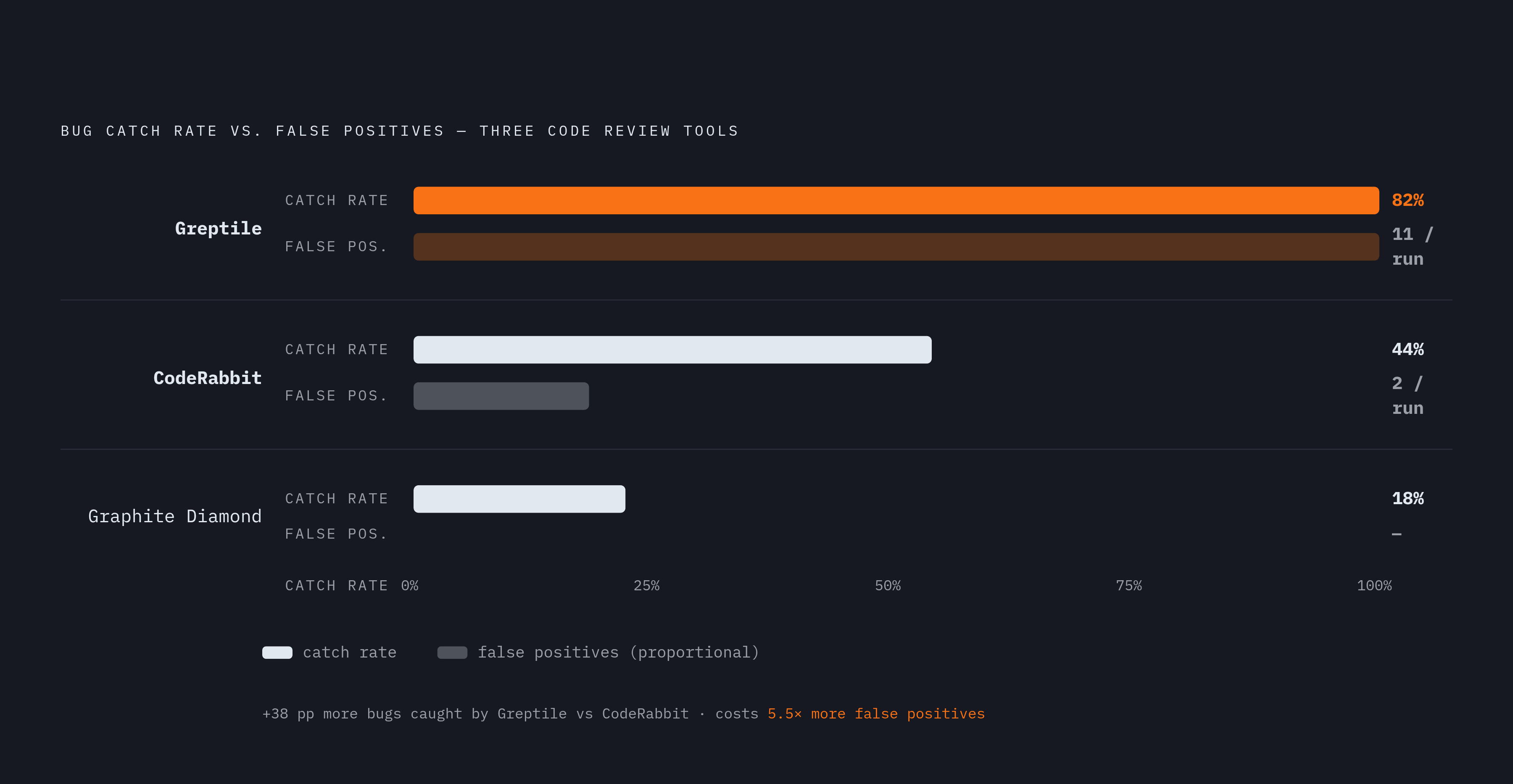
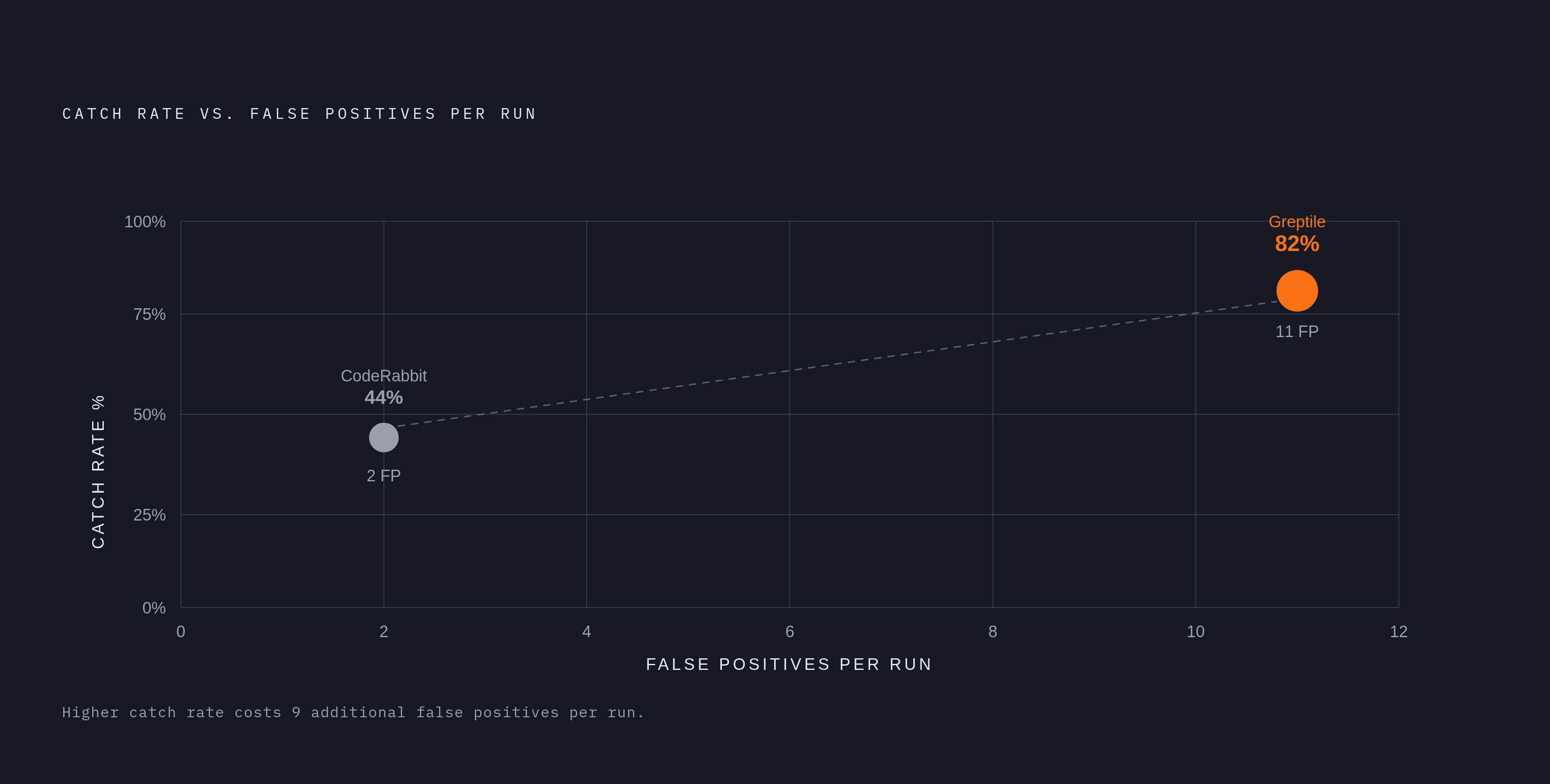
The number that gets attention: by Greptile's own benchmarking, it catches 82% of bugs versus 44% for CodeRabbit. That's a big gap. But it comes at a cost: Greptile generates 11 false positives per run versus 2 for CodeRabbit.
So here's the actual question a team has to answer: is nearly doubling your bug catch rate worth roughly quintupling your false positive count? There's no single right answer. Teams with the bandwidth to triage more comments will find that trade worth making. Teams already drowning in review noise will find it makes things worse, not better.
One more hard constraint: Greptile is GitHub-only. If your org runs on Azure DevOps or Bitbucket, this isn't an option, regardless of how good the analysis is.
Pricing: free for open source, Pro at $30 per seat per month with 50 credits included, additional credits at $1 each.
Qodo: the strongest option when governance and enforcement consistency matter most
Qodo (formerly CodiumAI) ships two products: a coding assistant called Qodo Gen and a PR review product called Qodo Merge. The interesting part for review purposes is Qodo Merge's governance layer.
Qodo 2.0 introduced a multi-agent architecture, and a subsequent update added something called the Rule System, currently in beta: a centralized way to define and enforce engineering standards across every repo in your org. You can set review rules, enforce security or correctness checks, and keep practices consistent across dozens of projects. This is the exact thing CodeRabbit doesn't offer, and for a large org with strict standards, it's not a nice-to-have. It's the difference between "we have a policy" and "we can actually prove the policy gets followed."
Qodo also offers a fully self-hosted option through PR-Agent, which matters a lot if you're in a regulated industry where code can't leave your infrastructure. PR-Agent is widely used as an open-source AI PR review tool in its own right.
On raw performance, Qodo published an open benchmark scoring a 60.1% F1 across 580 real-world issues, a useful reference point even if it's not directly comparable to Greptile's or CodeRabbit's numbers given different methodologies.
Pricing: a free Developer tier with 30 PR reviews plus 250 IDE and CLI credits a month, and a Teams plan at $30 per user monthly (annual) or $38 month-to-month.
Best fit: engineering orgs with multiple repos, defined coding standards, and an actual need to enforce those standards consistently, especially in regulated sectors where "we told people to follow the rule" isn't good enough.
GitHub Copilot Code Review: when platform consolidation outweighs specialized depth
GitHub Copilot Code Review became available in 2025. It gathers context from the broader repository before it posts a single comment. That's the same basic architectural idea as Greptile, executed differently and folded directly into the platform you're probably already using.
What stands out here is restraint. By design, Copilot Code Review aims to stay quiet when it has nothing actionable to add, a deliberate choice to protect signal quality rather than comment for the sake of commenting. That's a deliberate choice to protect signal quality rather than comment for the sake of commenting, and a direct answer to the verbosity problem that shows up with CodeRabbit and Greptile.
The cost argument is straightforward if you're already paying for Copilot: code review is included in existing Copilot Business and Enterprise subscriptions without an extra line item.
The constraints are just as straightforward. GitHub-only, so GitLab, Bitbucket, and Azure DevOps teams are out. And you need a Business or Enterprise Copilot subscription; there's no standalone version.
Best fit: teams already living inside the GitHub and Copilot ecosystem who'd rather not add another vendor to the stack for review specifically.
Graphite Diamond: prioritizing review process quality over comment volume
Graphite takes a distinctly different approach to the whole problem. Instead of building a smarter AI to review giant, messy PRs, Graphite's bet is: make the PRs smaller in the first place, through stacked pull requests. Diamond, its review tool, is built to work on PRs that are already organized for readability, not on raw, sprawling diffs.
That design choice shows up starkly in the numbers. Diamond is among the most selective of any tool out there, generating very few comments per PR by design. But selectivity has a cost: independent benchmarking puts Diamond's bug catch rate at just 18%.
Is that bad? Depends what you're optimizing for. Teams adopting Diamond aren't trying to maximize defect detection. They're trying to fix the workflow that made review painful in the first place: PRs too large to read carefully, reviewers skimming out of exhaustion, real bugs slipping through not because the reviewer wasn't smart but because nobody has the patience to read a 2,000-line diff closely.
If your team already uses Graphite for stacked PRs, and your actual bottleneck is reviewer fatigue and PR sprawl rather than raw bug detection, Diamond is solving the right problem. It's just not trying to be Greptile, and it shouldn't be judged like it is.
SonarQube: deterministic static analysis as a complement, not a substitute
SonarQube isn't new, and it isn't an AI reviewer in the same sense as the tools above. It's a long-standing rule-based static analysis platform, covering code smells, vulnerabilities, and duplication across a wide range of languages and frameworks. (SonarCloud and SonarQube Cloud refer to the same product, if you've seen either name floating around.)
The key difference is fidelity. SonarQube's results are deterministic and auditable: a rule either fires or it doesn't, and you can trace exactly why. AI review tools are probabilistic by nature; they're making judgment calls, which is exactly what makes them useful for semantic issues and exactly what makes them harder to audit.
That's why "SonarQube versus AI review" is a bit of a false framing. They're not really competing for the same job. SonarQube catches what's rule-definable: known vulnerability patterns, duplication, code smells with clear definitions. AI review catches the stuff no rule can fully encode: does this change actually do what the ticket says, does this logic make sense given how the rest of the system behaves. Regulated industries in particular tend to run SonarQube specifically because they need a hard, auditable quality gate, which no AI review tool, however capable, is built to satisfy on its own.
SonarQube Cloud includes SAST, quality gates, and compliance reporting alongside its own AI review features. Best fit: any team that needs a provable, auditable quality bar, layered on top of AI review rather than instead of it.
Agentic PR review: what it means when the tool can act, not just comment
Every tool covered so far, no matter how deep its analysis or how selective its comments, shares one limit: it can tell you about a problem, but fixing it is on you. A comment that says "this could cause a race condition" is useful. It is not the same thing as a fix that's already been written, tested, and merged.
For teams whose real bottleneck isn't finding problems but closing the loop on them, that gap matters more than any bug-catch-rate percentage. This is where agentic PR review comes in: tools built not just to comment, but to act. Write the fix. Run the tests. Trigger the CI/CD pipeline. Update the ticket in whatever downstream system tracks it. The review finding doesn't sit in a PR thread waiting for a human to get to it; it gets resolved as part of the same motion.
How much autonomy should you hand over? The practical answer is that it shouldn't be all-or-nothing. Some teams will want a tool that only ever suggests. Others will want fixes applied automatically for low-risk categories and left alone for anything touching production-critical logic. The right architecture gives you that slider instead of forcing a binary choice, and the more the review step is woven into the same environment as your IDE, terminal, CI/CD, and GitHub, the less it feels like a separate, siloed gate you have to clear.
The real question to ask when evaluating any of these tools in 2025 and 2026 isn't just "are the comments good?" It's "what happens after the comment gets posted?" For a lot of teams, that second question matters more.
Matching tool capabilities to team requirements
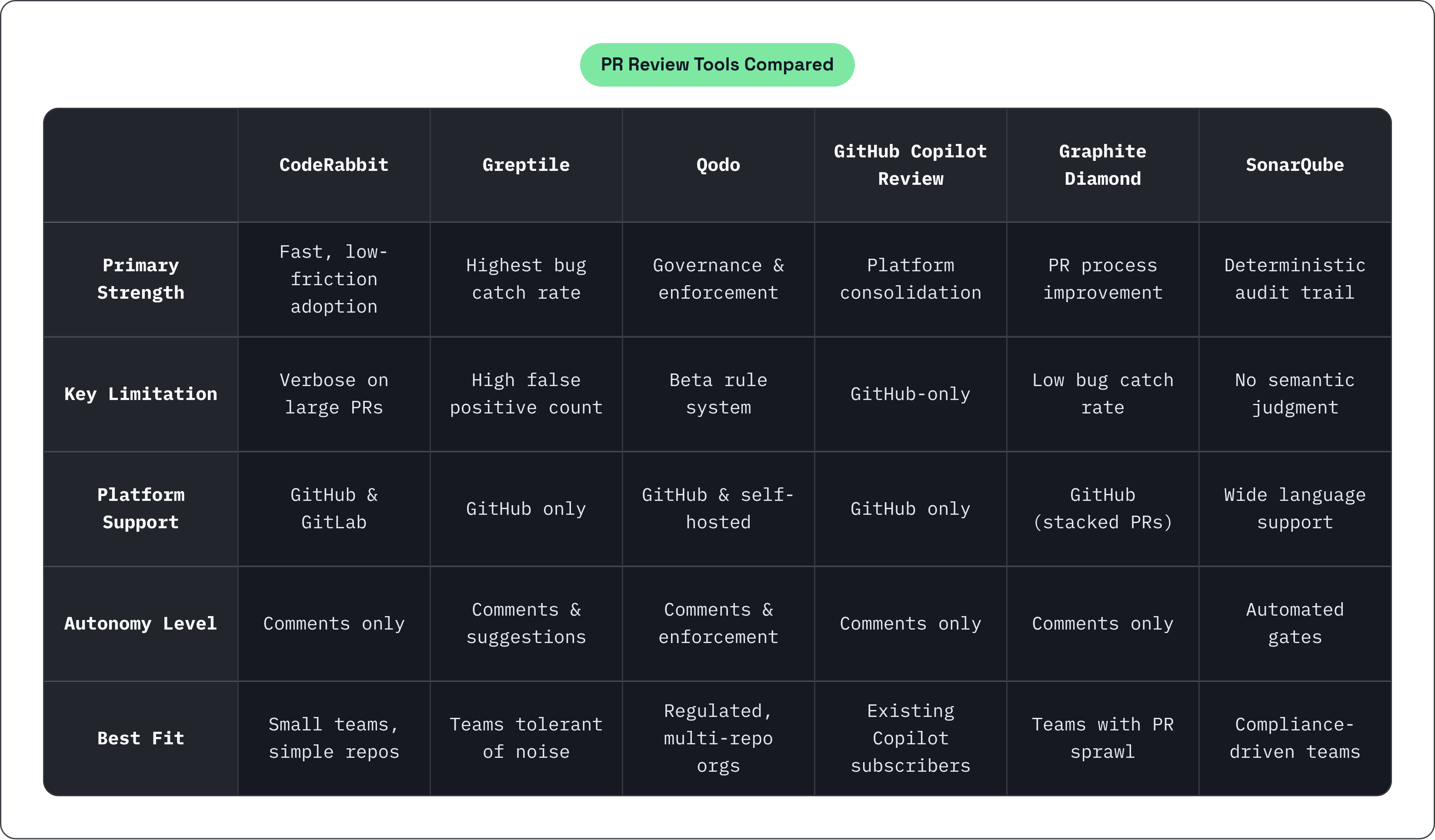
Line the five dimensions up and a pattern falls out pretty naturally.
- Want the highest raw bug catch rate and you're on GitHub? Greptile, if you can absorb the false positive load.
- Need consistent governance and enforcement across many repos, especially in a regulated industry? Qodo, particularly for its Rule System and self-hosting option.
- Already paying for GitHub Copilot and don't want another vendor? GitHub Copilot Code Review gets you integrated review at no marginal cost.
- Your real problem is PR size and reviewer fatigue, not missed bugs? Graphite Diamond addresses the structural cause.
- Need an auditable, deterministic quality gate for compliance? SonarQube, layered alongside whichever AI reviewer you pick, not instead of it.
- Want the easiest, cheapest entry point for straightforward codebases? CodeRabbit still does that job well, as long as your PRs stay a manageable size.
- Bottleneck is what happens after the comment gets posted, not the comment itself? That's the case for looking at agentic review tools that can act on findings, not just flag them.
None of these are wrong choices. They're different bets on which trade-off your team can live with: noise versus catch rate, breadth of platform support versus depth of analysis, comment-only safety versus autonomous action. The tools aren't converging toward one obvious winner, and given how differently teams are shaped, they probably shouldn't.