Coding Agents for Enterprise Engineering Teams
Coding agents accelerate existing problems unless your codebase and workflows are already sound.
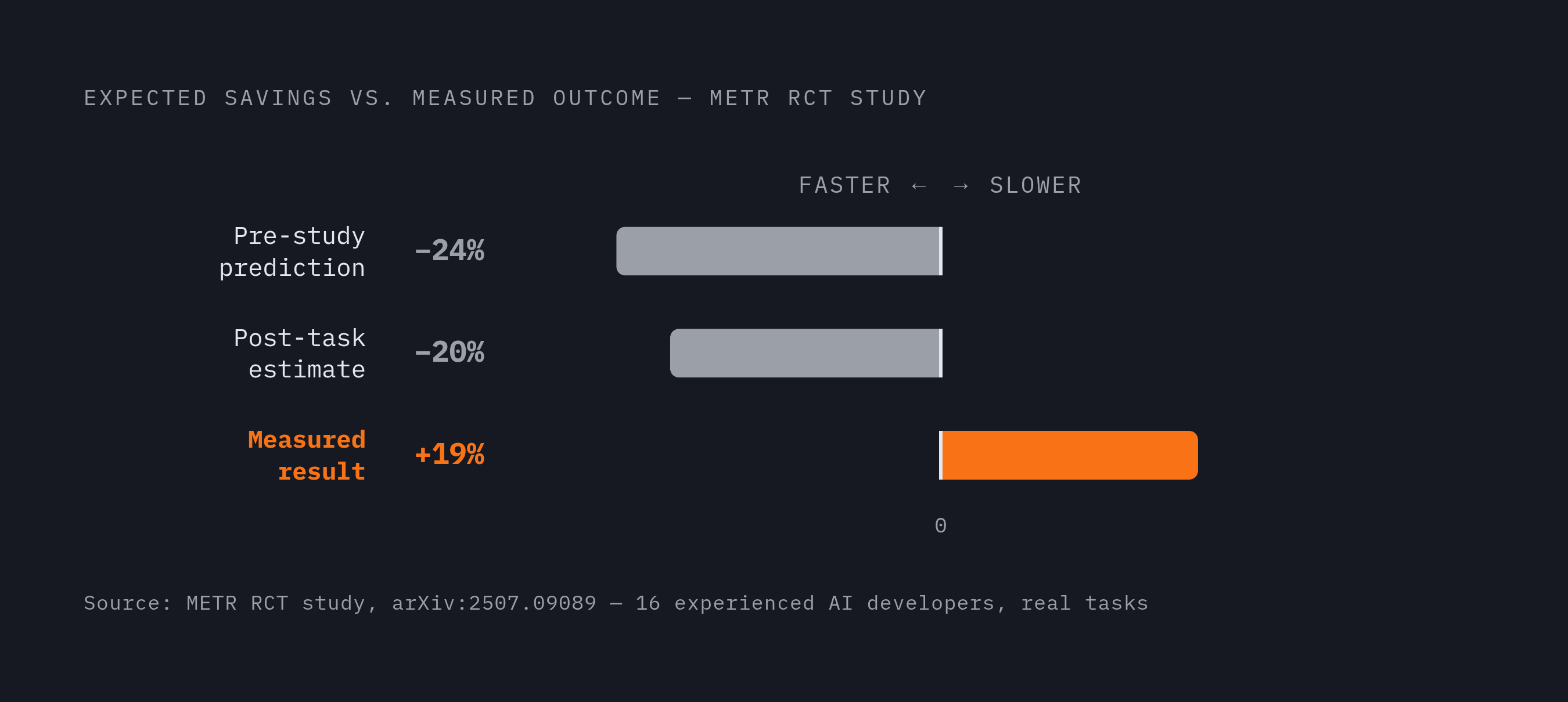
A rigorous randomized controlled trial published in July 2025 (arXiv:2507.09089) handed experienced open-source developers tools like Cursor Pro and Claude 3.5/3.7 Sonnet, then timed them across 246 real tasks. Task completion time went up by 19%. Not down, but up.
Take a moment to sit with that.
Before the study, those same developers predicted AI would cut their time by 24%. After finishing the tasks and experiencing the slowdown firsthand, they estimated they had saved 20%. Both guesses pointed in exactly the wrong direction — like a compass that points confidently south and calls it north.
So how do you reconcile that with the other numbers floating around? Daily AI users merge around 60% more pull requests than light users. Median PR cycle times dropped from 16.7 hours to 12.7 hours at high-adoption organizations. AI investments returned an average of $3.70 per dollar spent in 2025. Those are real numbers from real organizations, not vendor case studies.
Here is the thing: both sets of numbers are probably right. The difference between them is structural.
One analysis of over 120,000 developers found that even as AI-authored code crossed 26.9% of all production code, aggregate productivity gains haven't moved past 10%. Meanwhile, a separate look at enterprise deployments found that organizations with clean codebases and well-structured workflows saw incident rates fall dramatically, while poorly structured ones saw incidents roughly double. Same tool, wildly different outcomes.
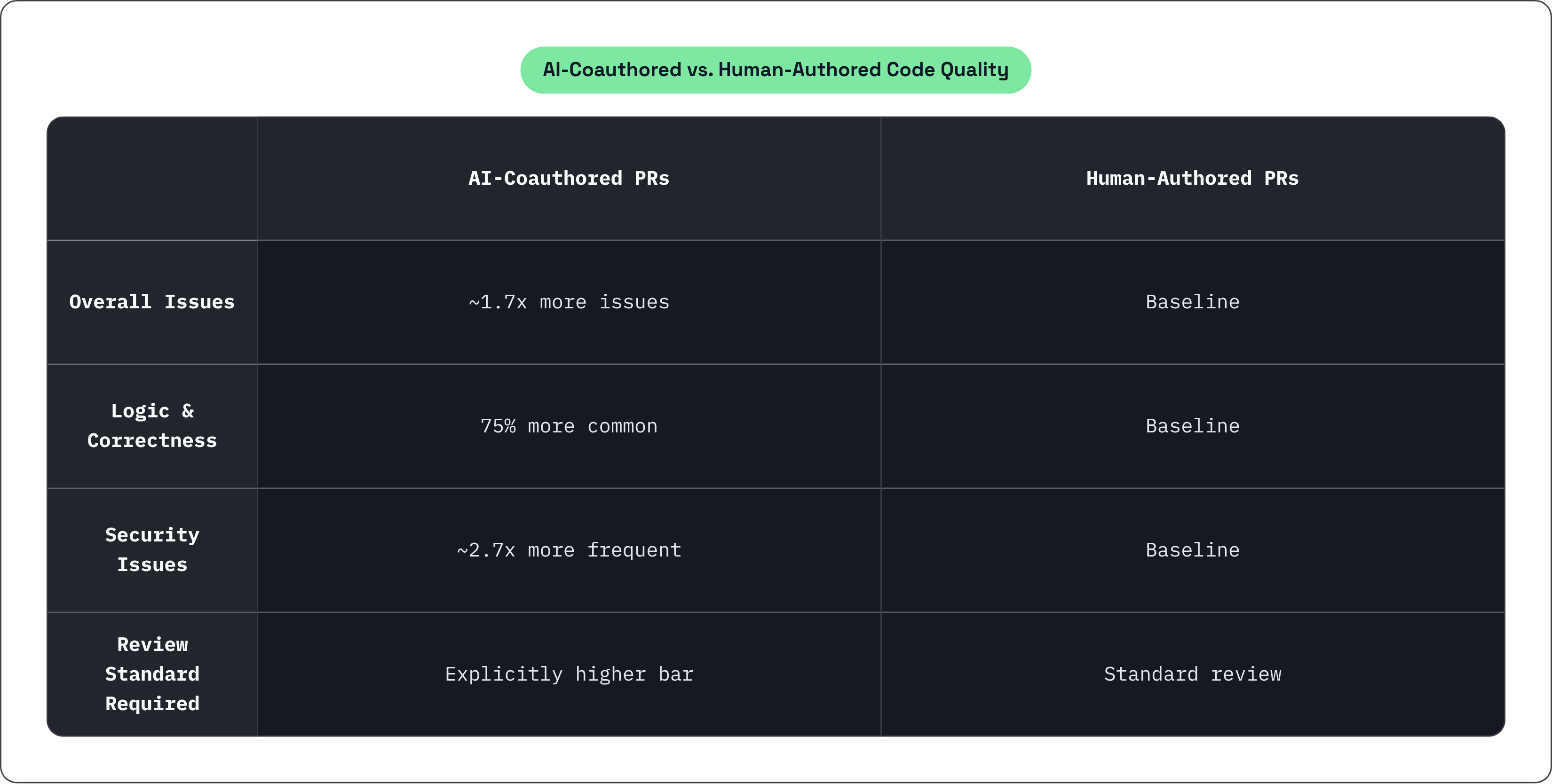
A December 2025 code review analysis adds one more piece: AI-coauthored pull requests showed about 1.7 times more issues overall, with logic and correctness problems running 75% more common and security issues appearing at nearly 2.7 times the rate of human-authored code.
The tool is not the variable. The workflow, the codebase health, and the governance around AI use are the variables. If your organization is fragmented or running on technical debt, deploying coding agents will not fix that — it will accelerate it.
What agentic coding actually means in a production engineering context
There is a version of this conversation that treats AI coding tools like a better autocomplete. Faster tab completion, smarter suggestions, a junior developer who never sleeps. That framing is outdated, and if your adoption strategy is built on it, you are already behind.
Modern coding agents do not complete lines. They understand repositories. They make coordinated changes across multiple files, run your tests, read the output, and iterate. That is a categorically different thing from what these tools were doing two years ago.
Three shifts drove that transition fast.
First, agents now operate in plan-act-observe-revise loops instead of generating a single response and waiting. They try something, see what broke, adjust, try again. Second, they are grounded in actual repository structure: symbol graphs, embeddings, structural parsers. This reduces hallucination and makes refactoring meaningfully safer. Third, the surfaces agents can act on have expanded. IDEs, CI/CD pipelines, external services. These are first-class integration points now, not bolt-ons.
The benchmark numbers show how fast capability has moved. On SWE-bench Verified, a standard test for real-world software engineering tasks, state-of-the-art systems went from under 2% in late 2023 to roughly 78% by spring 2026. That is not a gradual improvement — that is a cliff.
Multi-agent architectures are now a practical reality too. A lead agent breaks a problem down, delegates subtasks to parallel sub-agents running concurrently, then merges results. And increasingly, agents run in the background: a developer assigns a task, goes on to other work, and comes back to a pull request waiting for review.
Stop and think about what that means operationally. Your team is no longer just writing code and reviewing each other's code. It is managing a system that writes code, submits it for review, and expects your engineers to evaluate it at volume. Your review process, your CI/CD pipeline, your incident tracking — all of it needs to be designed with that model in mind, not adapted to it after the fact.
How to structure an evaluation process before committing at scale
Most enterprise AI evaluations are theater. Somebody runs a vendor demo, a few engineers try it on a greenfield project, people say it feels productive, and a purchase decision gets made. The METR RCT study reveals exactly why that fails. The slowdowns they found appeared specifically among experienced developers working on mature, five-year-old codebases. Not toy problems, not new projects, but the kind of code your team actually maintains.
If you are evaluating AI coding agents, you need to test them on your repositories. Not someone else's benchmark, not a demo environment. Your actual code, your actual complexity, your actual debt.
SWE-bench Verified and the newer SWE-bench Pro (1,865 problems drawn from 41 actively maintained repositories) are better proxies for production complexity than older benchmarks that frontier models have largely saturated. They are useful calibration tools, but they are starting points for understanding model capability, not substitutes for testing on your own codebase.
There is also a common trap in model selection worth calling out. The gap between the best and worst frontier models on real-world coding tasks is under 8%. If your evaluation energy is going toward picking the "best" model, you are probably optimizing the wrong variable. Fit to your specific task distribution matters more than leaderboard position.
What should you actually measure in a pilot?
- PR cycle time before and after, segmented by daily versus occasional AI users
- Issue rate in AI-coauthored PRs compared to your baseline (the December 2025 security and logic figures are a useful internal benchmark to beat)
- Developer time saved on specific task categories, not just a global estimate
- Incident rate, tracked from day one, because the variance across organizations is wide enough that you need a baseline before something goes sideways
On pilot design: the cleanest signal comes from randomly assigning tasks to AI-allowed and AI-disallowed conditions within your cohort. More work to set up, but it is the only way to get signal you can actually trust versus "people who chose to use AI feel good about using AI."
One leading indicator worth watching: the time it takes a new engineer to merge their first ten pull requests. At high-adoption organizations, that metric has been cut roughly in half over two years. It is measurable, it is meaningful, and it gives skeptical stakeholders something concrete to point to.
Matching models to task types across an engineering organization
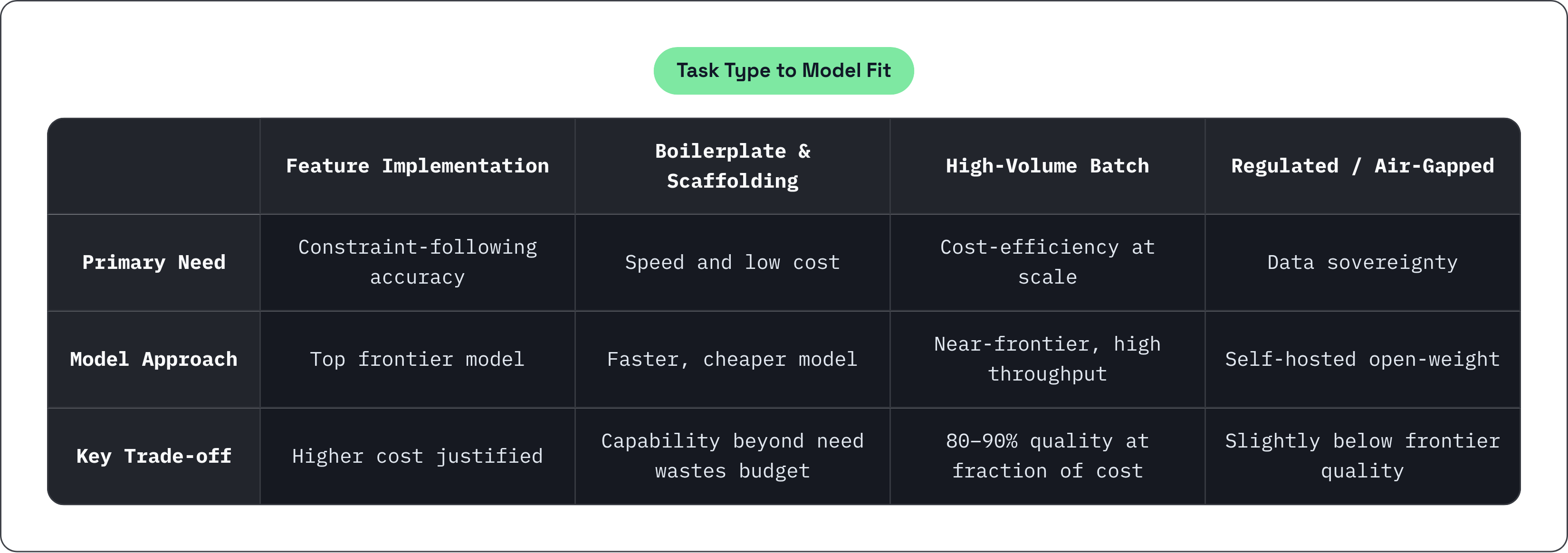
There is no best model for your engineering organization. There is a best model for each type of task. The way these systems are actually deployed in 2026 routes different requests to different models depending on what the task needs: complexity, latency, cost, context. A single enterprise-wide model choice is both wasteful and suboptimal.
So what does task-to-model routing look like in practice?
For feature implementation from a detailed spec, you want a model that tops real-world coding benchmarks. As of mid-2026, that means models in the 88% range on SWE-bench Verified. These are your careful constraint-followers, best at translating specs into correct implementations.
For boilerplate, scaffolding, and CRUD generation, reasoning depth is not what you are paying for. Faster, cheaper models get you what you need without burning budget on capabilities you are not using.
For high-volume batch workflows, the cost math is decisive. You can get 80 to 90% of frontier quality at a fraction of the cost and several times the speed. That is the right trade-off when you are running thousands of tasks.
For regulated or air-gapped environments where you cannot route proprietary code through an external API, the open-weight model landscape has matured. The strongest self-hosted options now score above 77% on SWE-bench Verified, which was unthinkable two years ago.
One honest caveat: frontier models have been trading the top spot on coding benchmarks on an almost weekly cadence. Any standardization decision needs a quarterly review built into it. The model you locked in six months ago may not be the right call today. That is just the environment, and your process needs to account for it.
Worth keeping in mind also: in production, the scaffolding around the model often matters more than the model itself. How the tool structures context, manages tool calls, handles loop iteration — a well-built scaffold with a slightly weaker model will outperform a poorly built scaffold with the strongest model available.
Which tool architectures fit which engineering environments
In 2026, there are three dominant approaches to how coding agents get integrated into engineering work.
The first is terminal-native. These tools live in the filesystem, run shell commands, read and edit files, run tests, and iterate. They suit teams comfortable with command-line workflows who want tight integration with their CI/CD setup. The trade-off is a steeper learning curve for engineers who live in a GUI.
The second is IDE replacement. Think of a VS Code fork with AI built in as a core primitive rather than bolted on. Deep repository awareness, multi-file changes through natural language, the familiar VS Code experience but with more agent depth than an extension provides. Cursor is the most prominent example.
The third is IDE augmentation. This integrates into whatever editors your team already uses without replacing them. Lower switching cost, broader language support, easier rollout. The right choice when minimizing workflow disruption is a higher priority than maximizing agent capability. GitHub Copilot fits this pattern.
But which architecture creates the right security boundary for your organization? Terminal-native tools with filesystem access create fundamentally different security considerations than IDE extensions. An agent that can run shell commands and edit any file it can reach needs explicit scope limits before it touches production-adjacent repositories. Define this before rollout, not after something goes wrong.
MCP (Model Context Protocol) servers have made agents extensible in powerful ways. An agent can now connect to databases, cloud providers, monitoring tools, and documentation platforms. An MCP client connecting to any of these needs a valid certificate and explicit trust boundaries. Each new connection is a capability gain and a new attack surface, so treat them accordingly.
One thing that holds up consistently across adoption data: agents that operate inside existing workflows see higher adoption than tools requiring context-switching into a separate environment. If engineers have to leave where they already work to use the agent, many simply won't.
Governance, security, and code quality controls that scale with agent adoption
Enterprises are reporting tens of thousands of new security findings per month attributed to AI-generated code. That is not a reason to halt adoption. It is a reason to treat governance as a prerequisite rather than something you add after the rollout.
The December 2025 code review data is worth keeping on your dashboard. Logic and correctness issues running 75% more common in AI-coauthored PRs, security issues at nearly 2.7 times the rate. The review bar for AI-authored code must be explicitly higher than for human-authored code — not assumed equivalent, but explicitly higher.
What controls should exist before you roll out broadly?
- Static analysis and SAST integrated into CI/CD on every AI-authored PR. Not periodic scans, but every PR.
- PR labeling that identifies AI authorship so reviewers know to apply appropriate scrutiny without slowing the entire queue.
- Secret scanning and dependency vulnerability checks automated at merge time.
- Defined scope limits on what agents can access: which repositories, which branches, which external services. Written down and enforced before the first incident, not after.
The autonomy question deserves real thought. Agents can be configured anywhere from targeted single-file edits to full end-to-end autonomous execution. A blanket policy of either "maximum autonomy everywhere" or "minimum autonomy everywhere" will either create risk or kill value. Treat it as a dial, not a switch.
Project-level instruction files are underused and effective. When you encode your team's standards directly into agent behavior, you get safer output without relying entirely on post-hoc review. The review still matters, but catching problems upstream is cheaper.
Track incidents from day one. Organizations that see incident rate increases after AI adoption are identifiable early if tracking is in place from the start. Set it up retroactively, and you have no baseline and no story.
Rolling out to a team: sequencing that avoids the adoption traps
The most consistent finding across all the research is this: AI amplifies organizational health. Teams with clear processes and clean codebases see force-multiplier effects. Teams with fragmented workflows and accumulated debt see their existing problems surface faster and louder.
So the first question before any rollout is not "which tool should we choose?" It is "are we in a state where amplification helps us or hurts us?" Assess your codebase and workflow hygiene before rollout, not after results disappoint.
If the assessment says you are ready, here is sequencing that actually works.
Start with a cohort of senior engineers. Not because junior engineers cannot use the tools, but because senior engineers can calibrate what good agent output looks like. They can define the review norms and identify where agents are wrong in ways that are subtle and consequential. You need that judgment in place before you scale.
Instrument the pilot fully before expanding. PR cycle time, issue rate, incident rate, developer time-on-task for specific categories. No baseline means no claim.
Expand by use case, not by headcount. Demonstrate agent value on a specific task type before enabling full autonomous workflows. Test generation, documentation, boilerplate — these are high-value, lower-risk proving grounds that also give skeptical stakeholders a concrete, attributable win.
Only enable background agents organization-wide after your review norms and CI/CD controls are established. Async agents submitting PRs at volume is a different operational challenge than individual developers using a coding assistant. Do not conflate the two.
On the change management side: roughly half of professional developers report using AI daily, but adoption within a single organization is rarely uniform. The gap in output between daily users and light users is large enough to create a compounding team-level disadvantage if left unaddressed. Find the non-adopters, understand why they are avoiding the tools, and address it directly.
How to measure outcomes at scale once agents are in production
Most organizations measure AI adoption. Licenses activated, features used, seats claimed. That is the wrong thing to optimize.
Adoption rate is a leading indicator. It tells you the tool is in use, but it does not tell you whether engineering performance is actually improving.
What does?
PR cycle time, tracked as a median rather than a mean. The distribution matters here. A few very long cycles can distort the average in ways that hide what is actually happening. High-adoption organizations moved from a median of 16.7 hours to 12.7 hours. That is your target range.
PRs merged per engineer per week. At high AI adoption, this runs at roughly double the rate of organizations at near-zero adoption. If your numbers are not moving in that direction, something in the workflow is failing.
Issue rate in AI-coauthored PRs versus human-authored. If your AI-coauthored PRs are generating issues at significantly higher rates than your baseline, your review process is not catching what it needs to catch. If the rates are converging, your governance controls are working.
And incident rate. This is the number that tells you whether the productivity gains are real or whether you are just moving problems downstream. The variance in outcomes across organizations is wide enough that you cannot assume you are on the right side of it.
Developer sentiment matters, but it is not the same as performance data. The METR study showed developers felt faster even when they were slower — a case where the map and the territory could not have been further apart. Self-reported productivity is a poor substitute for measured outcomes. Track both and trust the measurement.
The organizations seeing the strongest returns from coding agents are not the ones that deployed fastest or picked the best model. They are the ones that built measurement infrastructure first, ran honest pilots, and treated governance as a feature rather than a friction point. That is a slower path than just flipping the tools on, but it also tends to be the one that actually works.