Parallel Agent Execution in Large Codebases
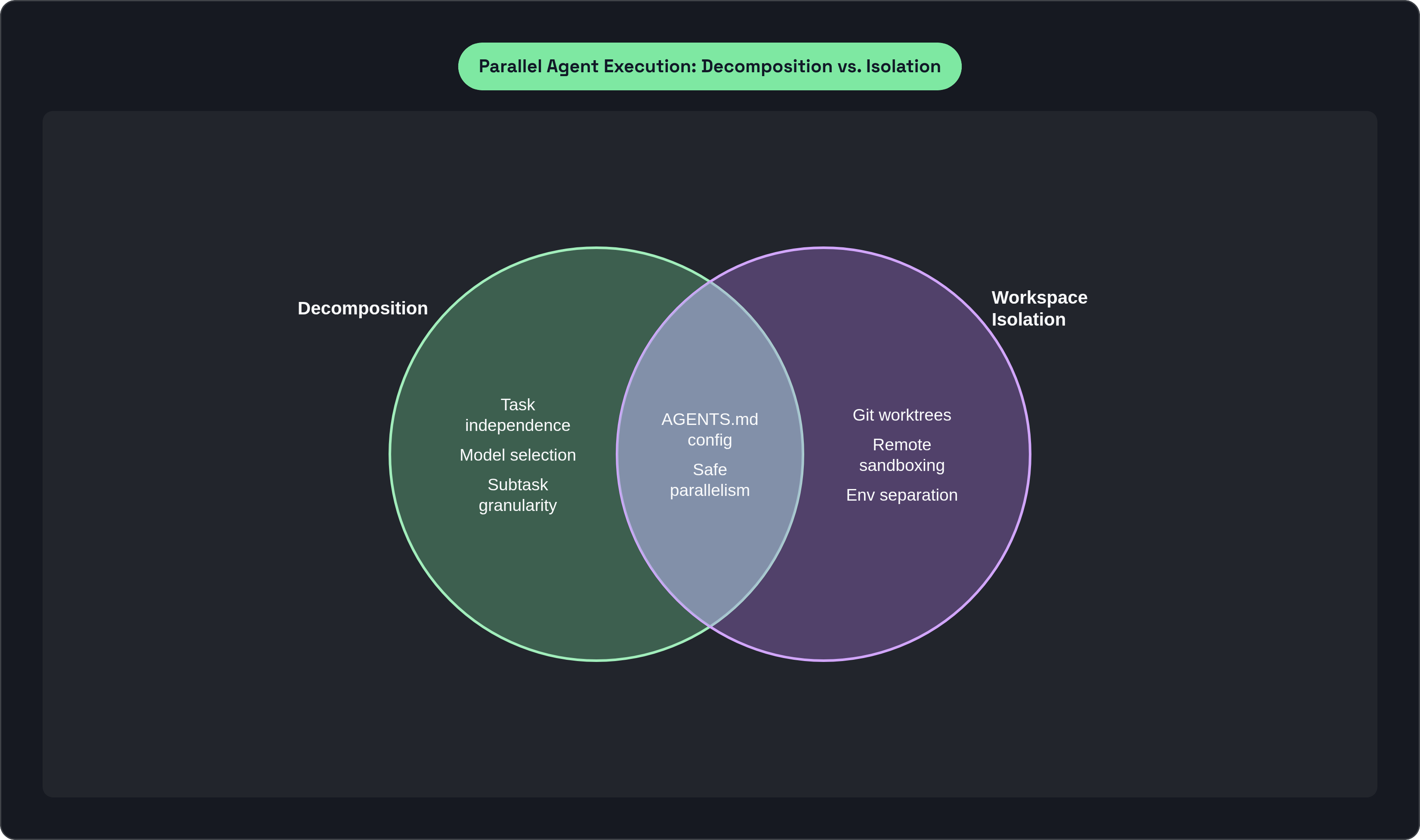
Successful parallel agents require up-front task decomposition, not isolation alone.
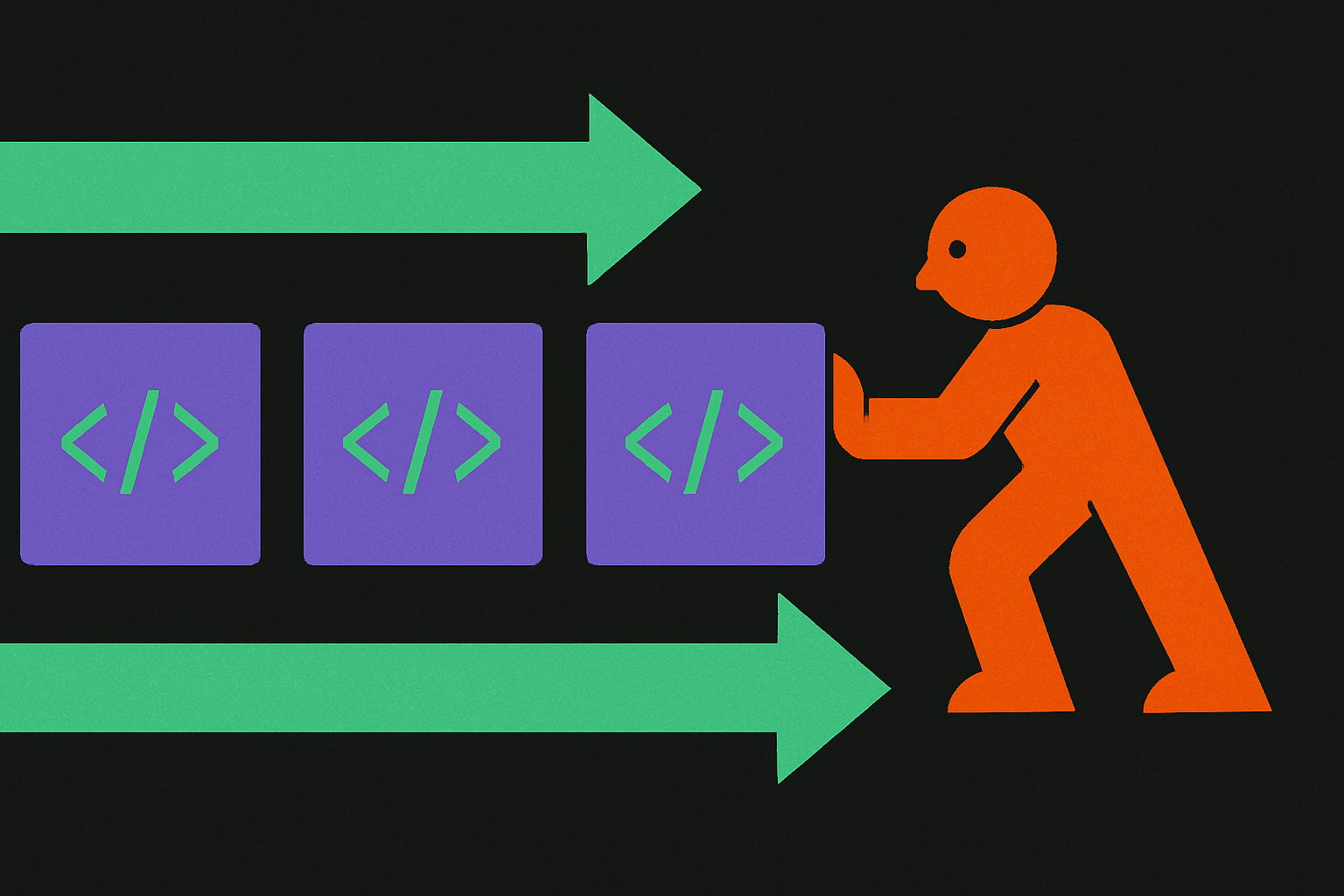
Decomposition is the prerequisite, not an afterthought, not something you patch with better tooling later. If you hand agents poorly scoped tasks, they will produce overlapping, contradictory, or incomplete output regardless of how well you've isolated their environments.
The question you have to answer before launching anything: which subtasks are independent? Not "roughly independent." Independent, meaning an agent completing one task does not need to know what another agent is currently deciding.
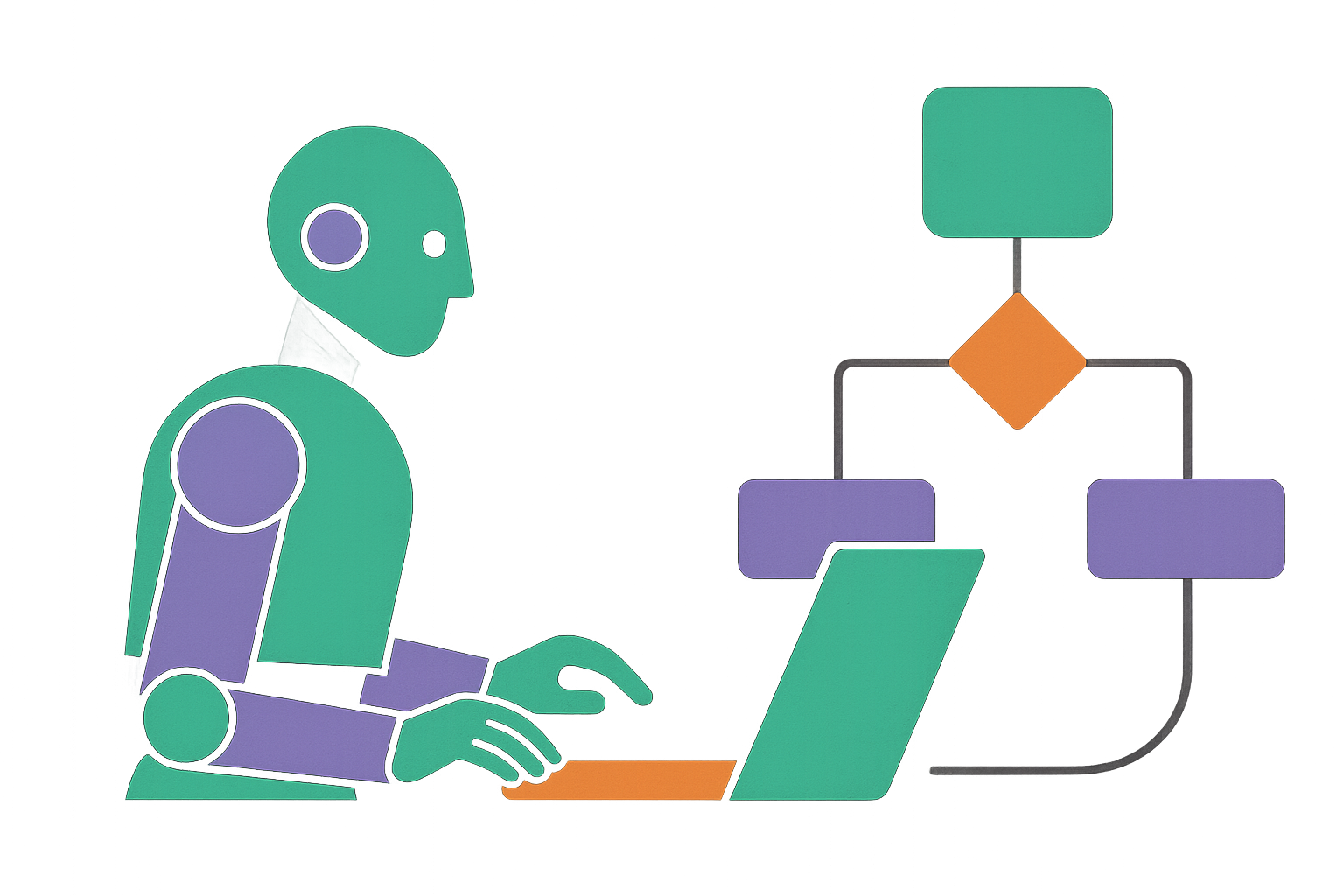
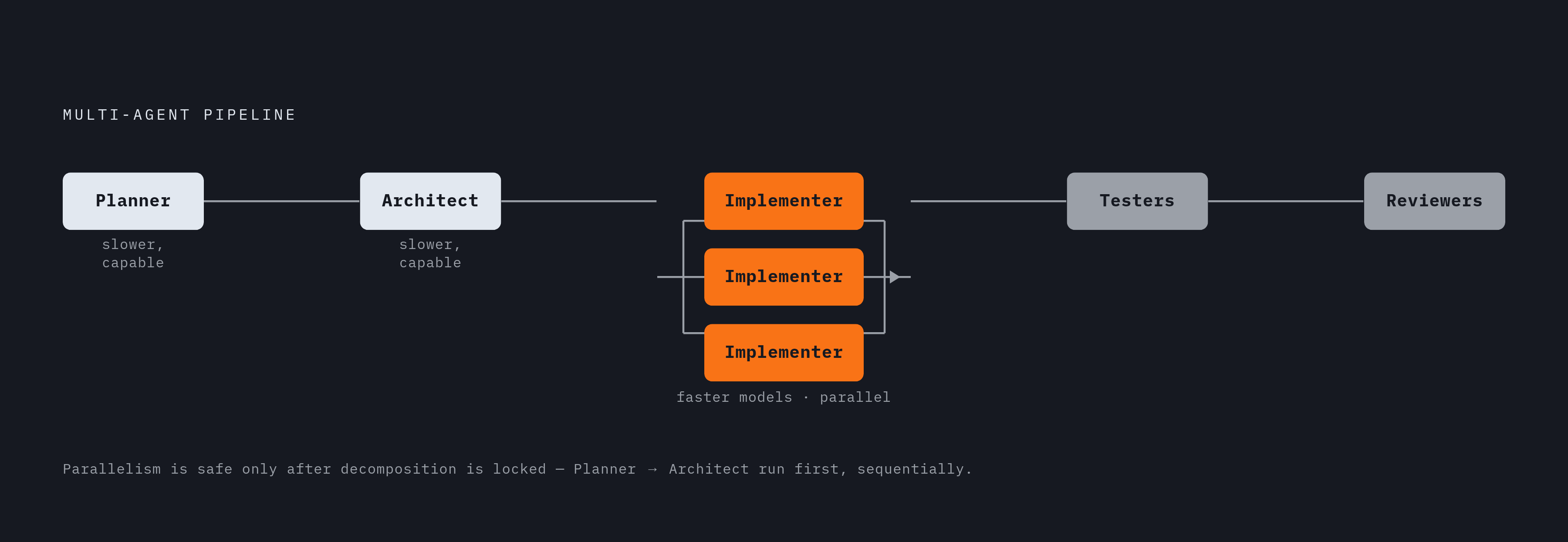
A pipeline that teams have actually used in practice looks like this: Planner, then Architect, then Implementers running in parallel, then Testers, then Reviewers. The planning and architecture phases exist specifically to identify which work can safely parallelize and which work must sequence. That sequencing decision is the whole game. Dependent tasks that get parallelized don't announce themselves with a merge conflict right away. They produce code that compiles, passes local tests, and then fails in integration — like a time bomb hidden inside a green checkmark. That's a much harder problem to debug, and frankly, a more demoralizing one.
There's also a model-selection dimension here that trips up a lot of teams. More capable, slower models belong in the planning and architecture phases, because decomposition quality determines everything downstream. Faster models can handle implementation once the scope is clear. Using your most capable model to write a single function is an expensive mistake. Using a cheaper model to do your decomposition is a worse one.
Granularity is the other variable most teams get wrong on the first try. Too coarse, and agents will touch shared files and produce merge conflicts. You've just created a distributed editing problem. Too fine, and coordination overhead eats the parallelism benefit entirely. You're paying the setup cost without capturing the gain. Right-sized means a subtask an agent can complete with minimal cross-agent communication, roughly a module, a feature boundary, or a single interface contract.
What does an agent actually need at the start of a task to operate cleanly? Three things, and all three matter:
- Explicit scope. Which files, modules, or interfaces are in play.
- Explicit constraints. What must not change.
- Interface contracts. What the subtask's output must look like for downstream agents or tests to consume it.
Without those inputs, an agent is making assumptions. In a parallel run, assumptions made by different agents compound into incompatibilities fast.
Anthropic's public demo of 16 agents parallelizing work on a Rust compiler that compiles the Linux kernel is worth studying here. The impressive part wasn't the agent count. It was the decomposition investment that made that agent count viable. The coordination happened before the agents ran, not during.
Workspace isolation: how git worktrees prevent agents from colliding
Even well-decomposed tasks will collide if agents share a filesystem. Two agents writing to the same working tree produce race conditions, overwritten edits, and state that's hard to reason about after the fact.
The solution that's become standard is git worktrees. A git worktree gives each agent its own checkout of the repository. Separate working directory, same underlying git object store. Agents work simultaneously without file conflicts. Merging happens explicitly, through a pull request or integration step, not accidentally through concurrent writes to the same file.
Some implementations take isolation further by running agents on separate remote machines rather than separate directories on one machine. The isolation is stronger: separate processes, separate environments, separate dependency state. The tradeoff is resource cost. Remote sandboxing makes sense for long-running tasks or tasks where environment state matters. Anthropic has documented running multiple sessions this way, some local via separate checkouts, some on cloud instances, depending on task characteristics.
But here's what isolation does and doesn't solve, and this distinction is worth sitting with.
Isolation handles simultaneous file writes, dependency version conflicts within a session, and environment bleed between agents. What it doesn't handle is logical conflicts. Two agents making architecturally incompatible decisions in separate branches still produce a merge problem. Isolation just means you discover that problem at integration time instead of mid-execution. Which, depending on how far along you are, can feel like stepping on a rake in slow motion.
This is why isolation is a prerequisite for safe parallelism, not a substitute for good decomposition. Teams that set up worktrees and then skip the decomposition work find this out the hard way, usually around the third integration attempt.
One configuration detail that matters more than it looks: project-level instruction files. Whether you call them AGENTS.md,.cursorrules equivalents, or something internal to your tooling, these files scope each agent's behavior from the start. Without consistent configuration, isolated agents can still make divergent assumptions about conventions, style, or interfaces. Same codebase, different mental models, and the merge conflict is just delayed.
Orchestration patterns that coordinate what agents do without creating bottlenecks
The orchestrator's job is straightforward to describe and difficult to implement well. Assign tasks to agents, track completion, route outputs to downstream agents or review. The failure mode that kills the parallelism benefit is an orchestrator that becomes a synchronous bottleneck. If every agent has to wait for the orchestrator to process its output before the next agent can start, you've rebuilt sequential execution with more moving parts and a larger infrastructure bill.
The design principle that actually works: agents coordinate through shared state and explicit outputs, not through conversation with each other. Steve Yegge has documented one real-world implementation of this, an orchestrator running 20 to 30 parallel agents, paired with a shared memory and issue-tracking system that agents can read and write without requiring direct agent-to-agent communication. The agents don't talk to each other. They talk to the shared state layer. The orchestrator manages task assignment and completion tracking. Human decisions, scope changes, and unresolvable conflicts get surfaced explicitly rather than silently resolved.
That last part matters more than people initially expect. An orchestrator that silently resolves conflicts is making architectural decisions on your behalf. Sometimes that's fine. Sometimes it produces code that compiles and ships and creates a production incident six weeks later, and you spend two days figuring out why the system is behaving the way it is.
One pattern worth separating out: the Writer/Reviewer split. One agent writes. A separate agent reviews, with context cleared between them. The reviewing agent can't inherit the writer's blind spots because it doesn't have access to the writer's reasoning process, only the output. This scales into a pipeline: Implementer, then Tester, then Reviewer as distinct agents rather than one agent switching roles. Each handoff is an opportunity to catch what the previous agent missed.
Research on trainable orchestrators is worth watching. One documented approach uses an orchestrator that spawns specialist subagents and runs heterogeneous subtasks concurrently. The results suggest that orchestration strategy, not just model capability, drives throughput and quality. A well-orchestrated group of moderately capable agents can outperform a collection of highly capable agents working without coordination. Which, if you've ever been on a well-run team with average talent versus a poorly run team with exceptional talent, probably doesn't surprise you. Think of it this way: a symphony played by a coordinated ensemble of decent musicians will sound better than the same instruments played simultaneously by virtuosos who've never rehearsed together.
Background and scheduled agents represent a distinct orchestration mode worth naming separately. Agents running documentation updates, issue triage, CI/CD follow-up, or deployment workflows on a schedule aren't triggered by a developer prompt. They're running when no one is watching. That changes the risk profile entirely and requires the most explicit scoping and guardrails of any parallel agent configuration.
How agents build a working understanding of a large codebase without overwhelming context
Large codebases don't fit in any single context window. An agent cannot be handed your entire repository and asked to understand it. Stuffing everything available into context degrades reasoning quality and increases cost without improving output. Most teams learn this after one expensive, confusing run.
The pattern that actually works looks less like database retrieval and more like what a new developer does in their first week. They read entry points. They follow imports. They look at tests to understand expected behavior. They examine interface definitions to understand contracts. They build a working model incrementally, through active investigation, not passive absorption.
What agents use to navigate effectively:
- File structure and module boundaries as a map of the codebase's intentions
- Test files as implicit specifications for how things are supposed to work
- Interface definitions and type signatures as contracts between components
- Commit history and PR descriptions as rationale for why things are the way they are
In multi-agent setups, this exploration problem has a coordination dimension. If five agents are independently trying to understand the same codebase, they're doing redundant work and potentially reaching different conclusions. A shared memory layer addresses this. Agents record their findings. Other agents read from the shared layer instead of re-exploring. It's the AI equivalent of shared documentation, and it prevents both redundant work and divergent understanding across parallel agents.
That raises a practical question for anyone setting up parallel runs: what can you provide upfront to reduce exploration overhead? Architecture docs, module maps, and key interface documentation let agents skip the early exploration phase. AGENTS.md-style configuration files aren't just style guides. They substitute for codebase knowledge agents would otherwise have to discover, which means they directly reduce the time before an agent is doing something useful rather than just orienting itself.
What oversight actually looks like across concurrent autonomous threads
Single-agent work has a natural rhythm for oversight. One output at a time, one decision point at a time, you can review as you go. Parallel agents break that rhythm completely. Multiple branches producing simultaneous outputs means a developer cannot review all of them in real time without the review cost eliminating the parallelism benefit. You end up back where you started, just more tired.
This isn't hypothetical. A 2026 AI engineering report covering tens of thousands of developers found that significantly more code is reaching production with no review at all, and that bugs per developer and production incident rates have risen alongside increased AI code generation. Parallel agents producing more output faster amplify this problem if the oversight architecture doesn't scale with the agent count.
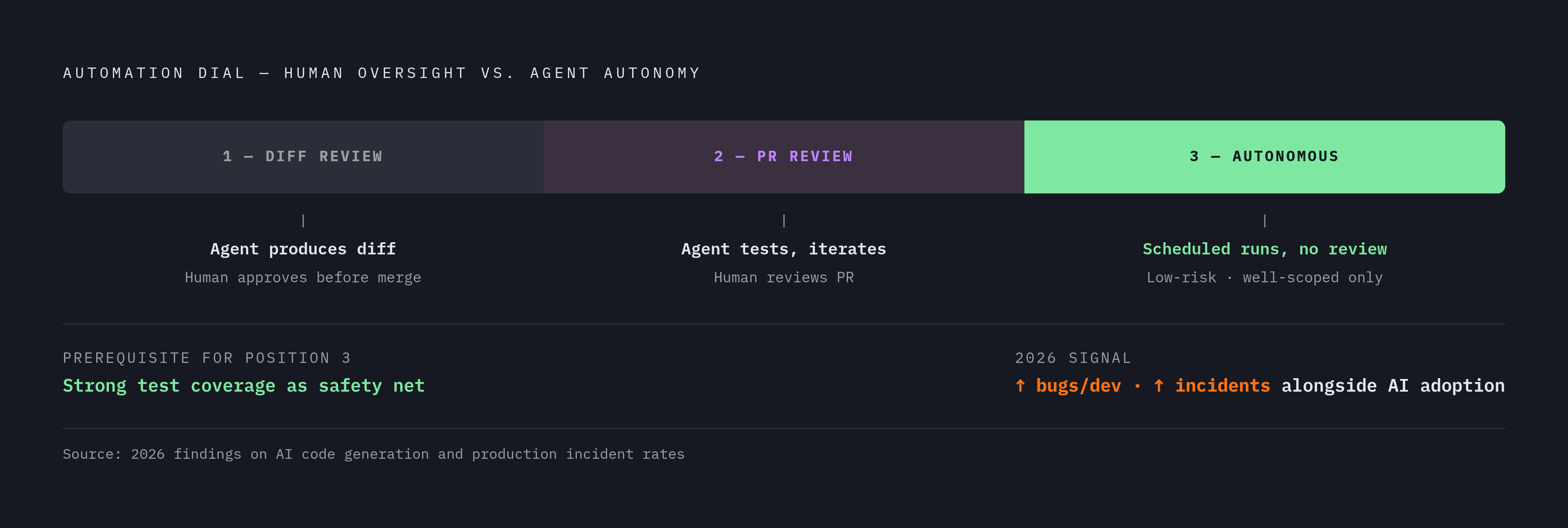
A more useful frame than "how much do we review" is thinking about an autonomy dial, not a binary choice between full oversight and full autonomy.
On one end: agents produce diffs for human review before any merge. Parallelism speeds generation. Humans still gate execution. On the other end: agents run tests, iterate on failures, and open pull requests. Humans review the PR, not every intermediate step. And then there are fully autonomous scheduled runs, which are appropriate only for low-risk, well-scoped tasks with strong test coverage acting as a safety net.
The appropriate level depends on task risk, codebase criticality, and team context. It's not a permanent setting. It's a decision you make per task type, and it should feel slightly uncomfortable every time you move it higher.
Practical oversight mechanisms that actually scale:
- Checkpoint approvals: agents surface for human decision when they hit scope boundaries, unexpected failures, or requests for broader system access.
- Test suites as automated reviewers: a passing test suite is the most scalable form of oversight for parallel implementation work. It doesn't replace judgment calls, but it catches a meaningful class of errors automatically.
- PR-level review: reviewing intent and structure at the pull request stage rather than watching every edit.
- Writer/Reviewer agent pattern: a first layer of automated review before the work reaches a human at all.
The quality risk is real. AI-generated code shows meaningfully higher rates of logic and correctness issues and significantly higher rates of security issues compared to human-written code. Parallel agents producing more output faster don't change those rates. They amplify the volume of output subject to them.
What oversight is not: watching every agent in real time, which negates the parallelism benefit, or delegating review entirely to another agent, which catches categories of issues but misses judgment calls entirely. The useful line to draw is this: humans should make decisions that require human judgment, and agents should handle decisions that have deterministic or testable answers.
Where parallel agent execution is mature enough to deploy and where it still breaks
Parallel agents work well today in a few specific contexts. Independent feature additions across separate modules, where the boundary between agents maps cleanly to the boundary between components. Parallel test generation across a codebase, which is close to fully parallelizable and benefits from multiple agents examining the same code from different angles. Documentation, issue triage, and CI/CD follow-up running as scheduled background agents. Refactoring with a stable interface contract, where agents can work on implementations independently because the interfaces aren't changing. And first-pass code review before human review, where the Writer/Reviewer pattern adds a quality layer without creating a bottleneck.
Where parallel execution still breaks: tasks requiring shared mutable state without clear ownership. Agents produce incompatible changes and you spend more time on integration than you saved on generation. Deeply interdependent systems where decomposition is difficult. Forcing parallel tasks on work that's actually sequential creates logical conflicts that take longer to resolve than sequential execution would have taken. And codebases with thin test coverage. Parallelism amplifies the production incident risk, because the automated oversight layer that makes higher-autonomy runs viable doesn't exist yet.
The verification overhead problem deserves honest acknowledgment. A rigorous 2025 randomized controlled trial found that experienced developers on complex tasks took longer with AI assistance than without it. The overhead of reviewing AI output exceeded the generation speedup. At scale, parallel agents multiply the review surface. Without better review tooling and automation, throughput gains get absorbed by verification costs. That's not a reason to avoid parallel agents. It's a reason to invest in the review infrastructure before you invest in the agent count.
The teams capturing gains from parallel agent execution share a few traits. They invested in decomposition before they invested in agent count. They built shared memory and state infrastructure so agents don't work from contradictory mental models. They calibrated autonomy levels to task risk rather than applying a single setting across all work. And they treated their test suite as a first-class oversight mechanism.
None of that is as exciting as "launch 30 agents and ship faster," but most things that actually work aren't.