Hybrid Deployment Models for AI Coding Tool Infrastructure
Engineering teams have stopped asking whether to bring AI coding agents into their workflows. The 2026 State of AI Agents Report backs this up directly: agents are already in production at most organizations, and what's holding teams back has nothing to do with whether the models are good enough. It's integration, security, and operational scale.
That shift exposes a problem with the two "obvious" deployment choices. Pure SaaS tools sound simple until a defense contractor, a hospital system, or a bank asks whether code can leave their environment at all. For a lot of those buyers, the answer has to be no, which rules out cloud-only tools before anyone even compares features. Fully self-hosted setups solve that problem but create a new one: someone now has to keep pace with frontier model releases, manage scaling infrastructure, and rebuild every integration a vendor would normally maintain.
Most organizations have already quietly rejected the idea that they need to pick one side. The 2026 State of AI Agents Report found that roughly half combine off-the-shelf agent tools with custom-built pieces, moving fast on the parts that don't matter competitively while keeping tight control over the parts that do. That's a recognition that the dominant infrastructure decision is no longer whether to adopt these tools but how to deploy them in a way that survives contact with enterprise security, integration, and scale requirements, not indecision.
AI coding agent infrastructure versus earlier enterprise software deployment
AI coding agents need persistent access to proprietary codebases, execute multi-step autonomous actions across production systems, and generate compounding security surface as they scale.
Consider what a single agent task actually touches. An agent assigned to fix a bug doesn't just edit one file. It navigates the codebase, writes the fix, runs tests, and submits a pull request, interacting with sensitive source code, the CI/CD pipeline, and internal APIs all in the same run. A traditional SaaS tool never asked for that kind of access. A project management dashboard doesn't need to execute code against a production database.
That level of access is exactly why enterprise buyers now show up to vendor evaluations with a specific checklist: SOC 2 Type II, SAML SSO, admin controls fine-grained enough to restrict what an agent can touch, zero-data-retention settings, logging of every file an agent opens, and execution inside sandboxes instead of shared infrastructure. Each item maps to a specific way an agent could otherwise leak or damage something.
Scale adds a second layer to the problem. Enterprise codebases don't live in one repository. They span dozens to hundreds of thousands of them, and an agent that can only see the file in front of it will miss the cross-service logic that makes an enterprise system work in the first place. Vendors have addressed this through retrieval methods that keep that cross-repository context inside the company's own perimeter: some index hundreds of thousands of files with selective retrieval, others pre-index entire repositories with vector embeddings and feed roughly 100,000 lines of related code into a single query. Either way, the context has to be there for the agent to function, and it can't leave the building to get it.
Research points at where this risk actually concentrates. It's not in code generation anymore. The bottleneck has shifted to review, integration, testing, security, and production operations, all of which need governance controls a pure SaaS product isn't built to hand a regulated buyer. That's the gap hybrid architecture exists to close.
How hybrid architecture distributes the layers of AI coding infrastructure
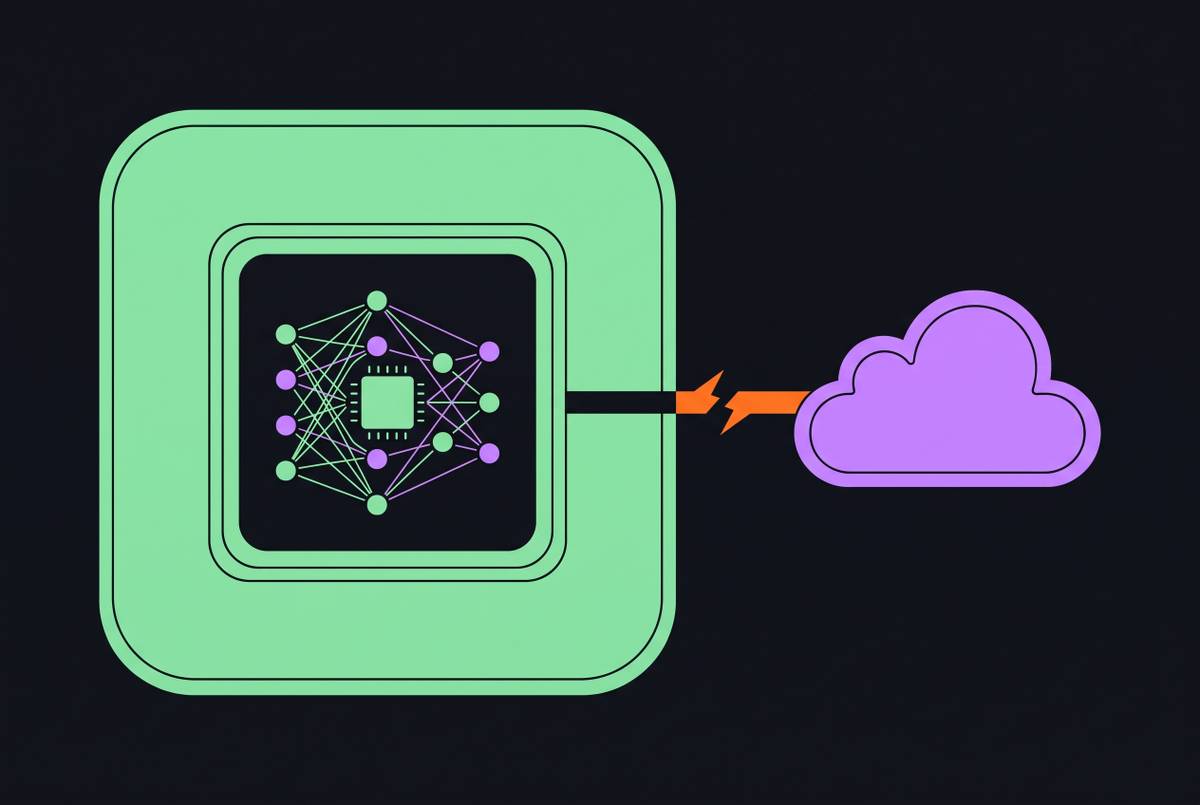
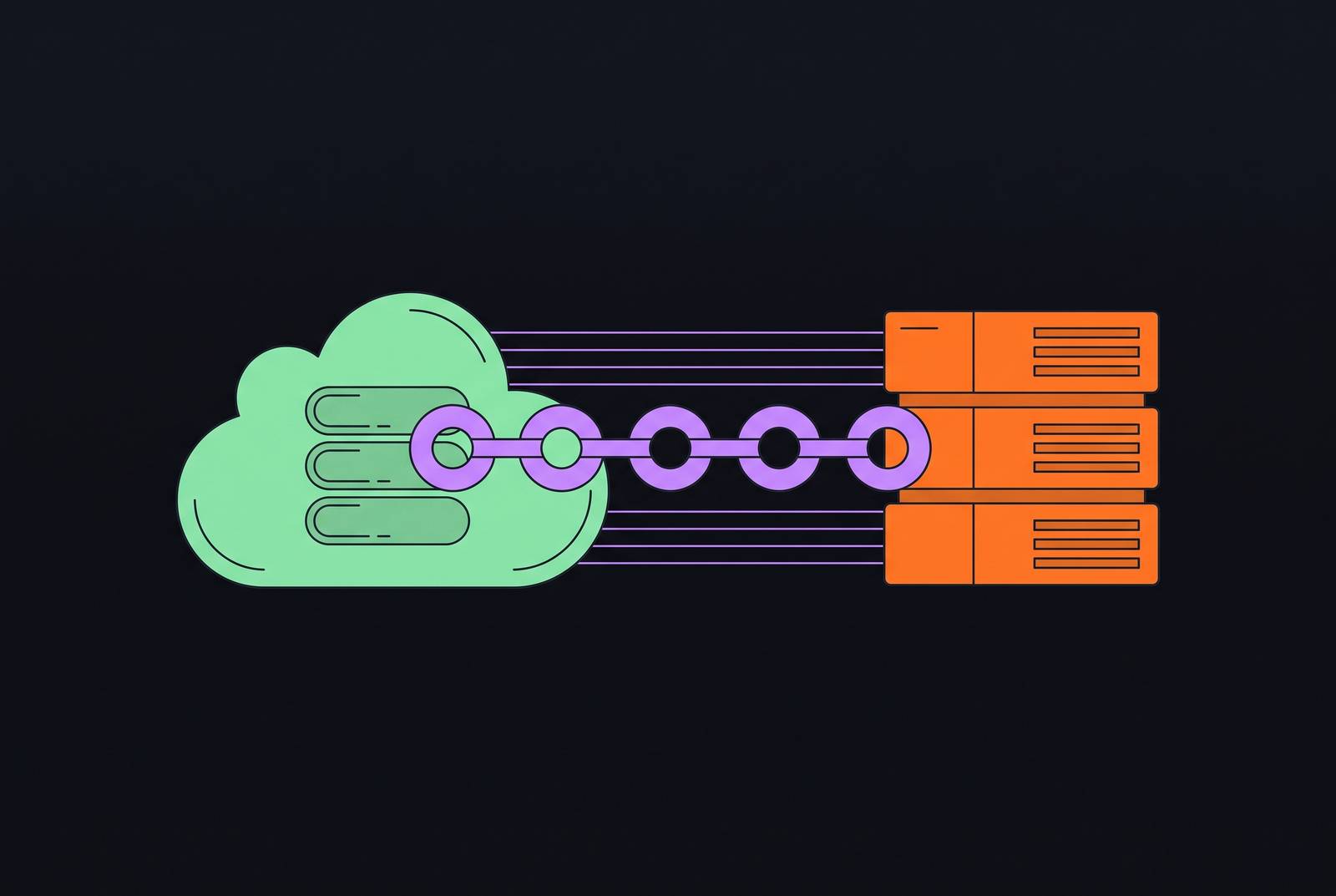
Hybrid is a deliberate split of responsibilities rather than one configuration a company buys off a shelf. It's a deliberate split of responsibilities, where the control plane, the model routing, and access to sensitive code get distributed across cloud and on-premise layers based on which layer is actually equipped to protect or serve each piece.
Picture a single task moving through the system. A developer posts in Slack asking an agent to fix a failing build. The orchestration layer picks that up and hands it to the agent, using a connector that treats Slack as a callable tool rather than granting the agent standing access to the whole workspace. The agent then needs code context, so it queries an internal retrieval system that pulls relevant files from across the company's repositories, all without that code ever leaving the company's own environment. Inference then gets routed, maybe to a model running inside the company's VPC for a routine fix, maybe to a cloud frontier model if the task calls for deeper reasoning. Once the fix is ready, the agent opens a pull request through a GitHub connector, and CI kicks off automatically. The commit never touched a foreign server without permission, but the agent moved fluidly across four separate systems to get the job done.
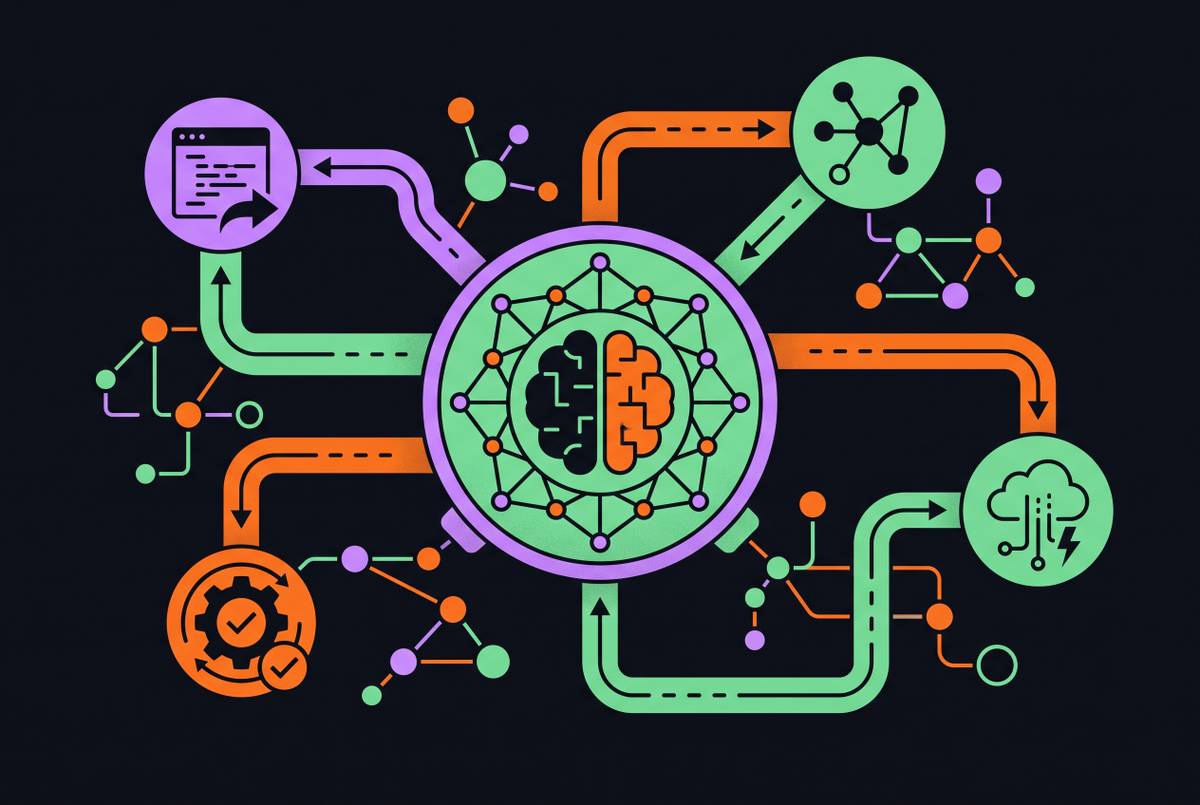
Three layers made that possible. The execution layer, where the agent actually touches code, runs tests, and triggers CI/CD, sits inside the enterprise's own VPC or on-prem environment, never off it. The model routing layer decides where inference actually runs, whether that's a self-hosted open-weight model for a sensitive task or a cloud frontier model for a task where output quality is worth more than keeping everything local. The orchestration and integration layer connects the agent to outside systems like GitHub, Slack, Jira, and CircleCI, usually through protocols like MCP that expose those systems as tools the agent can call without ever holding standing credentials to them.
Tabnine's enterprise setup is one concrete illustration of the routing layer at work: local models inside the enterprise perimeter handle basic completions, while larger hosted models, whether that's the customer's own VPC, an on-premises cluster, or Tabnine's own cloud, handle the heavier tasks that need them. The Model Context Protocol is what stitches the orchestration layer together in practice. A GitHub MCP server exposes Actions and CI/CD workflows as tools an agent can call directly. A Slack MCP connects an agent to messages, threads, channels, and files. MCP servers built for internal systems let an agent run long processes or query private databases inside a company's own Kubernetes clusters.
None of this fits into a single deployment category. Enterprise AI deployment frameworks name five deployment variants (public SaaS, private SaaS/VPC, on-premise, hybrid cloud, and air-gapped/classified), and the hybrid coding agent architecture maps across several of these simultaneously depending on which layer is being considered.
Security compliance forces hybrid architecture for regulated industries
For a bank, a hospital, or a defense contractor, the deployment architecture gets decided before anyone opens a feature comparison spreadsheet. Cloud-only tools fail on data sovereignty. Fully self-hosted tools often lack the governance layer auditors expect to see. Hybrid is what actually closes both gaps.
The compliance floor for enterprise coding agent evaluations in 2026 spells this out clearly: zero-data-retention has to be the default setting, not something a customer has to dig through settings to turn on. Every agent run needs a timestamp and a user identity attached to it. Execution needs to happen in an isolated environment, not on infrastructure shared across customers.
GitHub Copilot Enterprise shows where the cloud-only ceiling sits. It carries strong certifications, including SOC 2 Type II and ISO/IEC 27001:2022, and integrates deeply with GitHub's own ecosystem. It's explicitly not built for on-premises or air-gapped requirements, and financial services firms needing fully on-premises data processing are still outside its scope, even though data residency options introduced for the US and EU in April 2026 now cover a lot of regional processing needs. It's a scope limitation that rules certain buyers out by architecture alone, before any feature gets compared, without reflecting on the product's quality.
Tabnine Enterprise is built for air-gapped deployment, with full data sovereignty, SOC 2 Type II compliance, and a public trust center, making it a fit for defense and healthcare buyers who cannot let code cross into vendor cloud infrastructure under any circumstance. That doesn't make self-hosted architecture universally better. It makes it the right tool for a specific, narrow set of requirements, and those requirements come at the cost of the speed and managed scaling that cloud infrastructure otherwise provides.
Hybrid resolves this without asking a company to give up one side entirely. The execution layer, where sensitive code actually lives and runs, stays inside the company's own environment, satisfying data sovereignty requirements outright. The orchestration layer, meanwhile, uses managed cloud tooling with audit logging and role-based access control, satisfying the governance and operational requirements that a fully self-hosted system often struggles to build on its own.
None of this works, though, unless the split is enforced by policy rather than left to good intentions. Enterprise admin tooling has to let a company restrict which models, features, and repositories an agent can touch, with those rules enforced at the team and organization level. A company builds that governance into the system as infrastructure, rather than leaving it as a checkbox somewhere in a settings menu.
How hybrid integration depth shapes what AI agents can do in production
Security is the reason hybrid becomes mandatory for regulated buyers. Integration depth is the reason it becomes worth doing for everyone else. The difference between an agent that offers helpful suggestions and one that finishes real engineering work end to end comes down to how deep its connections into the rest of the workflow actually go, and hybrid architecture is what lets that depth exist without breaking the security perimeter described above.
A cloud SaaS tool with no internal connectors is stuck working with whatever's visible in the current file or editor session, and that limitation worsens once a codebase gets big enough to span multiple services.
Deep integration changes what's actually possible. An agent that can read a Slack thread to understand why a feature was designed a certain way, pull relevant history across repositories through pre-indexed retrieval, see why a CI build failed, open and review a pull request, and run tests inside an isolated VM is doing a materially different kind of work than an autocomplete tool with a wider context window. It's doing a materially different kind of work.
The 2026 enterprise workflow ecosystem makes this tangible. GitHub's MCP server exposes Actions and workflows as tools an agent can call directly. Slack's MCP pulls design discussion out of threads to give an agent context it wouldn't otherwise have. CircleCI's MCP server hands over build context and structured failure logs so an agent can actually diagnose why something broke instead of guessing. Purpose-built agents like Chunk go looking for flaky tests and open fix PRs on their own. Composable, multi-agent setups take this further still, coordinating subagents for tasks like code analysis and external library lookups, all working inside the same integration layer rather than off on their own.
That depth carries a real cost: MCP integrations expand the attack surface they're built on top of. The GitHub MCP server, for instance, can load heavy tool-schema overhead and large PR diffs that eat through an agent's context window fast. Turning MCP off is the wrong response; the fix is using it selectively, wiring up the connectors a given task actually needs instead of defaulting every session to the full integration surface.
The model routing decision inside a hybrid deployment: when to use self-hosted open weights versus cloud frontier models
Inside a hybrid deployment, deciding which model handles which task is a decision an engineering team makes on purpose. Different tasks call for different models, and getting that routing wrong costs either security or quality, sometimes both.
The frontier model landscape in mid-2026 isn't dominated by one clear winner. Independent benchmarks put Claude Code, running on Claude Opus 5.5 released September 22, 2026, at 66 on the Coding Agent Index, against 62 for Codex running GPT-6 Astra. That's a close enough gap that latency, cost, and fit for the specific task matter just as much as which one scores higher on a leaderboard.
Self-hosted open-weight models, including Llama 4, Qwen, DeepSeek, and Mistral, give a team full control over their data and predictable inference costs at scale. Their output quality sits a step below the closed frontier models on most tasks as of 2026, though that gap keeps narrowing, which makes them a sound default for high-volume, lower-complexity work where the data can't leave the perimeter in the first place.
In practice, routing tends to sort itself along task type. Basic completions, repetitive scaffolding, and internal tooling work go to self-hosted open-weight models running inside the VPC, which is exactly what Tabnine's hybrid architecture does. Teams working inside GitHub-native workflows lean on GitHub Copilot's ecosystem integration for that context. Developers who prefer working inside a visual IDE reach for agent-capable IDE tools with cloud agent support built in.
Cline takes a different approach to the same problem. It's an Apache 2.0 open-source coding agent that lets developers choose between hosted providers, enterprise endpoints, and local models directly, rather than routing decisions being made for them by a single vendor's infrastructure. Model flexibility is the design principle there, not an add-on bolted onto a fixed pipeline.
Cost is a factor in this decision too. Token costs for agentic tools can run into the hundreds or even thousands of dollars per engineer per month. Routing selectively, sending the routine work to cheaper models and saving frontier inference for the tasks that actually need it, is a real lever for controlling that spend at scale rather than defaulting everything to the most expensive option available.
Operational flexibility over time: why hybrid deployments adapt to changing scale, team structure, and model availability
Hybrid architecture keeps options open across the life of a deployment in ways that a locked-in SaaS contract or a fully self-hosted commitment can't match. Teams can swap model providers, expand how much autonomy an agent gets, or rework the execution layer without tearing the whole system down and starting over.
How much independence an agent gets is itself a design choice, not a fixed setting. In synchronous mode, a developer stays in the loop while the agent edits code and runs commands step by step. In background or asynchronous mode, the agent works independently and only surfaces results once the task is done. Enterprise coding agent tools support that interactive pattern, and enterprise deployments configure how much independence gets granted per team or per task type.
Research looked specifically at where and why developers draw the line on how much autonomy to hand an AI agent. The research found that autonomy limits are a design problem to be solved at the infrastructure level rather than a matter of individual preference.
Multi-agent coordination is where this scales further, and hybrid infrastructure is what makes it workable at all. A March 2026 paper on self-organizing multi-agent systems for continuous software development describes the emerging pattern: a planning agent organizes the work, a coding agent implements it, and a reviewing agent checks it for quality and compliance before anything ships. Running that setup requires the execution and orchestration layers to support multiple isolated runs happening in parallel. Some enterprise deployments already build for this, running every task in its own configurable Linux VM, with the repository, dependencies, services, and integrations set up before the agent even starts. That kind of isolation is built into the architecture itself, not handled through process or policy after the fact.
The gap between hybrid and the two pure options grows more visible as time passes. A pure SaaS setup can't evolve its execution layer independently of whatever the vendor decides to build next. A pure self-hosted setup can't absorb frontier model updates without a company investing in its own model operations team to keep pace. Hybrid lets each layer move on its own schedule, upgrading model access when a better one ships, expanding agent autonomy as trust builds, and restructuring execution infrastructure as team size and codebase complexity change, without any one of those changes forcing a rebuild of the whole system.