Intelligent Model Routing in Multi-Agent Coding Pipelines
Assigning the right model to each agent role cuts costs and improves pipeline reliability.
Intelligent Model Routing in Multi-Agent Coding Pipelines is the subject of this analysis.
Why multi-agent coding pipelines need a routing discipline, not just a model selection trick
Software development crossed a line sometime in the last year Best AI Model for Coding Agents in 2026: A Routing Guide openpr.com. Agents are no longer just autocomplete with better manners. Per Forrester's The State Of Agentic Software Development, 2026, agents now work across the whole development lifecycle, from analysis and design through build, test, and delivery Best AI Model for Coding Agents in 2026: A Routing Guide openpr.com.
One staged-maturation model puts the industry in a Stage II–III transition right now: single-task autonomous agents are giving way to multi-agent teams that mirror human engineering orgs. This isn't hypothetical. Stripe's Minions system has autonomous agents generating over 1,300 pull requests a week, pulled from Slack messages, bug reports, and feature requests InfoQ getunblocked.com.
So here's the question that matters once you have a team of agents instead of one model doing everything: who gets which model? An orchestrator planning a multi-service migration and a file-navigation agent listing a directory are not doing the same kind of thinking, so why would they use the same brain?
Leaving that question unanswered is still an answer, and usually a bad one. Assign one model across every role, and the pipeline either overpays for simple work or underdelivers on hard work, sometimes both in the same run. The sections ahead build the case that routing is a structural decision made from the pipeline's first design draft, not a cost-shaving afterthought. It's a structural decision about whether the pipeline produces correct, coherent output at all.
What "routing" means in a multi-agent coding context and why it differs from single-model assignment
Routing means picking the right model for the right task, instance by instance, instead of pointing every task at the same model regardless of what it needs Best AI Model for Coding Agents in 2026: A Routing Guide openpr.com. The point is to reserve expensive inference for cases that actually require it, rather than paying the frontier-model price for every request that comes through the pipeline Best AI Model for Coding Agents in 2026: A Routing Guide openpr.com.
Skipping that discipline produces two failure modes running at once. Simple tasks get over-provisioned, burning compute and adding latency for no benefit. Complex tasks get under-provisioned, and the quality problems that creates don't stay contained. They compound as they move downstream through the rest of the pipeline. A planning mistake made cheap becomes an implementation mistake, which becomes a review miss, and by the time anyone notices, three agents have built on a bad foundation.
What makes this different from routing in a single-turn chatbot setup? There, the task description itself carries almost all the useful signal. Someone asks a question, the system reads it, picks a model, done. But in a multi-agent pipeline, the task description is only half the story. The agent's role carries its own signal too, and a good router has to weigh both together, not just one. A "fix this bug" instruction means something different depending on whether it's headed to a planning agent or a file-search agent.
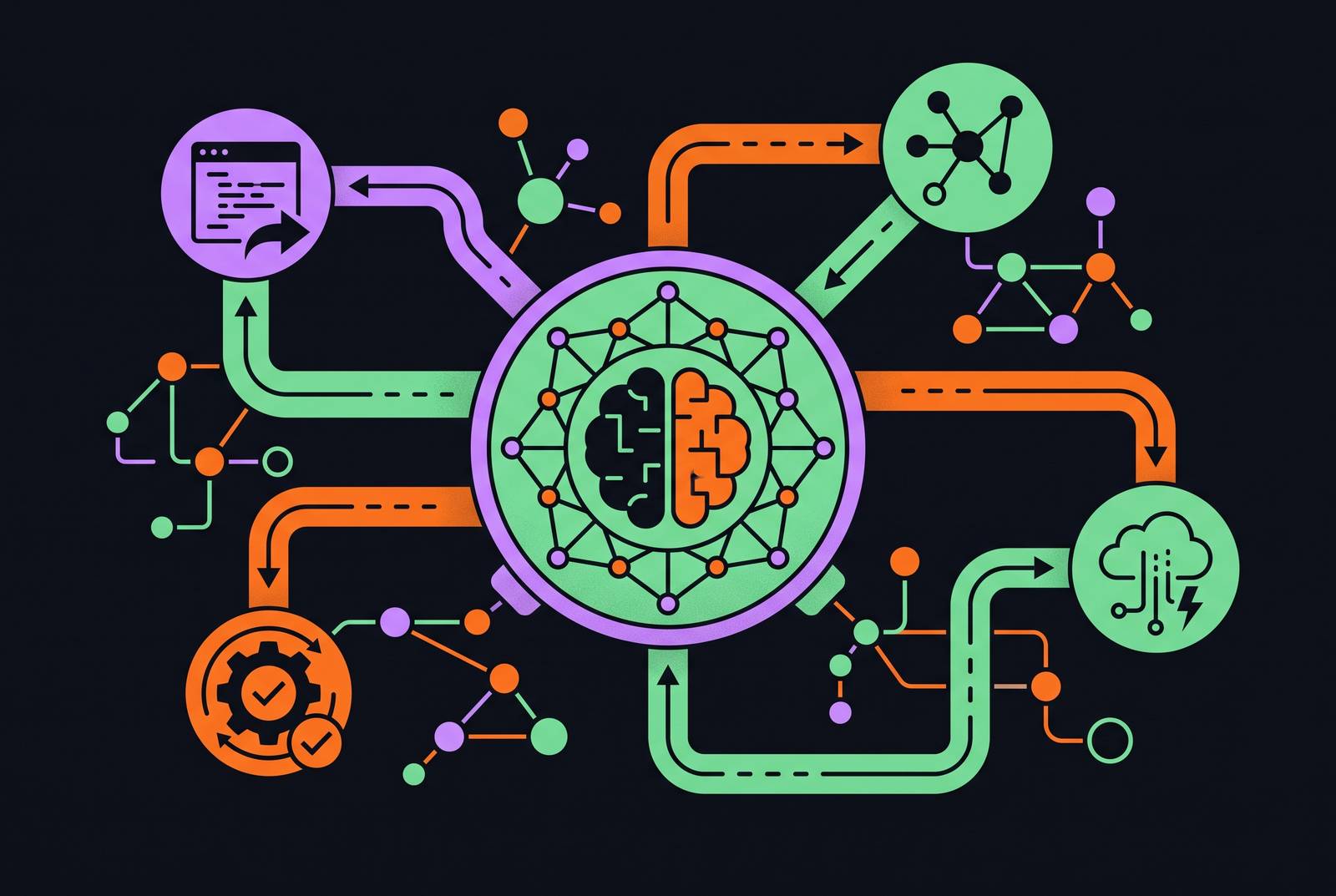
Three broad architectures appear across current systems. Static role-based routing assigns a model to each agent role when the pipeline is designed, and it stays fixed. Dynamic routing selects a model at runtime, based on how complex the incoming task looks. Hybrid approaches combine the two: a static model for the orchestrator, dynamic selection for the workers underneath it. Later sections dig into trajectory-conditioned and codebase-structure-conditioned variants, which add more nuance to the "dynamic" category. This three-way split is the map to keep in mind as the rest of this piece works through the details.
The four agent roles in a coding pipeline and what each one actually demands from a model
Breaking a coding pipeline into its typical roles reveals a pattern fast: orchestration, implementation, navigation, and review each ask for a different kind of thinking, and no single model profile handles all four equally well.
Orchestration is the planning layer. It takes an ambiguous request and breaks it into subtasks, figures out how those subtasks depend on each other, and manages work happening in parallel. Mistakes here are the most expensive kind, because every downstream agent inherits a bad plan with no way to catch the error on its own. Anthropic positions its deepest-reasoning model tier for exactly this kind of work: codebase refactoring and coordinating agents across a workflow. Separate research backs this up structurally. A confidence-aware framework built by researchers at Harbin Institute of Technology and the Chinese Academy of Sciences found that planning and revision tasks genuinely need large-scale models, while drafting and aggregation tasks do not.
Implementation, the actual code-writing, is deceptively varied. A 500-token edit and a 40,000-token cross-module refactor both fall under "implementation," but they need wildly different amounts of context to do well. CrewAI's documentation spells this out with concrete thresholds: small tasks up to roughly 4,000 tokens call for standard models, medium tasks between 4,000 and 32,000 tokens call for enhanced models, and anything larger needs a model with a genuinely large context window. Picking one fixed model for every implementation task means you either truncate large files or waste a big context window on a tiny edit. Mid-tier models with strong coding performance tend to be the practical sweet spot for most of this work.
Navigation, meanwhile, is the quiet budget killer. Listing directories, resolving symbols, tracing import paths: this is structurally simple retrieval work, closer to pattern matching than deep reasoning. Routing a frontier model to file navigation inflates input token costs by about 5x compared to a lightweight model doing the same job Best AI Model for Coding Agents in 2026: A Routing Guide. Navigation tasks happen constantly, so overpaying here at high frequency is one of the fastest ways to burn through a budget before it ever reaches tasks that actually need the expensive model.
Review sits between two traps. Running a frontier model serially on every review makes it a bottleneck slowing the whole pipeline down. Running a cheap model instead causes it to miss real vulnerabilities. Models with strong instruction-following tend to fit review work well, and whether the review runs synchronously or asynchronously matters too: async review can absorb more latency, opening the door to a heavier model without stalling everything else.
The case for taking role specialization seriously isn't just theoretical. Anthropic's own multi-agent research system beat a single-agent version running its most capable model by 90.2% on research retrieval tasks Best AI Model for Coding Agents in 2026: A Routing Guide. That gap didn't come from a stronger model. It came from splitting the work up and matching the right approach to each part.
How static role-based routing works and where its limits appear
Decide, at design time, which model each agent role gets, and don't reconsider it at runtime; that's static routing, the simplest version of all this. Intent's multi-agent architecture is a working example, assigning models through a model picker for each specialist agent, with a Coordinator, an Implementor, and a Verifier each getting their own designated model, following the same orchestrator-worker pattern Anthropic describes.
This works well when the workload inside each role is fairly predictable. If every "coordinator" task looks roughly the same in complexity, one model assigned to that role will serve it consistently. The trouble starts when complexity inside a single role swings wide. Static routing forces a choice: over-provision so the migration doesn't get shortchanged, or accept quality drops on the hard end to save cost on the easy end. There's no third option once the model is fixed.
The cost case for getting the split right is real. A three-tier setup, using a top-tier model for coordination, a mid-tier model for implementation, and a lightweight model for file operations, saves 51% compared to running everything on the top-tier model. But that number only holds if the role boundaries stay clean and stable. Static routing is the right baseline that dynamic routing builds on. The real question for any team is whether their task distribution is uneven enough to justify the added complexity of something smarter.
Why task-description-only routing fails agentic software engineering and what to use instead
Here's the precise problem with routing based only on the task description: two issue reports can read almost identically and still describe completely different jobs. One says "fix the login bug." So does the other. One turns out to be a localized typo. The other requires touching a dozen files across three modules. The router, reading only the prompt, cannot tell the difference Best AI Model for Coding Agents in 2026: A Routing Guide openpr.com.
This isn't a tooling gap that better prompt engineering fixes. SWE-Router provides a formal theorem showing that routing that conditions only on the prompt carries an irreducible error floor in multi-turn agentic settings. The information that would resolve the ambiguity doesn't exist yet when the task arrives. It gets generated by the agent itself, as it works.
And agents generate a lot of it. Failed tests, retrieved file contents, and stack traces all appear during the exploratory loop an agent runs before it starts writing a fix, and a substantial share of that loop is spent just localizing the bug rather than actually solving it. That's structural signal sitting right there, and a router that ignores it is throwing away the most useful information available.
SWE-Router's answer is to let a cheap model run a few exploratory turns first, then have a learned component read that partial trajectory and estimate whether the cheap model is actually going to solve this or not. Crossing a cost-adjusted probability threshold causes the system to escalate to a stronger model. Stay under it, and the cheap model keeps going. Theorem 4.1 in the paper shows that conditioning on the partial trajectory never makes routing worse, and it's strictly better whenever the exploration turns up useful information.
What does this mean for anyone building one of these pipelines? The routing decision gets better information as the agent works, and the pipeline needs to support mid-task escalation as a design requirement.
Cost data backs up why this matters so much. Pre-task cost estimates are close to useless. Trajectory-conditioned routing is the only approach that has a shot at working given how unpredictable these tasks actually are. As reported by getunblocked.com citing arXiv 2026, agentic runs on the same SWE-bench Verified task have differed by up to 30x in total tokens, and models underestimate their own cost with self-prediction correlation no higher than 0.39, making pre-task cost estimation unreliable and reinforcing the case for trajectory-conditioned routing, per the Best AI Model for Coding Agents in 2026: A Routing Guide from getunblocked.com and openpr.com.
Routing on codebase structure, not just task description or trajectory
There's a signal even trajectory-conditioned routing misses: the shape of the codebase itself. Most orchestrators today pick a topology (how many agents, how they're arranged) without ever looking at the code they're about to touch. A five-line bug fix inside a single file and a coordinated change spanning a dozen packages can generate query text that looks nearly identical, and a system reading only the query has no way to separate them.
One approach, called Retrieval-Guided Adaptive Orchestration, or RGAO, closes that gap by pulling a structural complexity signal from a hierarchical index of the code before deciding on a topology https://arxiv.org/list/cs/recent?skip=600&show=100. It looks at things like how deep the code's dependency tree goes, how tightly coupled different modules are, and how many symbols get pulled in during retrieval. Based on that, it routes to one of four setups: FASTPATH for trivial, contained changes, SUBAGENT for a single specialist handling something narrow, MULTIAGENT for either a pipeline or a parallel swarm of agents, and DEEPRESEARCH for retrieval-heavy, multi-stage work.
Does this actually help? In testing on a set of 250 labeled routing examples, RGAO cut misrouting from 30.1% down to 8.2% compared to a regex-based classifier, a gap that held up statistically getunblocked.com Retrieval-Conditioned Topology Selection with Provable Budget Conservation for Multi-Agent Code Generation. It also pairs this with a formal budget system, checked before any model call goes out, that guarantees delegated work never exceeds what its parent task was allotted.
These numbers come from a proxy testing setup, not a full run against SWE-bench, which the researchers have left for later work. That's a fair reminder that this corner of the field is still moving fast and conclusions are provisional. But the direction is clear enough to matter: codebase-structure routing is complementary to role-based and trajectory-conditioned routing, and a mature pipeline has room to compose all three signals at once.
The model pool selection problem: more models in a MAS is not automatically better
Before any of this routing logic can do its job, there's a prior question that's easy to skip past: which models are even in the pool to route between? It turns out the instinct to throw more models at the problem backfires. Research from NVIDIA and the University of Copenhagen found that widening the candidate pool in a multi-agent system often drags performance below what the single best base model would achieve on its own, because adding models from different families introduces instability the system can't shake off getunblocked.com.
The stronger move, per that same research, is picking candidates from within one model family rather than mixing families. That consistently outperforms a lone standalone model, while cross-family mixes tend to destabilize the system in ways routing logic alone can't fix getunblocked.com.
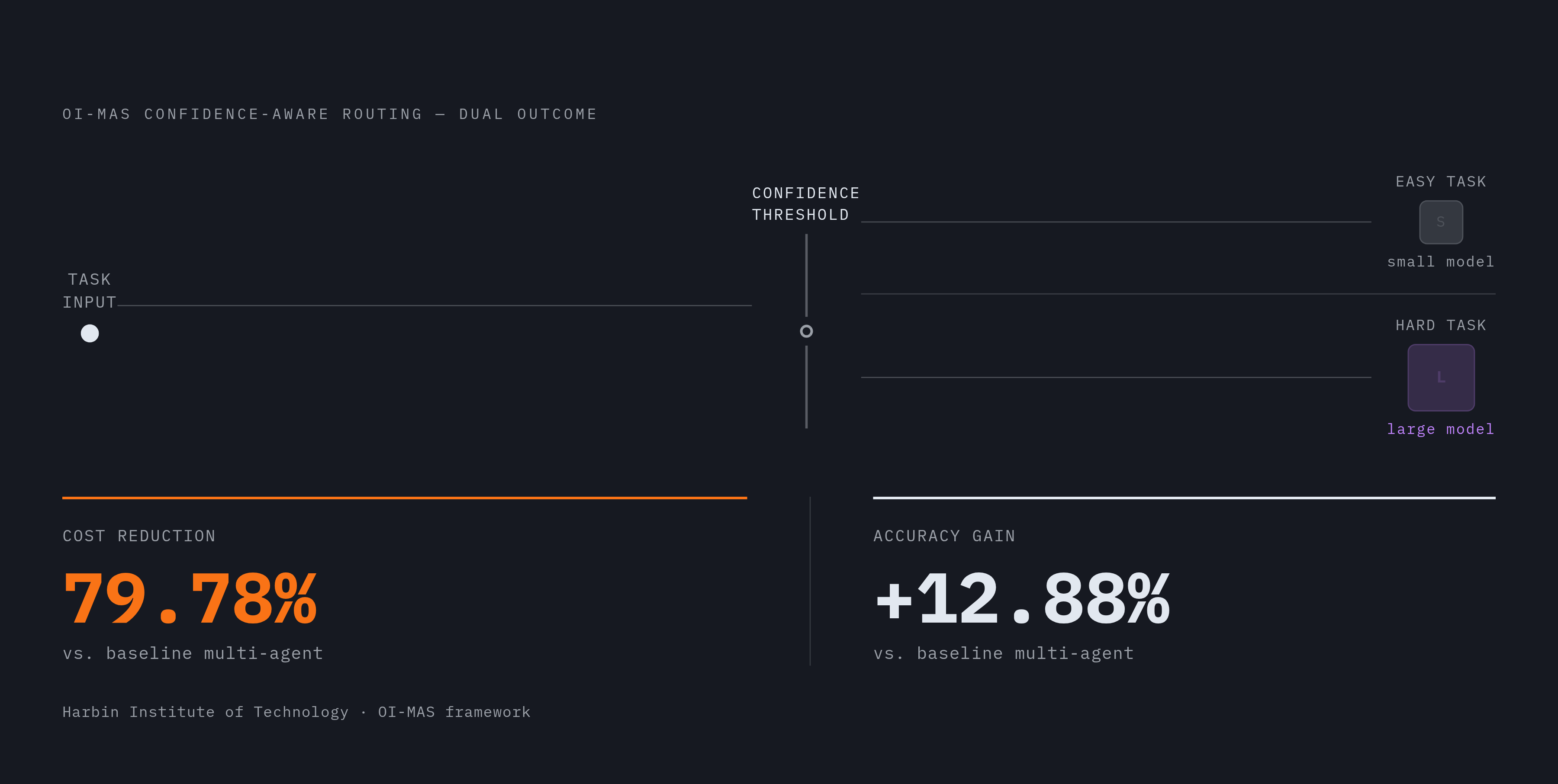
Layered on top of this is a confidence-aware angle from the OI-MAS framework out of Harbin Institute of Technology: when the system is confident about a task, send it to a smaller, faster model; when it senses real difficulty or uncertainty, escalate to something bigger Orchestrating Intelligence: Confidence-Aware Routing for Efficient Multi-Agent Collaboration across Multi-Scale Models. Done well, that approach improved accuracy by up to 12.88% while cutting cost by up to 79.78% against baseline multi-agent setups Orchestrating Intelligence: Confidence-Aware Routing for Efficient Multi-Agent Collaboration across Multi-Scale Models.
A router pointed at a badly assembled pool of models will confidently route to the wrong model every time, because the pool itself is the problem, not the routing logic. Start small, with one model family and two or three tiers within it, and confirm each tier genuinely beats the others on the specific role it's meant for before adding anything else. Wanting flexibility to plug in new models is a reasonable instinct, but stability across agent turns depends on consistency, so the pool and the routing strategy need to be designed together, not bolted on after the fact.
What benchmark scores for routing models actually measure (and what they miss)
SWE-bench Verified has become the standard yardstick for coding models: it tests whether a model can resolve real GitHub issues pulled from actual open-source Python repositories, covering the full loop of understanding a problem, navigating the code, fixing it, and verifying the fix, rather than testing an isolated puzzle. As of an April 2026 snapshot, the leaderboard showed Claude Mythos Preview at the top with 93.9%, GPT-5.3 Codex at 85%, and an average of 63.4% across 83 models evaluated Best AI Model for Coding Agents in 2026: A Routing Guide codeant.ai openpr.com.
But those numbers need a serious asterisk. In February 2026, OpenAI published a paper titled "Why SWE-bench Verified no longer measures frontier coding capabilities," pointing out that every major frontier model could reproduce gold-standard patches verbatim on some tasks in the set Best AI Model for Coding Agents in 2026: A Routing Guide openpr.com. That's not a small caveat. It means the benchmark, at least in part, has been measuring memorization rather than problem-solving.
The gap widens sharply on harder tests. Claude Mythos Preview's 93.9% on SWE-bench Verified drops to 45.9% on SWE-bench Pro, a tougher, long-horizon variant of the same idea codeant.ai.
That's part of why a wider set of benchmarks has emerged: SWE-bench Pro for long-horizon tasks, DeepSWE spanning 91 open-source repos, FrontierSWE, Terminal-Bench for hard CLI tasks, and SWE-Lancer, built around real-world freelance engineering, each exposing different failure modes.
For routing purposes, the takeaway is straightforward: a model topping a contaminated or narrow benchmark isn't automatically the right choice for a given orchestrator role. Evaluate models against the specific kinds of tasks a pipeline's roles actually generate, not against an aggregate leaderboard rank.
One more data point worth sitting with. In a "scout-and-route" configuration tested on 266 Python tasks from SWE-bench Pro, the system solved 159 tasks against 158 for the best single model, at around one-fifth the total cost per solve arxiv.org. What's notable is where that gain came from: not from cleverer model selection, but from a verified handoff mechanism between agents. Pipeline architecture, in that case, mattered more than which model sat at the top of any leaderboard.
Designing a routing strategy that balances cost, latency, and quality across the full pipeline
Every routing strategy that's built to last has to hold three things in tension at once, and none of them can be optimized in isolation without breaking one of the others.
Cost is the most visible one. Frontier models can cost an order of magnitude more per task than competitive open-weight alternatives, and industry reporting on intelligent routing puts the resulting savings somewhere between 20% and 80% in operating costs Best AI Model for Coding Agents in 2026: A Routing Guide openpr.com. That's a wide range, and it should be: the savings depend entirely on how cleanly a pipeline's roles are separated and how well the pool of models underneath them has been chosen.
Latency is the tension cost-cutting always threatens. Route too conservatively toward cheap models and escalation happens late, dragging out tasks that needed the stronger model from the start. Routing too aggressively toward frontier models turns every review or navigation step into a bottleneck the rest of the pipeline waits on.
Quality is the one that fails silently. A pipeline can look fast and cheap for weeks while quietly shipping bugs that a properly matched model would have caught, until the compounding cost of those errors appears downstream, in exactly the way role-mismatch and prompt-only routing produce it.
None of the individual techniques covered here (static role assignment, trajectory-conditioned escalation, codebase-structure signals, curated model pools) solves this by itself. Together, they're the difference between a pipeline that scales as workloads grow and one that quietly stalls under its own weight.
Sources
- Best AI Model for Coding Agents in 2026: A Routing Guide
- Orchestrating Intelligence: Confidence-Aware Routing for Efficient Multi-Agent Collaboration across Multi-Scale Models
- SWE-Router: Routing in Multi-turn Agentic Software Engineering Tasks
- Retrieval-Conditioned Topology Selection with Provable Budget Conservation for Multi-Agent Code Generation
- arxiv.org
- Mo' Models, Mo' Problems: How to best select model pools when designing Multi-Agent Systems
- 2026 Agentic AI Era: Why Multi-Model Routing Has Become
- codeant.ai