MCP vs RAG for Coding Agent Context Retrieval
MCP fetches live data; RAG indexes static docs—they solve different problems.
LLMs get trained on a snapshot of the internet, then frozen. That's the whole problem in one sentence. Asking a coding agent about your codebase, your live API schema, your open Jira tickets, or the internal doc your team updated yesterday makes it either guess or shrug. By 2026, that gap stopped being a theoretical concern. Agentic coding systems are now expected to handle planning, coding, testing, and shipping with minimal hand-holding. That means they need more than a code snippet. They need to know how the organization works, what the system looks like right now, and what's actually true this week, not last quarter.
Two failure modes come out of this gap, and they get treated as one problem when they're not.
The first is hallucination from missing knowledge. The agent doesn't know what's in the codebase, so it invents something plausible-sounding instead.
The second is staleness from frozen knowledge. The agent knows what the docs said six months ago, not what they say now. It answers with total confidence, and it's wrong, and nothing about its tone gives that away.
RAG (retrieval-augmented generation) and MCP (Model Context Protocol) are both responses to this gap. But they respond to different halves of it. That's the whole reason framing them as competitors misleads people before the conversation even starts. One retrieves knowledge. The other fetches state. Treating them as rivals is like arguing whether a filing cabinet beats a phone call. Depends entirely what you're trying to find out.
What RAG does: the pipeline, the strengths, and where it breaks
RAG's pipeline is mechanical, and once you see it laid out, the strengths and the failure points become obvious.
- Documents get parsed and chunked into smaller pieces.
- Each chunk gets embedded into a vector, a numerical representation of its meaning.
- Those vectors get stored in a searchable index, something like Qdrant or MongoDB Atlas.
- At query time, the system retrieves the top handful of chunks that are semantically closest to the question.
- The LLM gets the original prompt plus those retrieved chunks, and generates an answer grounded in that text.
No live API calls, no runtime fetching, and that's it. No live API calls, no runtime fetching. Everything relevant was already sitting in the index before the question was asked.
Where RAG genuinely wins:
Massive unstructured corpora. Vector search can semantically match across millions of pages in a way that would be completely impractical to handle through live tool calls. Stable knowledge. Internal wikis, PDFs, FAQs, historical documentation, resolved ticket archives. Things that don't change every day. Lower latency. No round trip to an external API mid-conversation. The data's already indexed and waiting. Fewer hallucinations, generally. Because responses get grounded in real, authored text instead of the model just making something up from pattern-matching.
Where RAG breaks down:
The core issue is that semantic similarity finds what looks relevant. Not what's correct. Not what's current. Just what's close in vector space to the question being asked. Those are three different things, and RAG only optimizes for one of them.
A stale vector store is the sharpest version of this problem. If the underlying docs changed but the index didn't get rebuilt, the model has zero signal that anything's wrong. It just answers, confidently, from data that's out of date. No warning label. No hedge. Just a wrong answer delivered with total conviction.
On top of that, the operational overhead compounds fast. Chunk size, chunk overlap, choice of embedding model, similarity thresholds, reranking logic, how retrieved context gets formatted into the prompt. Every one of those is a tuning decision, and small changes in any of them can produce surprisingly large, non-obvious swings in output quality. Embedding drift and corpus refresh cycles added into the mix make RAG start to look less like "set it up once" and more like "babysit it forever.""
Infragistics ran a 100-query benchmark that shows what this looks like in practice. Their RAG setup was an AWS Bedrock Knowledge Base, built from periodic documentation snapshots. When a property shipped in a patch release, it wouldn't show up in the index until the next re-index job ran. In the gap, the model answered questions about that property using outdated information, confidently, because nothing told it the ground had shifted underneath it.
What MCP does: the protocol, the architecture, and the shift in where intelligence lives
MCP is an open-source protocol, originally built by Anthropic, now picked up broadly across the ecosystem, including tooling from OpenAI. Instead of pre-loading a static index, it lets a model ask for what it needs, live, at the moment it needs it.
The MCP flow:
- A user gives input.
- An MCP client turns that into a structured request.
- An MCP server fetches data from an approved source, an API, a database, a SaaS tool, at runtime.
- That data comes back in a predictable, schema-defined format.
- The model generates its response using that fresh context.
The architectural difference from RAG comes down to where the boundary sits. In MCP, the application exposes a defined set of capabilities through the server. The model, through the client, requests what it needs within those limits. That's a cleaner separation of concerns than "pre-index everything and hope it's still true."
What does that actually buy you, operationally?
Context is fetched deterministically, the exact thing asked for, not the closest match to it. It's fetched deterministically, the exact thing asked for, not the closest match to it.
- Access controls, validation, and versioning can get enforced right at the tool layer. That matters a lot for anything compliance-sensitive: PII, financial records, healthcare data.
- No pre-processing, no pre-storage. Every query runs fresh, in real time.
RAG's whole value proposition depends on the world staying still long enough for an index to stay accurate, and that dependency is the point to sit with. RAG's whole value proposition depends on the world staying still long enough for an index to stay accurate. MCP asks, every time. It just asks, every time.
What a direct benchmark between the two approaches shows
Numbers help settle arguments that would otherwise just be vibes. Infragistics ran a 100-query benchmark pitting an MCP server against an AWS Bedrock vector Knowledge Base, using the same Claude model as the orchestrating LLM on both sides. The 100 developer queries covered component how-tos, exact API and type lookups, theming questions, feature-freshness checks, and code generation.
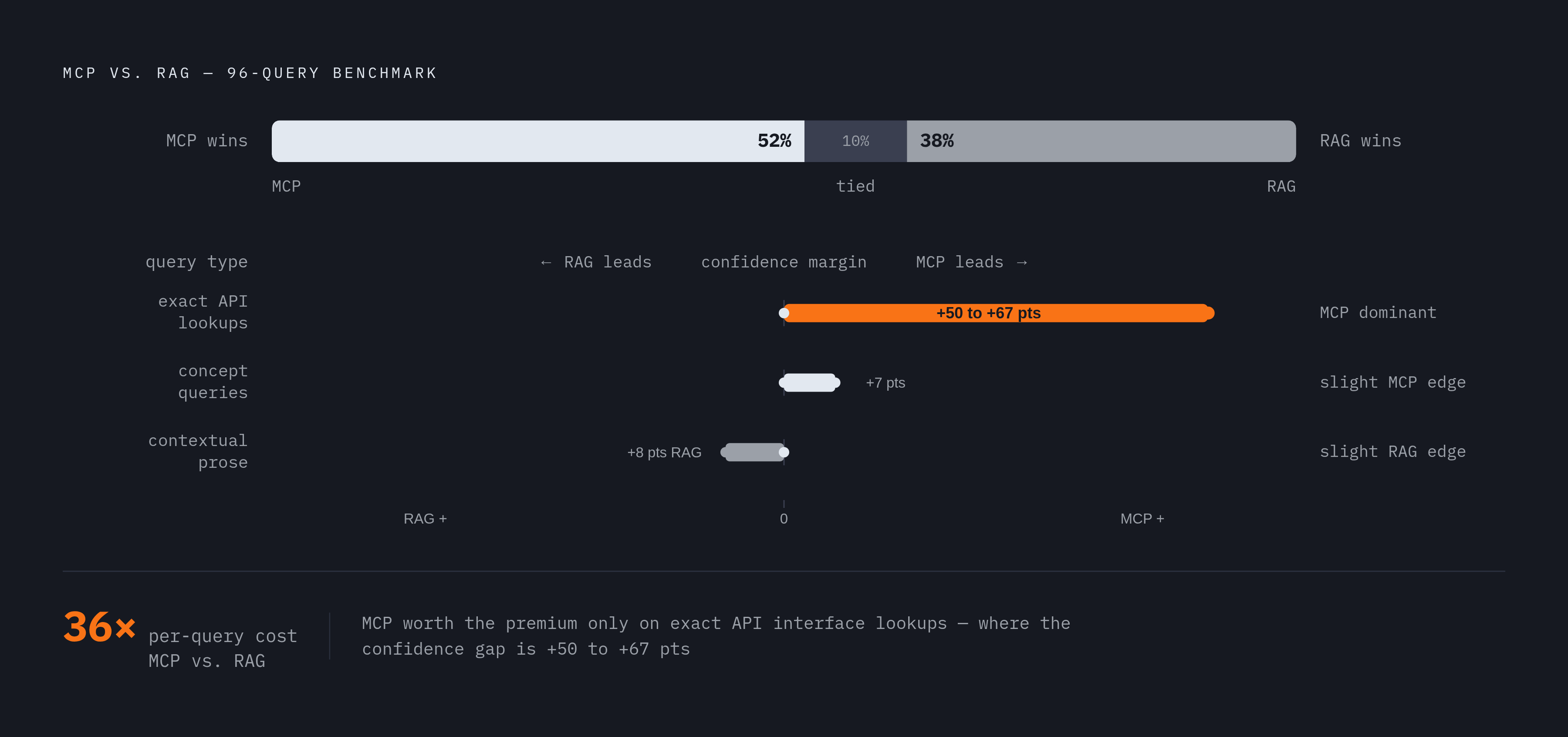
Across the 96 queries where both arms produced valid, comparable scores, MCP delivered the higher-confidence answer 52% of the time. RAG won 38% of the time. The rest tied.
Where did MCP pull ahead hardest? Exact API interface lookups, the query type where confidence gaps hit +50 to +67 points in MCP's favor. That's not subtle. And it makes sense given everything above: exact lookups are precisely where staleness does the most damage, and precisely where deterministic fetching has the biggest edge over "closest match in an index that might be a version behind."
But that win isn't free. MCP came with noticeably higher latency and something like 36 times the per-query cost. That's a real architectural line item, not rounding-error territory. That's a real architectural tradeoff, and it means the question isn't "which one is better," it's "which one is better for this specific query, at this specific price point, given this specific tolerance for waiting."
A practical decision framework: when to use RAG, when to use MCP, and what triggers a hybrid
RAG makes sense by default when:
- The knowledge base is large, unstructured, and doesn't change much: internal wikis, historical docs, resolved ticket archives.
- Latency budget is tight, and cost per query actually matters because you're running a lot of them.
- The task really is broad semantic search: exploratory documentation lookup, Q&A across a big text archive.
- The system's built on a large frontier-scale model that can make good use of retrieved context.
MCP makes sense by default when:
- Data changes faster than any reasonable re-index schedule could keep up with: live API schemas, patch release notes, real-time database state.
- Context is specific to a user or a session: current subscription tier, open support tickets, per-user permissions.
- Compliance rules forbid pre-storing sensitive data anywhere, PII, financial records, healthcare information.
- The answer needs to be exact, not approximate. The +50 to +67 point confidence gap from the Infragistics benchmark appears here.
- The model in play is smaller or mid-scale, where every token of context length counts and you can't afford to stuff a prompt with speculative retrieved chunks.
Inside a coding agent specifically, MCP earns its keep in a few concrete spots. Connecting Figma, Jira, or GitHub MCP servers lets an agent pull designs, tickets, and pull requests directly, no manual copy-paste of context into a prompt. Live compiler feedback loops work the same way: instead of front-loading every possible error case into a giant prompt, MCP keeps the prompt lean and lets the agent make tool calls to diagnose problems as they come up.
What triggers a hybrid? When the agent needs both. Picture a support agent that pulls troubleshooting steps out of a knowledge base (that's RAG) and also checks the customer's current service tier and open tickets (that's MCP). Neither piece alone tells the full story. Put together, they build a context pipeline that's aware of both the stable archive and the live state of the world, which is what a lot of real coding agent tasks demand.
How this plays out inside a real agentic coding workflow
Picture the 2026 version of "add rate limiting to the API gateway." An engineer types that sentence. The agent goes and analyzes the codebase, finds the relevant files, makes changes across however many modules that touches, writes tests, runs them, and opens a pull request. All without a human in the loop for each step. That's the baseline expectation now, not a demo. That's the baseline expectation.
These agents also don't run for a few seconds and stop. They run for minutes, sometimes hours, chaining tool calls and decisions together. Which means context retrieval has to hold up across an entire multi-step, multi-tool job, not just answer one isolated question well and call it done.
RAG fits into this picture wherever the task is about understanding, not checking. An agent exploring an unfamiliar codebase benefits from semantic search over stable internal documentation and historical knowledge. Ask it "how does our auth system work?" and it should be pulling from an indexed archive of design documentation, the same way a new engineer would dig through old docs before touching a single line of code. That's also where onboarding gets compressed: work that used to take a new hire weeks of reading and asking around can now happen in hours, because the agent can guide that exploration directly from indexed knowledge.
MCP fits wherever the task is about current state. An agent pulling live project state before deciding what to build next. An agent checking live repository state to see what needs fixing before moving forward. An agent fetching the current API reference to check that a function signature it just generated actually matches the live schema, not the schema from three releases ago. That last one lines up exactly with where the Infragistics benchmark found MCP's biggest confidence gains: exact API interface lookups.
Operational tradeoffs engineering teams need to weigh before committing to an architecture
Setup and ongoing complexity. RAG asks for upfront work in chunking, embedding, and indexing, and then keeps asking for maintenance: watching for embedding drift, keeping the corpus fresh, tuning reranking. MCP asks for upfront work defining and registering tool schemas, and the ongoing cost scales with how many systems get connected, but that pattern maps onto backend API work most engineering teams already know how to manage. RAG looks easy at the start and gets complicated later. MCP looks a little more formal up front and tends to stay predictable.
Cost. The Infragistics numbers put MCP at roughly 36 times the per-query spend of RAG. The Infragistics numbers put MCP at roughly 36 times the per-query spend of RAG, and that's a real line item. It's a real line item. For low-frequency, high-stakes lookups (exact API references, live state checks) that cost is probably worth paying. For high-frequency questions over knowledge that barely changes, RAG's cost profile wins by a wide margin.
Latency. MCP ran noticeably slower per query in that same benchmark. For an interactive coding assistant where a developer is sitting there waiting on the answer, that gap is noticeable and it affects how the tool feels to use. For a background agentic task that's already going to run for minutes or hours regardless, a few extra seconds on one tool call barely registers.
None of this adds up to "pick a side." It adds up to matching the tool to the shape of the problem: how often the underlying data changes, how much a wrong-but-confident answer would cost, and how much a developer's willing to wait. RAG and MCP address two different halves of the same gap, not the same job. They're just two different answers to two different halves of the same gap.