Agentic AI Frameworks for Multi-Step Code Refactoring
Multi-agent systems cut refactoring complexity in half compared to single-agent approaches.
Manual refactoring at scale isn't just slow. It's risky in a specific, structural way: a developer has to track every dependency that might break, rerun tests after each small change, and hold an entire plan in their head across days or weeks of work. Miss one caller of a renamed method, and the build fails somewhere downstream, hours later, in a place nobody was looking. That's exactly the shape of problem agentic AI was built to handle: long, multi-step work that needs planning, tool use, and checking your own work along the way.
Fewer than 10% of organizations track technical debt in any methodical way, according to recent research. That means most refactoring happens reactively, in a scramble, instead of as planned work. One-shot AI assistance, the kind that suggests a single edit at a time, runs out of road fast here. A tool that proposes one change can't sequence an extract-method step, a rename, a move-class operation, and a test rerun that all depend on each other. Teams still treating AI-assisted refactoring as "autocomplete, but longer" are going to hit a wall the moment two changes depend on each other.
What makes refactoring a natural fit for agentic AI
Refactoring has a property most coding tasks don't: it's supposed to preserve behavior. That gives it a built-in test for success. If the test suite passes before and after, the change worked. If it doesn't, something broke. That's a clean signal, and it's exactly what an AI agent needs to check its own work at every step, not just at the end.
It's also long and tool-heavy: plan the change, run it, check the outcome, fix what broke, repeat. That's the same basic loop agentic AI systems are built around.
Researchers sometimes frame this as a simple chain: state, actions, goal, transition, reward. The state is the code itself, its structure, its complexity. The actions are atomic moves like extract-method, rename-symbol, or run-tests. The reward tracks whether quality went up and whether anything broke. Framed this way, the agent isn't guessing at good code. It's working through a sequence of moves toward a measurable target, the same way a chess engine works toward checkmate.
Compare that to older inline-suggestion tools, the kind that autocomplete a line inside a single editing session. Those work one keystroke at a time, inside one file. An agentic system can work across an entire codebase, submitting a full set of changes the way a human contributor would open a pull request. And because the whole thing rests on tests passing, human reviewers get a clear place to focus: check whether the test suite itself is trustworthy, not every line the agent wrote.
How multi-agent architectures divide the refactoring problem
The strongest systems don't ask one model to do everything. They split the job across agents with specific jobs, the way a real engineering team splits work across roles. Asking one model to plan, rewrite, verify, and debug in a single pass is a mistake, and the research backs that up directly.
A typical setup looks like this:
- Planner/Context Agent: reads the project's structure, maps out dependencies, and proposes refactoring plans, scored by complexity, cohesion, and coupling.
- Transformer/Executor Agent: takes the plan and actually rewrites the code.
- Verifier/Validator Agent: compiles the result, runs static analysis tools like DesigniteJava, HLint, or CheckStyle, and runs the test suite.
- Repair/Debugging Agent: when something fails, finds the fault and patches it, trying again until it passes.
- Tool Adapter Agents: connect to the surrounding ecosystem, things like Maven, JUnit, GHC, EvoSuite, or RefactoringMiner, to pull in whatever context the other agents need.
These agents talk to each other over message-passing protocols, often structured as JSON, and the whole thing can run as a straight pipeline or as a feedback loop with checkpoints where a human signs off. Some setups even split a codebase into shards and run several agent copies on different modules at once.
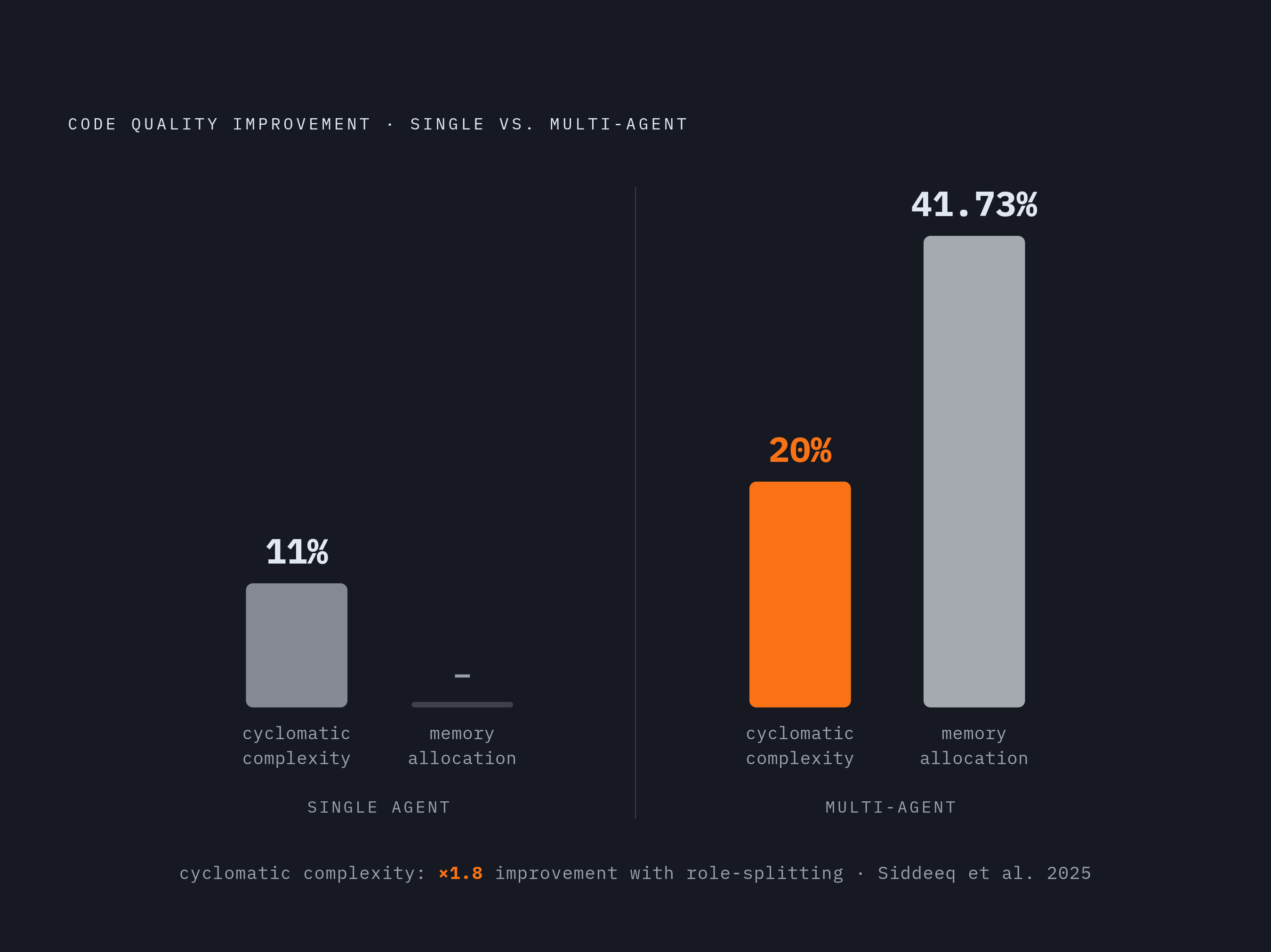
Does splitting the work actually pay off, or is it just a cleaner org chart? Research by Siddeeq et al. (2025) put numbers to it: a single agent cut cyclomatic complexity by about 11%, while a distributed multi-agent setup nearly doubled that, to 20%. Memory allocation savings hit as high as 41.73% in the same tests. That's not a rounding difference. Splitting the problem into roles produces measurably better code, not just a tidier org chart.
How reinforcement learning turns refactoring into a self-improving loop
Reinforcement learning treats refactoring as a decision process: the current state of the code, a set of possible moves, and a reward based on whether quality went up or a test broke. The advantage over supervised learning is that RL doesn't need a labeled set of "here's the wrong code, here's the fixed code" pairs. It learns by trying things on real code and watching what happens.
Three research systems anchor this space. SWE-RL (Wei et al., 2025) uses reinforcement learning on real software history to sharpen model reasoning. DeepSWE (Luo et al., 2025) trains a coding agent from scratch by scaling RL. SWE-Gym (Pan et al., 2025) builds training environments and checkers specifically for software agents to practice in.
Where does this head next? Multi-agent RL, where several specialist agents adjust their proposals in response to each other, the way a real engineering team argues its way to a plan. Over time, exposed to a team's own codebase and its own history of what gets accepted and what gets rejected, an RL-driven agent should get better at guessing which changes will pass review without a human stepping in to fix them.
The code quality precondition agents cannot work around
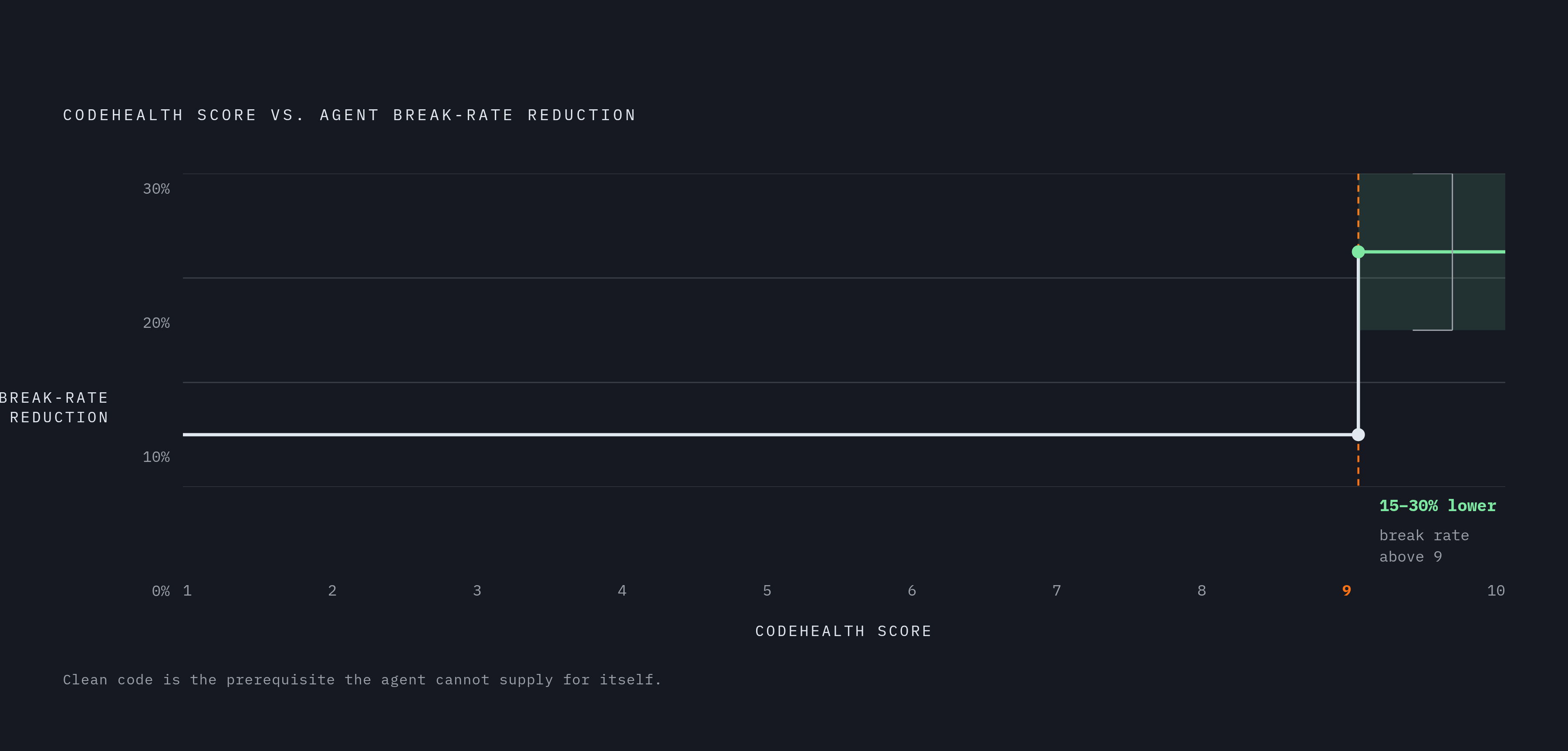
Here's the part most teams skip past, and it decides whether any of this works: agents perform worse on bad code, full stop. One study measured a "CodeHealth" score against how often refactoring by an automated tool broke something. Code in the healthy range (CodeHealth of 9 or above) saw 15% to 30% lower break rates than lower-scoring code.
What predicted safety wasn't the model's own confidence score, and it wasn't how many lines of code there were. It was CodeHealth, a measure of how clean and well-structured the code already is to a human reader. Code that's easy for a person to follow turns out to be safer for a machine to edit too. Thoughtworks made a similar point in its 2025 Technology Radar, coining the term "AI-friendly code design" to describe exactly this: AI coding assistants do better work on codebases that were already well factored.
That gives teams a practical lever, and most aren't pulling it. Use a code quality score to sort the codebase before turning agents loose. Start with the high-health modules, where break rates are low, and put more human eyes on the low-health ones instead of skipping them or treating every module the same. Investing in maintainability isn't a separate task from getting ready for AI. It's the prerequisite. Skip it, and a team ends up blaming the agent for a mess the codebase already had.
How leading orchestration frameworks handle multi-step refactoring workflows
Several frameworks now handle the job of coordinating agents through a multi-step refactor:
- LangChain / LangGraph: LangChain is built for fast prototyping across different model providers. LangGraph adds stateful orchestration, with checkpointing, branching, and retry logic, which matters a lot here: a failed step shouldn't wipe out progress made earlier in the run. LangSmith pairs with it for tracking what the agents actually did.
- Microsoft Agent Framework: the successor to both AutoGen and Semantic Kernel. It combines conversational multi-agent patterns with enterprise features like session-based state, middleware, and graph-based workflows. It ships in Python and.NET, and works with Microsoft Foundry, Azure OpenAI, OpenAI, Anthropic, Amazon Bedrock, Google Gemini, and Ollama. Best fit for teams already living in the Microsoft ecosystem.
- CrewAI: built around role-based agents, which maps naturally onto the planner/executor/verifier split described above. Good for quick prototypes.
- LlamaIndex Workflows: event-driven, built for document-heavy pipelines. Less central to pure code refactoring, but useful when a refactor also means digging through large amounts of documentation.
- Google ADK: native to Google Cloud, comes with built-in debugging tools, and is fairly opinionated about how things should run.
- OpenAI Agents SDK: minimal, clean multi-agent handoffs, well suited to a narrowly scoped refactoring assistant rather than an open-ended one.
- Mastra: built for TypeScript, bundling workflows, memory, and a Studio environment together. A natural fit for teams refactoring TypeScript codebases.
Older systems set the stage for these: AutoGen's earlier actor-model orchestration is a direct ancestor of what's now folded into the Microsoft Agent Framework.
For refactoring specifically, checkpointing and retry logic matter more than they would for a short task. A framework that loses its place halfway through a transformation isn't just annoying to use. It's a correctness problem, because a half-applied refactor can leave a codebase worse off than the one it started with.
What the agentic coding platforms bring to refactoring end to end
Beyond orchestration frameworks, a set of platforms now offer the whole pipeline: code generation, refactoring, test writing, debugging, deployment configuration, all in one place.
- Claude Code (Anthropic): strong scores on software engineering benchmarks, built to support long autonomous sessions, which suits multi-step refactors that run for a while without a human checking in every few minutes.
- OpenAI Codex (OpenAI): another end-to-end platform in the same top tier of capability.
- GitHub Copilot (GitHub): grew from autocomplete into a full workflow platform. Its Agent HQ feature lets multiple agents run side by side, useful for refactoring several modules in parallel.
- Gemini Code Assist (Google Cloud): a cloud-native coding assistant with good throughput for scanning large codebases.
- Devin (Cognition Labs): built to act like an assignable engineer rather than a suggestion box, with teams able to run several instances on different tasks at once.
- OpenHands (Wang et al.): an open platform for building generalist coding agents, supporting sandboxed execution and coordination between agents across coding and browsing tasks.
- Aider (Gauthier): terminal-native and light, a reasonable entry point for a team not ready to adopt a full platform yet.
Windsurf's "codemaps" feature deserves a specific mention: structured maps of a large codebase's dependencies and architecture that help an agent avoid a common failure mode, making a change that's correct in one file but breaks an assumption somewhere else.
For scale, consider what Jarred Sumner did with Bun: rewriting the entire codebase, over 535,000 lines of Zig, into Rust, in 11 days, using massively parallel agentic workflows. That's not a lab demo. That's proof this kind of parallel, long-running refactoring already works at production scale. Refactoring isn't some side use case in the agentic coding market. It's one of the main things driving people to adopt these platforms in the first place.
How to choose the right model for a given refactoring task
The standard benchmark for measuring a coding agent's real ability is SWE-bench Verified, which tests models against real-world software engineering tasks drawn from open-source repositories. That's structurally the same test a refactoring agent has to pass.
Here's the wrinkle worth sitting with: the gap between the best and worst frontier models on real coding tasks is smaller than the marketing around any one of them would suggest. Chasing the top of a leaderboard matters less than picking a model that fits the job actually in front of it. Whatever model tops the chart today probably won't in three months, and building a pipeline around this quarter's leader is a bet against your own future flexibility. That's the part most teams get backwards: they pick the model everyone's talking about, then rebuild the pipeline six months later when a cheaper or faster option catches up.
So how should a team actually pick? A few practical rules:
- For large batch jobs, throughput and cost per token matter more than raw capability.
- For a complex architectural refactor that needs a long, uninterrupted session, prioritize strong SWE-bench performance and session reliability.
- For legacy systems or proprietary languages (old COBOL, older Fortran), fine-tuning on domain-specific data helps where the base model simply hasn't seen much of that code before.
- For routine, high-volume work, renaming variables, updating types, deleting dead code, a cheaper mid-tier model does the job at a fraction of frontier pricing.
Newer benchmarks that track production-style agent work more closely than general reasoning tests do are worth weighing more heavily when judging a model for a refactoring pipeline specifically. And given how fast the frontier moves, keep any pipeline swappable between providers rather than locking into one.
How to structure a refactoring workflow with an agentic framework in practice
Putting all of this together, a workflow tends to run in phases.
Phase 1: Triage and prioritization. Score the codebase by a code-quality metric. Start with the highest-scoring modules, where agents are least likely to break something, and route the lower-scoring modules toward heavier human review rather than skipping them.
Phase 2: Plan decomposition. The Planner agent studies the code's structure and dependency graph and lays out a sequence of atomic moves: extract this method, rename that class, move this function, each one scored against the change it should produce.
From there, the pattern follows what's already been laid out: an Executor applies each step, a Verifier runs tests and static analysis to confirm nothing broke, and a Repair agent steps in when something does. Checkpointing matters throughout, so a failure partway through doesn't undo the steps that already succeeded. And a human stays in the loop at the one natural checkpoint this whole approach creates: not reading every line the agent writes, but confirming the test suite itself is trustworthy enough to be the judge.
That's the shift underneath all of this. Refactoring used to be a task where a person held the entire plan in their head and hoped nothing slipped through. Framed as a planning-and-verification loop instead, it becomes a task a machine can run end to end, with a person checking the one thing that actually matters: did the tests still pass.
Sources
- Agentic Refactoring
- Code for Machines, Not Just Humans: Quantifying AI-Friendliness with Code Health Metrics
- GitHub - feststelltaste/awesome-agentic-software-modernization: A curated list of tools, frameworks, patterns, and research for AI-driven and agentic approaches to modernizing legacy systems
- codewords.ai