No-Code AI Agents for Software Prototyping
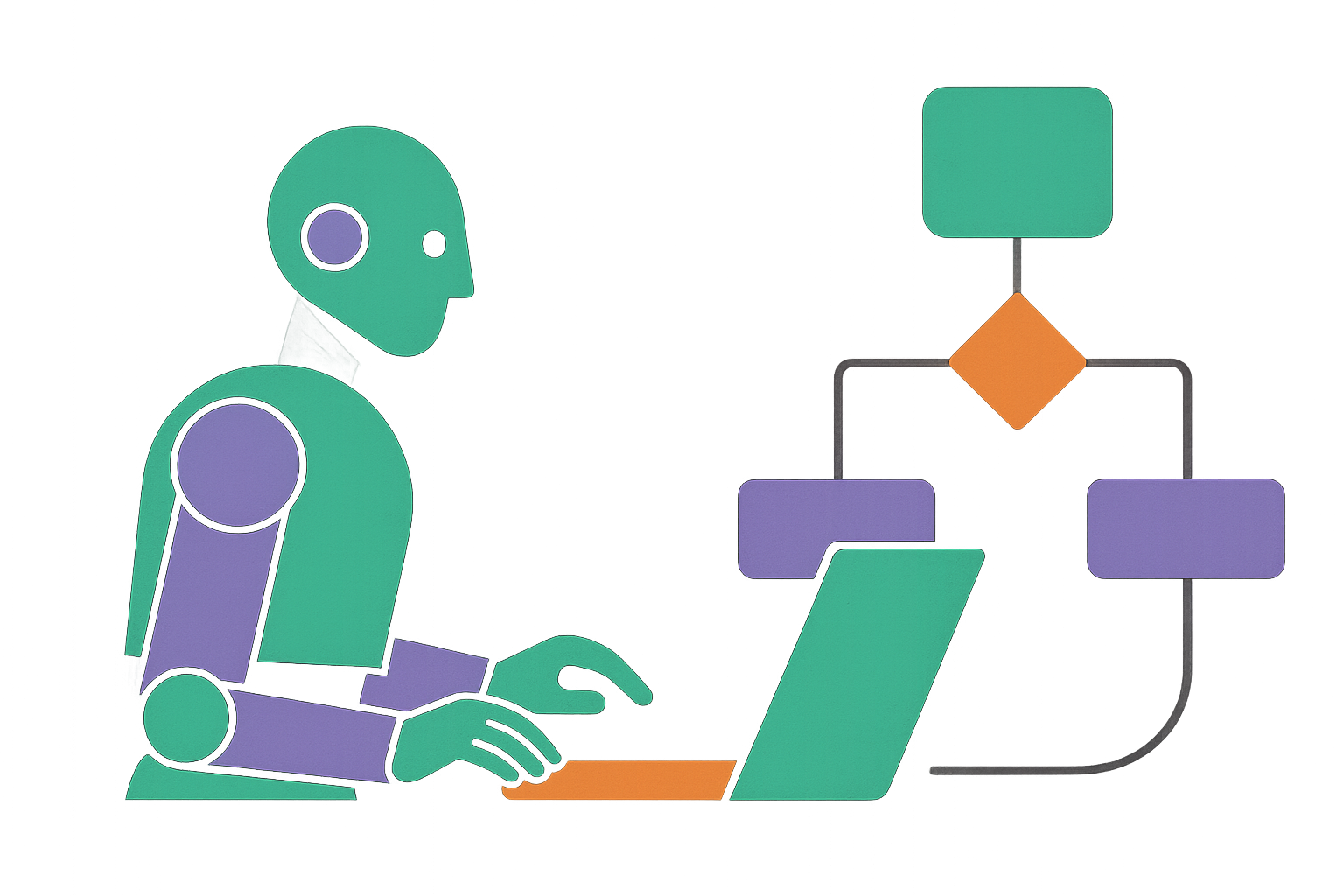
Custom AI agent development is expensive. Estimates floating around in 2025 put the range somewhere between $75,000 and $500,000, with timelines measured in months. No-code platforms claim to deliver roughly 80% of that functionality at a fraction of the cost, with companies reporting meaningfully faster time-to-market compared to custom builds.
Those numbers are almost entirely vendor-reported, which is worth remembering every time you see a headline savings figure. Independently verified ROI figures for no-code specifically are scarce.
The real unlock isn't just cost. It's that product managers and operations teams can prototype without waiting on scarce AI engineers. When engineers are a bottleneck (and they tend to be), removing that bottleneck for early-stage hypothesis testing has obvious value.
Model flexibility adds a practical layer on top. Platforms like MindStudio abstract away API keys and billing across multiple providers. A team can swap between Claude, GPT, Gemini, or an open-source alternative without re-architecting whatever they built. At the prototype stage, when you're still figuring out which model behaves well on your specific task, that flexibility matters more than it looks on paper.
One counterweight worth holding onto: roughly 95% of AI pilots fail to make it to production. If the economics of building are improving but the rate of reaching production is still that low, something other than build cost is the bottleneck — and it's probably not the thing the vendor marketing is talking about.
Where no-code agents accelerate the early prototyping phase
The prototyping phase has a specific job: fast iteration, low commitment, testing hypotheses, giving stakeholders something they can actually look at rather than squint at a Figma mockup. No-code tools are well-matched to exactly those needs.
Speed to first working demo is the most obvious win. Agents that would take weeks to build from scratch can be assembled in hours.
What tends to work well:
- Single-agent workflows with clear inputs and outputs. Document summarization, data extraction, content generation. These are well-contained problems where a no-code platform can connect an existing data source to an LLM and produce useful output quickly.
- Testing model behavior on real business data. Before committing to infrastructure, you can find out how a model actually handles your specific inputs. This is valuable information that no amount of vendor demos can substitute for.
- Rapid iteration on prompt logic. In a traditional development environment, changing how an agent reasons through a problem requires a redeploy cycle. In most no-code tools, you adjust and re-run in seconds.
- Multi-agent coordination for moderately complex workflows. A CrewAI-style research-draft-review pipeline would require significant engineering effort to build from scratch. In a no-code environment, you can have a rough version running quickly enough to actually learn something from it.
Stack Overflow's 2025 developer survey found that 84% of developers were already using or planning to use AI tools in their development process. No-code platforms extend that same momentum to non-developers who are testing product hypotheses.
No-code prototyping is best understood as a way to validate whether an agentic approach is worth building properly. It's a research phase, not a final architecture. That distinction is easy to forget when the demo is running smoothly and stakeholders are impressed.
Where no-code platforms hit walls as prototypes become real products
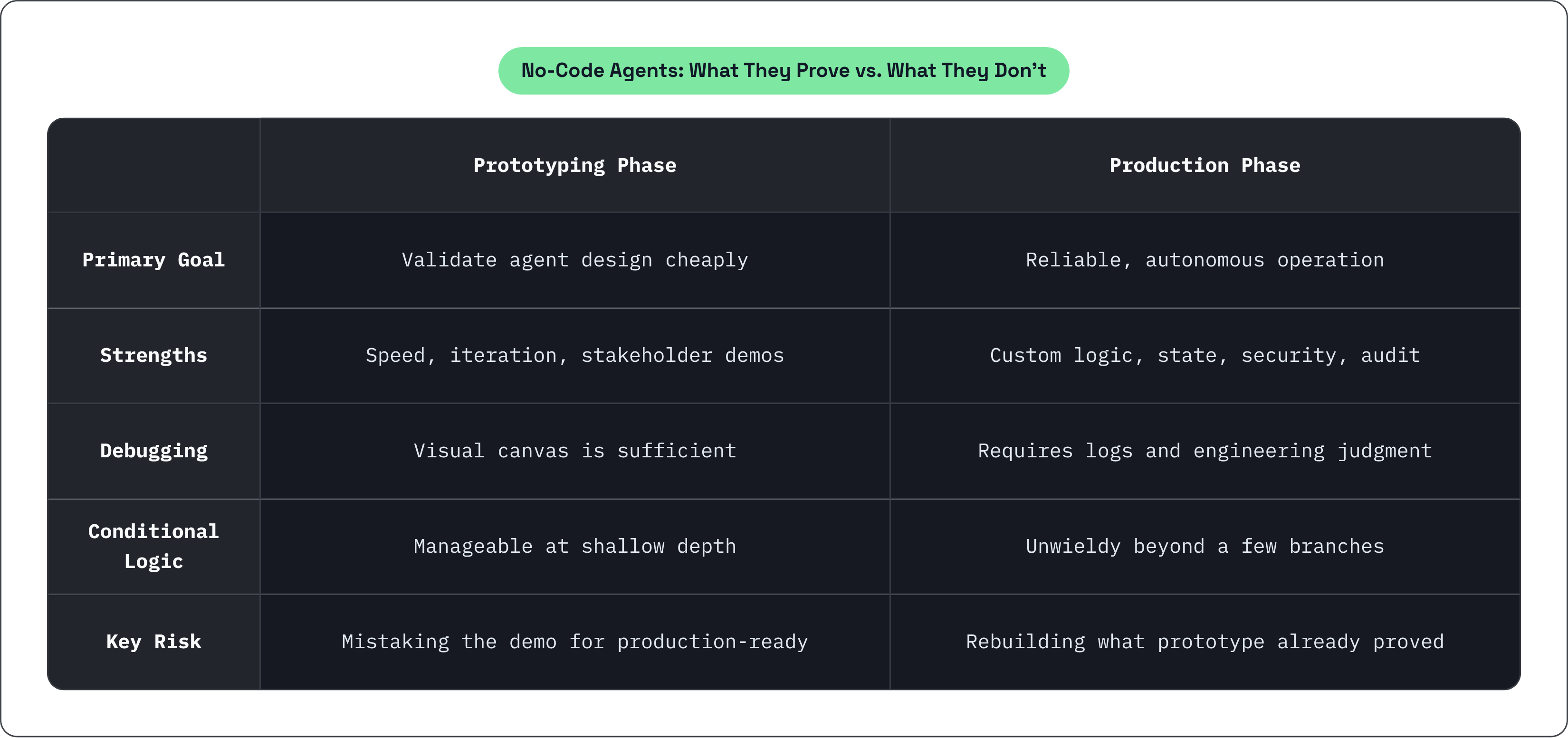
The gap between prototype and production is where most no-code agents stall — not because the prototype doesn't work, but because it works well enough to be convincing yet not well enough to be trusted with anything real.
McKinsey's State of AI 2025 found that only 23% of organizations had adopted agents at scale, and only 2% had deployed them at scale as of that same year, despite much higher experimentation rates. The bottleneck is consistently getting pilots into production, not building them.
Why does this keep happening? A few specific walls:
- Complex conditional logic. Visual editors become unwieldy as branching depth increases. What looks clean with three decision points becomes a maze with ten. Reading a stack trace is faster than tracing a failure through a canvas.
- Custom tool integration. Pre-built connectors don't cover every internal system. Anything proprietary requires code. At some point you're writing Python inside the visual editor, which defeats most of the original point.
- State management in long-running workflows. Managing reliable state across loops that run for minutes or hours without human intervention is difficult in no-code environments in ways that aren't obvious until something breaks at 2 a.m.
- Debugging. When a multi-agent pipeline fails, tracing which agent made which decision and why is significantly harder through a visual canvas than through a log file. The abstraction that made building fast makes debugging slow.
- Security and compliance. Stack Overflow's 2025 survey found that 81% of developers have concerns about the security and privacy of data in AI agent systems. No-code platforms' abstraction layers can obscure these concerns rather than resolve them. You may simply not know what's happening to your data inside the platform.
Research from CodeRabbit in December 2025 found that AI-coauthored outputs show roughly 1.7 times more issues than human-only outputs. In a prototype, that may be acceptable. In a production system, that ratio needs active mitigation that the visual canvas probably isn't surfacing for you.
At some point, validating agent output requires engineering judgment that no-code interfaces don't provide. The platform can help you build the thing. It cannot tell you when the thing is wrong in ways that matter.
How to read AI agent capability claims — what benchmarks and vendor numbers actually measure
No-code platform marketing tends to measure things like time-to-first-agent, number of templates available, and breadth of integrations. These are real metrics, but they are not the same thing as whether the agent will actually perform on your production workload.
The current standard for evaluating coding agent capability is SWE-bench Verified. The setup is rigorous: models receive a real GitHub issue and a full repository, and must produce a passing diff without hand-holding. As of mid-2026, scores among frontier models range from 54% to 81%. A score above 75% is generally considered strong evidence of autonomous coding ability.
That said, the benchmark has limits worth knowing. SWE-bench is Python-only, and OpenAI has flagged training data contamination concerns. SWE-bench Pro, which covers multiple languages and uses a standardized scaffold, is emerging as the more reliable comparison point.
No-code platform capability claims rarely reference these benchmarks at all. They're measuring something different, which means you cannot compare a vendor's "our agents handle complex workflows" claim to a SWE-bench score in any meaningful way.
The METR productivity study from July 2025 is instructive. In a randomized controlled study involving 16 experienced developers and 246 real tasks, developers using AI tools took 19% longer to complete tasks than developers working without AI. Those same developers estimated they were 20% faster. That perception gap maps directly onto how people evaluate no-code platforms. The tool feels fast. The output feels good. Whether the agent actually performs on real, messy, production-grade tasks is a different question — one you won't answer by watching a vendor demo.
What this means practically:
- Test on your actual tasks, not vendor demos. The demo is a clean, well-bounded example. Your problem probably isn't.
- Distinguish "can build an agent quickly" from "can build an agent that performs reliably." Conflating them is how teams end up surprised six months later.
- Model flexibility is a real differentiator. Platforms that let you swap between Claude, GPT, Gemini, and open-source alternatives let you find the right capability for each task. Lock yourself in before you know which model actually works for your use case, and you'll pay for it later.
How to use no-code prototyping as a development phase rather than a dead end
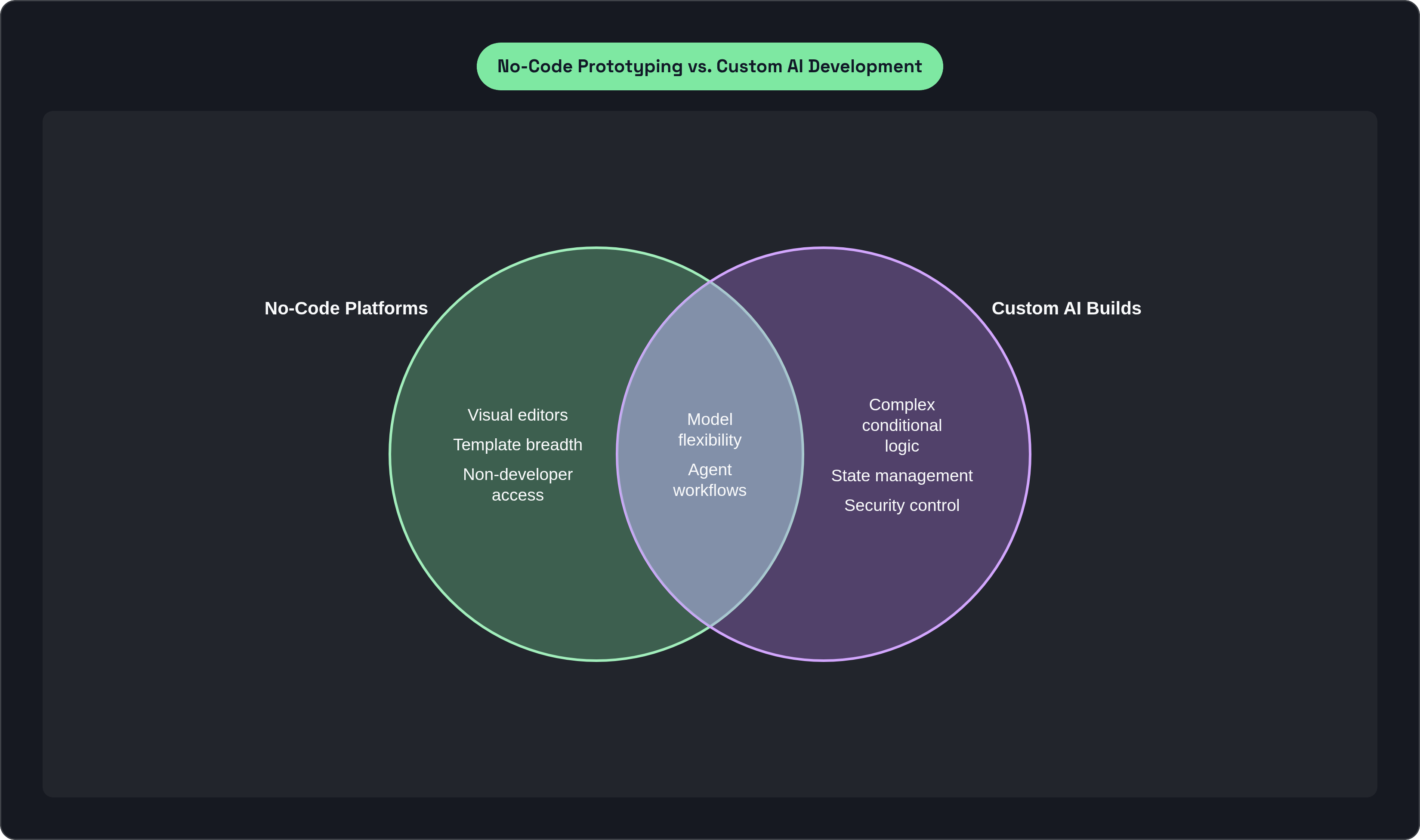
The right mental model is that no-code prototyping is a phase, not a destination. The goal is to validate agent design before committing engineering resources to a production build. Treat it that way, and it's a useful tool. Treat it as the final architecture, and you'll eventually hit one of the walls above.
What a successful no-code prototype actually proves:
- The task is automatable in principle.
- The model behaves acceptably on your real data, not just the vendor's demo data.
- The workflow logic is sound enough to be worth building properly.
What it does not prove: that the platform is the right long-term infrastructure.
The signals that it's time to move beyond no-code are usually clear in hindsight, less so in the moment:
- Debugging requires tracing logic the visual canvas can't expose.
- The workflow needs to run autonomously for extended periods with reliable state management.
- Security, compliance, or audit requirements exceed what the platform's abstractions can guarantee.
- The prototype needs to integrate with internal systems that have no pre-built connector.
The deployment gap is real but it's narrowing. The share of organizations with deployed agents nearly doubled from around 7% in mid-2025 to over 13% by the end of 2025. Teams that prototyped quickly and validated early were better positioned to make that move. The prototype isn't wasted work — it's the evidence base for the production build.
The best outcome of a no-code prototype isn't a demo that impresses stakeholders. It's a clear-eyed answer to how much human oversight the agent actually needs. That question — specifically how autonomous can this thing actually be before it becomes a liability — directly shapes how you architect the production system. If your prototype answers that question clearly, it did its job. Even if it never ships.