Slack and GitHub Integration for Autonomous Coding Agents
Agents now work openly in Slack, not alone in private tabs.
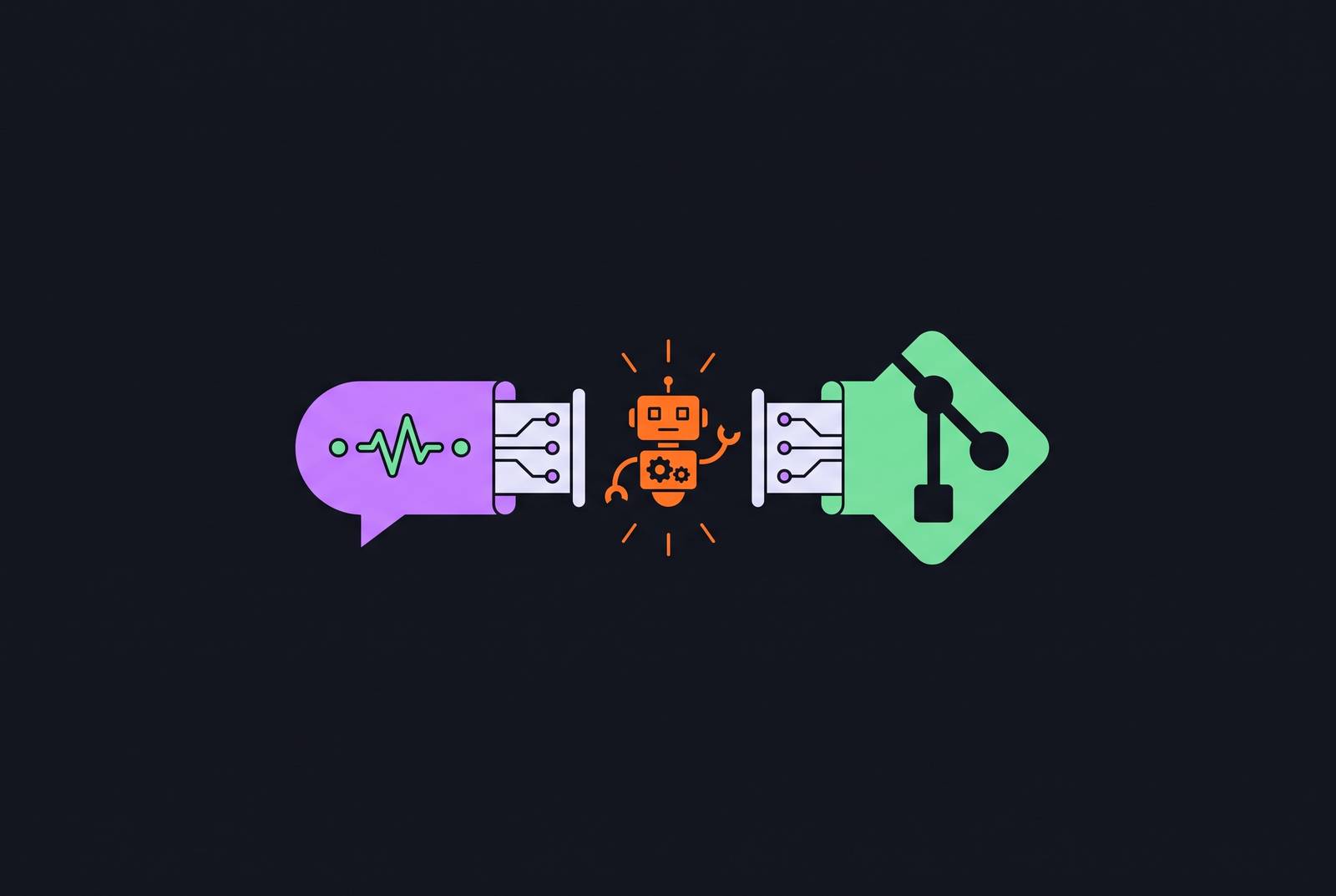
Slack and GitHub are turning into the place where AI coding agents actually live, not a tool developers visit when they need help. That's the real shift here. Instead of bouncing between a chat thread, an editor, a test suite, and a pull request, the work stays in one continuous conversation, and an agent does the parts that used to require a context switch.
Think about how a normal engineering task moves today. Someone raises a bug in a Slack thread. An engineer reads it, opens the IDE, writes a fix, runs tests locally, pushes a branch, opens a PR, and then goes back to Slack to say it's done. Every one of those handoffs loses a little context. The person reviewing the PR wasn't in the original thread. The person in the thread doesn't know the PR exists until someone pings them. Multiply that by a team of ten engineers and you get a lot of quiet friction that nobody bothers to name, because it's just "how work happens."
Slack's own engineers ran into a sharper version of this problem once coding agents entered the picture. Engineers would kick off an agent session in a private browser tab, work through it alone, and only bring the result back to the team once it was finished. That's the exact isolation Slack was built to eliminate, just recreated with an AI in the loop instead of a person. Slack's blog put the underlying philosophy plainly: work is better done in the open, in channels, not alone behind a closed door and revealed only once it's "done."
That's the argument behind pairing Slack with GitHub specifically. Slack is where intent lives. It's where specs get argued over, decisions get made, and context accumulates in threads. GitHub is where code lives, where issues get tracked, and where review history builds up over time. Neither one on its own gives an agent the full picture. Put them together, and an agent can see what people wanted, what's already been tried, and what the code actually does. When agents sit inside both of those spaces, collaboration stops looking like a relay race and starts looking like one long conversation that happens to produce shipped code.
What Slack Code is and how it works
Slack Code launched August 21, 2026. It's a new kind of product inside Slack: dedicated channels, called "code channels," where AI coding agents work directly alongside a team.
Five partners launched with it: Anthropic's Claude Code, Cognition's Devin, GitHub Copilot, OpenAI's ChatGPT, and Vercel's agent. Each one plugs in through its own access credentials, and Slack Code itself is available on any Slack plan. No premium tier required. You just need your own account with whichever agent you want to use.
Here's how a code channel actually forms. Mention a coding agent on something complicated in a regular Slack thread, and a dedicated code channel spins up automatically around that task. Inside it, you get:
- Code diffs, so you can see exactly what changed
- A plan tab, showing what the agent intends to do
- Live HTML previews, when relevant
- A conversation tab the whole team can read
Anyone on the team can jump into that channel from the original thread. They can add missing context, redirect the approach entirely, or just stop the session if it's headed the wrong way. Once the work wraps up, the channel archives itself, but it doesn't disappear. It sticks around as a searchable record of what happened and why.
That's a meaningful shift in who gets to watch an agent work. Sessions used to be a solo experience, visible only to whoever started them. Now they're multiplayer. The whole team can follow along in real time, and just as importantly, they can watch how a teammate prompts the agent. That's a quiet but real form of skill transfer. Nobody has to write a "how to prompt effectively" doc when everyone can just scroll up and see it happen.
Rob Seaman, Slack's interim CEO, framed the shift this way: code is no longer the bottleneck. The constraints that matter now are human judgment and human creativity. And notably, this wasn't dreamed up in a product meeting divorced from reality. Slack's own engineering team hit the private-browser-tab problem first, built code channels to solve it internally, and then shipped that solution to everyone else.
How the GitHub Copilot integration works end to end
GitHub Copilot's Slack integration entered public preview on August 21, 2026. It's available to organizations on GitHub Copilot Business or Copilot Enterprise plans, and usage draws against the Copilot entitlements those organizations already pay for. No new subscription needed to try it.
Starting a session is about as simple as it gets: mention @GitHub in a direct message, a channel, or a thread. That's it. No separate app to open, no tool to context-switch into.
From there, Copilot can do a fairly wide range of things without leaving Slack:
- Answer questions about code and GitHub activity, using both the conversation and whatever GitHub context it's permitted to see
- Triage bug reports, update existing issues, or create and label new ones
- Investigate a failure, make the code change, and validate the fix inside a secure cloud sandbox
- Open a pull request and link it straight back to the conversation that started it
The asynchronous piece matters more than it might sound like on paper. Copilot keeps working while the developer is in a meeting, or on a commute, or just doing something else entirely. The developer can steer the session from Slack, then pick the thread back up later from the PR itself, whether that's in a terminal, the Copilot app, or an IDE.
And the whole thread gets captured as context, stored right in the pull request. That means the conversation itself becomes the record of intent. Anyone reviewing the PR six months from now can see not just what changed, but why someone asked for it in the first place.
GitHub's own changelog from August 21, 2026 describes the full loop like this: a GitHub issue gets assigned, a secure environment spins up through GitHub Actions, the agent makes commits, opens a draft PR, and then waits for a developer to review it before anything merges.
On governance, GitHub built in some real guardrails. Every PR from the agent is attributed to the Copilot app identity, not to a human account, so there's no confusion about who wrote what. Actions stay bounded by whatever permissions already exist in the repository. And repository admins can require an extra layer of approval specifically for any PR attributed to that Copilot identity before it's allowed to merge.
Getting this running takes a few setup steps: an administrator has to enable the Copilot cloud agent policy, install or upgrade the GitHub app for Slack, and link the relevant GitHub account.
A senior product leader at GitHub summed up the thinking: Slack is a strategic part of a broader GitHub promise, that humans set direction and agents close the loop, and that has to hold true wherever developers happen to be working.
How the other launch-partner agents each approach the same channel
Slack Code launched with several partners, and each one brings something a little different to the same basic format.
Claude Code (Anthropic) already handles complex engineering tasks from the terminal and the IDE. Slack is just a new surface for the same capability. Slack's own blog states that it brings Claude directly into the codebase for building, debugging, and shipping, now inside a channel the whole team can see.
Devin (Cognition) leans further into autonomy than the others. It responds in Slack on its own and verifies its own work by running end-to-end in cloud agents, rather than waiting for a human to confirm each step. Jeff Wang, Cognition's President of New Enterprise, put the underlying philosophy this way: agents earn their place on a team the same way people do, by knowing when to contribute and when to stay out of the way. Cognition has pointed to an internal number that backs this up: merged PR counts rose tenfold over recent months, against only a 40% increase in headcount. That's the kind of gap that makes people pay attention to what an agentic loop can actually do at scale.
Codex (OpenAI) runs across the terminal, a code editor, and the cloud. It can understand a complex codebase, plan and implement features, debug problems, and, through OpenAI's own Slack integration, delegate tasks and answer questions right from a channel. Code review is a shared feature across the whole Slack Code platform, not something unique to Codex.
Vercel's agent is a confirmed launch partner, but the available detail doesn't go much beyond that inclusion. That's worth being upfront about rather than guessing at capabilities.
It's also worth noting that ChatGPT's exact availability window is listed as "available soon" rather than a firm date, so treat that one as pending rather than live.
Step back and look at the list as a whole, and a pattern becomes visible: Slack Code isn't betting on any single agent winning. It's betting on the channel format itself becoming the standard. The agent is a swappable component. The infrastructure is the product.
The autonomy-control tradeoff developers have to configure before agents can work safely
Here's the tension nobody can really dodge. A dev.to piece from August 2026 put it about as bluntly as possible: for years, developers have been told never to deploy code directly from Slack, and now Slack ships an AI that can write code on its own. That's a real tradeoff teams have to configure deliberately, every time, not a contradiction anyone smooths over with a clever feature. It's a real tradeoff teams have to configure deliberately, every time.
Before turning an agent loose, a team has to answer a few uncomfortable questions:
- How much access to the repository should this agent actually have?
- Does every write action, like opening an issue or creating a PR, need a human's sign-off first, or only the final merge?
- When the agent misreads the task (and it will, sometimes), who's responsible for untangling it, and where does that get recorded?
GitHub's answer leans on infrastructure it already had. Existing branch protections and permission policies still apply to agent-authored changes. Admins can require an extra approval specifically for PRs tied to the Copilot identity. That keeps a human in the loop before anything ships, without turning every single change into a manual bottleneck.
But governance is only half the risk. The security data deserves scrutiny. Research cited alongside this shift found that somewhere between 40% and 62% of AI-generated code contains security vulnerabilities. And 83% of companies planning to roll out AI agents discovered that their existing security tooling simply wasn't designed for autonomous code execution. That's a significant gap, not a minor one. That's a tool built for one era of software getting asked to police a different one.
And the review burden downstream is real too. A 2026 Opsera benchmark found that AI-generated pull requests take 4.6 times longer to review than human-written ones, and contain 15% to 18% more security vulnerabilities. Which raises an obvious question: if the agent writes the code faster, but a human has to review it nearly five times slower, where exactly did the time savings go? Mostly into the review queue, waiting for someone to catch what the agent missed.
The state of the codebase the agent is dropped into seems to matter more than any single policy setting. Teams with clean APIs, modular code, solid test coverage, and specs that are actually written down well get dramatically more value out of agents, and run into far fewer runaway-agent problems, than teams bolting an agent onto a messy, undocumented pile of legacy code. The agent is only as good as the map it's given, not magic. It's only as good as the map it's given.
Slack Code's structural answer to the audit problem is that the code channel is the audit log. Every redirect, every approval, every "wait, that's not what I meant" gets recorded in the shared conversation, and that conversation carries straight into the PR. Nobody has to reconstruct what happened after the fact. It's just sitting there.
What multi-agent collaboration across Slack and GitHub looks like inside the agentic SDLC
Forrester's June 2026 report, The State of Agentic Software Development, describes something it calls the agentic SDLC: autonomous agents now working across analysis and planning, design, build, test, and delivery, all orchestrated together, instead of one agent just generating code in a single pass.
Underneath that sits a division of labor that looks a lot like a small team, producing the following breakdown of roles:
- A planner agent works out the overall approach
Slack and GitHub map onto this pretty cleanly. Slack sits at the planning layer, where intent gets captured and tasks get handed off. GitHub sits at the execution and validation layer, where code actually runs, tests fire, and review gates either let something through or don't.
The biggest lever for productivity here is parallel execution: several agents working independent pieces of a problem at the same time, so one developer effectively gets team-scale output. It's parallel execution: several agents working independent pieces of a problem at the same time, so one developer effectively gets team-scale output. But that only works if the task got broken into clean, independent pieces to begin with. Hand an agent a tangled, ambiguous chunk of work and parallelism doesn't help, it just multiplies the confusion.
Humans don't disappear from this picture, they just move up a level. Agents are meant to flag uncertainty and ask for input when a requirement is ambiguous or a decision is high-stakes, like anything touching production. The developer's job shifts from typing code to setting direction, catching architectural problems, and giving final sign-off.
One underrated effect of all this is that it opens a door for people who aren't engineers. Inside a code channel, a product manager or a designer can describe a problem in plain language. The agent drafts something. An engineer reviews it before it ships. That widens who can meaningfully contribute to a codebase, without cutting engineering judgment out of the loop where it actually matters.
How to measure whether this workflow is actually faster, and what the productivity data says
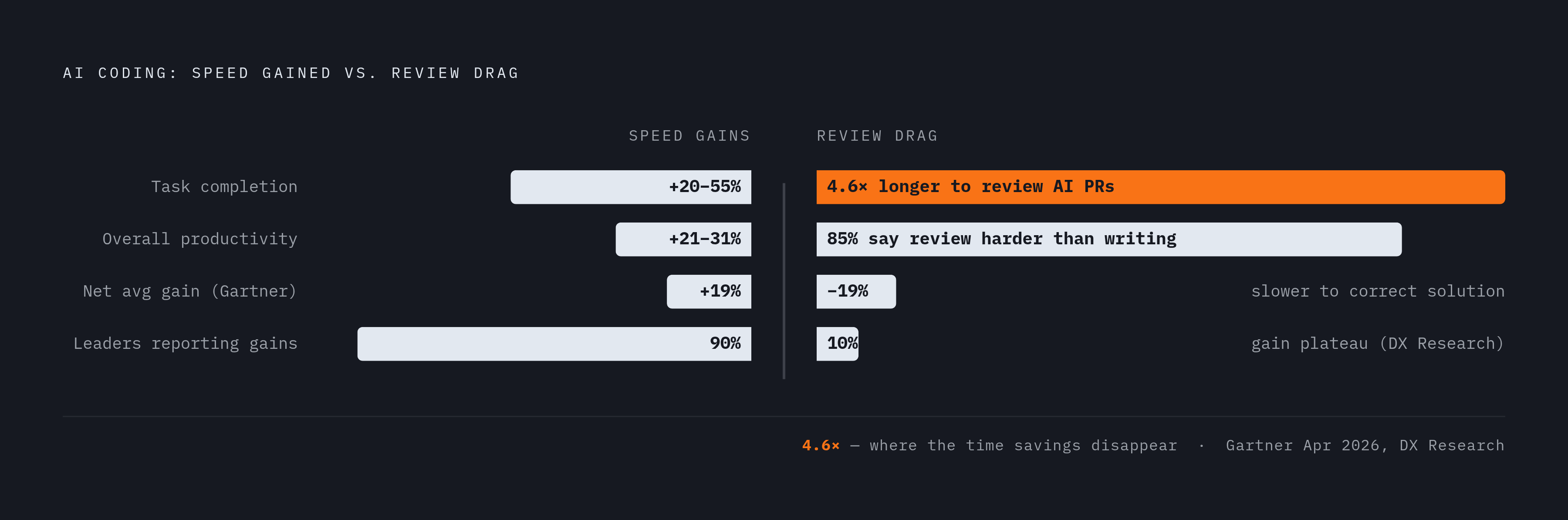
Here's a genuinely strange fact sitting at the center of all this: a large share of developers now use AI coding agents, and yet trust in AI accuracy has actually dropped, from 40% down to 29% year-over-year. People are using the tools more and believing them less. That gap is exactly what visible, reviewable, in-channel agent work is supposed to close. If everyone can watch the work happen and check it as it goes, trust has something to rebuild on besides a vendor's word.
The upside numbers show measurable gains in task-completion speed improvements, code output increases, and overall productivity gains, as detailed below. A Trigidigital impact study cited on dev.to in 2026 found task-completion speed improvements of 20% to 55%, code output increases of 12% to 15%, and overall productivity gains between 21% and 31.4%. Gartner's April 2026 data lines up with that direction: 90% of engineering leaders reported improvements from AI coding tools, with a net average productivity gain of 19.3%.
But the counter-evidence deserves equal space, not a footnote. A 2026 report found developers using AI were, on average, 19% slower to reach a verified correct solution than those working manually, and pinned the slowdown mostly on the burden of reviewing what the AI produced. A 2026 GitLab enterprise report found 85% of teams now say reviewing AI-generated code is a bigger challenge than writing code themselves. And A 2026 study from DX Research found productivity gains plateauing around 10%, even with 93% of the 121,000 developers surveyed reaching for AI tools regularly.
Put those two sets of numbers side by side and a pattern jumps out: the code gets written faster, but somebody still has to read it, and reading it carefully takes real time. That's the exact bottleneck a shared, visible code channel is built to attack. Instead of one person reviewing alone at the end of a chain, review becomes a team activity happening in real time, while the work is still fresh in everyone's head.
That also means the old ways of measuring engineering output don't tell the whole story anymore. PRs per week, lines of code, commit counts, all of those numbers can go up in an agentic workflow without productivity actually improving, because volume and value aren't the same thing anymore. How much of the codebase is AI-generated, velocity adjusted for the complexity of what shipped, code quality over time, and actual cost against actual return is worth tracking instead.
The cost structure that changes when agents run inside existing Slack and GitHub plans
Gartner pegged the enterprise AI coding agent market at somewhere between $9.8 billion and $11.0 billion annualized, as of April 2026. That's a market enterprises are actually committing real spend to, not experimental-budget money. That's a market enterprises are actually committing real spend to.
On return, Larridin's 2026 figures put a healthy range at 2.5x to 3.5x average ROI, with the top quartile of teams seeing 4x to 6x. That math only holds if the cost side of the equation includes actual token and usage-based spending, not just what a company pays for seats. A lot of teams underestimate their real agent costs by only counting the subscription line.
And that usage cost is a genuinely new variable. Agentic tools introduce token-based charges that can run anywhere from $200 to over $2,000 per engineer per month, depending on how much autonomy is granted and how many parallel sessions are running at once. Background sessions and long-running agent tasks push that number up fast, often faster than anyone budgeted for.
Here's where Slack Code's own pricing gets interesting. Slack Code sits on any Slack plan, no premium tier needed. GitHub Copilot's Slack integration draws against Copilot entitlements a team already has, and can be tracked against existing Copilot cloud agent budgets, though the cloud sandbox the agent invokes during a Slack session bills separately and needs its own budget line. Meanwhile, each individual agent, Claude, Devin, Codex, Vercel's, gets metered on its own by its own vendor.
So the interface layer itself, Slack plus GitHub, isn't really where new cost appears. The cost variable is agent consumption, and parallel or background execution is exactly what drives that consumption up. Teams need real visibility into that spending before they scale this kind of workflow across a whole org, not after.
Not every task needs the most expensive, highest-capability model available. Routing simpler jobs to less expensive models, and saving the frontier model for genuinely hard problems, is one of the more straightforward ways teams protect their ROI as usage scales up.
Setting up Slack and GitHub integrations for an autonomous coding workflow: what teams need to do before the first agent session
Before anyone mentions an agent in a channel and expects it to actually do something, a few pieces have to be in place. GitHub's own changelog from August 21, 2026 describes GitHub Copilot's Slack integration specifically as follows:
- The organization needs to be on GitHub Copilot Business or GitHub Copilot Enterprise. The integration isn't available on lower tiers.
- An administrator needs to turn on the Copilot cloud agent policy. This is the setting that actually lets the agent run in a secure cloud sandbox rather than just answering questions.
Getting these two things sorted first isn't busywork. It's the difference between an agent that can actually open a PR from a Slack thread and one that can only chat about the code without ever touching it. The setup is small. What it unlocks, a genuinely shared workflow between the place where decisions get made and the place where code gets shipped, is the actual point of all this.
Sources
- The new GitHub Copilot experience in Slack - GitHub Changelog
- Slack launches Code for AI coding collaboration
- Slack Just Turned a Chat Channel Into a Place Where AI Agents Can Write Code
- How Coding Agents Work in Slack
- Slack Code: Where Your Team and Agents Build Together
- Integrating Copilot cloud agent with Slack - GitHub Docs
- Introducing Slack Code: Agentic Coding for Teams
- salesforce.com