Automated Code Review Tools for Security Vulnerabilities
AI-written code carries security risks that automated review tools are built to catch.
AI-generated code makes up close to half of all commits now, and somewhere between 40% and 62% of that code carries a security vulnerability, depending on which study you trust. That's close to a coin flip on every pull request.
Stanford researchers found that developers using AI assistants wrote less secure code in four out of five tasks, but felt more confident about the security of what they'd written. That gap between how safe you feel and how safe your code actually is needs a tool sitting between you and the merge button.
Veracode's 2025 research backs this up: AI introduces vulnerabilities in nearly half of all coding tasks it looked at. Legit Security disclosed a Copilot Chat prompt injection that pulled AWS keys out of private repos through hidden PR comments (fixed in August 2025). Amazon's AI coding tool once deleted a production environment on its own, causing a 13-hour outage. These are previews of what's coming, not edge cases.
A 2026 InformationWeek report found AI-generated pull requests take 4.6 times longer to review and carry 15% to 18% more security vulnerabilities than code a person wrote start to finish. The tool that was supposed to save time is quietly handing that time to whoever reviews the output. Automated security review isn't a nice add-on for teams using AI to write code. It's the toll you pay to use AI responsibly at all.
What automated security code review tools actually do
Strip away the branding and here's the plain definition: this is software that reads your source code and looks for vulnerabilities, insecure patterns, exposed secrets, and compliance gaps, without a human having to read every line first.
That's different from a general AI code reviewer checking your style or whether your function does what you meant it to do. Security tools are built and tuned around specific vulnerability classes: SQL injection, cross-site scripting, hardcoded API keys, that whole family of known troublemakers.
Most serious tools run on two mechanisms at once:
- Pattern matching (rule-based scanning). This catches known vulnerability signatures by recognizing structural patterns in the code. It knows what SQL injection tends to look like, so it flags anything that resembles it.
- An AI or LLM layer. This traces where data actually goes as it moves through the program, catching problems the rule-based approach is structurally blind to (bugs that only exist when you look across functions or across files).
Both often rely on something called AST analysis, short for Abstract Syntax Tree. Instead of scanning your code as plain text, the tool parses its actual structure, the way a compiler would. That's how it finds exactly where in the call graph a vulnerability lives, instead of just guessing from the surrounding words.
What these tools don't do matters just as much. They don't judge your architecture. They don't know your business logic. They don't understand your threat model the way a senior engineer who's been burned before would.
Where you meet these tools varies: comments on a pull request, a gate in your CI/CD pipeline, or inline suggestions right in your editor. The touchpoint shapes how much attention the findings actually get.
The three layers of automated security scanning and what each one catches
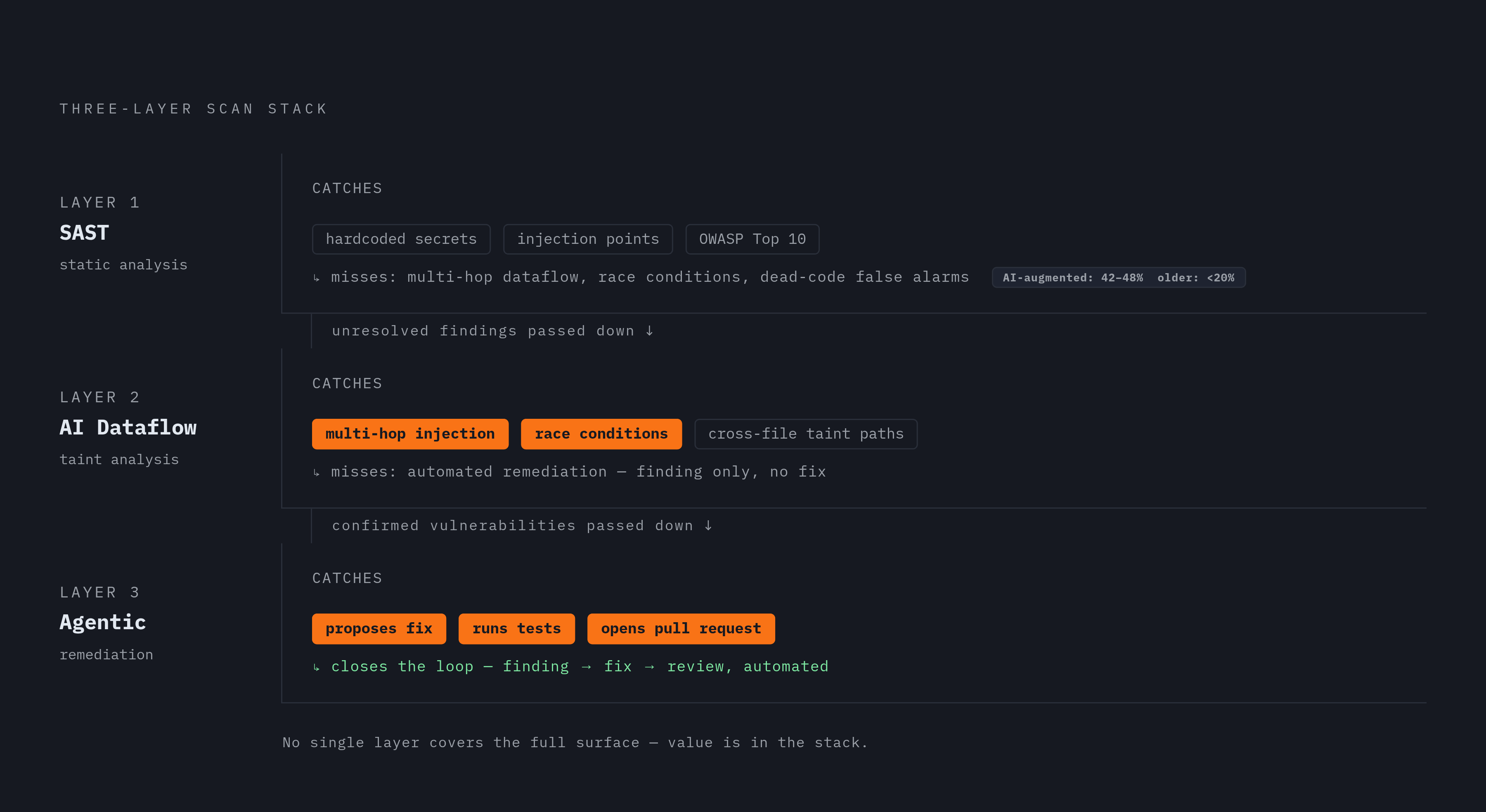
Think of this as three nets stacked on top of each other, each one catching what slipped through the last.
Layer 1: Static Application Security Testing (SAST)
SAST reads your code without running it, checking for known vulnerability patterns using rule libraries and AST parsing.
It catches: hardcoded secrets, injection points, unsafe deserialization, weak crypto, and most of the OWASP Top 10 patterns.
The catch: SAST sees code as text, not as a system in motion. It has no idea if a vulnerable line ever actually runs, so it throws a lot of false alarms at paths that are dead code. Older SAST tools catch less than 20% of issues that actually matter. The newer AI-augmented versions have pushed that up to somewhere around 42% to 48% of real-world runtime bugs. A cross-tool study also found that combined SAST tools work best for C and Python, balancing what they catch against how often they cry wolf, while combined LLMs do better for Java.
Layer 2: AI-assisted pattern recognition and dataflow analysis
This is where LLMs trace how data actually moves. From a user typing something into a form, to that value hitting a database call, to it showing up unfiltered in a rendered page. That's a tainted path, and rule-based tools can't follow it because it spans multiple files and functions.
It catches what SAST misses: injection bugs that need several hops to trigger, race conditions, broken permission checks, secrets that are fine in one context and a leak in another.
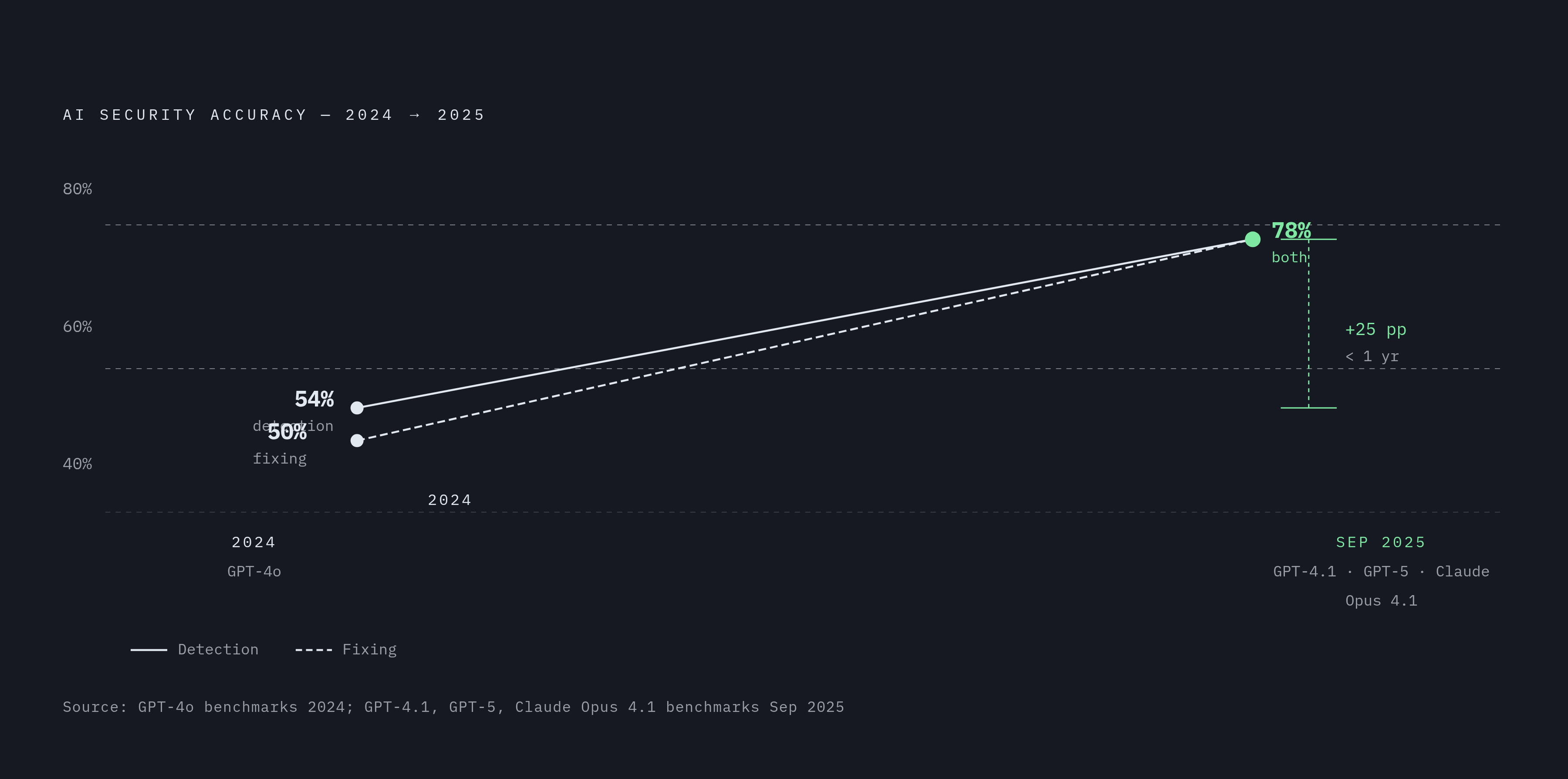
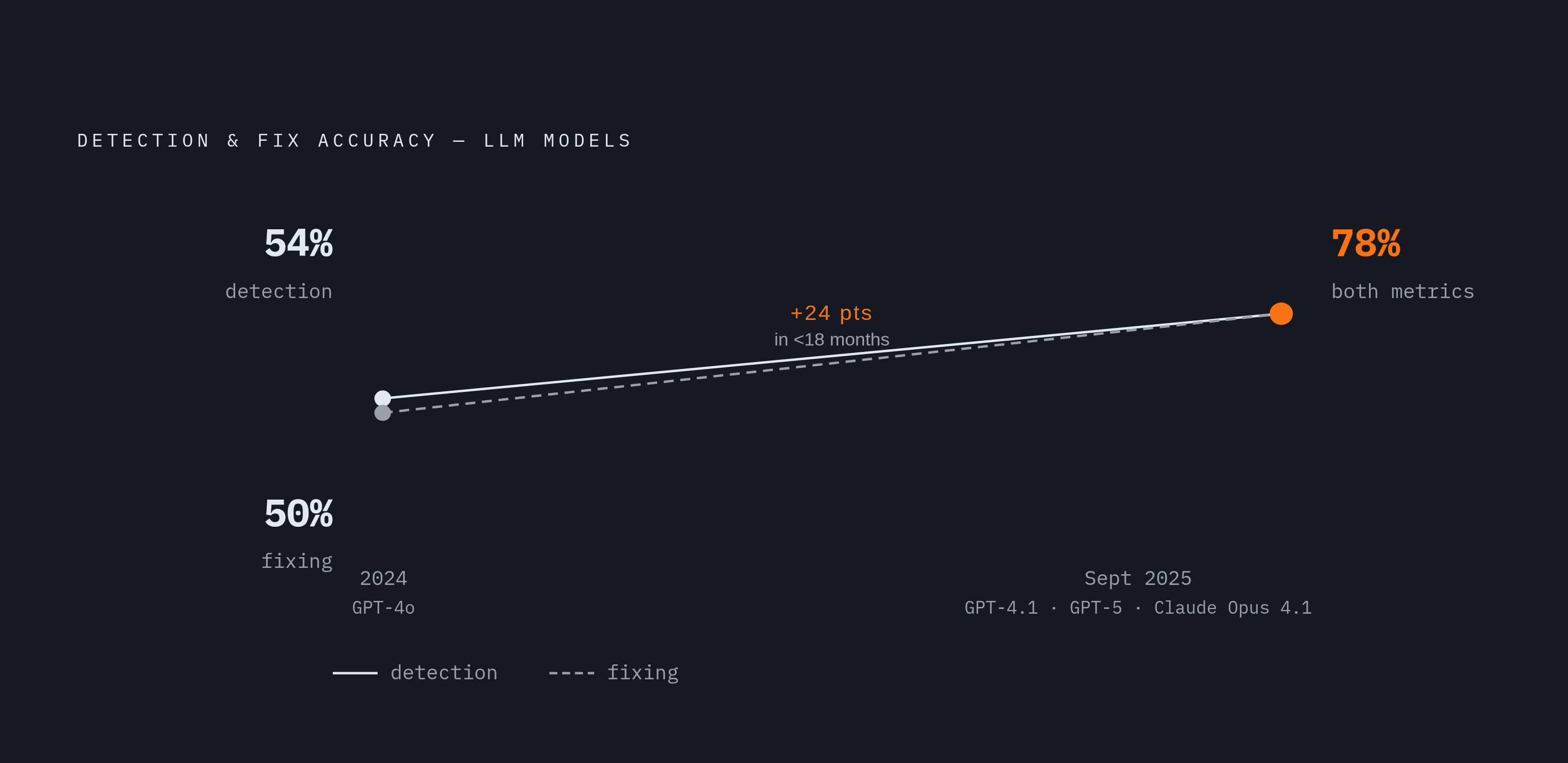
The progress here has been fast. GPT-4o in 2024 hit around 53% to 56% detection accuracy and about 50% fixing accuracy. By September 2025, GPT-4.1, GPT-5, and Claude Opus 4.1 had all climbed to roughly 78% on both.
There's a stubborn weak spot, though: these models often can't tell the difference between vulnerable code and the patched version of the same code. Business logic flaws, the stuff about what the code was supposed to do, mostly stay out of reach. No model can read your product requirements doc.
Layer 3: Agentic and hybrid remediation
This layer goes past flagging problems into fixing them. The agent reads the finding, proposes a fix, runs tests against it, and either opens or updates a pull request.
Research backs the "combine everything" approach. IRIS, presented at ICLR 2025, showed that pairing LLMs with CodeQL beat CodeQL running alone. SAST-Genius, from IEEE S&P 2025, used an LLM to filter out SAST's false positives and cut that noise down substantially. Hybrid wins over either approach by itself, and that's what the research keeps finding.
The agent's loop usually goes: read the finding, trace the relevant code, propose a fix, check it doesn't break existing tests, then hand it to a human for approval. The developer stays the one who decides what actually ships.
Put the three layers together and you get the real picture: SAST for breadth, LLM dataflow analysis for depth, agentic remediation to close the loop on fixing what's found. No single layer covers the whole surface. That's just the nature of the problem.
Where each major tool sits in this stack
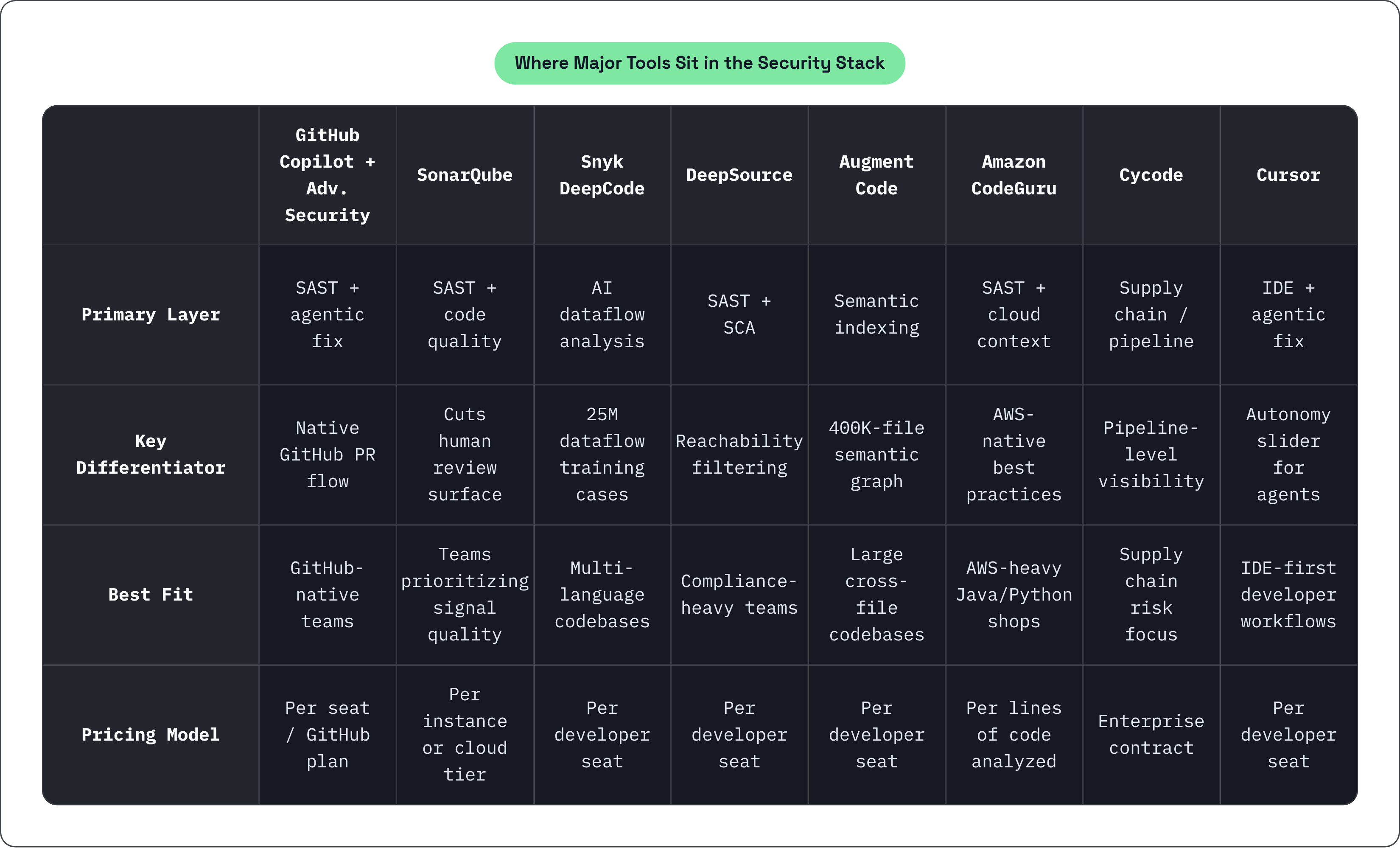
Tools don't just differ in what they catch. They differ in where they live, what languages they cover, and how findings actually reach you.
GitHub Copilot + Advanced Security bundles CodeQL (SAST), secret scanning, and Copilot Autofix right into the GitHub pull request flow. If your team already lives in GitHub, this is the path of least resistance, and Autofix proposes fixes inline at the PR stage.
SonarQube (Sonar) acts as an independent check on AI-generated code, flagging defects, vulnerabilities, exposed secrets, and code that's gotten too tangled to maintain safely, all at the PR stage. It's built around a specific idea: cut down what a human reviewer has to look at by surfacing the highest-risk stuff first.
Snyk DeepCode trained on a large body of real codebases, with 25 million dataflow cases across 11 languages behind it. It gives you remediation guidance specific to your situation, so you're not off Googling the fix yourself.
DeepSource covers secrets detection across more than 165 providers, from AWS to Stripe to Twilio. Its software composition analysis uses reachability analysis, meaning it only raises an alarm about vulnerabilities in code paths your app actually runs, a direct answer to the false-positive fatigue problem. It also builds in compliance reporting for OWASP Top 10 and SANS Top 25 out of the box.
Augment Code takes a different angle: its Context Engine indexes over 400,000 files using a semantic dependency graph, so it understands how authentication actually works in your codebase, not some generic textbook version. A 2025 evaluation credited that depth of indexing with a 59% F-score on code review quality.
Amazon CodeGuru makes the most sense if you're already deep in AWS. It understands how your code talks to S3, DynamoDB, and Lambda, and flags AWS best-practice violations right alongside security bugs. Language support leans heavily toward Java and Python, and pricing scales with lines of code analyzed rather than team size, which is worth doing the math on before you commit at scale.
Cycode sits a level up, at the software supply chain and pipeline level rather than just the file or PR level. It ranked first for Software Supply Chain Security in Gartner's 2025 Critical Capabilities for Application Security Testing, and was named a Leader in the 2025 IDC ASPM MarketScape.
Claude Code Security, announced by Anthropic in February 2026, reportedly found real bugs in decades-old, expert-reviewed open source projects, a signal that frontier models are starting to find novel vulnerabilities, not just ones that match something they've seen before.
Cursor takes the "meet developers where they already are" approach seriously. Its Bugbot runs security and correctness review directly in the IDE and the pull request flow, the same place code gets written. Teams report 40% time savings on code review, and around 50% of flagged issues get fixed before merge. Its agents can go further too: trace a vulnerability's root cause across files, propose a fix, run tests, and update the PR, which is the agentic layer a lot of standalone scanners simply don't have. Cursor also gives you an autonomy slider, so you decide whether agents run the whole remediation loop themselves or stop and wait for your review on each fix.
What these tools reliably miss and why
None of this works if you think the tools catch everything. Knowing exactly where they fall short is half of using them well.
Business logic vulnerabilities. A tool can only judge what your code does, not what it was supposed to do. Broken access control, authorization bypasses, workflows that are technically correct but logically wrong, these all require someone who knows the intent behind the system. No scanner has that.
Design-level flaws. Threat modeling, a badly drawn trust boundary, an architecture decision that seemed fine at the time. None of that shows up as a pattern in a file. It's structural, and structure is largely invisible to something scanning line by line.
Novel attack patterns. Rule libraries and LLM training data both lag behind what attackers are actually doing right now. A brand-new exploit chain often won't match anything the tool has learned to recognize, because it hasn't seen it yet.
The agent-as-attack-surface problem. A large share of companies planning to deploy AI agents have found their existing security tools were never built with autonomous code execution in mind. The threat surface now includes the agent itself, not just the code it's looking at.
False positive fatigue. Even the best tools generate noise, and AI-written pull requests carry meaningfully higher security issue rates than human-written ones, meaning reviewers have more to sort through. Reachability analysis, the approach DeepSource uses, is a partial fix.
The patch-confusion problem. LLMs often struggle to tell vulnerable code apart from its patched version. That means a suggested fix can, in some cases, quietly reintroduce the same kind of bug in a slightly different shape.
The dual-use problem. Palo Alto Networks concluded in May 2026 that frontier models are extraordinarily good at finding vulnerabilities and turning them into working exploits, in near real time. That's the same capability that makes these tools useful for defense, and exactly why the underlying models are risky if exposed without any controls around them. The better these tools get at finding bugs, the better they'd be at exploiting them too, in the wrong hands.
Let the automated tools gate on what they're actually reliable at: secrets, injection points, known CVEs, tainted dataflow. Save human attention for logic, architecture, and anything the tool itself flags as uncertain. That split isn't a compromise. It's just matching the tool to what it's actually good at.
How to choose the right combination for a given engineering context
There's no single tool that covers the whole vulnerability surface, so the real question isn't "which tool is best." It's which combination fits how your team already works.
Start with where findings need to show up.
- IDE-first teams get the most value from inline feedback, catching problems while the context is still fresh in your head.
- PR-centric teams benefit from tools that annotate or gate the pull request, since that's already the moment everyone's paying attention.
- CI/CD-heavy teams need scanners built into the pipeline that can block or warn before merge without anyone having to remember to run them.
Match the tool to your language and ecosystem. Java shops tend to get more out of combined LLM-based tools, per the cross-tool research mentioned earlier. C and Python codebases often get a cleaner signal from combined SAST tools. AWS-heavy teams naturally lean toward CodeGuru. GitHub-native teams lean toward Copilot Advanced Security.
Think about scale honestly. Per-line-of-code pricing, like CodeGuru's model, can get expensive fast as your codebase grows. Team-size pricing is more predictable at scale. Context depth starts to matter more the bigger you get: a tool that can index hundreds of thousands of files semantically, the way Augment Code does, will catch cross-file bugs that a file-by-file scanner simply can't see.
Know your appetite for false positives. High-compliance industries like finance and healthcare probably want tools with built-in OWASP and SANS reporting, plus reachability filtering to cut the noise. Fast-moving startups might care more about fix velocity than exhaustive coverage. High pre-merge fix rates, like the roughly 50% Cursor reports, reduce the pile of security debt that otherwise accumulates after you've already shipped.
Decide how much autonomy you're comfortable with. Teams that are ready for it can let agents run the full remediation loop on their own. Teams newer to AI review might prefer advisory-only mode, approving every fix by hand. That's a decision every team needs to make regardless of tool.
Don't marry one model. Detection rates shift fast by model and by task (frontier models went from about 53% to roughly 78% in about a year). Whatever tool you pick, favor one that isn't locked to a single model under the hood. The best model for finding security bugs today probably won't be the best one in six months.
Deploying automated security review without creating new blind spots
Here's where most teams actually mess this up: they treat the tool as a one-time setup instead of something that needs ongoing attention. Rule libraries go stale. Thresholds never get tuned after the initial rollout. False positives pile up until developers just start clicking past every alert without reading them.
That last part is the real danger. Alert fatigue is a security risk in its own right. Once developers learn that most of what the scanner flags is noise, they stop reading closely, including the rare alert that was actually pointing at something real.
The fix isn't complicated, but it takes actual maintenance: tune thresholds regularly, use reachability analysis where it's available to cut dead-code noise, and treat your rule library the way you'd treat a dependency, something that needs updating.
Automated security review doesn't replace judgment, it just changes where judgment gets spent. Spend less of it re-reading every line for a known SQL injection pattern. Spend more of it on the architecture decisions and business logic questions no tool can answer for you. That's rigor aimed at the part of the problem that's still yours to solve.