DevOps Tool Ecosystem for Teams Using AI Agents
Four layers crack under agent-scale load, and most teams aren't prepared for the pressure.
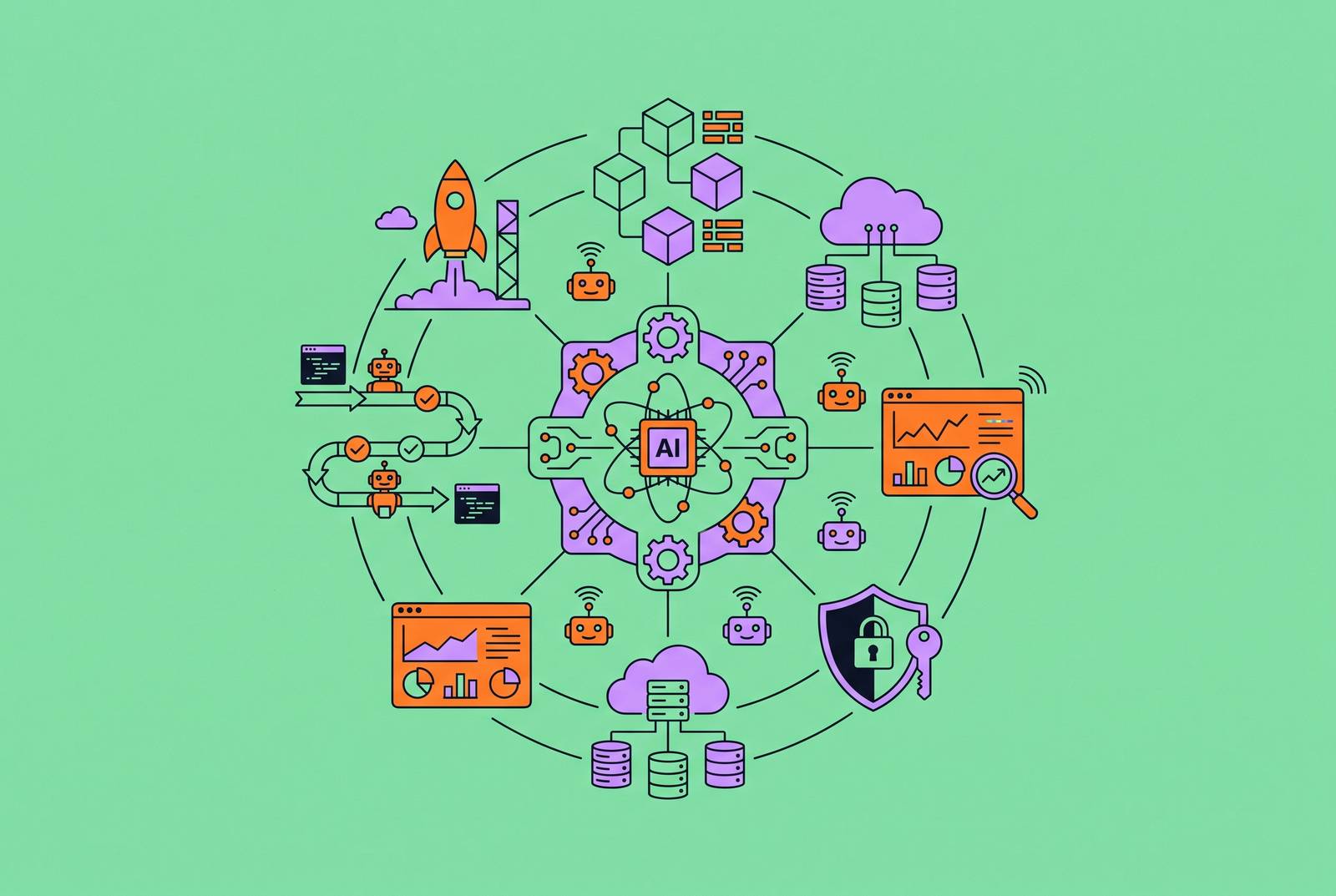
The agent-era DevOps stack: 11 layers, 120+ tools
Agents now write code, run tests, open pull requests, and respond to CI failures with little to no human involved while it's happening. Agents plan the work, do the work, and check the work. A person shows up at the start and at the end, and not much in between.
That's different from a copilot. A copilot suggests a line, and a person decides whether to take it. An agentic system takes a goal, breaks it into steps, writes the code, runs it, notices when something's broken, and tries again, often with nobody watching the middle part. A planner agent might break "add rate limiting to this API" into sub-tasks. A coding agent builds each one. A reviewer agent checks the result for quality and compliance. The loop closes on its own.
Stripe shipped 1,300 pull requests in a single week by running agents across its development workflow, not by hiring 1,300 more engineers. That's a pace no human review process was ever built for.
Three things came together to make this possible. Frontier models got reliable at structured function-calling: calling tools and APIs predictably instead of guessing. Orchestration frameworks got stable enough to run in production instead of falling over after a few steps. And enterprise adoption moved past proof-of-concept into "this runs our pipeline now."
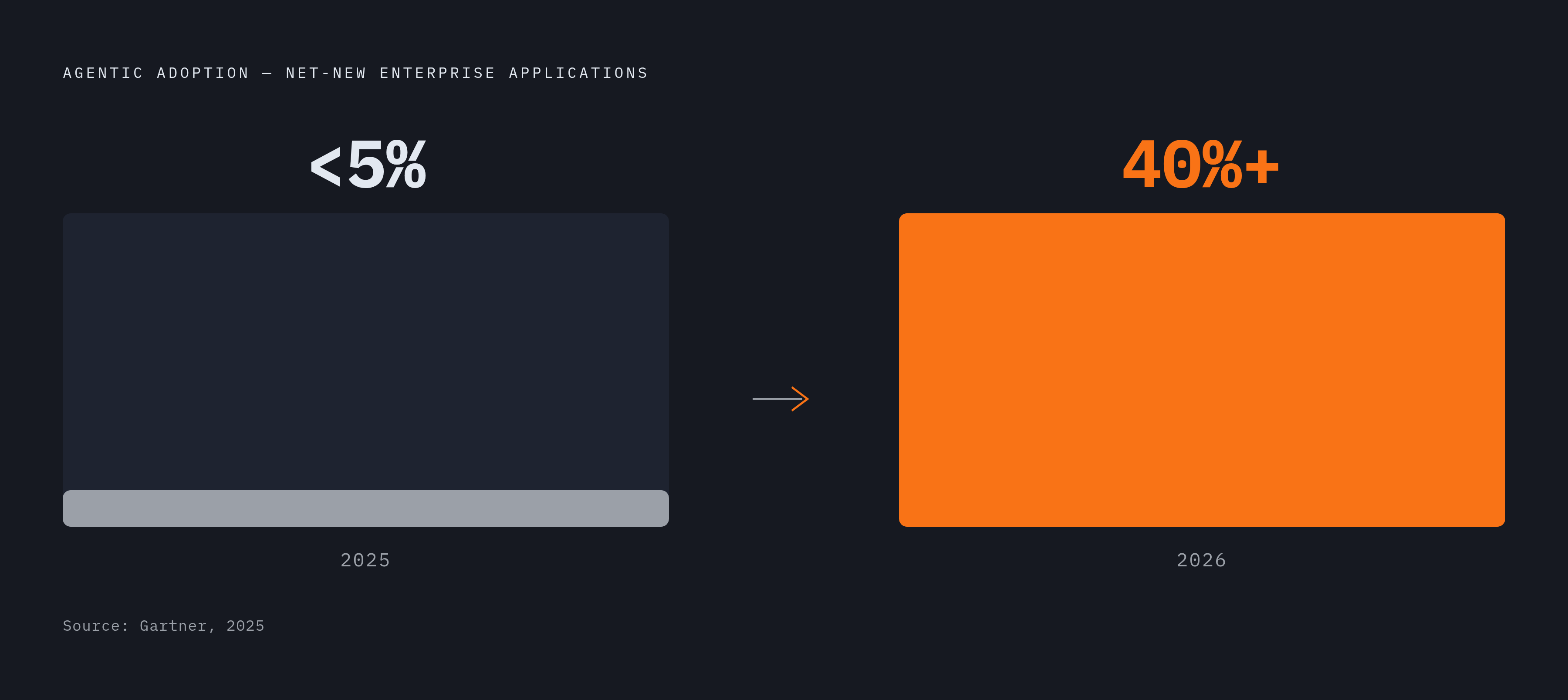
Gartner projects more than 40% of net-new enterprise applications will include task-specific agent capabilities by the end of 2026, up from under 5% in 2025, a sprint rather than a gradual trend. That's a sprint, not a gradual trend. A pipeline built for humans working one commit at a time doesn't just feel that speed. It cracks under it, in specific, findable places.
As of early 2026, the tool landscape isn't a handful of scrappy startups anymore. StackOne's maintained landscape map counts more than 120 production-ready tools spread across 11 distinct categories, a fully segmented market rather than a fringe experiment. That's a fully segmented market, not a fringe experiment.
The 11 layers, and roughly what each one handles:
- AI agent frameworks (code-first orchestration, the logic that runs the agent's loop)
The layers aren't independent, and treating them like they are is the most common mistake teams make setting this up. StackOne's own framing is that "winners integrate best with the others," meaning picking a tool at one layer without thinking about the layers above and below it is a mistake. A great coding agent that can't talk to your observability layer is a liability wearing a shiny feature as a costume.
The most telling development going into 2026, per StackOne's analysis: every major AI lab now ships its own agent framework. OpenAI's Agents SDK, Google's ADK, Anthropic's Agent SDK, Microsoft's Semantic Kernel (now merged with AutoGen), HuggingFace's Smolagents. That tells you where each lab thinks the real value sits. It also tells you where the lock-in risk hides: a lab's own SDK integrates tightly with that lab's own models, and loosely, or not at all, with everyone else's. Pick one of these as your default and ask whether you're choosing a tool or choosing a landlord.
The map is useful. But not every layer on it gets stressed the same way once agents start running through it at volume. Four layers break first, in predictable, specific ways, and knowing which four is more useful than memorizing all eleven.
The four layers where human-paced tooling breaks under agent load
Agents don't just do the same work faster. The volume, the concurrency, and the kinds of errors change at every stage they touch. A tool built to handle one engineer committing a few times a day was never tested against ten agents committing around the clock.
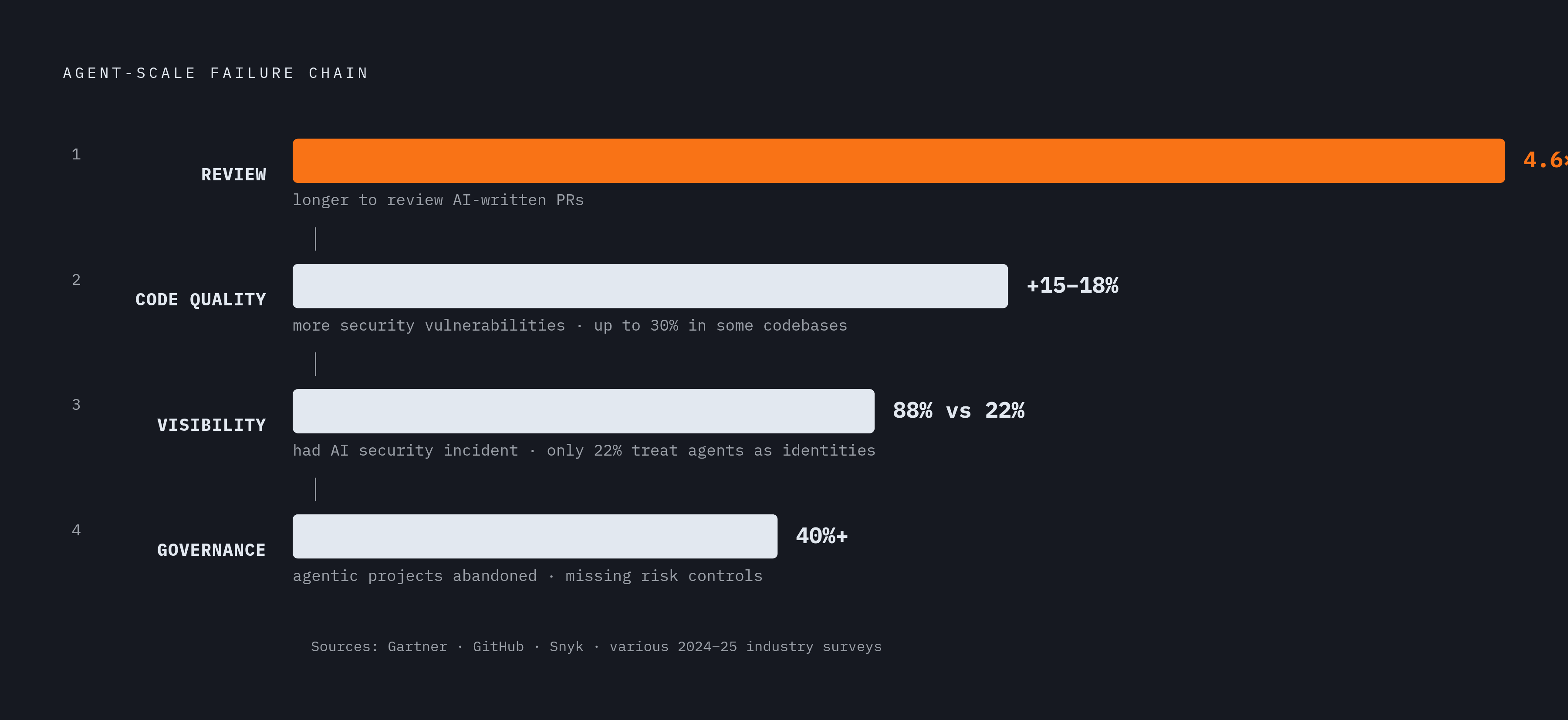
Review capacity goes first. The pipeline speeds up on the writing side and jams on the reading side. Human approval becomes the tightest constraint in the whole system, which is a strange place to land after adding automation. An Opsera benchmark found AI-generated PRs take 4.6 times longer to review than PRs written by humans. Agents didn't remove the bottleneck. They moved it, and made it worse.
Code quality and churn follow close behind. Opsera's 2026 benchmark found AI-generated PRs carry 15% to 18% more security vulnerabilities than human-written code, and separate research found some enterprise codebases show up to 30% more vulnerabilities when using AI tools. When code gets rewritten or reverted at a higher rate than human-written code, that's review discipline or prompting practice failing to catch problems early. Security scanning gates were tuned for the pace of human commits. They were never calibrated for agent-scale throughput, and the vulnerability counts show it.
Visibility disappears next, and this is the one that should worry people most. Agents work across multiple steps, tool calls, and sessions. Standard logging captures what came out the other end, not how it got there. Research cited by Symphony Solutions found 88% of organizations have already had an AI-related security incident, yet only around 22% treat agents as identity-bearing entities. Most companies aren't tracking their agents as things that can act on their own. Agents are doing the work. Most systems aren't watching them do it.
Governance stalls the whole thing. Per Gartner's research, most agent deployments don't fail during experimentation. They stall during security review, permissions setup, or the grind of integration hardening. Gartner expects more than 40% of agentic projects to get abandoned, usually from rising costs, unclear business value, or risk controls that never got built. Most pipeline tools assume a sequential, human-driven workflow. None of them have a native concept of an autonomous agent asking for elevated permissions in the middle of a task. That request has nowhere to go, because nobody built it a place to go.
Review capacity, code quality, visibility, and governance: those four failure points are the test the rest of this piece runs against every layer of the stack.
Orchestration frameworks: choosing the layer that controls agent behavior
An orchestration framework runs the agent's loop. It handles planning (breaking a goal into steps), tool use (calling APIs, databases, running code), reflection (checking its own intermediate results), and memory (keeping state across steps). Picking the wrong one here means every layer downstream inherits the weakness.
The architecture trend in 2026 is graph-based orchestration replacing simple chain-based patterns. LangGraph and Google's ADK both model agent behavior as a directed graph, which lets a workflow stay stateful and support multiple agents working together instead of one agent running a straight line of steps.
GitHub star counts and positioning as reported by StackOne show the current field:
- LangChain, 126,000 GitHub stars, the foundational library most Python agent builders touch at some point
StackOne's own read: the lab-specific SDKs give the tightest integration with their own models, at the cost of being locked to that provider.
That last tradeoff deserves more skepticism than most teams give it. Tight integration today can mean an expensive rebuild the day a team wants to switch models, and a lab's own SDK is never neutral about which lab's model it recommends. The "official" framework from a model provider is a sales channel first and a tool second.
For DevOps work, framework choice decides whether an agent can checkpoint its progress, recover after a failure, and get interrupted mid-task. That matters a lot for anything long-running in CI/CD. LangGraph hitting a stable 1.0 API and CrewAI adding production checkpointing both matter for the same reason: an agent that can't resume after a crash is a liability sitting in the middle of a pipeline, and no amount of clever prompting fixes that.
Coding agents and IDE integration: where agents enter the codebase
Coding agents in 2026 don't just autocomplete a line. They generate code, refactor it, write tests for it, debug it, and configure how it deploys.
The current field:
- Claude Code (Anthropic, 2025), an agentic coding tool
The practical rule: agents should work where developers already work. IDE, terminal, Slack, GitHub. Not in a new siloed tool nobody logs into. Judge any coding agent against that bar first, before looking at benchmark scores.
Stripe's approach argues against the easy assumption that a bigger, more general model always wins. The company fine-tuned Claude on its own internal codebase, with the resulting gain in domain-specific accuracy estimated at 40% to 60%. Off-the-shelf agents, however capable, tend to stumble on a codebase's own conventions, internal libraries, and quirks, unless someone puts in that tuning work. Buying the most powerful model on the market and skipping this step is a common way to waste the money spent on that model.
The DevOps math here is simple: whichever coding agent gets picked sets the pace of commits and PRs the rest of the pipeline has to absorb. Picking a fast one without fixing the review bottleneck from the last section just means the pipeline finds a new place to jam.
Model selection for pipeline tasks: routing the right model to the right job
No single model wins every task in 2026. The smarter setup routes different kinds of requests to different models, based on how complex the task is, how fast the answer needs to come back, and what it costs.
Benchmark snapshot from July 2026, from morph LLM and gitautoreview:
On SWE-bench Verified, the leaders are GPT-5.6 Sol (96.2%, independently verified) and Claude Opus 5 (96%) and Claude Fable 5 (95.0%).
- On Terminal-Bench 2.0, which covers security, DevOps, and infrastructure work, GPT-5.3 Codex leads at 81.8% running with the ForgeCode agent.
- On Frontend Code Arena, Kimi K3 ranked first, ahead of Claude Fable 5.
- A cluster of mostly open-weight models runs close together on SWE-bench: DeepSeek-V4-Pro-Max (80.6%), MiniMax M3 (80.5%), Qwen3.7 Max (80.4%), and Kimi K2.6 (80.2%).
Most teams chase the top score instead of the price tag next to it, and that habit is where the budget actually leaks. DeepSeek-V4-Pro-Max scores 80.6% on SWE-bench, matching several frontier models, and it ships with MIT-licensed weights. Its output price runs $0.87 per million tokens, a fraction of what frontier models from major labs typically cost. Comparable benchmark score, substantially lower cost, a gap worth checking before signing off on a model choice.
That gap matters because token costs on agentic pipelines aren't small. Developer productivity benchmarks put the added spend at $200 to $2,000 or more per engineer per month, on top of whatever seat licenses already cost. Routing the right task to the right model is a direct lever on that bill. Picking the flagship model by default, every time, regardless of task, is how teams leave money on the table for no gain in output quality.
A second flag matters before anyone treats these scores as gospel: the same model can score very differently depending on how an evaluation harness is configured, sometimes shifting results more than swapping the model does. Run the comparison in your own environment before betting a pipeline on someone else's number.
The benchmarks that actually tell frontier models apart for pipeline work now are SWE-bench Verified, Terminal-Bench 2.0, and benchmarks focused on tool calling, rather than older general-purpose evaluations that no longer differentiate among top-tier models.
A workable routing heuristic:
- High-stakes code generation and refactoring: frontier models with strong SWE-bench performance
Model choice should stay open. Developers deserve the best model for a given task, whoever makes it. Locking an entire pipeline into one provider's model is an architectural risk wearing a convenience costume.
Observability and evaluation tooling: making agent behavior legible to the team
Standard logging tells a team what an agent output. It doesn't tell them how the agent got there. Agents make intermediate decisions: which tool to call, what to look up in memory, which branch to take when something doesn't go as planned. Regular DevOps monitoring was built to watch deployments and errors, not a multi-step reasoning process, so most of that decision trail never gets captured.
For agent observability to actually help a team, it needs to cover a few specific things: tracing the entire reasoning loop, not just the final output; tracking every tool call an agent makes and what came back; showing exactly where a multi-step chain broke down when something fails; and recording which model, and which version of that model, produced a given result.
That last point matters most once a pipeline routes tasks across several models, a frontier model for hard problems, a cheaper open-weight model for routine ones, as described above. Knowing which model produced a given piece of code is the only way to trace a bug back to its source when something breaks three steps downstream. Skipping that record leaves a team guessing between a bad prompt, a bad tool call, and a model that simply wasn't good enough for the job it was handed.