AI Coding Agent Deployment Automation Patterns
Splitting deployment across your SDLC beats concentrating automation on code generation alone.
Most teams deploying AI coding agents right now treat deployment as a single decision rather than recognizing it as a system of smaller ones. An agent gets bolted onto the coding step, developers see real speedups writing and editing code, and leadership assumes the rest of the delivery pipeline will feel the benefit too. It doesn't work that way.
Forrester's State of Agentic Software Development, 2026 puts a number on the gap. Coding improvements of thirty to forty percent, measured at the code-generation step alone, translate into overall team productivity increases of less than ten percent. Planning, testing, review, and release stay manual, so the bottleneck simply shifts downstream. Speed up the fastest part of a slow system and the system is still slow. The code gets written faster, then sits waiting for a human to review it, test it, approve it, and ship it, at the same pace as before.
This is a structural problem, not a tuning problem. Gains compound when AI gets applied across the full software development lifecycle, with analysis, planning, design, build, test, and delivery moving together, since that is where the bottlenecks were compounding. A faster coding stage feeding into a manual testing stage doesn't produce a faster SDLC. It produces a pile-up in front of testing.
Forrester frames this as the decisive pressure facing tech leaders in 2026: deliver faster and safer results without scaling headcount or increasing risk. Agentic approaches are emerging as the only credible way to do both at once, but only when applied with intention about where and how agents fit into the whole pipeline, including the parts that aren't easiest to automate first.
The real question for a team adopting agents is which patterns govern how they coordinate with each other, how much autonomy they're given, and where they plug into the engineering workflow. Those choices, made deliberately or made by default, are what separate a team that gets a modest productivity bump from one that restructures how it ships software. The rest of this piece is a map of those decisions.
The three orchestration models that govern how agents coordinate across the SDLC
The single highest-leverage decision in any agentic deployment is how agents are orchestrated relative to each other and to the humans around them. Three structural models cover most of what teams are actually running today, and each comes with its own tradeoffs. None of them is a more advanced version of the others. They're suited to different kinds of work and different levels of organizational readiness.
The first model is single-agent, task-scoped execution. One agent receives a bounded task, a feature, a bug fix, a refactor, navigates the codebase, implements the change, runs tests, and surfaces a pull request for a human to review. The paper "Agentic Software: How AI Agents Are Restructuring the Software Paradigm" places this capability in what it calls Stage II: Single-Task Autonomous (2025-2027), an emerging stage where agents can navigate codebases, implement features, and submit pull requests on their own, shifting the human's job from doing the work to specifying it and verifying it. The same paper identifies Stage I, Tool-Augmented (2023-2025), as the mode most teams are still operating in today. Single-agent execution works well for contained tasks where an error has a small blast radius and the review step is straightforward. Its limit is coordination: the agent produces a good artifact, but that artifact doesn't connect upstream to planning or downstream to delivery. It's an island of automation, which is exactly the failure mode the previous section described.
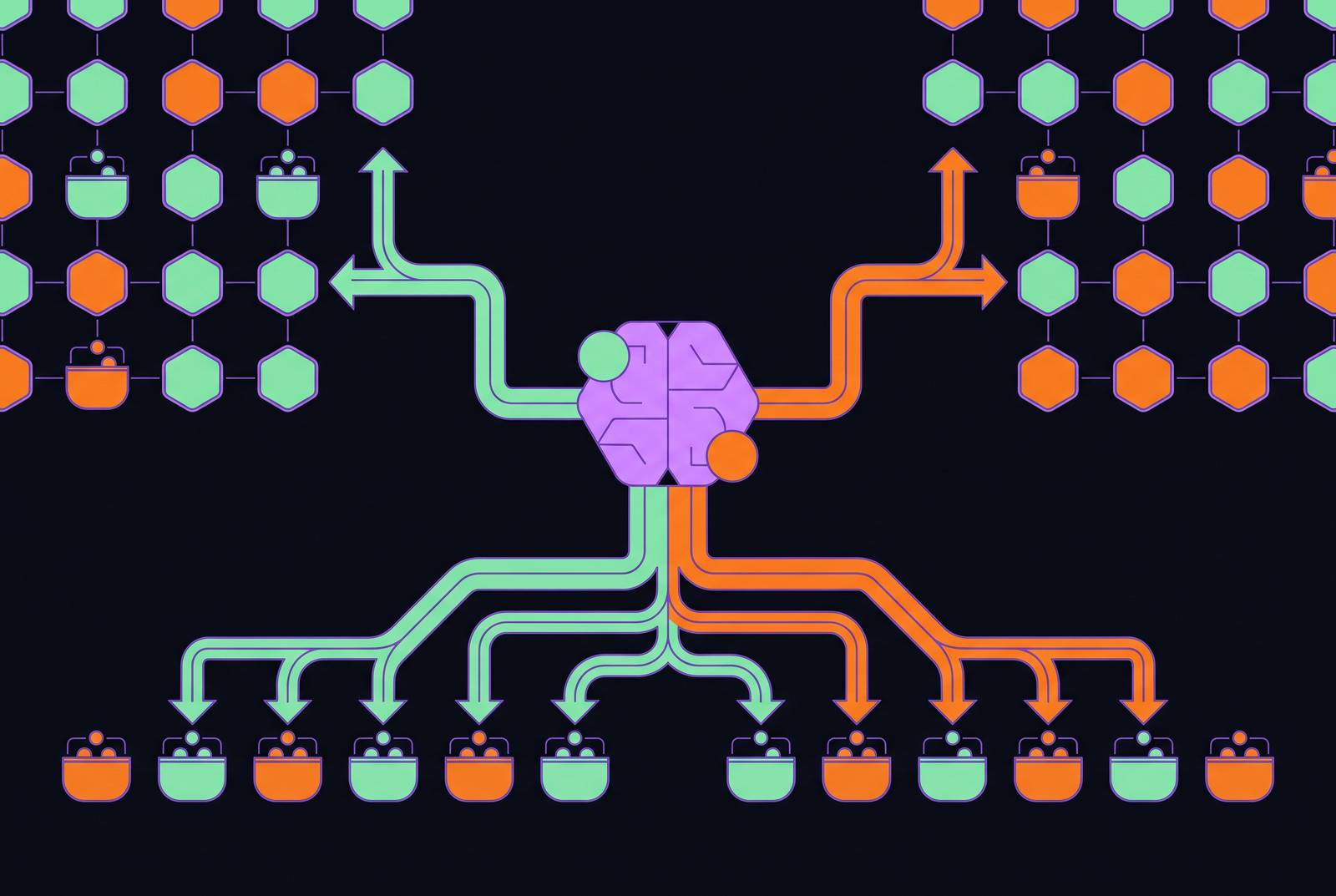
The second model is the orchestrator-worker pipeline. A coordinating agent, or a lightweight orchestration layer, breaks a high-level goal into subtasks and hands each one to a specialized worker agent, then assembles the results into something coherent. Forrester observes that leading adopters are shifting from point tools toward platforms that coordinate multiple specialized agents, rather than continuing to pour effort into code generation alone. The decomposition step is where this model lives or dies. That's the moment where a high-level intent gets translated into concrete, executable subtasks, and any ambiguity in the original request propagates outward into inconsistent behavior across the worker agents. The quality of the orchestrator's planning is the single point of failure worth watching closest.
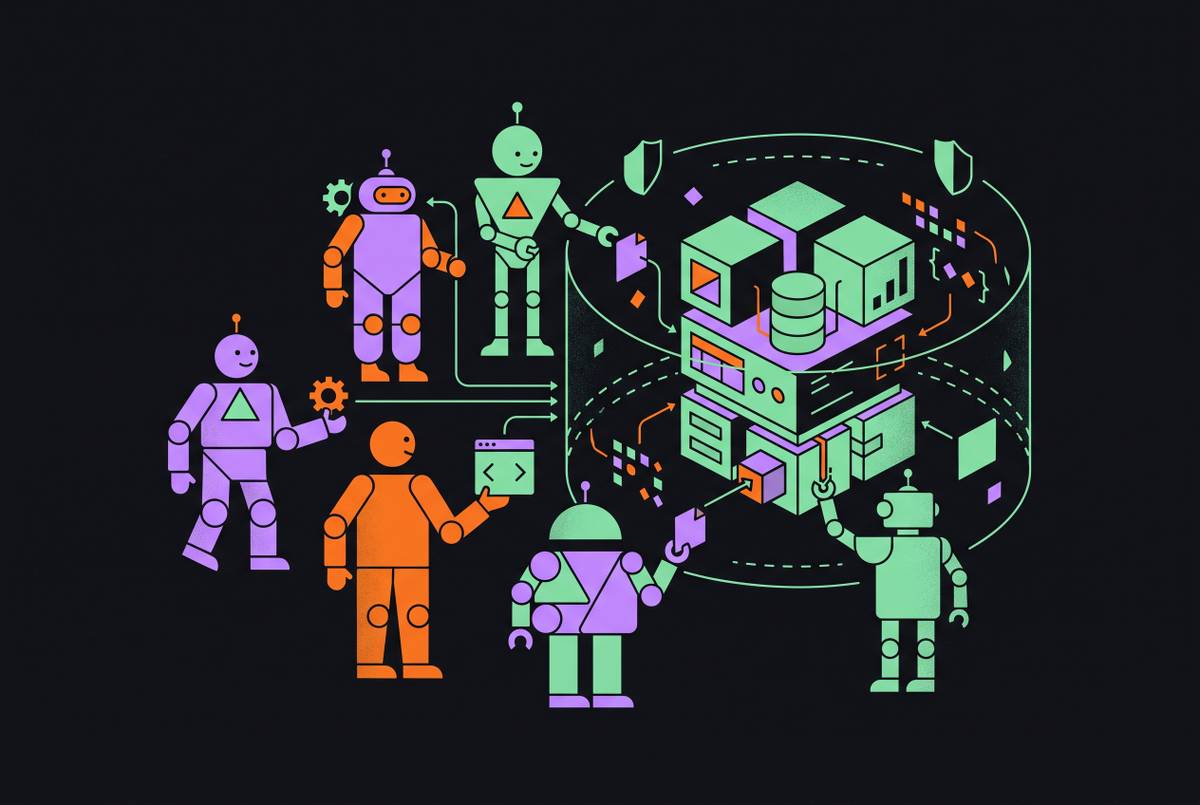
The third model is multi-agent team coordination, where specialized agents, one for planning, one for coding, one for review, one for testing, one for documentation, operate as peers on a shared task, echoing how a human engineering team is organized. Forrester notes that across every role in this model, the critical human skill is the ability to give AI peers clear intent, context, and constraints, not pure technical depth. Architects and senior engineers end up spending their time on system design and what's often called context engineering: making sure each agent operates inside the right boundaries. This model carries the richest coordination and also the richest failure surface. The more agents coordinating with each other, the more opportunities for small errors to compound and for accountability gaps to open up between one agent's output and the next agent's input.
None of these three models is a destination teams are supposed to graduate toward. A team with a small, high-trust codebase and low governance maturity might deliberately stick with single-agent execution for a long stretch, and that's a reasonable choice, not a stalling-out. The decision should track the type of work and the team's readiness to govern coordination complexity, not a race toward the most elaborate setup available.
The synchronous/asynchronous split and human oversight
A second pattern dimension governs this too: whether an agent runs synchronously, with a developer present the whole time, or asynchronously, running independently and returning a finished artifact. This is a governance decision with direct consequences for how oversight gets structured and where problems get caught.
In synchronous execution, the developer stays present while the agent edits code, asks clarifying questions, runs commands, or reacts to feedback inside an IDE or terminal. That produces a tight feedback loop. Errors get caught close to the point where they're introduced, because a person is watching the work happen in something close to real time.
Asynchronous execution looks different. The agent receives a task specification, works in an isolated environment for anywhere from minutes to hours, and comes back with a branch, a pull request, test output, or a report. The paper on agentic software restructuring describes systems in this mode as capable of navigating codebases, implementing features, and submitting pull requests without a human present for any of it, shifting the human's job from doing the work to specifying it upfront and verifying it after the fact. That shift introduces something new to manage: an agent session as its own unit of work, distinct from a single prompt and its response.
That introduces a real gap in oversight. When an agent runs unobserved, answering the question "why was this allowed to happen?" depends entirely on having a complete run record, the starting task, the repo and ref, which tools had permission to do what, which model and provider were involved, and any policy exceptions that got granted along the way. The agent's own summary of what it did isn't a substitute for that record, because the summary is generated by the same system whose behavior is in question.
What are teams actually doing with this choice in practice? The research gives a clear answer. A study of professional software developers found that those using agents build their workflows around deliberate approval points. They plan before letting an agent implement anything, and they validate agentic output before trusting it. No respondents in that research indicated agents are suitable for fully autonomous operation. Developers who use these tools daily are choosing, as a group, to keep a hand on the wheel.
The practical rule that follows: match the synchronous/asynchronous choice to the risk of the task, not to the maximum autonomy the tool happens to support. A task that touches a payment system or an authentication flow warrants synchronous or near-synchronous oversight even if the platform is fully capable of running the whole thing unattended. Capability and appropriateness are two different questions, and conflating them is how teams end up with incidents they didn't see coming.
Setting autonomy boundaries before a run starts
If synchronous versus asynchronous is about when a human watches, this section is about what the agent is allowed to do regardless of who's watching. Autonomy boundaries that live only in a prompt are structurally weak, because an agent can reason its way around a prompt-based instruction the moment it decides the current situation counts as an exception.
This failure mode is a reasoning problem. The agent is doing what it was built to do: pursue the goal it was given. If a constraint in the prompt reads to the model as a soft preference rather than a hard boundary, the model will override it when the goal seems to call for it. The fix is moving the boundary out of the prompt entirely and into configuration that gets enforced before the agent ever starts reasoning about the task.
The AGENTS.md pattern is the clearest version of this. It's a plain Markdown file sitting at the root of a repository, holding conventions, build commands, directories that are off-limits, and the specific safety and approval rules every agent run has to follow. Every agent reads the same file on every run, making the rules structured policy that can't be talked out of. An agent can argue with a prompt. It can't argue with a file it's required to read and a system configured to enforce what that file says.
Permissions need to work the same way. Read-only access should be the default state for any agent, with write operations requiring explicit approval, mapped to specific pre-approved actions like opening a pull request. This is defense in depth applied to what the agent is capable of doing in the first place, rather than trusting the agent to restrain itself once it's already capable of more.
The output surface matters just as much as the permissions model. Agents should open draft pull requests, never push directly to main or to any protected branch. Every one of those draft PRs needs to carry a problem statement, the agent's own rationale for the choices it made, and the assumptions it operated under. A human reviewer isn't just checking whether the diff looks reasonable at that point. The reviewer can see why the agent made the choices it made, which is a very different and much more useful review than eyeballing a code change with no context behind it.
Set up this way, the boundary is a configuration decision made before the run starts, backed by a permissions system and an output format that enforce it independent of what the agent decides in the moment.
The integration points that connect agents to where engineering work happens
An agent confined to a single tool is cut off from the rest of the SDLC, no matter how well its orchestration model and autonomy boundaries are designed. The integration points a team wires up decide whether an agent can act on real engineering signals or only on what a developer manually hands it. These integration points are a pattern choice in their own right, worth configuring deliberately rather than accepting whatever a platform sets up by default.
The IDE and terminal are the baseline for synchronous work. The developer directs the agent against a local or remote codebase, watches the change happen in context, and approves or rejects it before anything moves further downstream. This is the tightest feedback loop available and gives a developer the most direct control over what the agent does. It fits exploratory work, complex refactors, and anything where the specification is still being figured out as the work happens.
GitHub extends that reach into events a developer never has to trigger by hand. An agent wired into GitHub can act on an issue being opened, a pull request being created, or a CI failure surfacing, responding to the event itself as it happens. That unlocks a set of continuous automation patterns: triaging and routing incoming issues, keeping documentation in sync with code changes, investigating CI failures and proposing fixes, and improving test coverage over time, all triggered by what's happening in the repository. The same permissions logic from the previous section applies here directly: read-only by default, with write access limited to specific pre-approved GitHub operations like opening a pull request. The permissions model is what enforces the autonomy boundary at this layer, not any assumption about the agent behaving conservatively on its own.
Slack works as a third kind of surface, an ambient one. Any team member can invoke agent capability from inside an ongoing conversation, scoped to that thread, with no commit happening until a developer takes a deliberate action somewhere outside Slack. The thread itself functions as the oversight record: the request, the agent's response, and the decision to act on it are all visible in one place, which makes the exchange auditable after the fact. Code that originates from a Slack conversation still has to pass through the same code review and CI/CD gates as any other change. Slack is a way to invoke an agent, not a way around the review pipeline that governs everything else.
Holding all of this together is the same AGENTS.md file described in the previous section. Scope, permissions, off-limits directories, and build conventions get read by the agent on every run, regardless of whether that run was triggered from the IDE, a GitHub event, or a Slack thread. That consistency is what keeps an event-driven system from becoming a set of one-off configurations with their own quietly different rules.
The last piece is non-negotiable. Every integration surface, GitHub, Slack, any event-driven automation, has to feed into the same CI/CD pipeline that governs every other code change in the organization. An agent that can commit code without passing through CI creates a structural gap in the audit trail, and that gap exists no matter how carefully the autonomy boundaries were designed everywhere else. The integration points are where the patterns described earlier in this piece, orchestration, autonomy, oversight, either hold together as one coherent system or come apart at the seams.