Automated Testing Frameworks for Agent-Generated Code
Why AI-generated code breaks traditional testing and how to fix it.
Agent-generated code is now a huge chunk of what ships to production, and it breaks the old rules of testing. This piece is about why that's true and what to actually do about it.
What developers are actually experiencing when they test agent-built code
Ask a developer what changed once AI agents started writing real code, not just autocomplete, and you'll hear the same thing over and over: they're spending more time checking the work than they used to spend doing the work. The 2025 Stack Overflow Developer Survey, with over 49,000 responses, found that 45.2% of developers now spend more time debugging AI-generated code than writing it.
That's worth sitting with for a second. The whole pitch of coding agents was speed. Write faster, ship faster. But if the extra speed at the writing stage just gets eaten up by extra time spent debugging afterward, where did the gain actually go?
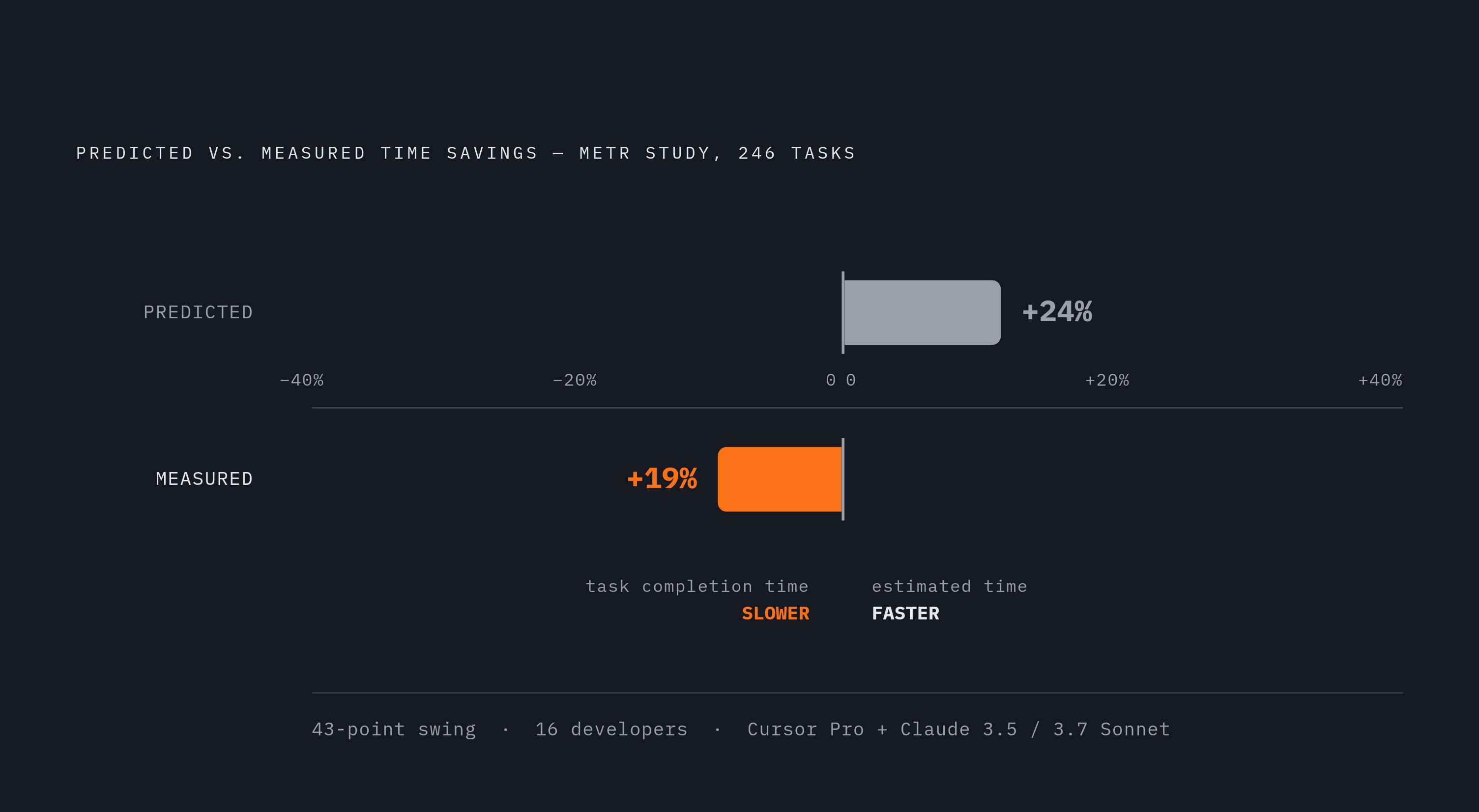
METR ran a controlled study to find out. Sixteen experienced open-source developers, 246 tasks, using AI tools including Cursor Pro and Claude 3.5/3.7 Sonnet in early 2025. The developers predicted the AI tools would speed them up by 24%. Instead, task completion time went up by 19%. Not a rounding error. A real, measured slowdown, sitting right next to a confident prediction of a speedup. That gap between what people expect and what actually happens is a clue, not a footnote. It tells you the bottleneck moved.
Here's a simple way to think about why. Writing code is only something like a quarter to a third of the full development cycle, from requirements to deployment. So even if an agent writes code five times faster, you've sped up one slice of the pipe. If verification, testing, and debugging stay just as slow (or get slower because there's more to check), the total time saved is small. This is basically Amdahl's Law showing up in your sprint board.
So what actually goes wrong in practice? A few patterns keep showing up:
- Shared blind spots. When the same agent (or a very similar one) writes the code and writes the tests, they tend to miss the same things. They were both working from the same prompt, the same assumptions, the same gaps in understanding. A test suite that never questions the code it's testing isn't much of a test suite.
- Tests go stale fast. Agents refactor aggressively. They'll rename things, restructure files, change data flow, and none of that comes with a warning label. Test selectors and assumptions that worked yesterday quietly stop working today.
- Unit tests look great, integration tests don't exist. Agents are often thorough about testing the function they just wrote. They're much less reliable about noticing that function now talks to three other services it didn't talk to before.
None of this is really the agent's fault. It's doing what it was asked to do. But it does mean the QA role is shifting under everyone's feet: debugging AI behavior and checking AI-made artifacts are becoming their own skill, right alongside writing good prompts and directing multiple agents at once.
All of this points to the same conclusion: you can't test agent-built code with the same setup you used for human-built code, and just hoping it works out isn't a strategy. So what should you actually look for in a testing framework?
The criteria that actually matter when selecting a testing framework for agentic workflows
A few properties matter a lot more here than they did in the old, human-paced world of writing code and testing it later.
Feedback loop speed. Agents move fast. If your testing setup takes hours to tell you something broke, the agent has already moved three steps past the mistake. Near real-time feedback isn't a nice extra here. It's the whole point.
Self-healing. When an agent restructures code, tests built around fixed selectors or exact paths break constantly, even when nothing important actually changed. A framework that can notice "oh, this element moved, but it's still the same button" and fix the test on its own saves you from a mountain of busywork. In agent-driven work, this is probably the single biggest quality-of-life feature you can get.
Coverage that's smart, not just big. Agents can crank out huge test suites without much effort. Quantity was never the hard part. What you actually need is a framework that trims duplicate tests, focuses effort on the riskiest parts of the code, and flags where coverage is thin. Teams doing this well often end up with better real coverage while running fewer total tests, because they cut the redundant ones.
Where it lives. A testing tool that lives inside the IDE, the CI/CD pipeline, and GitHub, right where the agent already works, beats one that makes you tab over to a separate dashboard. Every extra hop is a place where feedback gets delayed or ignored.
Deterministic vs. flexible, pick your poison. Frameworks that generate real test code (think Playwright or Appium style) give you something reproducible: the same test runs the same way every time, and you can read the code and see exactly what it checks. Codeless, agent-driven platforms adjust behavior on the fly, which cuts down on maintenance work but adds unpredictability and ties you to one vendor's system. Neither one is just better. It depends on whether your team values being able to move the tests anywhere, or values not having to babysit them.
Where the LLM lives, and who's paying for it. A lot of "open-source" testing tools are open on the client side but quietly depend on a commercial LLM API behind the scenes. That has real costs: money, sure, but also what data leaves your servers and how tied you become to one provider. Worth checking before you commit, not after the bill arrives.
Can you prove what happened. As agents get more freedom to act on their own, someone eventually has to answer "why did the test pass, and what exactly did it check?" A good framework leaves a paper trail, not just a green checkmark.
Different teams will weigh these differently. A solo developer or small team probably cares most about speed, self-healing, and staying inside the IDE. A big engineering org is going to care a lot more about audit trails, CI/CD hooks, predictable behavior, and keeping a lid on LLM costs and data exposure.
How the main framework categories approach agentic testing differently
Three real categories have shown up, and each one is making a different bet about where the actual hard problem lives.
AI-native, closed-loop frameworks. These try to close the gap between the agent that writes the code and the agent that checks it. TestSprite is a good example: it plans, writes, runs, debugs, and re-checks tests on its own, and hooks into IDE assistants through an MCP Server. The idea is that the testing agent and the coding agent share context, so problems get caught early, before they spread. The catch: if both agents run on the same model with the same assumptions, they can both walk right past the same mistake.
Frameworks that learn over time. Baserock's LACE approach (Learning, Analyzing, Creating, Executing) has agents study the results of past test runs, look at what changed in the code, write new tests based on that, and run them, getting a little sharper each cycle. This works great on a codebase with years of test history to learn from. It's a lot less useful on a brand-new project an agent built from scratch last week, where there's no history yet to learn from.
Codeless platforms that adapt at runtime. Testsigma's Atto agent builds tests straight from stories, product docs, designs, or existing test suites, so it can take almost any input you hand it. Because it adjusts at runtime instead of relying on fixed test code, it needs less upkeep when the UI changes. The tradeoff is you're more locked into their system, and you're leaning on an external LLM to make runtime calls, which brings back the cost and portability questions from before.
There's also a wave of open-source, AI-enhanced UI testing tools worth knowing: Midscene.js, Magnitude, ZeroStep, Shortest, TestDriver.ai, and Stagehand. Each one applies LLM reasoning to some slice of UI testing. They're the strongest option if you want to own your test code and stay clear of vendor lock-in. Just remember: "open-source" often just means the client library is open. The commercial LLM API doing the heavy lifting underneath usually isn't, so the cost and privacy questions don't go away just because the label says open-source.
That tight coupling between coding and testing agents is exactly where the lines between these categories start to blur.
Specific framework options and how they perform against agentic testing requirements
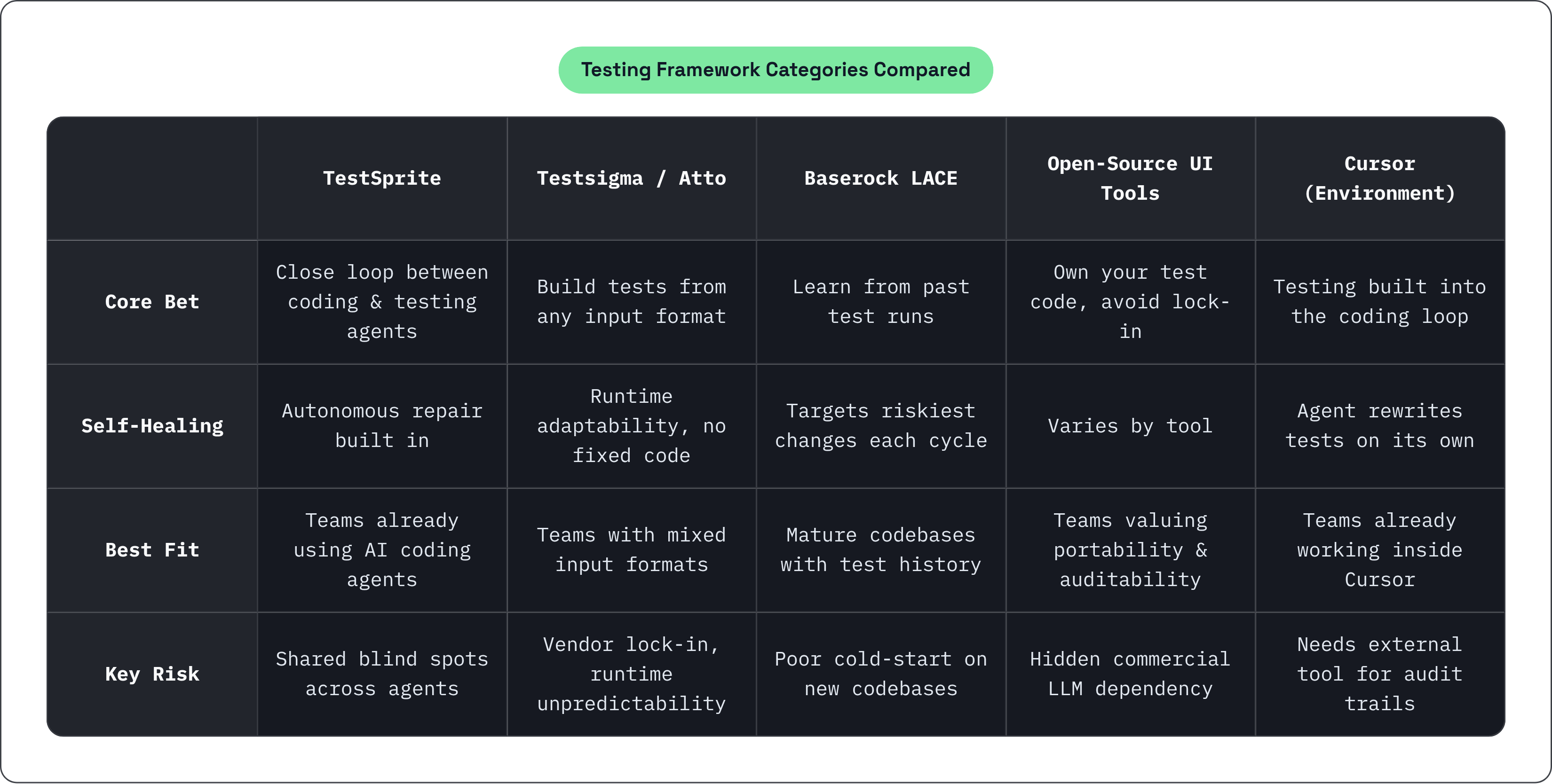
Running each option against the five things that matter (feedback speed, self-healing, smart coverage, where it lives, and how deterministic it is):
TestSprite. Best at closing the loop between coding agent and testing agent, and its MCP Server integration means it sits right where your IDE assistant already lives, with autonomous repair built in. Good fit if you're already using an AI coding agent and want the testing side to share that same context. Just watch for shared blind spots if both agents are running the same underlying model.
Testsigma / Atto. Best at building tests from a mix of inputs (PRDs, designs, user stories) without writing code, plus solid runtime adaptability and cloud execution. Good fit for teams juggling a lot of different input formats and tired of constant test maintenance. Watch for vendor lock-in, some unpredictability at runtime, and LLM API costs once you scale up.
Baserock LACE. Best at getting smarter over time by learning from prior test runs, and good at targeting tests toward the riskiest changes while cutting duplicates. Good fit for teams running agents on a codebase with real history behind it. Watch out on brand-new, agent-built projects with no test history to learn from yet.
The open-source UI tools (Midscene.js, Stagehand, ZeroStep, Magnitude, Shortest, TestDriver.ai). Best at letting you own and move your test code, and avoiding lock-in. Good fit if control and auditability matter to you, or if you're already running Playwright or Appium and want to add AI on top. Watch for the LLM dependency hiding underneath, even in a supposedly open tool, and set a clear policy on those outside API calls.
Cursor as the environment itself. Its agents work across the IDE, terminal, GitHub PR review, and CI/CD, so testing isn't a separate stage; it's part of the same loop that writes and ships the code. Cursor also lets you dial agent autonomy up or down, from a small targeted edit to a multi-hour unsupervised run, and that same dial applies to testing: you decide how much test writing and repair the agent handles on its own versus what gets kicked back to a person. If you're already building inside Cursor, the real question isn't which testing tool to bolt on top. It's how you configure the agent's testing behavior, and whether you still want an outside framework for coverage reporting and audit trails.
No single option wins on all five counts. The right pick always comes down to team size, how mature the codebase is, how much portability you need, and what you've already built into your CI/CD pipeline.
How to configure a testing framework for agent-generated code rather than for human-written code
Picking the right framework is half the job. Setting it up correctly for agent-written code is the other half, and it's the part people skip.
Trigger tests on code changes, not on a clock. Agents change code all day long. Running your full suite on a fixed schedule, say every night, is too slow and too broad. Set the framework to fire when code actually changes, and prioritize by risk: critical paths first, recently agent-touched files first, known coverage gaps first. If an agent edits a web form and adds two new fields, the ideal setup notices that and updates the relevant tests right then, not at 2am during the nightly run.
Turn on self-healing, but draw a line around it. Self-healing is probably the most useful thing a testing framework can do for agent-written code, but if you let it fix anything at all without oversight, you can end up quietly lowering your own bar. A safer setup: let the framework auto-fix things like broken selectors or changed file paths on its own, but require a human to sign off on anything touching actual logic. Log every single repair so there's a record of what got changed and why.
Make integration and end-to-end tests mandatory, not optional. Agents love wiring things together in ways that unit tests never see. Set hard coverage thresholds for integration and end-to-end tests as gates in your CI/CD pipeline, not just for unit tests. A codebase with high unit coverage and zero integration coverage isn't well tested. It just looks well tested.
Don't let the same model grade its own homework. If the agent writing your code and the agent writing your tests are the same model working off the same prompt, they're likely to miss the same things. Use a different model for test generation, or at least give it a more skeptical, adversarial framing when it writes tests. That's usually enough to surface the kind of mistake the coding agent was never going to catch on its own.
Use whatever model choice your environment gives you. If your environment lets you pick from a range of frontier models, use that flexibility on purpose. Don't default to the same model for everything just because it's convenient. The extra five minutes of setup buys you a testing process that actually questions the code, instead of one that just agrees with it.