DAST Tools in Agentic Deployment Pipelines
AI agents ship code faster but break more, forcing DAST tools into pipeline gates instead of audits.
AI coding agents now scaffold features, write their own tests, manage dependencies, and open pull requests with barely a human hand on the wheel. Over 86% of organizations already use AI coding agents for more than basic autocomplete, and a lot of those agents sit directly inside CI/CD pipelines, shipping code on a loop that never really stops.
Scans that once took hours now finish in minutes. The cost of that speed appears in the numbers.
Telemetry across 84 enterprise engineering organizations and more than 14,200 developers, gathered by codeninety.com, found that AI coding assistants cut individual PR lead time by 32.4%. Good news, until you read the rest of the sentence: defect injection rates rose 50%, security vulnerability flags rose 61.1%, and PR review time rose 41.5%. Code ships faster and breaks more, and someone still has to catch it before it hits production.
A benchmark from Opsera backs this up from a different angle. AI-generated pull requests carried 15% to 18% more security vulnerabilities than human-written code, and took 4.6 times longer to review. Comparing those two studies side by side reveals a pattern: agents are excellent at writing code and mediocre at knowing when that code is dangerous. That gap doesn't close itself. Something has to sit in the pipeline and check the agent's work, every time, at the speed the agent is working. That's the job DAST is being asked to do now, whether it was built for it or not.
What DAST does and why runtime testing catches what static analysis misses
DAST (Dynamic Application Security Testing) tests an app the way an attacker would: from outside, against the running system, with no access to source code or internal architecture. It doesn't read the code. It pokes at the thing the code became.
In practice, that means DAST tools:
- Throw real attack payloads (SQL injection, cross-site scripting, authentication bypass attempts) at live endpoints
That's a different job from SAST (Static Application Security Testing), and the two aren't competitors so much as coworkers with different shifts. SAST reads source code before anything runs, and it's good at catching injection patterns, unsafe deserialization, and weak cryptography at the code level. DAST waits until the app is actually running, and catches the things that only exist once it's running: authentication flaws, access control gaps, runtime misconfigurations, business logic problems.
Enterprise applications built across distributed architectures, APIs, cloud platforms, and third-party services create an entire category of vulnerability that SAST simply cannot see, because SAST never watches the app behave.
That business logic gap matters most. Take BOLA (Broken Object Level Authorization) or IDOR (Insecure Direct Object Reference): a user requests an object, like an invoice or a profile, by ID, and the app forgets to check whether that user is allowed to see it. There's no bad line of code to flag. The code is doing what it was told. The flaw only exists in the interaction, when a real request comes through and the app's logic fails to ask "should this person see this?" As escape.tech points out, a tool has to actually interact with the app's interfaces and workflows to find that kind of thing. Reading the code won't reveal it, because the code isn't wrong. The behavior is.
How DAST functions as a pipeline gate rather than a periodic audit
For years, DAST worked like a scheduled inspection: security teams ran scans weekly, or once per release, as an audit step tacked onto the end of the cycle. That model made sense when releases came out every few weeks. It makes much less sense now.
When agents are opening PRs at high velocity, a weekly scan is always looking at code that's either already shipped or already replaced. The audit checkpoint model isn't just slow, it's structurally out of sync with how fast the thing it's supposed to check is moving.
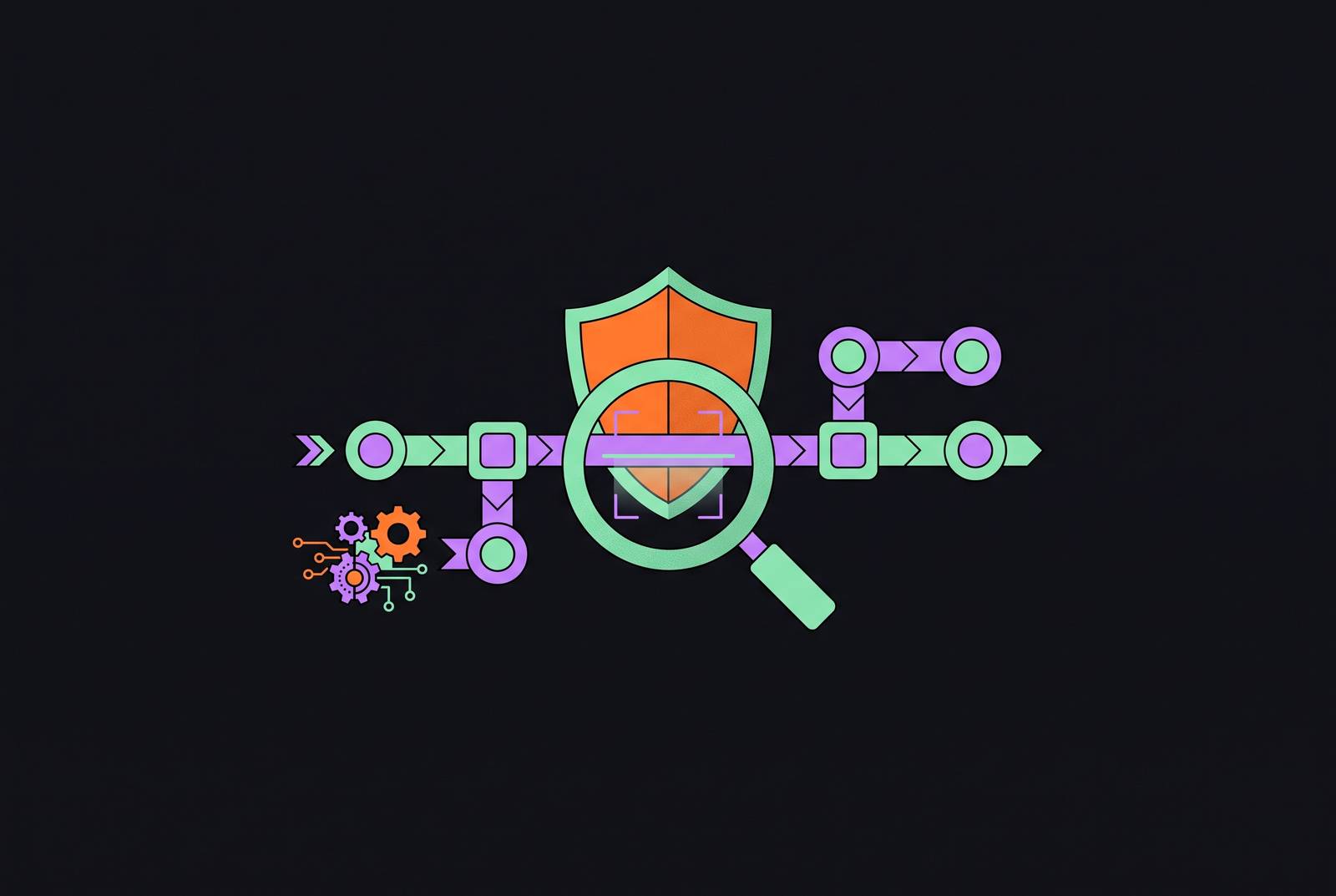
The fix is to stop treating DAST as an event and start treating it as a gate, wired directly into the pipeline at multiple points:
PR validation. A lightweight scan fires when a pull request opens or updates. If findings cross a severity threshold, the PR fails right there, before it merges. Staging gate. A fuller scan runs on merge to staging. Critical findings block promotion to production until they're resolved. Pre-release scan. A focused, deep scan runs right before deploy, aimed specifically at whatever new attack surface the release introduces. Continuous or nightly scan. A full crawl of the staging environment runs on a schedule, catching the slow drift and configuration changes that build up between releases.
A few operational habits make this actually work instead of just sound good on paper:
Incremental scanning. Only test the endpoints touched by the current diff, not the whole app every time. That's what keeps scan time short enough to fit inside a CI feedback loop instead of stalling it. Settle in advance which severities break the build and which just get logged for someone to triage later. When this step is skipped, every scan either blocks nothing or blocks everything, and developers learn to route around the gate. Machine-readable output. Results need to land in formats like JSON, SARIF, or HTML that flow straight into vulnerability management tools, issue trackers, and dashboards, no manual exporting, no copy-pasting into a spreadsheet. Authentication that actually holds up. Pipeline DAST has to log in as a real user, and modern apps gate that login behind OAuth, SSO, MFA, SAML, and token refresh. A scanner that breaks the moment auth changes fails silently. It's failing silently, and a silent failure in a security gate is its own kind of vulnerability.
How AI is changing what DAST tools themselves can do
Legacy DAST was built for a world of server-rendered monoliths getting scanned once a week. That world is gone. Escape.tech's buyer's guide is blunt about it: API-first apps shipped through constant CI/CD cycles need scanning tools that were designed for this decade, not the last one.
The threat side of the equation is moving just as fast as the development side. CrowdStrike's 2026 Global Threat Report clocked average eCrime breakout time (how long it takes an attacker to move from initial access to actually doing damage) at 29 minutes, 65% faster than 2024, alongside an 89% year-over-year jump in AI-augmented attacks; escape.tech sourced the report. Development sped up. Attacks sped up right along with it. A DAST tool running on last decade's assumptions is bringing a weekly checklist to a fight that now moves in minutes.
That pressure is pushing AI into DAST tooling itself, in three fairly distinct ways:
Adaptive scan coverage. Rather than applying a fixed payload set uniformly, tooling increasingly tailors test patterns to the specific application and its observed attack surface. Agentic scanning. Tooling shifts toward continuous behavioral observation of the running app, closer to always-on runtime monitoring than a scan that runs on a timer. Contextual prioritization. Findings get ranked by actual business impact and exploitability, using real usage patterns and threat intelligence, rather than by a generic CVSS score that treats a theoretical flaw the same as an actively exploitable one.
The more interesting shift is a new category sitting right at the edge of DAST: agentic pentesting. Equixly's Agentic AI Hacker is a useful example of where this is heading. It tests a live, running app from the outside, which is classic DAST behavior. But before it attacks anything, it reasons about the app first: mapping endpoints, tracing authentication flows, following data dependencies, working out state transitions.
That reasoning step matters because some vulnerabilities only exist in sequence. Endpoint B might only be exploitable after a very specific interaction with endpoint A first, a multi-step chain that a traditional crawler, which just hits endpoints one at a time with no memory of what came before, will walk right past. According to equixly.com, this kind of tool plugs into CI/CD and can trigger off new feature deployments, code commits, or changes to an API spec, producing results that repeat consistently without a security engineer babysitting every scan.
The DAST tools available for agentic pipelines in 2026, evaluated on pipeline-gate criteria
Judging a DAST tool for pipeline-gate duty means asking a specific set of questions, drawn from escape.tech's own selection framework:
- Does it catch business logic flaws like BOLA, IDOR, and broken access control, or just the standard OWASP Top 10 checklist?
- What's the false positive rate? Some vendors claim under 5%, though published benchmarks show a wide spread, with the OWASP Benchmark recording DAST false-positive rates as high as 82% in some tools. A high rate doesn't just waste time, it teaches developers to ignore the gate.
- Does it natively speak REST, GraphQL, gRPC, and SOAP, or just run generic injection tests and hope they translate?
- How deep does the CI/CD integration go, meaning pre-built connectors, incremental scanning, and severity-based build failure?
- Does it handle MFA, SSO, OAuth, and SAML without breaking, since a scanner that can't authenticate is a scanner that can't see half the app?
- Does it hand back machine-readable results with fix advice and a direct line into Jira or whatever issue tracker the team already uses?
Escape holds a 5.0/5 G2 rating, the top score in escape.tech's own comparison table. Its distinguishing feature is a feedback-driven Business Logic Security Testing (BLST) engine, built specifically to catch IDOR, BOLA, and broken access control, the exact category most scanners miss. Escape.tech documents a false positive rate under 3.7%. It supports REST, GraphQL, and SOAP for external scans, integrates natively with GitHub, GitLab, and Jenkins, and ranks findings by business impact and exploitability while auto-generating Jira tickets with remediation code matched to the app's own stack. It now includes an agentic pentesting capability alongside its DAST engine, though escape.tech's buyer's guide notes that coverage of complex multi-step attack chains is still expanding.
OX Security delivers DAST through its OX Agentic Pentester, backed by OX Cloud for runtime context and visibility across whatever's actually deployed. According to ox.security, autonomous verification cuts alert fatigue by up to 60%. It ships CLI and Docker image scanners with official integrations for GitHub Actions, GitLab CI, Jenkins, and Azure DevOps. Its VibeSec approach embeds security checks directly into AI coding assistants, aiming to stop insecure code before it ever reaches the pipeline, a design choice that matters a lot now that agents are the ones writing the code. OX positions itself less as a standalone DAST tool and more as an ASPM (Application Security Posture Management) platform, correlating dynamic findings against the app's broader security posture.
Cycode builds DAST natively into its Agentic Development Security Platform. Cycode.com reports that its DAST and SAST findings correlate with data from another analysis category covering open-source components across more than 100 connectors spanning source control, CI/CD, cloud, and other security tools. The differentiator here is scale: cross-signal correlation across a large web of connectors, which matters most to enterprise teams already running a sprawling toolchain and looking for one place to see it all line up.
None of these tools solve the underlying math from the first section: agents write code faster than humans can review it, and that code carries more risk per line than what came before. What they do is move the check as close to real time as the shipping itself. Whether that's enough depends less on which vendor gets picked and more on whether the severity thresholds, the auth handling, and the incremental scan scope actually get configured with the same seriousness as the agent's own prompt.
Sources
- 5 Best DAST Tools for Enterprise Security in 2026: Scaling Beyond Basic Web App Scans
- Top 11 DAST Tools in 2026: APIs, CI/CD & Business Logic
- DAST Tools: Complete Buyer's Guide & 10 Solutions in 2026
- Is agentic AI changing the DAST vs. penetration testing discussion?
- What Is DAST? Dynamic Application Security Testing in the Agentic Era - Cycode