LlamaIndex vs LangChain for Code Context Retrieval
LlamaIndex's Node structure beats LangChain for precise code retrieval.
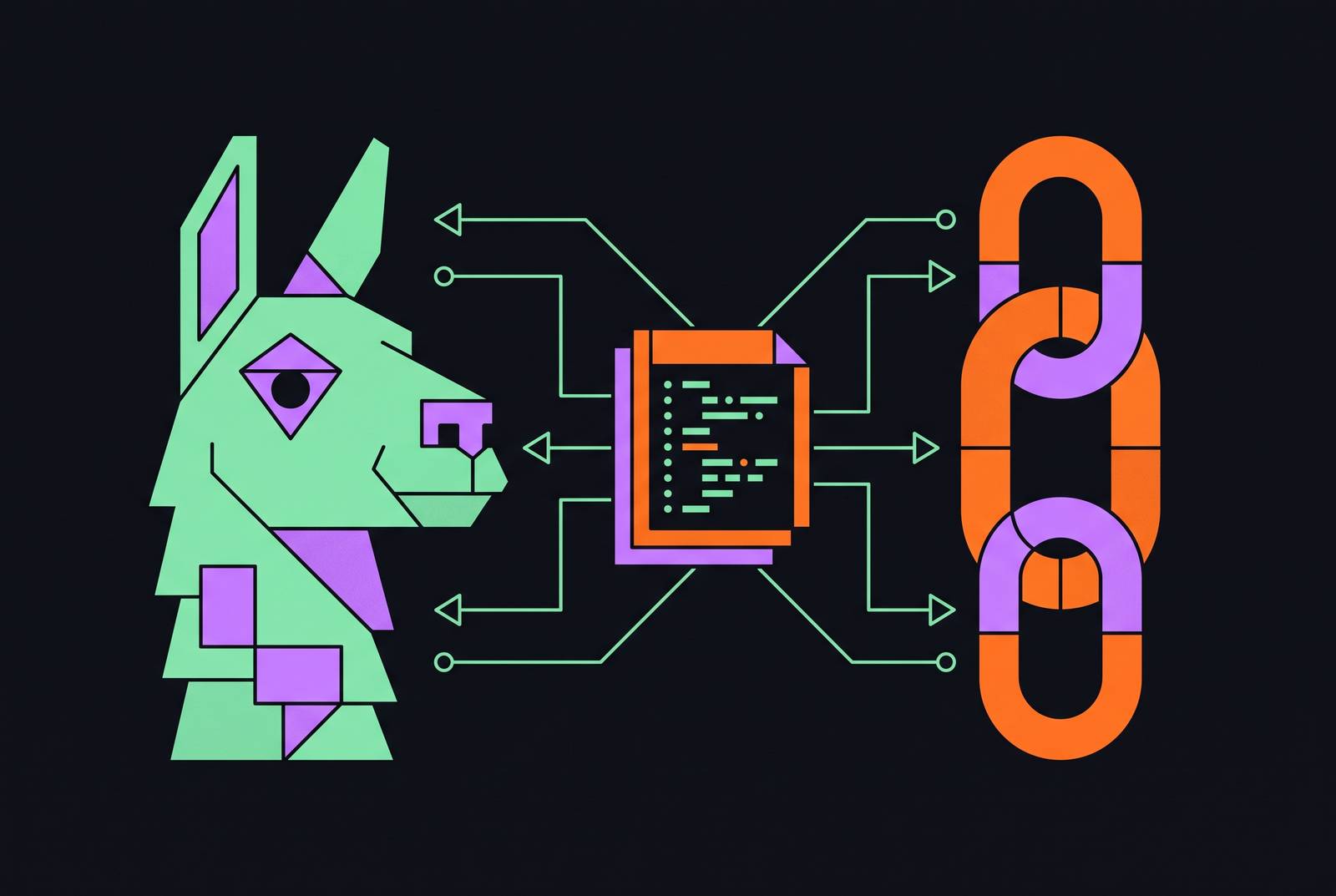
LlamaIndex describes itself as a data framework for connecting documents, databases, and APIs to LLMs using flexible indices and query engines. Accurate description. But it undersells the design decision that actually matters.
The central abstraction is the Node. Not a raw text chunk. A structured unit that carries metadata, cross-references, and parent-child relationships. That distinction sounds like an implementation detail until you need to retrieve a function definition along with its class context and its callers. Then it's the whole ballgame.
The ingestion pipeline moves in stages:
- Data connectors pull from sources (S3, file systems, databases, APIs, GitHub repos)
- Node parsers chunk and structure the content
- Indices organize everything for query time
The index variety is a real design choice, not just a settings menu. Vector, list, tree, keyword, and graph indices each trade off speed, accuracy, and structural complexity differently. LlamaIndex makes that choice available to you rather than hiding it behind a single default. That matters more than it sounds.
The query engine handles chunk selection, ranking, and context assembly. The retrieval logic is opinionated and built-in. Your team does not wire it up from scratch.
As of May 2026, LlamaIndex supports over 5,500 pre-built integrations, more than 130 file formats, and more than 100 programming languages. For code context retrieval specifically, that means pulling from GitHub repos, SQL schemas, Notion docs, and cloud storage without building custom connectors for each one.
What LangChain was built to do and where orchestration differs from retrieval as a primary job
LangChain's primary job is assembling multi-step, multi-tool workflows. Conditional routing. Memory across turns. Agents that reason before acting. That is where it was designed to excel, and it does.
The 500-plus service connectors reflect that orchestration purpose. LangChain's value compounds when you need to coordinate many things across many steps. Retrieving one thing very precisely is a different job, and it was not the job LangChain was primarily built for.
LangGraph, which reached stable v1.0 in October 2025, is where the serious agent work lives. Graph-based state management, checkpoint persistence, interrupt-and-resume for human-in-the-loop approval, explicit state transitions. If your agent needs to pause before merging a pull request and wait for a human to sign off, LangGraph handles that cleanly.
LangSmith addresses a different production problem entirely. Not "did the request fail" but "why did the agent's reasoning go wrong at step 140 of 200." Stack traces don't exist for reasoning failures. LangSmith's observability at the reasoning level is useful, and there is no native equivalent in LlamaIndex. Worth noting now; worth accounting for later.
LangChain has surpassed 130,000 GitHub stars versus LlamaIndex's nearly 48,000. That gap is worth interrogating rather than accepting as a quality signal. It reflects LangChain's earlier start and its broader orchestration use cases, not its fitness for precise code retrieval.
Why code context retrieval is harder than general document retrieval and what that demands from a framework
Code is not prose. That sentence sounds obvious. But sit with the implications for a second.
A function references other functions. A class inherits from a file you have not loaded. A single method call only makes sense if you can see its interface definition and at least some of its callers. The meaning of any given code chunk is rarely self-contained, and that is the core problem.
The granularity question is more acute in code than in plain text:
- Chunk too small: the model loses context and reasons incorrectly
- Chunk too large: you exhaust the context window or dilute retrieval precision
In a general document system, chunking is mostly a configuration decision. In a code retrieval system, it is a semantic decision. Get it wrong and the model does not just miss a fact. It reasons about a broken picture of your codebase, and that is a meaningfully different failure mode.
What a retrieval system actually needs to do well for code:
- Find the right chunk using both semantic and keyword precision
- Return enough surrounding context for the model to reason correctly
- Understand relationships between chunks (caller and callee, imports, inheritance)
- Handle multiple languages, file formats, and mixed content like docstrings, comments, and config files
Re-ranking matters more here than in general retrieval, too. The first retrieved result is often not the most relevant. A system that skips re-ranking will regularly surface the right answer at the wrong abstraction level. The model gets a method signature when it needed the full class, or it gets the class when it needed the module. Either way, the reasoning degrades from there.
This is the actual frame for evaluating both frameworks. Not which is more popular. Which was designed to solve this specific retrieval shape.
How LlamaIndex's Node architecture handles the code context granularity problem
LlamaIndex has a native capability called Small-to-Big retrieval. The idea is simple, and the implementation is what actually earns the framework its keep.
At query time, the system matches on a small, precise chunk. Then it automatically surfaces the larger parent context to the LLM. In practice for code: match on a specific function signature, deliver the full class or module. The model gets precision at search time and context at inference time. That is the tradeoff you want.
That parent-child relationship is built into the index structure. It is not a workaround your team has to architect manually with metadata links. And that distinction matters more than it might seem. Manually building parent-child metadata relationships across a large codebase is error-prone at scale. It is the kind of thing that works in the demo and breaks three months later when someone renames a module and forgets to update the references.
LlamaIndex also supports hybrid retrieval, combining semantic vector search with keyword-based search. That combination addresses a code-specific challenge that trips up a lot of teams. Function names, library identifiers, and class names are often better matched by exact keyword than by semantic similarity. Searching for "useAuthToken" should find "useAuthToken," not something conceptually adjacent to authentication tokens.
Re-ranking algorithms and context-aware filtering are part of the query engine, not bolt-ons the team has to integrate separately.
On vendor-reported performance numbers from 2025: they cite meaningful improvements in retrieval accuracy and speed, but these are not independent peer-reviewed figures. The directional signal is consistent with the architectural explanation, which is worth more than the specific numbers anyway. If the retrieval layer was designed around this problem, it should perform better on this problem. That logic holds even when you discount the benchmarks.
How LangChain approaches retrieval and where it falls short as the primary job
LangChain has retrieval components. Vector store integrations, document loaders, retrieval chains. These work. They are just building blocks inside an orchestration toolkit rather than a purpose-built retrieval engine, and that distinction shows up in practice.
LangChain gives you the parts to assemble retrieval. LlamaIndex gives you a retrieval system with the hard decisions already made and tuned. For some teams, that difference is irrelevant. For others, it is the whole reason to choose one over the other.
Parent-child context relationships, re-ranking, and hybrid retrieval are not defaults in LangChain. Teams have to design and maintain that logic themselves. For a team with dedicated infrastructure engineers, that is a reasonable tradeoff for the control it buys. For a small team moving fast on a retrieval-centric product, that assembly burden is real cost, not just theoretical overhead.
But here is where LangChain's retrieval actually earns its place: when retrieval is one step in a longer chain. Retrieve code context, reason about it, call a tool, write a test, commit to a branch. In that pipeline, the orchestration layer justifies its presence. The retrieval step does not need to be perfect in isolation. It needs to fit correctly into a reasoning loop that can compensate for ambiguity.
So the question worth asking before you pick a framework is not "which retrieval is better" in the abstract. It is whether your retrieval step needs to stand on its own or whether it feeds something larger. That distinction changes the math considerably.
The convergence pattern most production teams are actually running
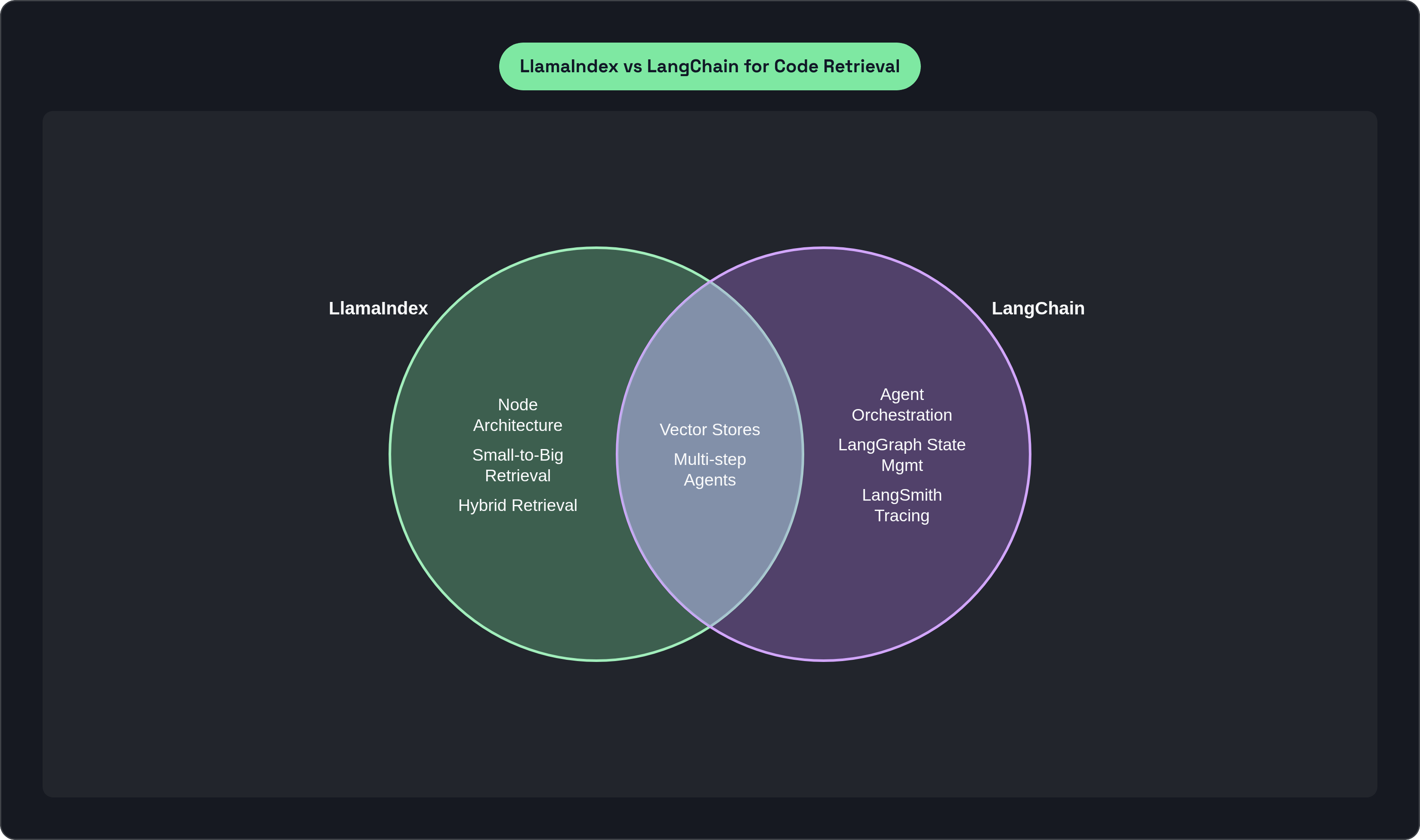
Most production stacks do not force a binary choice, and that is worth acknowledging plainly. The pattern that shows up repeatedly in real deployments is LlamaIndex as the knowledge layer and LangChain or LangGraph as the orchestration layer.
The division of labor is clean. LlamaIndex handles what to retrieve and how to rank it. LangChain handles what to do with what was retrieved and how to route between tools and agents. Each component does the job it was actually designed for.
This is not a hedge or a cop-out. It reflects a real architectural principle: specialized components outperform general-purpose ones when the task is well-defined. You would not use the same tool to index a codebase and to manage agent state across a 200-step reasoning loop. Why would you expect one framework to do both jobs equally well?
One counter-trend worth sitting with: teams that started with LangChain are, in some cases, quietly rewriting to thinner abstractions. The OpenAI Agents SDK, released in March 2025, has picked up real traction. It provides tool use, multi-agent handoffs, built-in tracing, and guardrails in a minimal package. The signal there is that framework overhead is a genuine concern at scale, and some teams would rather own the complexity than have it managed for them.
Framework choice is a starting-point decision. The architecture that makes sense at MVP may not be the right one eighteen months later. Build the layer boundaries clearly enough that swapping one component does not require rebuilding the whole thing.
A decision framework for teams choosing a starting point for code context retrieval
The primary question cuts through most of the noise: is retrieval the end goal, or is it a step in a larger agent workflow?
If retrieval is the end goal (code search, context injection into prompts, documentation surfacing): start with LlamaIndex. The opinionated defaults, the parent-child node relationships, and the hybrid retrieval were built for this shape of problem.
If retrieval feeds a multi-step agent (retrieve, reason, act, test, commit): consider LlamaIndex for the retrieval layer and LangGraph for the orchestration layer. Let each tool do the job it was designed for.
If the use case is primarily agent orchestration with light retrieval needs: LangChain alone may be sufficient. Do not add a framework you don't need.
Team size and infrastructure capacity also shift the calculation:
- Small team, fast iteration: LlamaIndex's defaults reduce the surface area to get wrong
- Larger team with dedicated infrastructure engineers: LangChain's composability gives more control over every layer
Codebase characteristics matter too. A large, multi-language, multi-repo codebase is where LlamaIndex's format breadth and parent-child node relationships are most directly relevant. A codebase embedded in a broader enterprise knowledge graph connecting Notion, Confluence, or SQL schemas is where LlamaIndex's integration depth reduces the ingestion engineering burden meaningfully.
One factor that often gets skipped: observability. If agent reasoning traces are critical for production debugging, factor LangSmith's reasoning-level tracing into the total value of the LangChain stack. There is no native equivalent in LlamaIndex. That is a real gap, even if it is not a dealbreaker on its own.
Both frameworks are open-source. The cost is engineering time and token spend, not license fees. The decision is really about where to invest developer hours, and only you can answer that with your team's current capacity.
Where AI coding agents fit into this stack and what it means for how retrieval gets used
Agentic coding changes the retrieval problem in a way that is worth thinking through rather than just nodding at.
An agent that plans, writes, tests, and iterates on code does not query a codebase once. It queries it repeatedly, across every loop iteration. Retrieval precision compounds. A small miss at step three of the plan-modify-test-verify loop propagates forward into steps four, five, and six before anyone sees the output. The agent does not just surface a wrong result. It acts on it, potentially across multiple files, test suites, and CI checks, before a human reviews the diff.
That error propagation is the real cost of imprecise retrieval in an agentic system.
The security dimension compounds the concern further. A meaningful portion of AI-generated code contains security vulnerabilities even under favorable conditions. When the retrieval layer feeds the agent incorrect or incomplete context about how authentication is handled or how an API contract is structured, the output quality problem quickly becomes a security problem. Those two failure modes are separate issues that compound each other.
Some tools integrate retrieval, orchestration, and execution into a single environment, collapsing the IDE, terminal, and code review workflow into one surface. Developers do not have to make a framework architecture decision in isolation. The agent layer can abstract over the retrieval infrastructure while the developer stays in control of how much autonomy to grant.
But underneath that abstraction, the retrieval layer still exists. And it still makes a difference. The more autonomous the agent, the more consequential each retrieval decision becomes, because there are fewer human checkpoints between a retrieval miss and a shipped mistake.
Getting retrieval right matters more as agents become the primary consumers of retrieved context, not less. That's the shift worth planning for.