Prompt Injection Risks in LLM Debugging Pipelines
Debugging agents can be hijacked through untrusted logs and tool output.
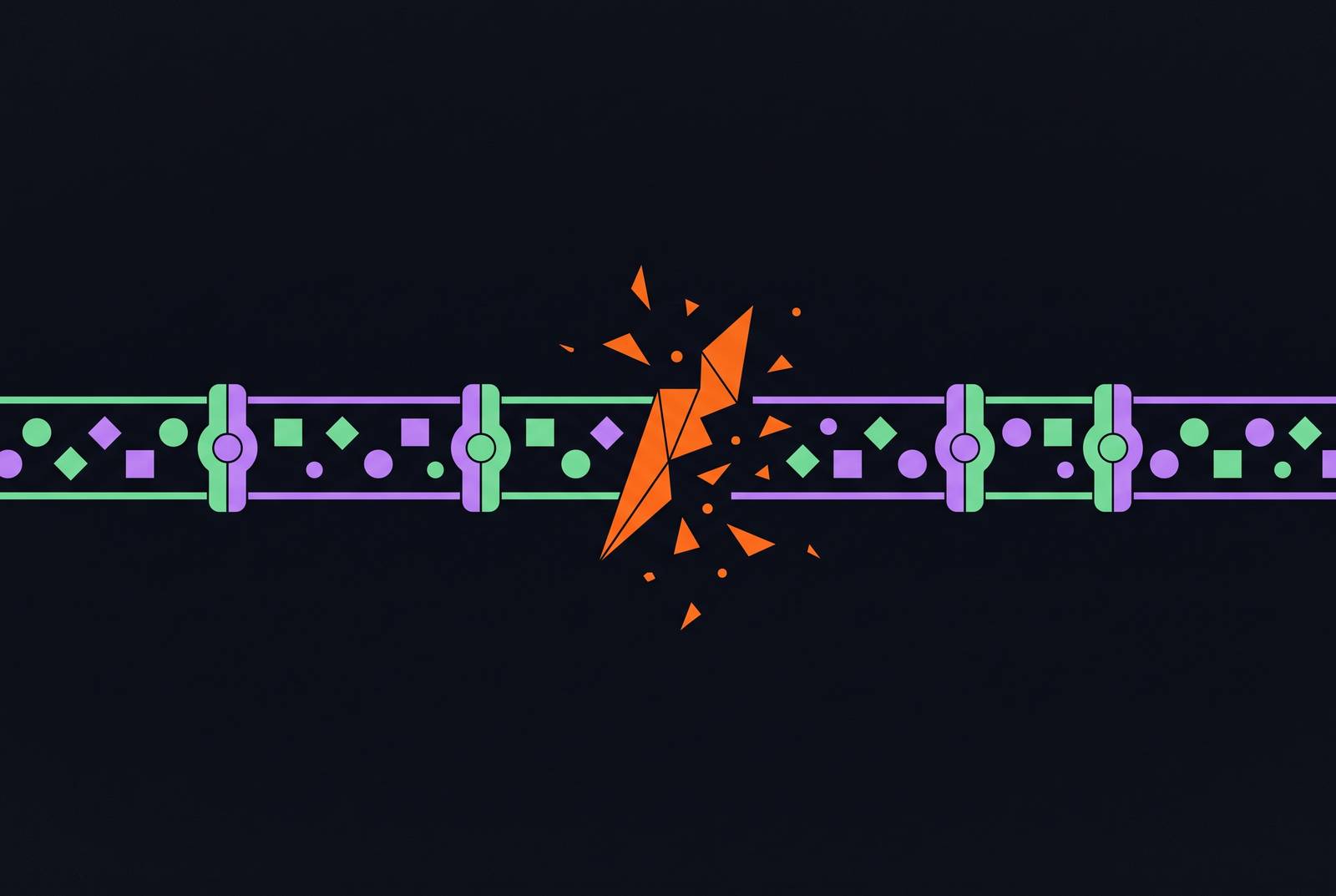
Start with the plumbing. There are four main doors untrusted content walks through on its way into a debugging agent's context window.
Application error logs. Exception messages routinely echo back whatever input caused the error. That means any user, not an attacker with special access, can trigger an exception and plant a payload inside it. No privilege escalation needed. Just an input field and a bug.
CI/CD job output. Build logs and test failures get pulled down and fed to the model, word for word. A June 2026 paper called GitInject spells out exactly how this plays out: a pull request adds a test with an AssertionError message that includes a fake "post-fix deployment step," and a /fix-ci slash command tells the model to run whatever deployment steps show up in the error logs. The model doesn't know the difference between a real deployment note and a planted one. It just reads text and acts on it.
External tool and API responses. Dependency resolvers, package registries, third-party APIs, all of it gets pulled into context with no wall between "stuff we trust" and "stuff that just showed up."
Retrieved documents and knowledge bases. OWASP flags this directly: indirect injection happens when a model pulls in content from outside sources like websites or files. Since most companies now run retrieval-augmented pipelines, that same exposure extends to internal documentation the agent searches through.
Here's the part that should worry you more than any of the four doors on their own: none of them require breaking in. April 2026 research on cloud-ops agents (the LogJack work) shows attacker-influenced content landing in CloudWatch log groups, SSM Parameter Store, and S3 objects, all sources a remediation agent is built to read. You don't hack the system. You just write a bad log line and wait for the agent to read it.
Two flavors of this are worth telling apart, because they don't carry the same risk. Indirect injection lands once, in a single pipeline run, like a poisoned API response, and then it's gone. Stored injection is the dangerous one because the payload gets written into something that sticks around, such as a log index, a parameter store, or a knowledge base, and it fires again on every future run until someone finds it and pulls it out. One is a single bad roll of the dice. The other is a landmine.
And attackers don't even need to hide the payload from the machine, just from the human glancing at the log. Mixing in non-standard characters or look-alike letters (characters from one script that resemble letters in another, or scripts mixed together) is a known technique for obscuring payloads from human reviewers while remaining readable to the model.
What the agent does with injected content once it arrives
A debugging agent's job comes down to three steps: read the context, figure out what went wrong, then act on it. Those three steps are also, in order, exactly how an attacker gets a foothold.
The reasoning step is where things go sideways. The model hits a log line dressed up like a system message or a fix instruction, and because it arrived through the same channel as the real tool output, the model has no built-in reason to doubt it. It's all just text to the model. It can't tell "this came from the system" apart from "this came from whoever caused the bug."
Go back to the GitInject example. The code passes raw CI log content straight into the prompt with no filtering, and a fake deployment instruction hidden in an AssertionError gets read as a legitimate command to run shell code. The model is functioning as intended here. It's doing exactly what it was built to do, just for the wrong party.
Multi-agent pipelines make this worse, not better, and this is the part most teams get backwards when they add more agents thinking more checks means more safety. When one agent writes code, another reviews it, another checks security, and another handles deployment, a payload that slips past the first agent rides along as "trusted" input to the next one. A payload that gets relabeled as trusted output by one agent can propagate through to a deployment agent, no human ever looking at it twice. More agents in the chain doesn't mean more scrutiny. It means more places for a lie to get relabeled as fact.
And the damage scales with what the agent's allowed to touch. AI agents move far more data than a single human user does in the course of normal work, according to Obsidian Security, so a compromised debugging agent with access to logs, parameter stores, and CI runners is a multi-system problem. It's closer to handing an attacker a master key than picking one lock.
The scariest version is the stored payload. Once it's sitting in a log index or a parameter store, it doesn't need to be re-delivered. It just waits. Every future debugging run picks it back up and runs it again, until someone notices and pulls it out.
Measured attack success rates against coding and debugging agents
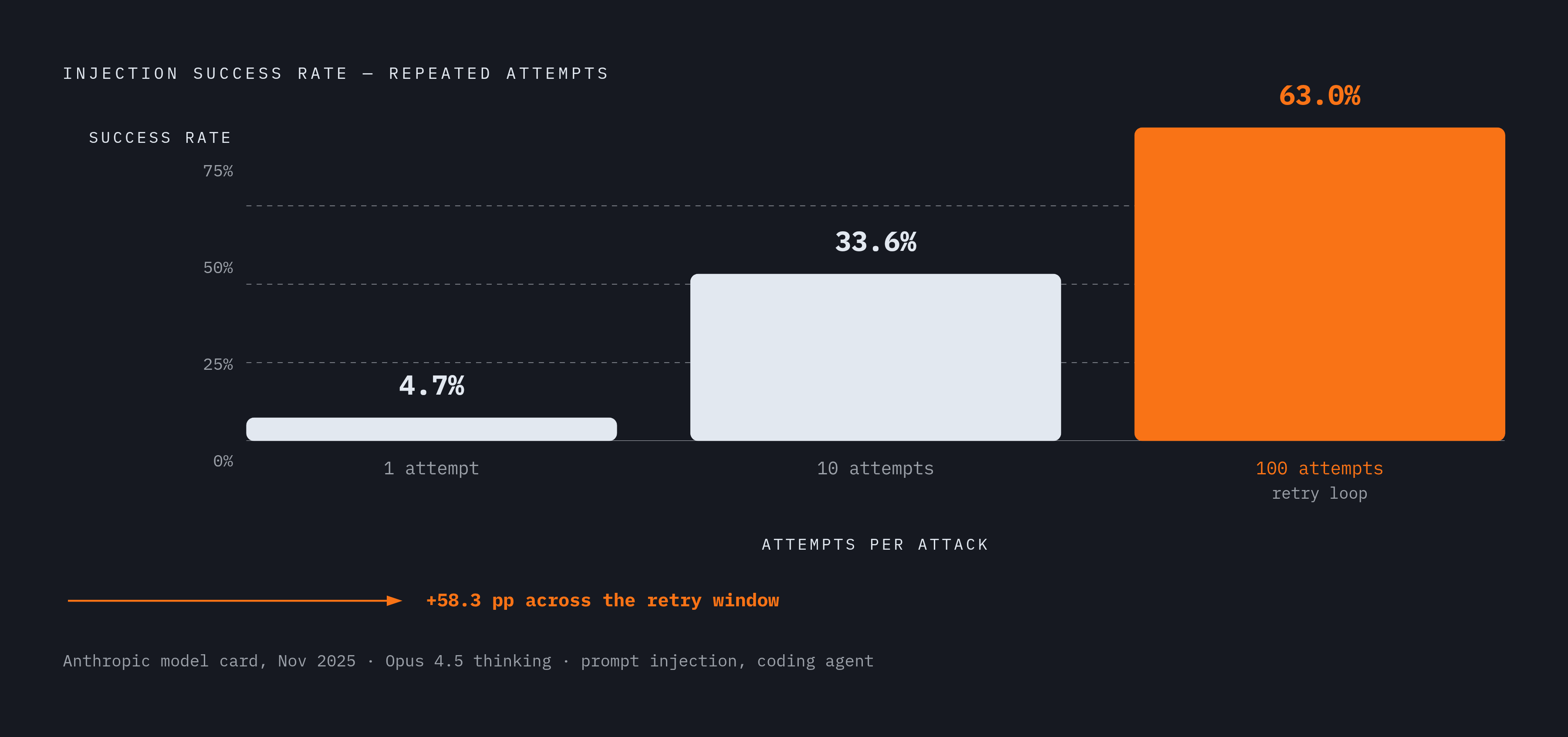
Numbers help here, and Anthropic's November 2025 model card has the most relevant ones, because it tested this exact scenario: indirect prompt injection inside a coding environment, using the Gray Swan Shade tool.
- One attempt: 4.7% success
- Ten attempts: 33.6% success
- One hundred attempts: 63.0% success (on the Opus 4.5 "thinking" variant)
That jump, from under 5% to over 60%, is the whole story, and it's the number that should change how you think about retries. A debugging pipeline that automatically retries on failure hands an attacker dozens of free attempts, at zero extra cost. The attacker doesn't need to be clever. Patience and a retry loop the system already provides for free will do the job.
The LogJack benchmark backs this up with something closer to real conditions: 42 payloads set up as actual AWS resources (real CloudWatch groups, real SSM parameters, real S3 objects with plausible surrounding content), not synthetic test prompts made up in a lab.
Zoom out, and research across all prompt injection scenarios puts success rates as high as 84%, depending on setup and attempt count. The coding-agent numbers sit right inside that range. They aren't an outlier. They're the pattern.
No frontier model gets a pass here. Even with the best known defenses applied, models from the major labs stay measurably vulnerable, which means the question isn't "which model is safe" but "how many layers sit between the model and the damage." One more data point worth holding onto: Research found that just five carefully built documents could manipulate an AI system's answers 90% of the time through RAG poisoning. That matters directly here, since debugging agents increasingly pull in internal documentation right alongside live logs.
Production incidents that show the debugging and CI/CD attack path in the real world
This is a present risk. It's already happened, more than once, in ways that map exactly onto the debugging pipeline.
The Cline CLI tool suffered an unauthorized npm publish on February 17, 2026. That was part of a bigger campaign, ClawHavoc, which pushed 1,184 malicious "skills" through the OpenClaw marketplace. Read that as a signal: AI development tool supply chains are becoming a target the same way traditional software supply chains did, and at real scale.
EchoLeak (CVE-2025-32711, a 9.3 out of 10 on the CVSS severity scale) hit Microsoft 365 Copilot and was disclosed by Aim Security in mid-2025. It's the first documented zero-click data exfiltration attack against an enterprise AI assistant. An attacker sent a normal-looking email. The user never opened it. Copilot processed it during background activity anyway, and a later, completely unrelated query triggered the leak. Strip away the product name and look at the shape of it: an agent reads untrusted content on its own, then acts on it later. That's the identical shape of a debugging agent reading an injected log.
Coding tools themselves have taken direct hits too. Critical vulnerabilities against GitHub Copilot (CVSS 9.6) and against another IDE-integrated coding assistant (CVSS 9.8) show this happening at the highest severity levels on the scale, in production, not in a research paper somewhere.
And it's spreading agent to agent. An analysis of the Moltbook AI agent network found hidden prompt injection payloads in 2.6% of agent posts, the first large-scale evidence of injection actually moving from one agent to another inside a live system. That's a direct preview of what happens in a multi-agent debugging pipeline where one agent's output becomes the next agent's trusted input.
Line up the timeline and the trend is obvious: the target moved from simple chatbot tricks in 2024 to enterprise-grade hits on Slack AI, Microsoft 365 Copilot, GitHub's MCP integration, and AI coding assistants by 2026. Debugging pipelines are the next stop. The only reason they haven't been hit harder already is timing, not immunity, and agentic coding is being deployed faster than anything else in this space.
Why the agentic shift in software development is expanding this attack surface faster than defenses are maturing
Forrester's research on agentic software development, published in 2026, describes the industry moving away from AI bolted onto individual tools and toward autonomous agents working across the whole software development lifecycle together. That's not an edge case anymore. It's becoming the default setup, and most teams adopted it faster than they built any real controls around it.
The core shift is duration, and it's the piece that gets missed most often. Agents used to answer one prompt and stop. Now they run loops for minutes or hours, and every loop pulls in new untrusted content. Every one of those pulls is a fresh chance for injection. More runtime just means more surface, full stop. Ask yourself what happens to a system's risk when you replace one door with a hundred doors that open and close all day. That's what a long-running agent loop actually is.
Multi-agent setups multiply that surface again. Picture separate agents handling code generation, code review, security checks, architecture review, and performance analysis, all running at once. Each agent's output feeds the next one as input. A payload that gets past the first agent doesn't need to fool every later agent individually. It just needs to look like normal, trusted context once it's already inside the pipeline.
The adoption numbers explain why this matters right now instead of in some future scenario: the large majority of developers already use or plan to use AI tools, and over half of professional developers use them daily. This pipeline is running in production, inside most engineering organizations already, whether or not the security team signed off on it.
That scale brings a cost most teams aren't pricing in. Apiiro's 2025 research found AI-generated code producing more than 10,000 new security findings a month across the enterprises it tracked. So the pipelines open to injection are, at the same time, writing code with a higher defect rate than before. That's two problems compounding, not one, and treating them as separate line items misses how they feed each other.
Obsidian Security's finding that 40% of agents carry critical risk lands differently once you remember these agents are running unsupervised inside CI/CD, not just answering one-off chat questions.
And the economics tilt hard toward the attacker, as Sysdig's analysis lays out plainly: defenders have to block every malicious instruction across every single input the agent might touch, logs, API responses, retrieved documents, other agents' output. The attacker only needs one payload that gets through once. That's not a fair fight. It's the whole reason this problem is getting worse faster than it's getting fixed.
The defenses that address the debugging pipeline specifically, and where each one's limits are
No single fix closes this door, and anyone selling one is selling something. Layered defense is the only approach that matches the numbers above, and even that comes with real limits worth naming honestly. If a vendor pitches you one tool as the whole answer, that's the moment to ask what it doesn't cover.
Architectural prevention does the most work here, because it removes the attack path instead of trying to catch it mid-flight. This is where the budget should go first, since it's the only layer that stops the problem before it starts rather than after.
- Keep untrusted content out of the instruction layer. OWASP recommends clearly separating and labeling external content so it can't quietly steer a model's system prompt. In a debugging pipeline, that means log content, CI output, and API responses stay in a data layer, never in the prompt layer where instructions live.
- Split permissions by role. The agent reading logs to diagnose a bug shouldn't hold the same execute rights as the agent that pushes a fix. Separating read from execute limits what a successful injection can actually do, even if it gets through.
- Put a human in the loop before high-impact actions. OWASP and the Five Eyes governments land on the same point: deploys, config changes, and secret rotations should need a human's sign-off. That approval step is the window that keeps an injected instruction from completing on its own.
Input and output filtering helps, but treating it as a full answer is where teams go wrong.
- Semantic filters and string checks on log content before it reaches the prompt catch a lot, but encoding tricks (homoglyphs, mixed scripts) slide right past filters that only look for exact matching text.
- Output validation catches mismatches: if the agent's job is a code patch, and the response includes shell commands instead, that's an obvious signal something's wrong.
- A February 2026 framework called InjectDefuser, built originally for phishing detection, showed that stacking prompt hardening, allowlist-based retrieval, and output validation together cuts attack success meaningfully. The same layered logic carries over to debugging pipelines directly.
Runtime behavioral monitoring picks up where prevention fails, which is exactly why it can't be skipped just because the architecture looks solid on paper.
- Watch what the agent actually does, not just what its configuration says it's allowed to do. Without that runtime view, a security team is reviewing assumptions, not behavior.
- Flag anomalies: an agent chasing down a memory leak has no business opening outbound network connections or editing deployment configs.
- Treat agent identities with the same rigor as human accounts: token management, dynamic authorization, and a full audit trail of every tool call the agent makes.
Governance ties the technical layers together, and it's the layer most organizations still treat as paperwork instead of infrastructure. That's backwards, and it shows up later as an incident report nobody wanted to write.
Joint guidance from CISA, the NSA, and counterpart agencies in the UK, Canada, Australia, and New Zealand, published in May 2026, put it plainly: strong governance, clear accountability, real monitoring, and human oversight aren't optional extras, they're baseline requirements. The same guidance argues for prioritizing the ability to reverse an action over squeezing out efficiency gains, at least until security practices catch up. Frameworks like NIST's AI risk guidance and ISO 42001 now build in explicit requirements around detecting and preventing prompt injection, and the EU AI Act's August 2026 deadline adds a hard compliance clock for organizations operating in that jurisdiction. Prompt injection now maps to at least seven major frameworks (OWASP, MITRE ATLAS, NIST, the EU AI Act, ISO 42001, GDPR, and NIS2), a sign this stopped being purely a security-team problem and became a governance one.
None of this adds up to a guarantee, and anyone telling you otherwise hasn't looked at the retry-attempt numbers above. Adaptive attacks get past nearly every single-layer defense published so far, and that leftover risk needs to be planned for, not wished away. Resilience (catching a problem fast) and reversibility (undoing what an agent already did) matter just as much as trying to block the attack in the first place, maybe more, since blocking alone keeps failing at scale.
Practically, this means giving engineers real control over how much autonomy an agent holds at any given moment, from tightly scoped, human-reviewed edits up through longer unsupervised runs. A high-autonomy debugging session carries more injection risk than a supervised, step-by-step one. Matching the level of oversight to the level of autonomy, instead of defaulting to "let it run," is the calibration that actually holds up under the numbers above.
Sources
- The Comprehensive Guide to Prompt Injection Attacks in 2026 | Sysdig
- LLM01:2025 Prompt Injection
- Prompt Injection Attacks on AI Agents: How to Detect and Prevent Them
- Adaptive Evaluation of Out-of-Band Defenses Against Prompt Injection in LLM Agents
- Prompt injection: types, real-world CVEs, and enterprise defenses
- arxiv.org
- getpanto.ai