LLM Benchmark Interpretation for Coding Task Selection
Leaderboard scores hide task mismatch and contamination that doom real-world performance.
A developer picks the top model on a public leaderboard, wires it into their pipeline, and watches it choke on the exact work they needed it for. That gap is about benchmark mismatch: the leaderboard score measured a different kind of task than the one the developer actually cares about. It's about benchmark mismatch: the leaderboard score measured a different kind of task than the one the developer actually cares about. A model can top a function-level test and still lose 60 points on repository-scale edits. Training data contamination can inflate a score by 15 to 20 percentage points on top of that. Mismatch and contamination are two separate problems, and they stack. Treat leaderboard rank as one clean signal, and you've quietly mixed both of them into a single number that tells you almost nothing about your own codebase.
How benchmark mechanics determine what a score measures
Every coding benchmark works on the same mechanic underneath: the model gets a problem description, writes code, and passes only if every hidden test case succeeds. No partial credit. "Mostly right" counts as wrong.
That binary setup makes the sampling method matter as much as the model. Pass@1 checks whether the first attempt works. Pass@10 samples ten completions and asks whether any of them pass. Those measure different things. If a pipeline retries on failure the way most agent setups do, a Pass@1 score is telling a story that doesn't match how the system actually runs in production.
Then there's saturation. When the top models all cluster near the ceiling, the gaps between them stop meaning anything. HumanEval, one of the oldest function-level tests, has GPT-5.3 Codex at 93%. At that level, a few points of difference is noise.
Contamination affects all of it. If a test question showed up in a model's training data, a high score there reflects memorization, not reasoning. That kind of leakage can inflate results by 15 to 20 percentage points, which is large enough to flip a "best model" decision entirely on its own.
Function-level benchmarks: what they measure and their limits
HumanEval is the benchmark most people picture when they hear "coding benchmark." It's 164 hand-written Python problems, each one a single function completed from a docstring, checked against unit tests. No outside libraries, no dependencies, most solutions under 20 lines.
What that setup tests is narrow: can the model turn a written spec into working code at the level of loops, conditionals, and basic list operations. That's a genuine skill, and it's worth knowing a model has it.
What it doesn't test is everything that makes real engineering hard. There's no codebase to navigate, no other files to keep consistent, no existing API contract to respect. The distance between "write this isolated function" and "fix this bug in a 40,000-line service" is a difference in kind. It's a different kind of problem.
Saturation makes the gap worse for decision-making purposes. GPT-5.3 Codex is at 93%, and with frontier models clustered near that ceiling, HumanEval can't tell one frontier model from another anymore. It still has a job: comparing open-weight models or fine-tuned variants against each other. But for choosing among the top commercial models, it's stopped being useful.
Repository-level benchmarks and the engineering work they test
SWE-bench Verified closes a lot of that gap by testing something closer to a real job. The model gets an actual GitHub issue from a real Python project, along with the full codebase, and has to write a patch that fixes the bug without breaking anything else. Claude Opus 4.6 scores 80.8% here, and as of 2026, anything above 75% counts as frontier-level performance.
What this benchmark demands that HumanEval never asks for: reading a bug report written in plain language, finding the right spot in a multi-file codebase, writing a fix that respects the existing structure, and confirming it passes regression tests. That's the actual loop of software engineering, compressed into one evaluation.
One caveat matters a lot here: Epoch AI's evaluation scaffold for SWE-bench Verified went through a major infrastructure upgrade in February 2026 (version v2.0.0). Scores from before that upgrade and after it aren't directly comparable. The evaluation conditions behind a SWE-bench number come from the fact that Anytime a SWE-bench number gets cited, the evaluation conditions behind it need to come along with it, or the number is close to meaningless.
OpenAI put out a statement saying SWE-bench Verified no longer measures frontier coding capability, and stopped reporting scores on it. That's a benchmark aging out in real time, not over years, but in the space of a single release cycle.
Benchmarks for algorithmic ability and contamination resistance
LiveCodeBench takes a different approach to contamination: instead of trying to detect leakage after the fact, it removes the opportunity for it. Problems get pulled continuously from LeetCode, AtCoder, and Codeforces, all dated after a given model's training cutoff. Qwen3.5-397B leads LiveCodeBench at 83.6%, a figure that may already have been passed by other models since it was recorded.
What LiveCodeBench actually measures is raw algorithmic reasoning, tested fresh with every release. It's the strongest available signal for tasks built around optimization problems, competitive-programming-style logic, or genuinely novel problems, precisely because a model can't memorize its way to a high score on a problem that didn't exist when it was trained.
The Aider Polyglot Leaderboard runs on a different logic. It uses 225 exercises from the Exercism collection, spread across six languages, and scores models on a first attempt plus one retry after seeing test feedback. It's built specifically around Aider's own edit loop, which makes it narrower in scope but also one of the most trusted, practitioner-cited comparisons when cost and accuracy both matter.
Agentic and long-horizon benchmarks for the tasks that matter most in 2026
Writing one function and running a long agent loop are not the same skill. An agent loop means calling tools, reading the results, recovering from failures, and holding onto context over dozens of steps. A benchmark that only tests function generation has no way to predict how a model behaves once it's driving a terminal on its own for twenty minutes.
Terminal-Bench 2.1 was built for exactly that kind of long-horizon, agentic terminal work. GPT-5.6 Sol leads at 88.8%. For scale, Claude Opus 4.6 scores 65.4% on Terminal-Bench 2.0, Claude Sonnet 4.6 scores 59.1%, and GPT-5.4 xhigh scores 75.1%. The spread here is much wider than anything seen on function-level tests, which is itself informative: agentic work separates models in a way isolated coding problems don't.
The Artificial Analysis Coding Agent Index tells a similar story from a different angle. It's a composite score built to capture agentic coding performance rather than success on a single isolated task, and GPT-5.6 Sol leads there too, at 80.
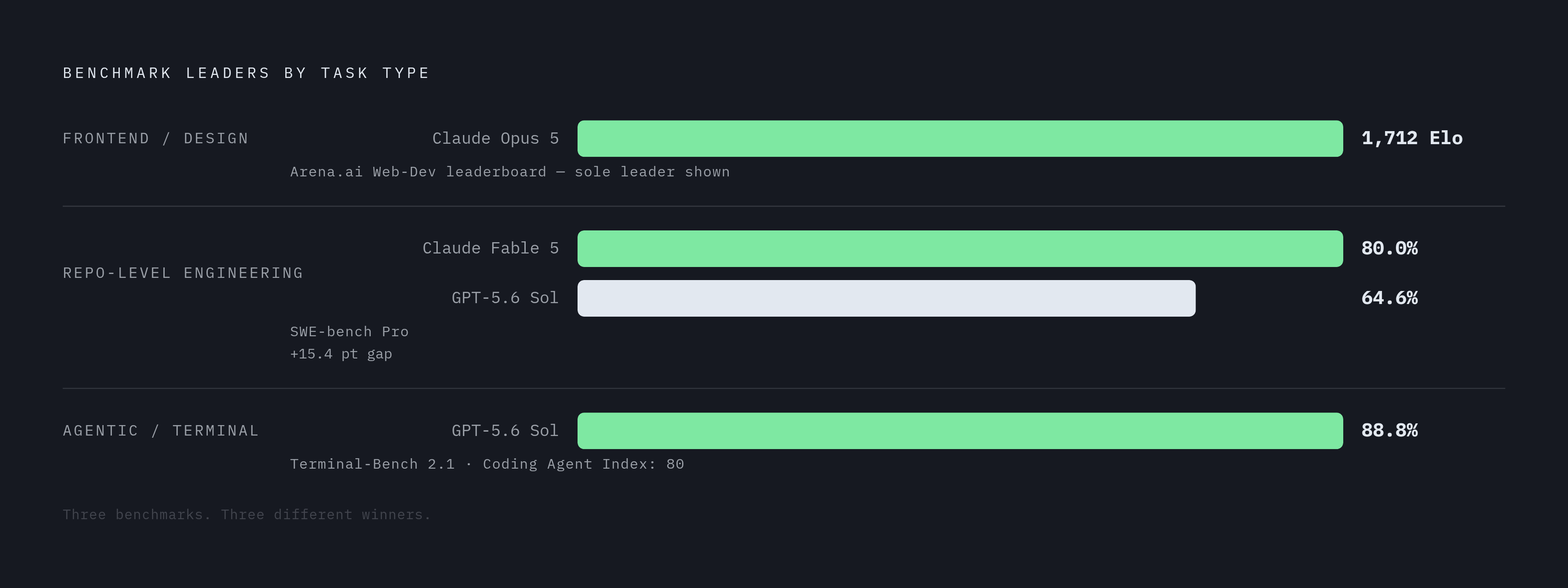
Put the specialized leaderboards side by side, and a pattern appears fast: no one model wins everywhere. Claude Opus 5 leads blind developer preference for frontend and design work, at 1,712 Elo on the arena.ai Web-Dev leaderboard as of August 10. Claude Fable 5 leads SWE-bench Pro at 80.0%, a full 15.4 points ahead of GPT-5.6 Sol's 64.6% on that same test. GPT-5.6 Sol leads agentic terminal work. Three different benchmarks, three different winners.
Leaderboard scores separated by task type
Read enough of these benchmarks side by side, and something becomes obvious: the same models land in different spots depending entirely on which test you're looking at. That's the data working correctly, telling you that these models specialize. It's the data working correctly, telling you that these models specialize.
Break it down by task type, and the picture sharpens:
Frontend and design-oriented coding: Claude Opus 5 leads blind developer preference at 1,712 Elo on arena.ai's Web-Dev leaderboard, as of August 10. Repository-level engineering: Claude Fable 5 leads SWE-bench Pro at 80.0%, ahead of GPT-5.6 Sol's 64.6% by 15.4 points. A gap that size is big enough to justify routing different work to different models. Agentic terminal and long-horizon tasks: GPT-5.6 Sol leads both the Artificial Analysis Coding Agent Index (80) and Terminal-Bench 2.1 (88.8%).
None of this means one model is "the best." It means each benchmark is measuring a different job, and the leaderboard only makes sense once you know which job matches your work.
Reading benchmark failure modes to predict where a model will break on your work
A single aggregate score hides the reason behind it. Two models can land on the same number for completely different reasons, and knowing why a model fails predicts its behavior far better than the score itself does.
Failure analysis breaks down into three distinct categories, and each one maps to a different kind of task:
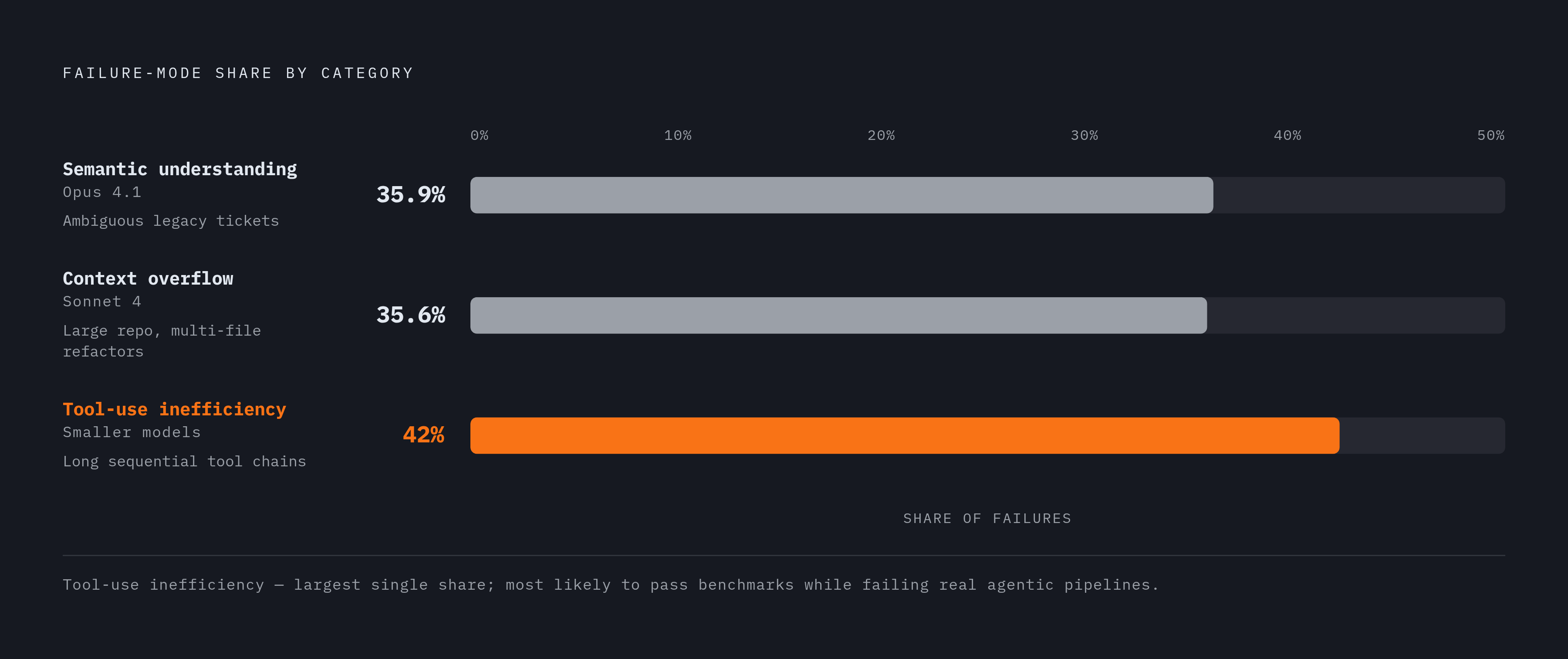
Semantic understanding failures made up 35.9% of Opus 4.1's failures. The model misreads what the code is supposed to do. This is most visible on ambiguous legacy tickets and poorly written issue descriptions, where the task itself is unclear before any code gets touched. Context overflow failures made up 35.6% of Sonnet 4's failures. The model loses track of what it's doing across a long context window. This hits hardest during large repository navigation and multi-file refactors, where the relevant information is spread across more files than the model can hold onto at once. Tool-use inefficiency accounted for 42% of failures among smaller models. The model calls a tool wrong, or misreads what the tool sends back. This is most damaging in agentic pipelines that depend on a long chain of correct, sequential tool calls.
These failure modes explain the benchmark gaps directly. A model that scores well on HumanEval but poorly on SWE-bench Pro is very likely hitting context overflow or semantic misreading once the codebase gets big, not a shortage of raw reasoning ability. That distinction matters for fixing it: a reasoning problem and a navigation problem call for different solutions.
When an agent says a task is done, search the codebase for other places that use the symbols it just touched. If something turns up that the agent never opened or looked at, the task isn't actually finished, even if the tests it ran came back green. A benchmark would mark this context overflow failure as a pass.
Building a personal evaluation workflow when public benchmarks don't cover your codebase
Every benchmark discussed here runs on public code: open-source repositories, published competitive programming problems, well-known GitHub issues. None of that touches an organization's internal APIs, its naming conventions, or the legacy decisions baked into a codebase over years. A model that tops SWE-bench Verified has proven nothing about its understanding of an organization's internal APIs, its legacy systems, or the unwritten conventions in a particular team's code.
That's the practical limit of every public leaderboard. They're useful for narrowing the field, and reading them by task type (function-level, repository-level, algorithmic, agentic) tells you which models are even worth testing further. But the final step, matching a model to the actual shape of the work in front of a developer, has to happen on that developer's own code. Public benchmarks can point toward candidates. They can't make the last call.