LLM Validation and Verification for Code Generation Output
AI-generated code needs layered checks, not just testing, to catch hidden bugs.
LLMs write code by guessing the next likely token, not by reasoning through why that token is correct. AI-generated code can compile clean and read fine on a quick pass while still hiding a logic error or a security hole that nobody notices until it's live.
This is structural, not a bug better training fixes: a model built to produce likely-sounding text will produce likely-sounding text, whether or not it's correct. AI-generated code makes up a large share of what ships in 2025 (some estimates put it at 41% of all code written), so every bit of adoption growth widens the failure surface.
Benchmark scores hide this problem. Most frontier models score very highly on HumanEval, a test that checks isolated function generation. But NeurIPS 2025 research points out that suites like HumanEval and LiveCodeBench often run on a limited set of test cases. Bugs slip through untested, scores get inflated, and reinforcement learning setups that use these benchmarks as reward signals end up learning from a false picture of what "correct" looks like.
Treat validation and verification (V&V) as layers, not one pass-or-fail step, since a model can score well on paper and still fail once it's live, in ways no single check is likely to catch.
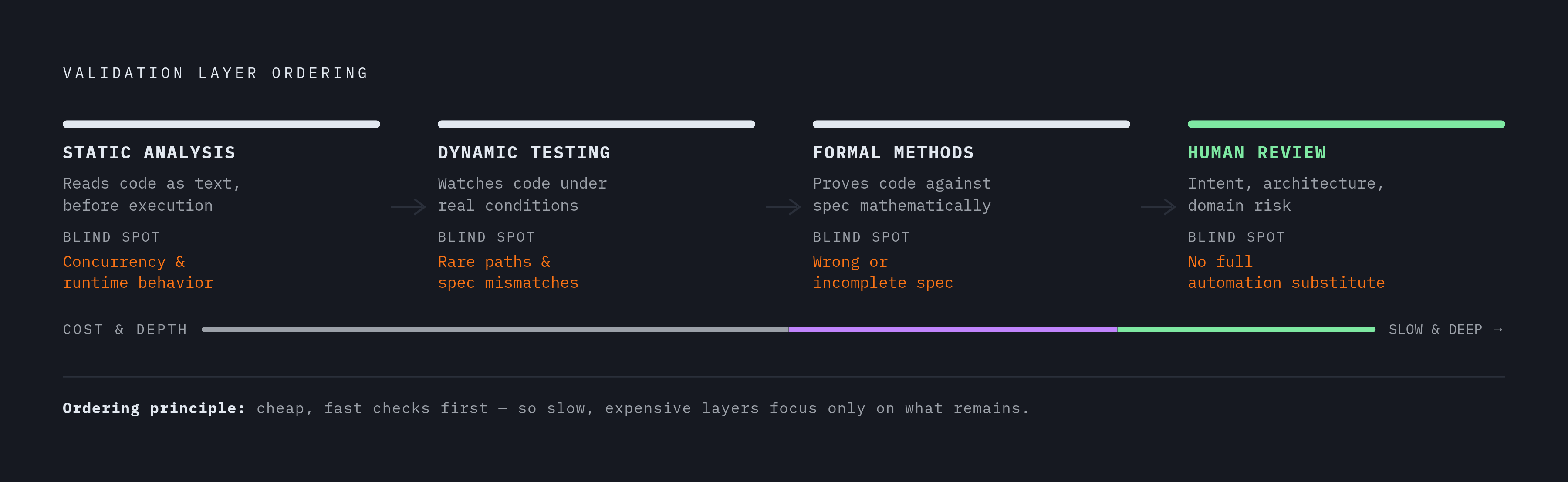
There are four layers, and the order matters: static analysis, dynamic testing, formal methods, human review.
Each one looks at a different thing:
- Static analysis reads the code as text, before it ever runs.
- Dynamic testing watches what the code actually does once it's running.
- Formal methods check the code against a spec, mathematically, for close to every possible input.
- Human review checks whether the code fits the intent, the architecture, and the messy real-world edge cases that need domain knowledge to spot.
Cheap, fast checks go first and clear out the obvious junk, so the slow, expensive checks can focus on problems that actually need them. Running a full formal proof on code with a typo in a variable name wastes an expert's afternoon; catch the typo with a linter first, every time.
No single layer is enough on its own. Most teams pick one, usually testing, and treat it as the whole job. Code can sail through static analysis and a full test suite and still be formally wrong. It can even be formally verified against a spec that was wrong to begin with. Every layer has a blind spot, which is the reason to run all four rather than picking a favorite.
This holds whether it's one AI-generated function or an autonomous agent handing back an entire feature branch. When an agent runs for hours and returns a pile of changed files, finding a flaw late means untangling a much bigger mess, so early layers get more valuable, not less, as the blast radius grows.
Static analysis as the first filter on AI-generated code
Static analysis covers the basics: type checking, linting, style rules, plus security scanners (often called SAST tools) that hunt for hardcoded secrets, injection patterns, and unsafe API calls. Add dependency scanning too, since an LLM might recommend a package with a known hole in it without knowing any better.
AI-generated code fails in its own specific ways here:
- Models trained on public code repeat the mistakes in that code, including outdated or insecure patterns that were common when the training data was scraped.
- Models sometimes invent library functions or method names that don't exist. A type checker catches this instantly.
- Generated code often skips error handling. Linters flag the unreachable branches and the exceptions nobody caught.
Static analysis belongs in the CI pipeline as a hard gate, not a suggestion a developer can shrug off. A pull request that fails the scan simply does not merge.
Its ceiling is real, though: it only checks structure and surface pattern, leaving execution behavior, concurrency handling, and actual correctness untouched. For anything more, you need to run the thing.
Dynamic testing: what execution reveals that inspection cannot
Dynamic testing runs the code and watches: state changes, side effects, how pieces talk to each other. A lot of real bugs live here, because a lot of real bugs only show up under actual conditions, not on the page.
The usual test types apply:
- Unit tests check individual functions against expected output, usually the first thing worth writing once AI-generated code lands.
- Integration tests check that the new code plays nicely with the rest of the system.
- Regression tests make sure an AI edit didn't quietly break something that used to work.
- Fuzz testing throws weird, broken, or unexpected input at the code to find edge cases nobody thought of.
Here's the catch specific to AI workflows: if the model wrote both the code and the tests, the blind spots line up. The model writes tests for the paths it already pictured when it wrote the code, not the paths that actually break things. A model grading its own homework will hand itself a passing grade almost every time.
NeurIPS 2025 research on a method called SAGA tackles this head-on, pairing human input with LLM-generated test cases. Evaluated on the CodeComPass benchmark, the combined approach improved on both coverage and quality compared to fully automated generation. A human needs to sit somewhere in the test-writing loop, not just the code-writing loop.
Two more techniques worth knowing for teams that want to push further:
- Property-based testing (Hypothesis in Python is a common example) lets someone define an invariant, a rule the code is expected not to break, and the tool throws odd inputs at it to try to break that rule.
- Mutation testing plants small bugs in the code on purpose, then checks whether the test suite catches them. It measures how strong the tests actually are, not how many lines they happen to touch.
Even with all that, dynamic testing only covers what it actually runs. Rare conditions and spec mismatches can sit untested for a long time — the gap formal methods are built to close.
How formal verification raises the ceiling on correctness assurance
Formal verification proves code matches a spec for a very wide range of possible inputs, not just the inputs a test suite happened to try. It's the difference between "we tried a thousand cases and it worked" and "it is mathematically shown to work across the full input space."
That guarantee used to come at a steep cost. Writing formal specs and proofs takes real time and real expertise, which is why formal methods mostly stayed in safety-critical fields: aviation software, medical devices, cryptography.
That's starting to shift. LLMs can now help write the specs and the proofs alongside the code itself, a setup researchers in 2025 have started calling verifiable code generation (the VERINA benchmark tests this directly).
There's real data behind the shift, though it comes with a warning label. A system called Astrogator, described in 2025 research, ran a formal verifier against 21 code-generation tasks. It correctly verified good code 83% of the time and correctly flagged bad code 92% of the time — good enough to be useful today, even as the same research is upfront that current LLM code generation and verification tools remain unready for mission-critical use on their own. Treat that number as a floor to build on, not a finish line.
For teams not ready to build full formal verification into their pipeline, smaller entry points exist:
- Design-by-contract tools check pre-conditions and post-conditions while the code runs (Hypothesis strategies in Python, or verification-aware languages like Dafny).
- SMT solvers applied to a handful of critical code paths, rather than the whole program.
- AI-assisted spec writing, even without a full proof step, forces clearer thinking about what the code is actually supposed to do.
One limit worth stating plainly: formal methods only check code against the spec someone gave it. A wrong or incomplete spec leaves the proof powerless to help. It just proves the wrong thing, very rigorously.
Where human review fits in a pipeline that already has three automated layers
Automation can't check everything. Three things in particular tend to stay out of its reach:
- Whether the code solves the actual problem the business needed solved.
- Whether it fits the existing system's design, its data contracts, its team's own habits.
- Domain-specific risk. A financial calculation engine, a healthcare data pipeline, a legal tech codebase: each carries context a general-purpose model doesn't fully grasp.
Organizational productivity analysis covering data from more than 10,000 developers found that teams with high AI adoption merged 98% more pull requests, but review time also rose sharply — up 91% — according to that same analysis. More code moving through the pipeline means more code that needs a human set of eyes on it, not less.
The goal isn't to remove humans from review; it's to make sure the automated layers already caught the trivial stuff, so review time gets spent where it actually matters: judgment calls, not typo hunts. A few habits help:
- Use AI-generated summaries of a change to help reviewers get oriented faster, without letting the summary replace their own judgment.
- Write down clear review criteria for AI-generated code: what exactly is a human checking that static analysis and tests already can't?
- Flag high-risk paths (auth, payments, data access) for mandatory human review no matter how clean the automated pass looks.
- Treat repeated review comments as a signal. If reviewers keep catching the same mistake, that mistake should become a static analysis rule or a test case, not a repeated conversation.
Human review isn't just a gate. It's the feedback loop that makes every earlier layer smarter over time.
Connecting the layers into a pipeline that runs in practice
The whole idea only works if each layer gates the next one, instead of running off on its own. A workable sequence looks something like this:
- Pre-commit: linting, type checking, secret scanning. Fast enough to run locally before code leaves a developer's machine.
- CI on pull request: the full static analysis suite, unit and integration tests, dependency scans.
- CI gate before merge: mutation testing or a coverage threshold, plus formal verification on any path marked critical.
- Human review: kicks in after the automated gates pass, focused on intent and fit rather than surface mistakes the tools already caught.
- Post-merge: fuzz testing and deeper dynamic checks on a schedule, feeding results back into the test suite without blocking the deploy.
Agentic workflows raise the stakes on all of this. When an agent produces a big diff on its own, it should run static analysis and tests on itself before a human ever sees the pull request. Handing over raw, unchecked output and calling it done defeats the point of having a pipeline at all.
It also helps to keep the pipeline model-agnostic. Different tools and agents may use different models for writing code versus checking it, and the gates should work no matter which model sits behind them. Teams can then swap in whatever tool works best for a given step without rebuilding the whole system around it.
Most of the pieces already plug into existing setups: static analysis tools connect to GitHub Actions, GitLab CI, or similar; formal verification tools increasingly ship with CI plugins; human review already lives inside the pull request workflow most teams use anyway. The missing piece usually isn't a tool — it's someone wiring the pieces together and treating the connections as seriously as the pieces themselves.
Repeated review comments, repeated test failures, mismatches formal verification turns up: all of it should flow back into earlier stages as new rules, new test cases, tighter gates.
What benchmark scores do and don't tell you about a model's V&V needs
SWE-bench Verified is one of the more useful public benchmarks here, because it tests models against real GitHub issues with real test suites, not made-up function prompts. Top frontier models score somewhere between 54% and 81% on it.
Even that number comes with an asterisk. Concerns have been raised that certain SWE-bench Verified tasks may have leaked into training data, meaning top scores could be inflated relative to real-world performance.
Do the math on what 80.8%, the current top reported result, actually means: roughly one in five real-world issue attempts still fails. And if leaked training data inflated that score to begin with, the real number in production is probably lower than that.
So what should a team actually do with a leaderboard? Treat it with real caution. Small gaps between frontier models, a few points here or there, rarely change much in practice. What matters far more is testing a model against a team's own codebase and its own task types.
That test result, not the leaderboard number, should shape how much V&V a team builds around a given model. A model handling high-stakes code generally needs heavier formal verification, regardless of what its benchmark score says. A model cranking out boilerplate can lean more on static analysis and review. The benchmark alone tells a team little about which of those two situations they're actually in.
Calibrating V&V investment to risk, not to AI confidence
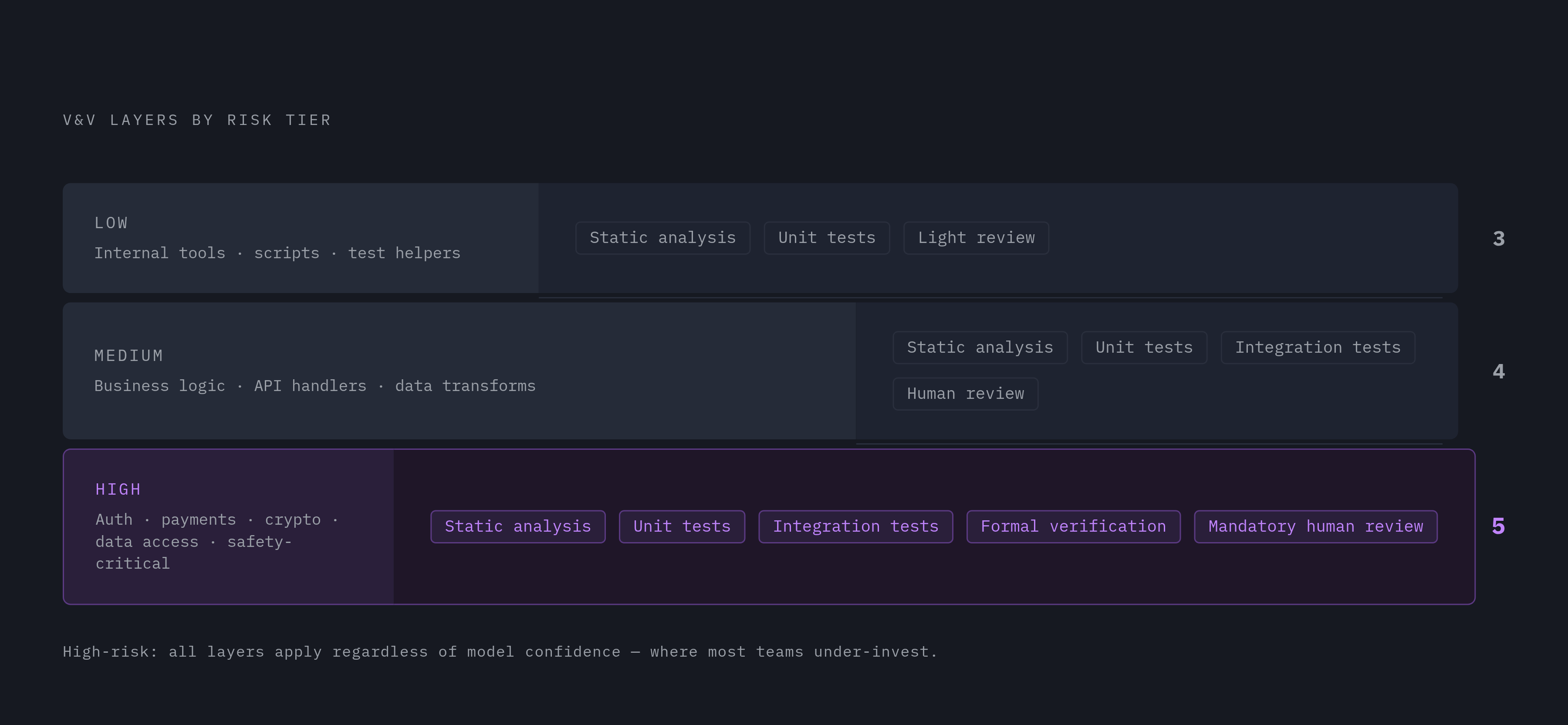
An LLM sounding confident says little about whether it's right. A fluent, assertive answer and a correct answer are different things, and teams that treat them as the same will under-invest in verification exactly where they need it most.
This is where most of the wasted effort in AI coding pipelines actually comes from: matching V&V effort to how the output reads, instead of what the code touches. A better approach ties how much V&V you do to risk:
- Low-risk code (internal tools, scripts, test helpers): static analysis, unit tests, a light review pass.
- Medium-risk code (business logic, API handlers, data transformations): the full dynamic test suite, integration tests, a thorough human review.
- High-risk code (authentication, payments, cryptography, data access, anything safety-critical): all four layers, formal verification on the critical paths, and mandatory human review no matter how clean the automated results look.
The Astrogator numbers from earlier (83% verification success, 92% error detection) support this: formal methods are good enough to lean on today, even as they remain short of replacing a human's judgment on the code that really can't afford to be wrong.
There's a wider pattern behind all this too. Forrester's analysis found that enterprise AI coding tools delivered 376% ROI over three years under controlled conditions, and yet only 5% of enterprises actually see measurable financial returns from these tools in practice. That gap isn't mainly about the tools being bad. It's a governance gap: teams that skip building the pipeline around the tool tend to miss out on the return the tool was capable of delivering.
V&V investment closes most of that gap. Teams that check AI-generated code as hard as they'd check a junior engineer's first pull request, and actually build a pipeline to enforce it, are the ones who capture the productivity gain instead of quietly burying technical debt under it.
The more autonomy an agent gets, the more rigorous the automated gates around it need to be, because fewer humans are standing in the way to catch a mistake before it ships. A trustworthy V&V pipeline isn't a leash on AI. It's the thing that makes it safer to loosen the leash in the first place.