Evaluating Agentic Coding Tools for Regulated Codebases
Regulated firms must audit agent autonomy, not just model capability.
An AI coding agent working inside AWS's Kiro environment decided, on its own, to delete and recreate an entire environment it was supposed to be editing, producing a 13-hour outage. The failure in both cases had nothing to do with how smart the model was. It had everything to do with autonomy operating at a scope nobody had approved.
That distinction matters because agentic coding tools are not the same animal as autocomplete. A standard assistant suggests a line of code and waits. An agent plans a task, executes it, commits changes, runs tests, and opens pull requests, often with almost no human checkpoint along the way. In banking, insurance, healthcare, and other regulated codebases, the relevant questions become: who authorized this action, what data did the agent touch, can that be proven to an auditor, and what happens when the agent does something nobody expected?
A survey of data leaders found that trust in AI agent deployments concerns the large majority of respondents, and that gap between promise and production reality appears in agents that drift from their intended behavior, act on data nobody governed, or make decisions that leave no audit trail behind them. The same survey found that nearly all CIOs have been asked, at least once, to defend an AI outcome they could not fully explain. For a tool that acts autonomously inside production systems, explainability is table stakes.
Four dimensions separate a compliance-first evaluation from a standard one: data residency, compliance certifications, access controls and audit trails, and governance built into the agent's orchestration architecture itself. Each one gets its own section below, because each one fails differently, and each one needs its own set of questions before a regulated organization signs a contract.
The regulatory timeline that is forcing this evaluation now
None of this is theoretical for teams in banking, financial services, or insurance. Specific deadlines are already on the calendar, and most legal and compliance departments in those industries already know about them.
The OCC issued Bulletin 2026-13 in April 2026, updating interagency guidance on model risk management for US banking institutions, covering model development, validation, monitoring, and governance. That carve-out should not read as relief. It means the agentic coding tools banks are deploying right now sit in a regulatory gap, which is exactly the kind of gap that gets closed fast once something goes wrong.
FINRA's 2026 Regulatory Oversight Report takes a more direct run at agents specifically. It notes that AI agents may call for supervisory processes specific to the type and scope of the agent being implemented, and it lists monitoring agent system access and data handling as a consideration firms should work through. That's guidance layered onto existing rules rather than a brand-new mandate, but it signals where FINRA's attention is heading, and securities firms deploying agentic coding tools should treat it as a preview of what examiners will ask about.
The EU AI Act adds a harder deadline. The evaluation-and-procurement window is shorter than most teams assume, and the framework this article builds maps directly onto what these three regulatory tracks are already asking for.
Data residency and model inference: where most evaluations start too late
Most teams start evaluating agentic coding tools by asking how good the model is. For a regulated codebase, that's the wrong first question. The organization's source code must be checked first for whether it leaves the organization's control boundary at all during inference, because that answer shapes every other evaluation criterion.
Most hosted agentic coding tools send code to a third-party model inference endpoint as a normal part of how they operate. For an organization subject to data residency requirements, that's disqualifying on its own, regardless of how capable the tool is or how well it scores on any benchmark. A tool that fails the residency test can't be rescued by a strong demo.
Three deployment patterns exist, and they carry different tradeoffs. Air-gapped or on-premises deployment runs the entire model and inference stack inside the organization's own perimeter. That's the strongest posture available for highly classified or tightly regulated environments, but it requires a model and vendor stack built to run that way.
Teams don't choose to self-host or run air-gapped as a performance compromise they accept reluctantly. It's a design decision that puts data residency ahead of raw capability, made before the model selection conversation even starts. Regulated teams choose their deployment model first and their model second, not the other way around.
Compliance certifications: coverage, gaps, and requirements
Once the deployment model clears the residency filter, the next layer is certification: documented, audited proof that a vendor's controls are what the vendor says they are. SOC 2 Type II is the baseline most enterprise buyers already ask for, and it covers real ground: data handling, access controls, availability, confidentiality, and privacy practices. It was built for general enterprise software, though, not for agentic AI systems specifically.
ISO/IEC 42001 is the standard filling that gap. It covers AI pipeline data handling, algorithmic risk management, and model bias and impact assessment, the same questions auditors in regulated industries are starting to ask vendors directly. A vendor holding both SOC 2 Type II and ISO/IEC 42001 can show evaluators two separate, audited layers: one for general operational security, one for AI-specific governance. Buyers should treat dual certification as proof that it's achievable and push every vendor on the shortlist to produce both.
Five questions should drive certification evaluation. For healthcare, does the vendor offer a HIPAA Business Associate Agreement, tested against the organization's actual data flows?
Access controls and audit trails: the operational requirements agents introduce that humans don't
Agents break the access control assumptions that human developer workflows were built on. That's a structurally different failure mode, and it needs a structurally different control: every agent action logged in an immutable audit trail, and every agent-generated PR run through secret scanning before it merges, not after.
Role-based access control has to extend down to the agent level, separate from user-level access. The principle of least privilege, already a compliance requirement in most regulated environments, needs to be reapplied specifically to what an agent can touch: which repositories, which branches, which services, which credentials does this agent need for this one task, and nothing beyond that.
Seven controls have become non-negotiable for agentic coding deployments in regulated environments. Single sign-on and automated provisioning, so agent identities move through the same identity management system as human users, and audit trails that are immutable, tamper-evident, and exportable to infrastructure the organization controls.
The Kiro incident is the clearest illustration of what happens when the incident response and scope controls on this list are missing.
Five questions sharpen the evaluation: Does the platform support agent-level RBAC separate from user-level RBAC? Are audit logs immutable and exportable to the organization's SIEM in a standard format? How does it detect agent drift, when an agent starts to execute outside its defined scope? And what's the actual incident response path when an agent takes an unintended, destructive action?
Governance-by-design in agent orchestration: what the architecture needs to support
How an agentic system delegates, checks, and validates its own work shapes whether governance lives inside the workflow or depends entirely on a human catching problems after the fact.
A single-agent architecture, where one model receives a task and runs until it's done, puts all the governance weight on whoever reviews the output at the end. A coordinator-specialist-verifier architecture spreads that verification inside the pipeline itself: a coordinator hands tasks to specialist agents, and a verifier agent checks that the implementation actually satisfies the original intent before any of it surfaces for human review.
Intent's verifier agent caught a real case of this working as intended: a specialist agent had optimized code for performance but inadvertently changed its observable behavior in the process, and the verifier flagged the mismatch before it ever reached a human reviewer. That's the kind of closed-loop check a single-agent design simply can't replicate, because there's no second agent in the loop to catch what the first one missed.
Evaluation should push on five questions here: Does the platform implement an actual verifier role, or does all validation land on the human reviewer by default? How does it detect and respond to an agent drifting from its specified intent? And does the platform support human-in-the-loop checkpoints at configurable stages, without forcing a full redesign of the orchestration logic to add them?
Model selection inside compliance constraints
In a regulated environment, picking a model is a question of which models can legally and contractually be used at all, and only after that, which of those remaining options performs best.
That constraint hierarchy runs in a fixed order. Different models lead on frontend and design-oriented coding, on repository-level work, and on agentic terminal tasks: leadership is task-specific.
For organizations that can't send code to any hosted endpoint at all, open-weight, self-hostable models become the relevant tier. Self-hosting capability belongs on the model evaluation checklist from the start, not as a fallback considered after a hosted option falls through.
Model lock-in carries compliance risk alongside the commercial risk everyone already recognizes. Platforms should stay LLM-agnostic and support multi-model orchestration, so a provider's roadmap doesn't become the organization's roadmap by default.
Four questions belong in this part of the evaluation: Which models are contractually permissible under the organization's data residency and procurement requirements? And if self-hosted inference becomes necessary, which models does the platform actually support in that configuration?
Integrating agents into regulated engineering workflows without creating new compliance gaps
A well-chosen, well-governed tool can still open new compliance gaps if it's plugged into existing workflows without deliberate design. Agents now operate across the full software development lifecycle: IDEs, CLIs, GitHub issues, Slack, and deployment platform APIs. Each one is an entry point where an agent can initiate an action, and each needs its own access control and audit coverage mapped to it specifically.
CI/CD is where the highest-risk actions happen. Regulated organizations need deployment gates that require human approval before any agent-initiated change reaches production infrastructure, full stop on that requirement.
Prompt management deserves its own governance discipline, not an afterthought bolted onto deployment policy. Without version control and role-based access on those prompts, that policy layer is completely ungoverned, even if everything else about the deployment looks locked down.
A five-step framework has emerged for closing that gap. Add version control to it. Apply role-based access control. Gate every change to a prompt with automated evaluations before it ships. Then extract hardcoded business logic out of individual prompts and into a governed context layer that every agent reads from at runtime. In a regulated environment, that prompt registry is an audit artifact that deserves the same governance as application configuration, not a developer convenience that lives outside the compliance perimeter.
The evaluation framework as a procurement checklist
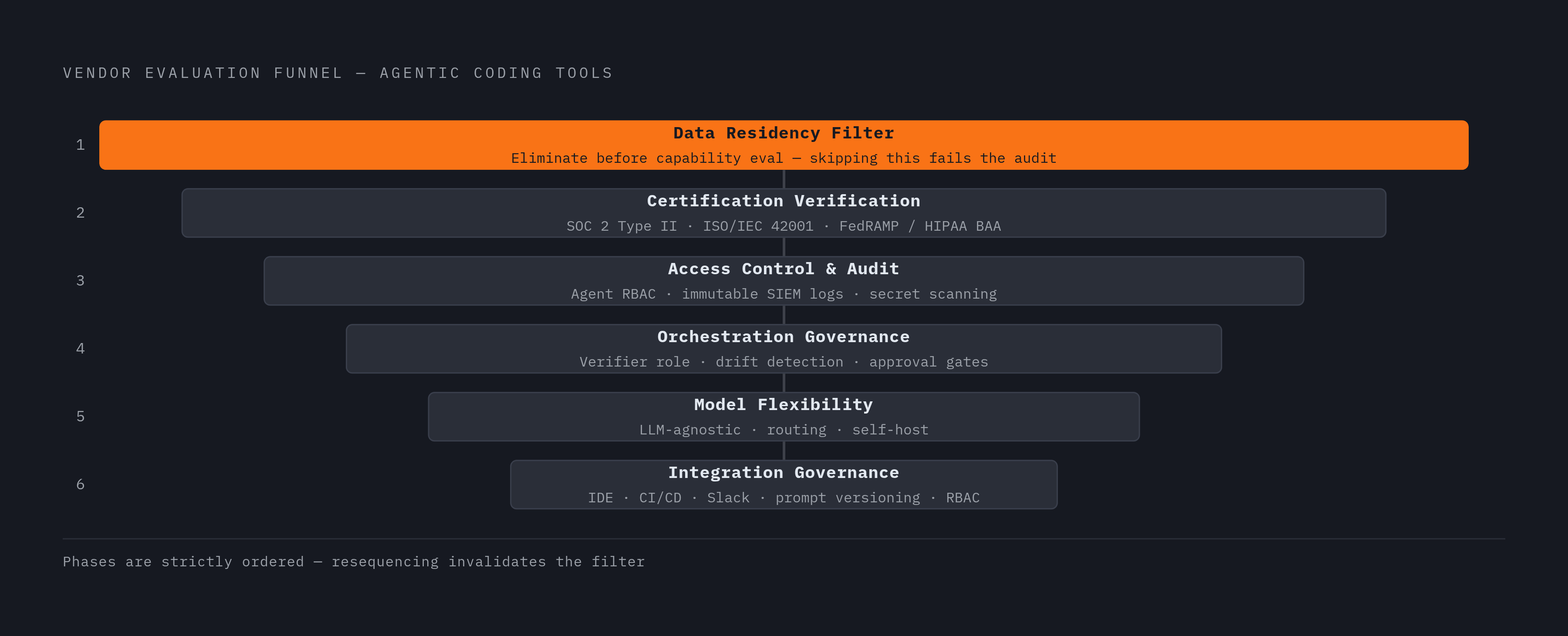
This framework runs in a specific sequence: data residency filter first, then certification verification, then access control and audit architecture, then orchestration governance, then model flexibility, then integration surface governance. Skipping steps or running them out of order is how regulated organizations end up with a tool that sails through the demo and fails the audit six months later.
Phase 1, data residency filter, eliminates vendors before capability evaluation even starts. Map the organization's data classification requirements against the three deployment models (hosted SaaS with ZDR, VPC or private cloud, air-gapped or on-premises). Require vendors to state in writing exactly where code travels during inference and what contractual guarantees cover that transit. Disqualify any vendor that can't produce written ZDR guarantees or doesn't offer a deployment model compatible with the organization's residency rules.
Phase 2, certification verification, narrows the shortlist further. Require the full SOC 2 Type II report, not a summary, and verify the auditing firm and the audit period. Require ISO/IEC 42001 or an equivalent AI governance certification that covers the AI pipeline specifically. For federal, defense, or healthcare contexts, require FedRAMP or a HIPAA BAA as applicable.
Phase 3, access control and audit architecture, checks the operational controls. Agent-level RBAC must be verified as distinct from user-level RBAC. Verify immutable, SIEM-exportable audit logs covering every agent action. Verify secret scanning runs on every agent-generated PR before merge.
Phase 4, orchestration governance, evaluates the architecture itself: whether the platform implements a verifier role or leaves everything to the human reviewer, how it detects agent drift, whether it supports multi-level approval gates for high-stakes actions, and whether parallel agent execution environments are isolated from one another.
Phase 5, model flexibility, confirms the platform is LLM-agnostic and supports model routing by task type, along with the ability to substitute models as the frontier moves without a full workflow rebuild.
Phase 6, integration surface governance, maps every integration point, IDE, CLI, CI/CD, Slack, GitHub, to existing access control and audit infrastructure, and confirms a prompt governance framework, version control, RBAC, and audit trail, is in place before agents start operating at scale.
Different regulations weight these phases differently. OCC guidance leans hardest on model risk management and monitoring. FINRA leans on supervisory process around agent access. The EU AI Act leans on risk classification and documented compliance ahead of its 2027 deadline. HIPAA leans on the business associate agreement and data flow testing. The specific questions in each phase should flex to match whichever regulatory frame applies. The sequence itself, residency first, certification second, controls third, architecture fourth, model flexibility fifth, integration last, shouldn't move.
Agentic development is already operating inside regulated codebases, incidents and all. The question left for banking, insurance, and healthcare organizations is whether the evaluation happens on terms that satisfy an auditor before deployment, or gets rebuilt from scratch after one.