Model Drift Detection in LLM-Powered Developer Tools
Coding agents drift across multiple layers, and catching it requires monitoring each one separately.
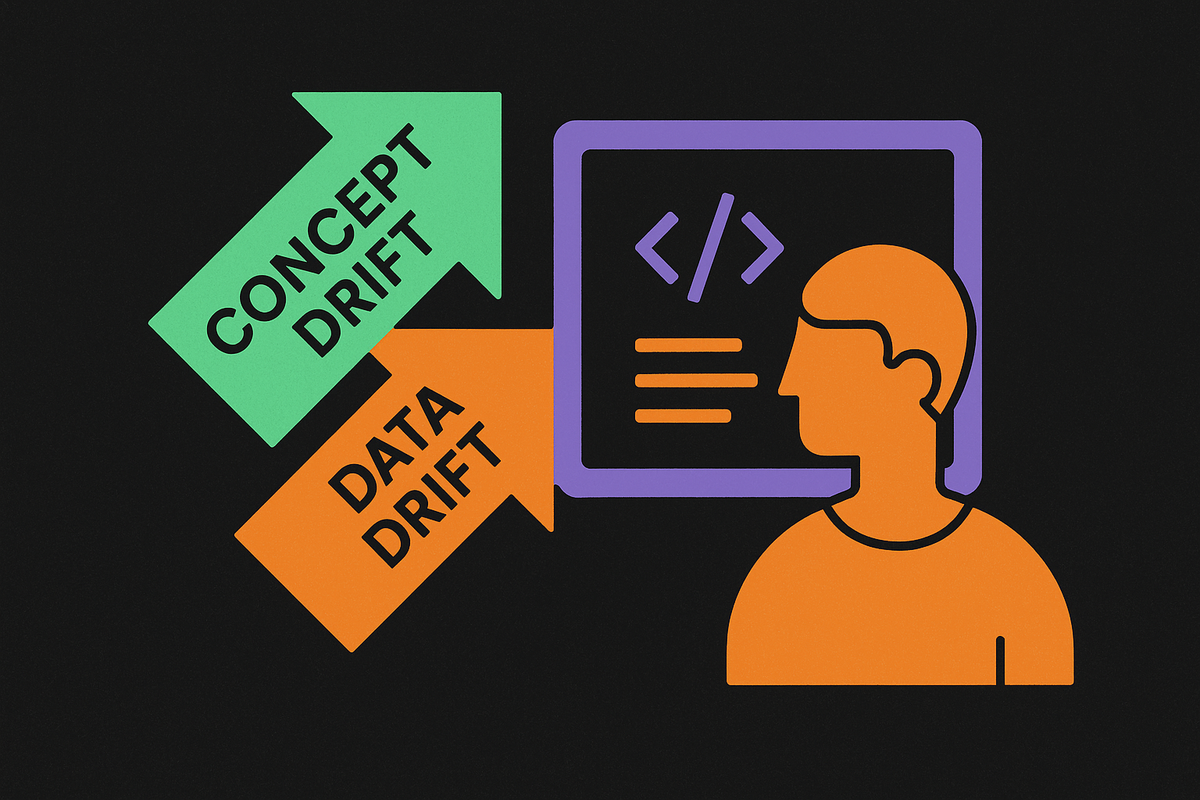
A model used to drift one way: worse. The world moved, the training data stayed put, and predictions slowly stopped matching reality. Today's coding agents run on stacks with a dozen moving parts (prompts, model versions, retrievers, tool schemas, planners), and any one of them can shift without anybody touching a thing. Often you can't even tell which piece moved. A retrieval index re-embedded over a weekend, with no one notified, can produce exactly that kind of ghost: the model unchanged, the outputs different, and no obvious place to look. Drift is five or six failure modes stacked on top of each other, and catching it means watching each layer on its own instead of waiting for the final output to look wrong.
A 2024 production LLM setup was small enough to hold in your head: one prompt, one model ID. A 2026 agent stack has several of each, plus a planner gluing it all together, and most teams aren't training any of it themselves. They're pinning to dated vendor snapshots and wiring the pieces together with duct tape and hope. Drift becomes a property of the whole contraption you built on top of the model, not the model itself.
For coding agents, this matters more than it does for a chatbot. These agents write code, run tests, open pull requests, trigger deployments. When one drifts, you get a bug that got merged, a test that got skipped without anyone noticing, a deploy that should have stayed put, shipping anyway. If your only signal is "the output looks bad," the damage is already sitting in production by the time anyone finds out.
Where drift actually gets in
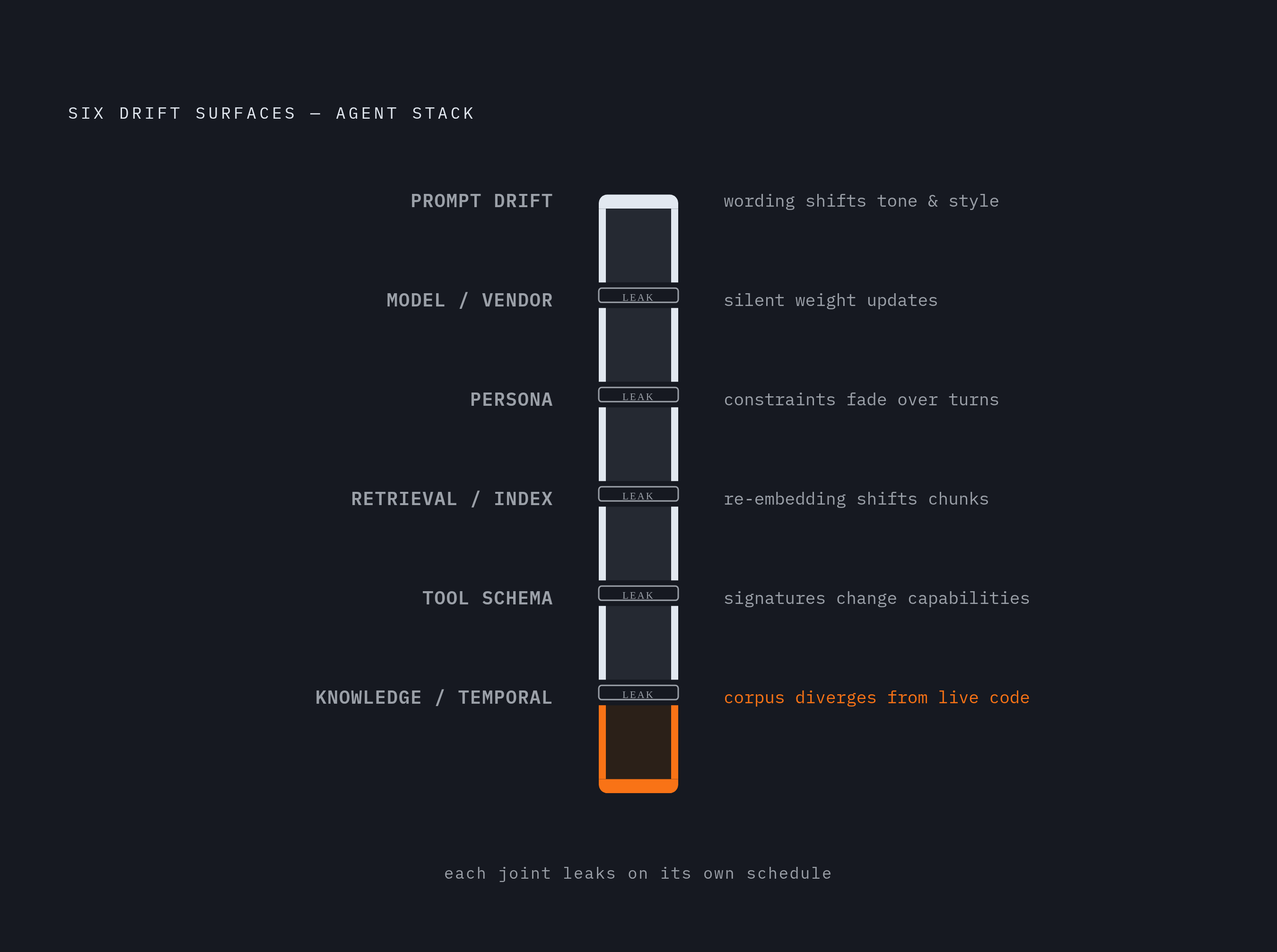
Think of the stack as a pipe with several joints. Any one can leak, and they rarely leak on the same schedule.
Prompt drift is the embarrassing one, because it's on you, not some vendor. Someone tweaks an instruction to fix a bug, and that small wording change quietly shifts tone or formatting or code style across every downstream call touching that prompt. Nobody flags it, because nobody thinks a rewording counts as a deploy.
Model and vendor drift happens when providers ship weight updates under the same model name, often with barely a changelog entry. Your JSON parser breaks because the model started adding a preamble it never used to add. A code generator drops the format you told it to follow, for no reason you can point to. None of this shows up on a latency graph, because nothing technically errored — the output just changed shape. A team scoring every production trace can catch this as a slow, multi-day dip in a groundedness score — visible only because they were watching, days before the provider confirms a weight update went out midweek.
Persona drift is specific to agents holding long sessions, hundreds or thousands of turns deep. Somewhere in that stretch, the agent forgets a constraint set at turn ten, or insists you agreed to something you never agreed to. It's failing to stay consistent with its own earlier self, which is a stranger kind of wrong to chase down than a plain factual error.
Retrieval and index drift shows up when you re-embed your document corpus. The model itself stays exactly the same, but the chunks it retrieves for the same query might be completely different — same question, different context, different answer. Tool schema changes cause a similar headache: change what a function signature looks like, and you've quietly changed what the agent thinks it's allowed to do.
Knowledge and temporal drift is the slow one. Every model has a training cutoff. Every codebase keeps moving past it anyway. A retrieval corpus indexed six months ago might describe a library interface that no longer exists. This is close to the default state of most deployed models, running on a clock that started ticking the day it shipped.
Why your dashboards stay green while things quietly break
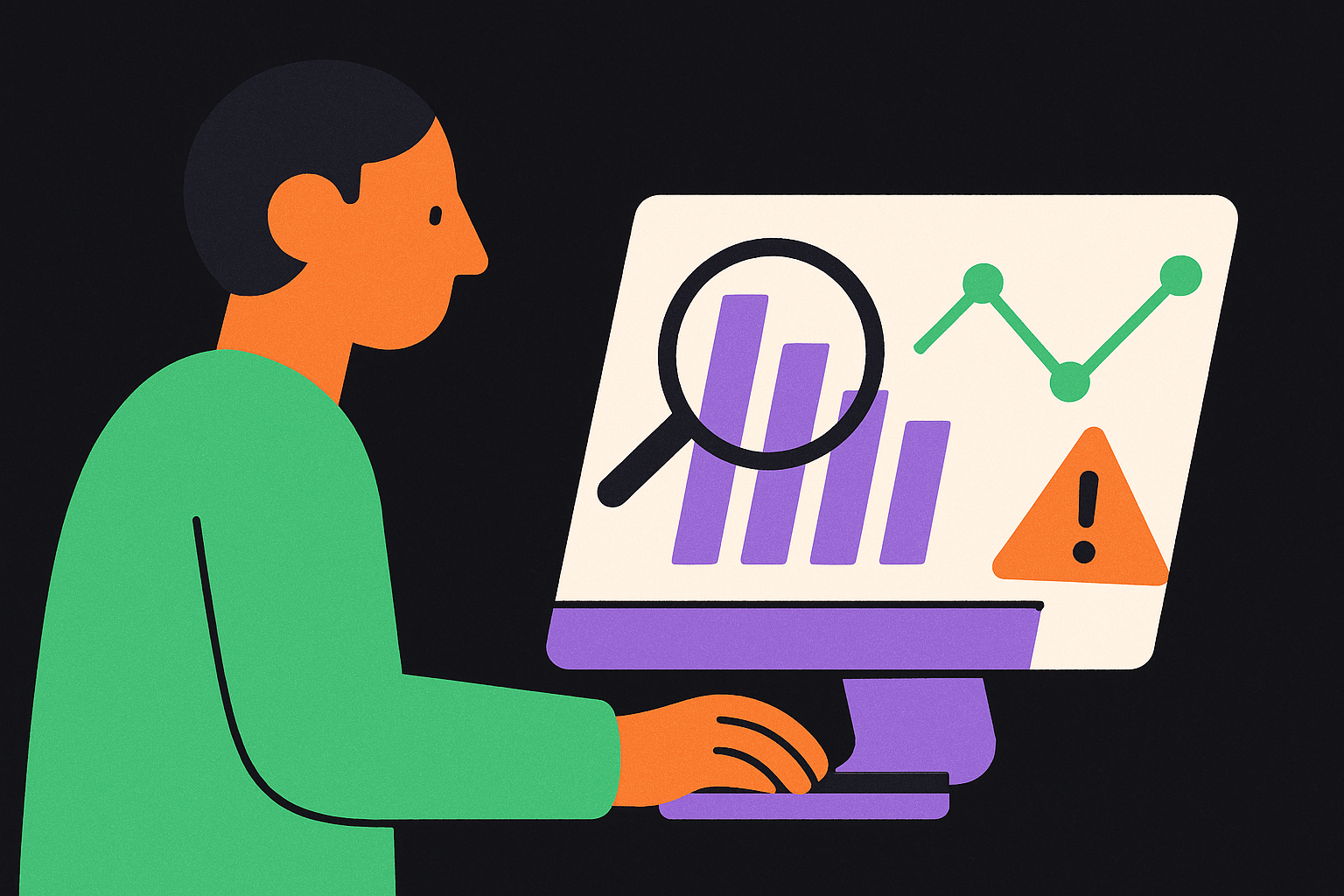
Standard application monitoring tracks latency, error rate, token counts, request volume. Useful numbers, all of them. Rarely do they twitch when a model's behavior quietly gets worse. Error rate sits at zero, latency looks normal, no alerts fire, and code quality erodes underneath all of it.
Logs offer little help either. A log tells you what was sent and what came back. Whether what came back today behaves like what came back last week is a separate question, and somebody has to actually ask it.
There's a nondeterminism problem underneath all of this too. Even at temperature zero, the same prompt can produce meaningfully different completions run to run, thanks to batch variance at inference time. A single spot-checked response tells you almost nothing about what's happening at scale.
Which leaves one real gap: score every production trace, not a manual check every so often. Periodic review only catches drift if you happen to look at close to the right moment, and "close to the right moment" is a fragile strategy at best.
Matching the fix to the failure
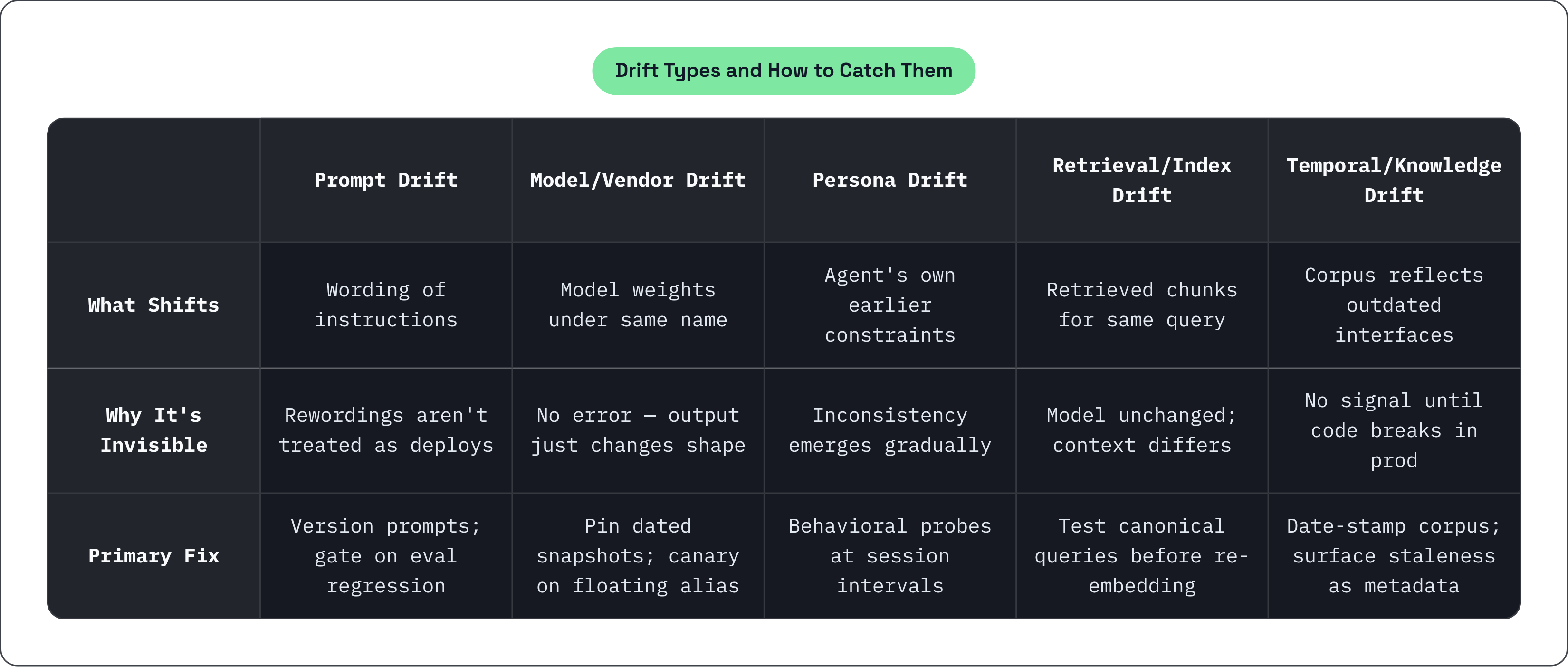
Each surface wants its own kind of watchfulness. Try to catch all of them with one dashboard and you'll feel reassured right up until you're not.
Prompt drift. Treat every prompt like source code. Version it, so every change becomes a diff you can review instead of a quiet in-place edit nobody remembers making three weeks later. Run a held-out eval suite before and after any change, and gate on a regression threshold. Shadow testing helps too: route a slice of live traffic to the new prompt, run it side by side against the old one, compare the output distributions before rolling out fully.
Model and vendor drift. Pin to a dated snapshot, not a "latest" alias. Run a canary on the floating alias, diffed against your pinned version, so a provider's silent update shows up as a score change before it reaches production. Score every trace with an LLM-as-judge or an embedding-based metric, and alert on a rolling decline, not just error spikes.
Persona drift. Inject behavioral consistency checks at intervals through a long session: structured probes that ask, plainly, are we still following the constraint set ten turns back? Compare behavior at session open against session close. Flag any session where compliance slid past a threshold you defined ahead of time.
Retrieval and index drift. Keep a canonical set of test queries. Run them before and after any re-embedding or index update, and check the retrieved chunks for semantic overlap. Treat tool schema changes the same way you'd treat a deployment: version it, test agent behavior against the diff, keep a rollback path ready.
Temporal and knowledge drift. Date-stamp your corpus. Track when documentation was last indexed, and surface that staleness to the agent as metadata, so it can flag its own uncertainty instead of stating something outdated with unwarranted confidence. Re-run your benchmark on a schedule tied to current library versions, not once at launch and never again.
What embeddings catch that judges miss, and vice versa
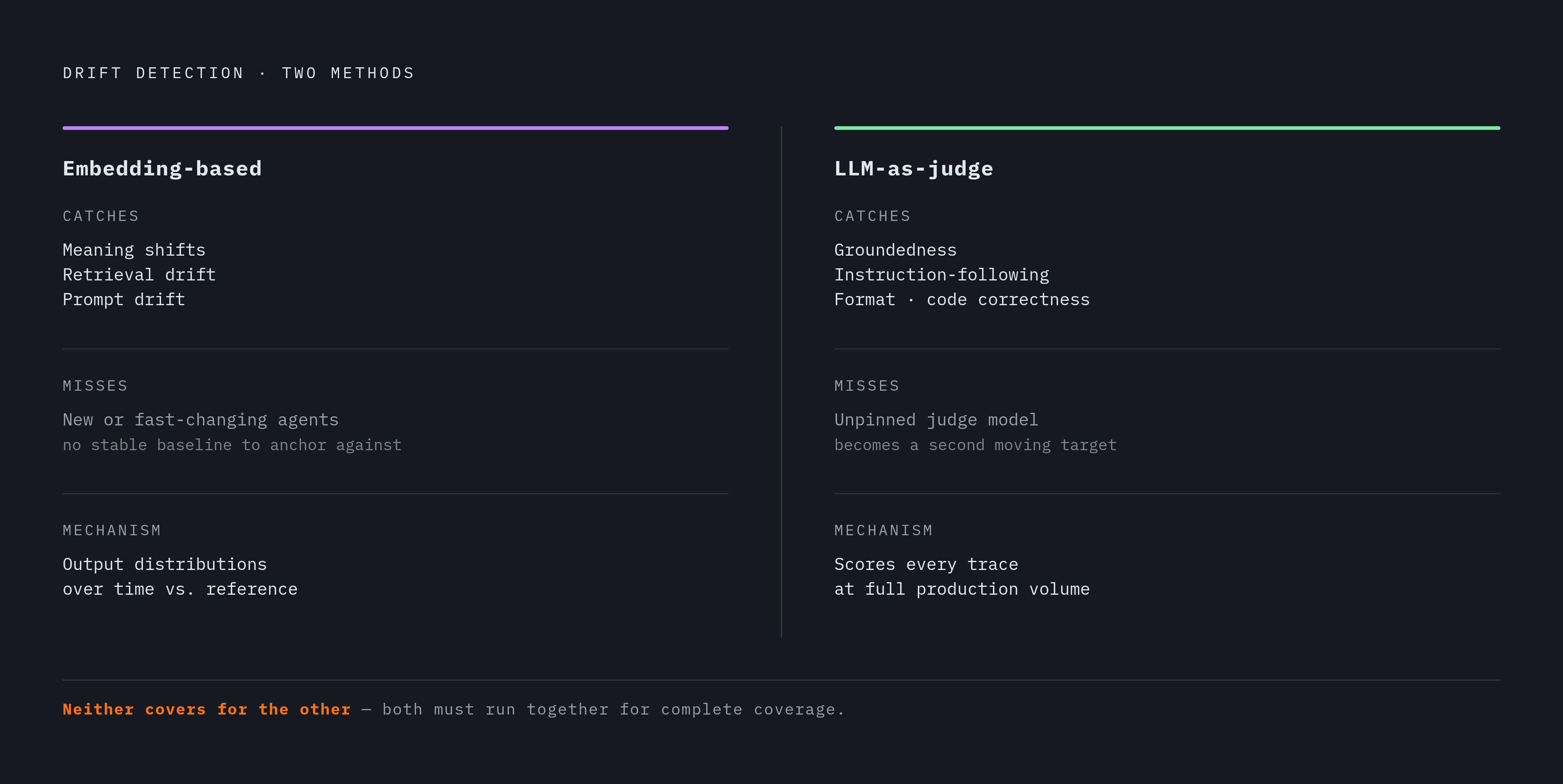
Two approaches cover most of this ground, and they catch different things.
Embedding-based drift detection compares vector representations of outputs over time, looking for a shift in meaning that a plain string comparison would sail right past. It works well for retrieval drift and prompt drift, where the change is in meaning rather than exact wording. The catch: you need a stable reference distribution to compare against, and building that baseline for a brand-new agent, or one sitting on a codebase that changes weekly, is a real challenge.
LLM-as-judge scoring works differently. A second model reviews production outputs against defined criteria: groundedness, whether instructions were followed, format compliance, code correctness proxies. It scales to full production volume without needing a human to read every trace, and it works best applied to every trace rather than a sample, because a slow eval-score decline is exactly the pattern a sampled review misses. One catch worth sitting with: the judge model itself needs to be pinned and versioned, or you've got two moving targets instead of one.
Run them together. Embedding distance flags a shift in the overall shape of things. LLM-as-judge flags a specific criterion falling short. Neither covers for the other.
Who's actually building this
A handful of platforms are built around this, each coming at it from a slightly different angle.
Arize and Arize Phoenix run automated monitoring across ML and AI applications, with data distribution testing and tracing for performance degradation. Phoenix is the open-source, development-focused version, suited to self-hosting and instrumenting your own stack. It surfaces drift through diagnostics you review yourself rather than automatic runtime enforcement, and it has no built-in compliance mapping to something like the EU AI Act.
Fiddler does real-time monitoring for data drift, data integrity, outliers, and performance drops, with root-cause analysis attached. Its Trust Service adds LLM quality and moderation checks with low-latency guardrails, which matters for coding agents, where every added millisecond gets felt somewhere downstream.
Galileo built its agent drift detection around an embedding-based method with few baked-in assumptions about the shape of your data's distribution, aimed at the kind of semantic complexity you get from coding agent outputs specifically.
Langfuse, open-source, is built around nested observations that capture the full lifecycle of a request: multi-step traces, full sessions, all of it. That structure lets you compare prompt versions, model versions, tool calls, and response patterns across time windows directly. Self-hosting gives you full control over your trace data, which matters if you've got data-residency requirements to answer to.
DriftWatch, also open-source and self-hostable, is built specifically for behavioral change detection with a short claimed detection window — a reasonable lightweight starting point if you want something running before committing to a full observability platform.
Whatever you pick, ask the same handful of questions first. Does it score every trace, or only a sample? Does it handle multi-step agent traces, or just single-turn completions? Can you pin and version the judge model itself? And does self-hosted versus SaaS actually make sense given your data residency, latency needs, and cost at the volume you actually run?
Building drift-awareness into the tools themselves
Agentic coding tools, including the ones pairing a local IDE with a persistent cloud agent, sit directly on the path of every prompt, every model call, every tool invocation, every response. A bolted-on observability pipeline is unnecessary for them to notice drift. They're already standing in the room where it happens.
What that could look like in practice:
- The agent flags, mid-session, when its own response drifts from a constraint set earlier in that same conversation.
- The IDE tells you, plainly, which pinned model snapshot and which retriever index version are active right now, instead of burying that in a config file nobody opens.
- Before a prompt edit gets committed, the tool shows how eval scores shifted on a held-out test set, right there at the point of the edit.
This gets more urgent as agents take on more autonomous work: multi-file edits, full test suites, pull requests opened without a human clicking anything. The longer an agent runs unsupervised, the wider the gap grows between a drift event happening and someone noticing its effects downstream. Instrumenting earlier, inside the agent runtime itself, is what closes that gap.
The boring habits that actually save you
Detection matters. But the best drift event is the one that never gets the chance to pile up, and a handful of habits do most of that work.
Pin your snapshots. Every production model should run on a dated version, not a floating "latest" alias. Run a canary against that floating alias on a held-out eval suite, so you get advance warning before a provider's update reaches your users. Apply the same discipline to your retriever version and your tool schema version too.
Treat your eval suite like it needs upkeep, because it does. A suite calibrated at launch goes stale about the moment your codebase moves on without it. Update it on a real schedule, and make sure it tests more than semantic similarity. Behavioral consistency, format compliance, and code correctness proxies each deserve their own test.
Put a human back in the loop for the long, high-autonomy runs. As agents take on longer stretches of independent work, spanning hours and dozens of tool calls, a structured checkpoint stops drift from quietly compounding before anyone looks at the result. Giving a developer direct control over how much independence an agent gets at any moment is itself a drift-management tool. Narrow the scope, and you narrow the blast radius of whatever goes wrong.
Regulation is starting to catch up to what careful teams were already doing anyway. The EU AI Act's continuous monitoring rules are beginning to formalize practices a lot of engineering teams already treat as table stakes. If you're building high-risk agent workflows, expect audits to eventually check for the same discipline you should've had in place from day one.
None of this is glamorous. It's snapshots, evals, and a canary running quietly in the background that nobody thinks about until the day it saves someone's afternoon. But get it in place, and drift tends to show up in minutes instead of days: a quick hotfix instead of a week of quietly degraded code shipping to production while every dashboard in the building stays green.