Integrated Development Environments Adapting to Agentic Runtimes
IDEs are becoming autonomous agent runtimes, not just code editors.
IDEs are getting torn apart and rebuilt right now. Not a paint job, not a new icon set. The old loop, you type, the tool suggests, you accept or reject, is fading out. The new one: you say what you want, an agent plans it, breaks it into steps, runs commands, checks its own work, and keeps going until it's done.
That sounds like a small change. It drags the whole definition of "IDE" along with it.
Think about what that loop needs to actually work: planning, reflection, memory, orchestration. A regular code editor was never built to hold any of that. It was built to show you text and maybe guess the next word.
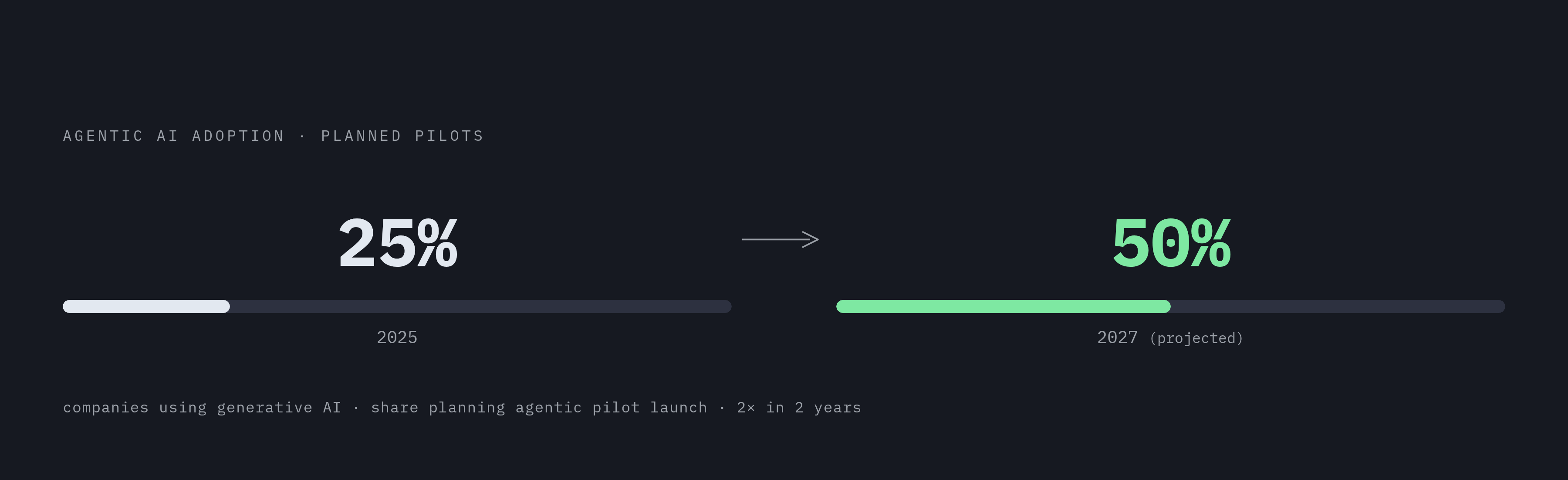
Models got reliably good at structured function calls. Frameworks like LangGraph and CrewAI hit stable production APIs. Companies stopped running pilots and started shipping the real thing, mostly in the same eighteen-month window, 2025 into 2026. Deloitte has a number that captures the pace: a quarter of companies using generative AI planned to launch agentic pilots in 2025. By 2027, that's expected to hit half.
What "agent-native" actually means as an architectural requirement
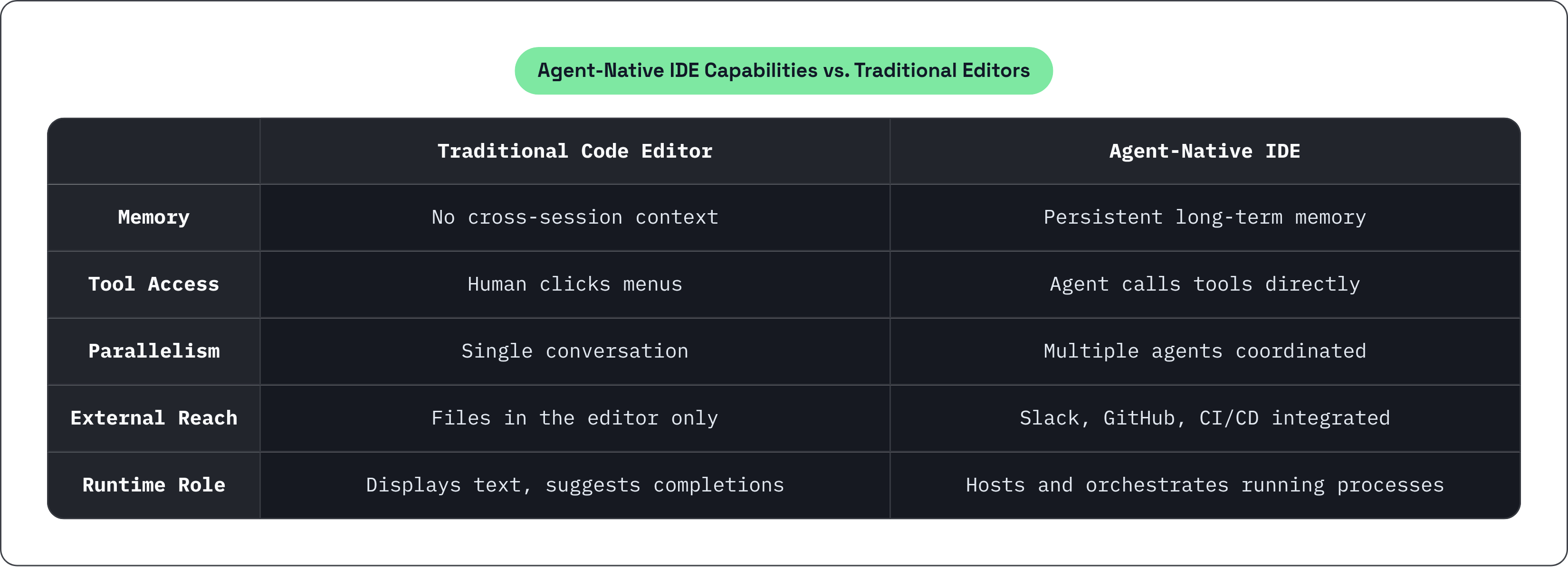
Bolting a chat sidebar onto a code editor doesn't make it agent-native. There's a real gap between that and an environment rebuilt so an agent can run inside it on its own, instead of answering questions from the sidelines.
What actually separates the two:
- Persistent memory. The agent remembers last session. You're not re-explaining the codebase every morning.
- A tool orchestration layer. Shell access, test runners, search, version control, file reads and writes, called directly by the agent, with a human rarely needed to click on its behalf.
- Parallel agent management. More than one agent running means the IDE has to track each, show what it's doing, and keep them from stepping on each other.
- Ambient integrations. A door into Slack, GitHub, CI/CD, the places where decisions actually get made, not just the one file open in front of you.
None of that bolts on as a plugin. It changes how the program runs underneath, not what it looks like up top. The IDE has to become something that hosts a running process, not something that displays one.
Agent-native doesn't mean everything runs on autopilot. A well-built system covers the whole range, a one-line fix up to an agent working alone for hours, and the developer picks the setting each time. Full autonomy isn't the goal. Having the option is.
Persistent memory and codebase-wide context as the first structural redesign
Picture a real codebase. Tens of thousands of files. Years of decisions, half undocumented, some made by someone who left the company three years ago and took the reasoning with them. No agent holds all of that in working memory. It needs something structured to search instead. An index, not a card catalog you read cover to cover.
Windsurf calls its version codemaps: structured representations of a large codebase that let an agent understand dependencies and architecture without reading every file.
Some tools take a different approach by building the full IDE rather than riding inside another editor, which allows deeper access to how the project is indexed. That difference shows up once a repo gets big enough that "just read the files" stops being an option.
Two kinds of memory matter, and they do different jobs:
- In-session memory. Short-term notes on the current task. What it tried, what broke, what's next.
- Cross-session memory. The long-term stuff. Naming patterns, architecture choices, decisions already made, so nobody re-litigates the same argument every run.
Keeping that long-term memory accurate as the code changes underneath it remains unsolved. Stale context is often worse than no context, because the agent acts on it with a confidence that turns out to be wrong. Writing rules files and setting project-level context isn't a setup step you do once on day one. It's maintenance now, ongoing, unglamorous, easy to skip.
Tool orchestration layers and why the IDE had to become a runtime host
A tool orchestration layer is what lets the agent actually do things. Run a shell command, kick off a test suite, search the codebase, read what CI just spat out, make a commit. Each of those has to exist as a clean, callable action, not a menu item a human clicks.
The IDE now manages those calls, catches it when one fails, hands the result back so the agent can decide what happens next, and keeps a record of the whole thing. That's a full execution environment, a job editors rarely had to do before.
Kiro takes an interesting stance: write the full spec first, requirements, design, task list, before a single line of code runs. It slows the agent down on purpose, so it works from an actual plan instead of guessing its way through the middle.
Claude Code makes nearly the opposite bet. Anthropic shipped it as a terminal tool, not an IDE feature. A prompt, access to the code, and the loop just runs. The IDE is one place to host this. Other hosts may work just as well.
Worth being honest about where this breaks. Clear, bounded tasks, run a test, read a file, tend to work fine. Long chains of open-ended reasoning, where the agent has to guess right many times in a row with nobody checking in, still fall apart more often than anyone likes to admit. The orchestration layer needs a plan for failure, not just a happy path: error handling, retries, clear spots where a human steps in. An agent that fails quietly halfway through and says nothing about it is worse than one that stops and admits it's stuck.
Parallel agent management and what it changes about the developer's role
Once an agent runs on its own, the obvious next move is running several at once, each chewing on a different task against the same codebase.
Cognition's Devin makes this concrete. Teams spin up several Devin instances at the same time, each on different work. At that point it stops feeling like an assistant and starts feeling like a small team of engineers who happen to not be human. Google's Antigravity runs on the same idea, several Gemini-based agents in parallel under a planner that coordinates them. The IDE isn't one conversation anymore. It's a coordination point for several conversations happening at once, which is a strange thing for a code editor to turn into.
That asks more of the environment than most editors were built to give:
- Isolation. Agents can't trip over each other's changes. Branch handling and separate workspaces go from nice-to-have to load-bearing.
- Visibility. One place to see what every agent is doing and where each is stuck, not five terminal windows you're babysitting.
- Conflict resolution. When two agents touch the same code, the IDE flags it instead of quietly merging two changes that don't actually agree.
What this does to the developer's job is real. Less typing, more directing. Handing out tasks, reading what comes back, untangling conflicts, deciding when to step in. A team that's good at running parallel agents starts to look different from one that isn't, in how they split work, how they review, how careful they are before hitting merge.
The autonomy dial as a design requirement, not a convenience feature
An IDE that only offers "fully automatic" or "fully manual" doesn't hold up, because real work doesn't live at either extreme. Fixing a typo and shipping a whole feature end to end are not the same job. They deserve different leashes.
A working system needs a real range:
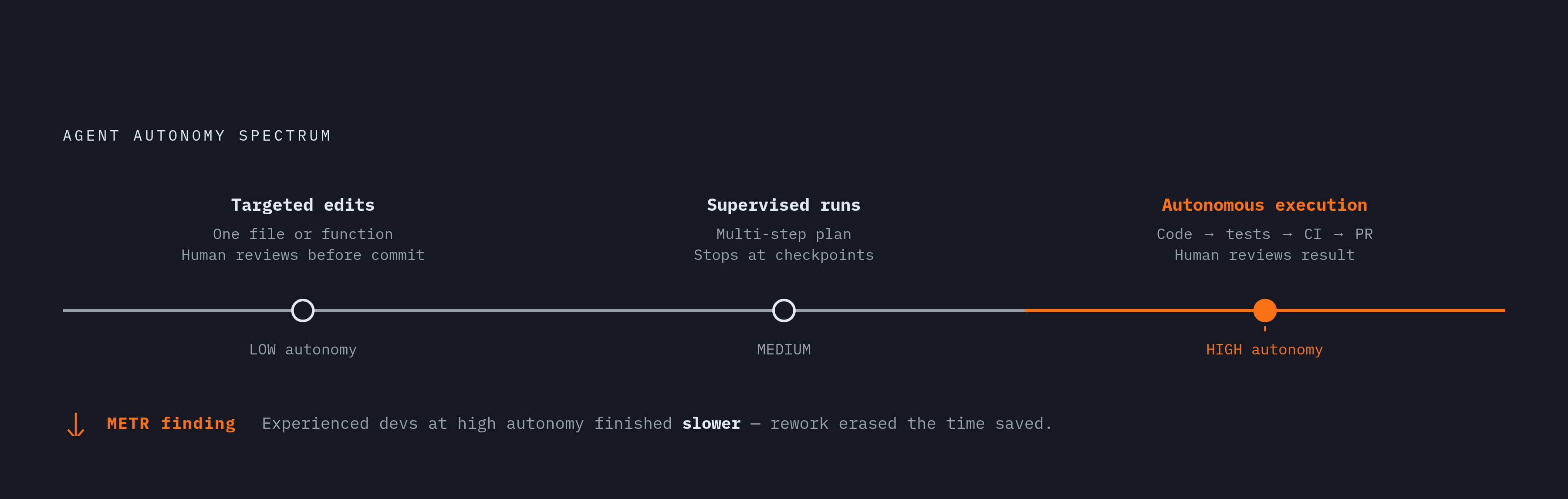
- Targeted edits. The agent touches one file or function. A human reviews before anything's committed.
- Supervised runs. The agent works a multi-step plan but stops at set checkpoints, waiting for a yes before moving on.
- Autonomous execution. The agent handles the whole thing, code, tests, fixing CI failures, opening the pull request, and you review the finished product instead of watching every step.
New users tend to start supervised and drift toward autonomous once they get a feel for what the agent can actually be trusted with. Good design makes that drift smooth, not a settings menu buried three clicks deep. Rules files, banned actions, required checkpoints need to be visible, set on purpose rather than discovered by accident.
METR ran a study worth sitting with for a second. Experienced developers, using frontier AI tools, on codebases they already knew well, finished slower. One likely culprit: running the agent too autonomously created rework that ate up whatever time it saved. That's the exact failure the autonomy dial exists to prevent. However independent the agent gets, someone still has to see what it did, understand why, and undo it if needed. That floor stays fixed.
Ambient integrations and why the IDE boundary had to expand beyond the editor
Coding doesn't happen only in the editor, though a lot of tooling still acts like it does. Decisions get made in Slack. Reviews happen on GitHub. Builds pass or fail in CI/CD. A developer's actual mental map of a project spans all of that at once. An agent stuck inside one file window is missing most of the picture.
What ambient integration actually looks like, in practice:
- Terminal. Agents that run the command themselves and read the output, instead of just suggesting one for you to copy and paste.
- GitHub. Agents that read issues, open pull requests, respond to review comments, fix CI failures, without you switching tabs. GitHub's 2026 Agentic Workflows feature, still in technical preview, is built for exactly this.
- CI/CD. Agents commit more often, so the pipeline has to keep up with the extra volume. Agents that read a failed build and fix it themselves close the loop without pulling a human back in.
- Slack. Agents that show up where the team already talks, instead of forcing everyone into another app just to check on one task.
Some tools show what this looks like stitched together: the IDE, a command-line version, Slack, GitHub PR review, all connected. The bet is that the agent works wherever you already work, no detour through a separate tool required.
For companies, that raises the stakes. An IDE that reaches into Slack, GitHub, and CI/CD is now competing on integration depth with the companies that make Slack, GitHub, and CI/CD. That's a different fight than "whose autocomplete is better." Some things stay human no matter how far this goes: prioritization calls, architecture tradeoffs, actually talking to stakeholders. Execution moves to agents. Judgment stays put.
Where the current architectural designs fall short and what that implies for what comes next
None of this is finished, despite what the marketing around it suggests.
Memory goes stale, and nobody's cracked keeping long-term context accurate while the codebase shifts underneath it in real time. An agent leaning on outdated architecture knowledge writes code that looks completely fine and is quietly wrong, in a way you might not catch until it breaks something three weeks from now.
Reliability has a ceiling. Agents handle clear, bounded tasks well: run this test, read this file, done. They still stumble on long open-ended reasoning chains, where one bad guess early wrecks everything downstream. The orchestration layer manages the mechanics; the reasoning remains the agent's own unresolved problem.
Measuring the actual payoff is hard. Lines of code and commit counts are easy to track and mostly meaningless, maybe worse than meaningless. Rework, review burden, decision quality, the stuff that actually matters, is much harder to see. Teams end up setting the autonomy dial mostly by feel, which is a strange way to run infrastructure that touches production code.
A lot of pilots got scrapped too. The tools mostly worked; the habits around them, review practices, how tasks get split, how rules get written, never got updated to match. The tool changed. The team stayed the same. That gap is where most of the failed pilots actually live.
What's still open: cleanly resolving conflicts between multiple agents, tracking where a piece of memory actually came from, auditing what an agent touched across every tool it reached into.
Persistent memory, tool orchestration, parallel agents, reaching into Slack and GitHub and CI: all of it is already shipping, already changing how teams work today, gaps and all. Whether that's reassuring or unsettling probably depends on how much rework you've had to clean up after an agent that seemed very sure of itself.