What Cursor AI Reveals About AI-Native IDE Design
An AI-native IDE treats the agent as a first-class actor, not an assistant riding shotgun.
Cursor is a clear example right now of what an AI-native IDE looks like, versus a regular code editor with some AI duct-taped to the side. Many developers don't realize how big that gap can be. You can see it in the design choices that define this category: a dial for how much control you hand over, agents that run in parallel, hooks into the rest of your workflow, and the freedom to swap models depending on the job.
Here's the split happening in the IDE market right now. One camp bolts AI onto a traditional editor. You get autocomplete, some inline suggestions, maybe a chat panel parked on the side. The other camp builds the whole tool around AI actually doing the work. Many developers try the first kind and assume they've found the second. Often they haven't, and the difference can be bigger than it sounds.
The 2025 Stack Overflow survey polled more than 49,000 developers across 177 countries. Cursor's usage came in at 18%, its first year on the list, well behind the leading incumbent's 68%, but ahead of nearly everything else that's newer. For a tool doing something different to climb that fast, something about the approach seemed to be working. This piece is an attempt to name what that something is.
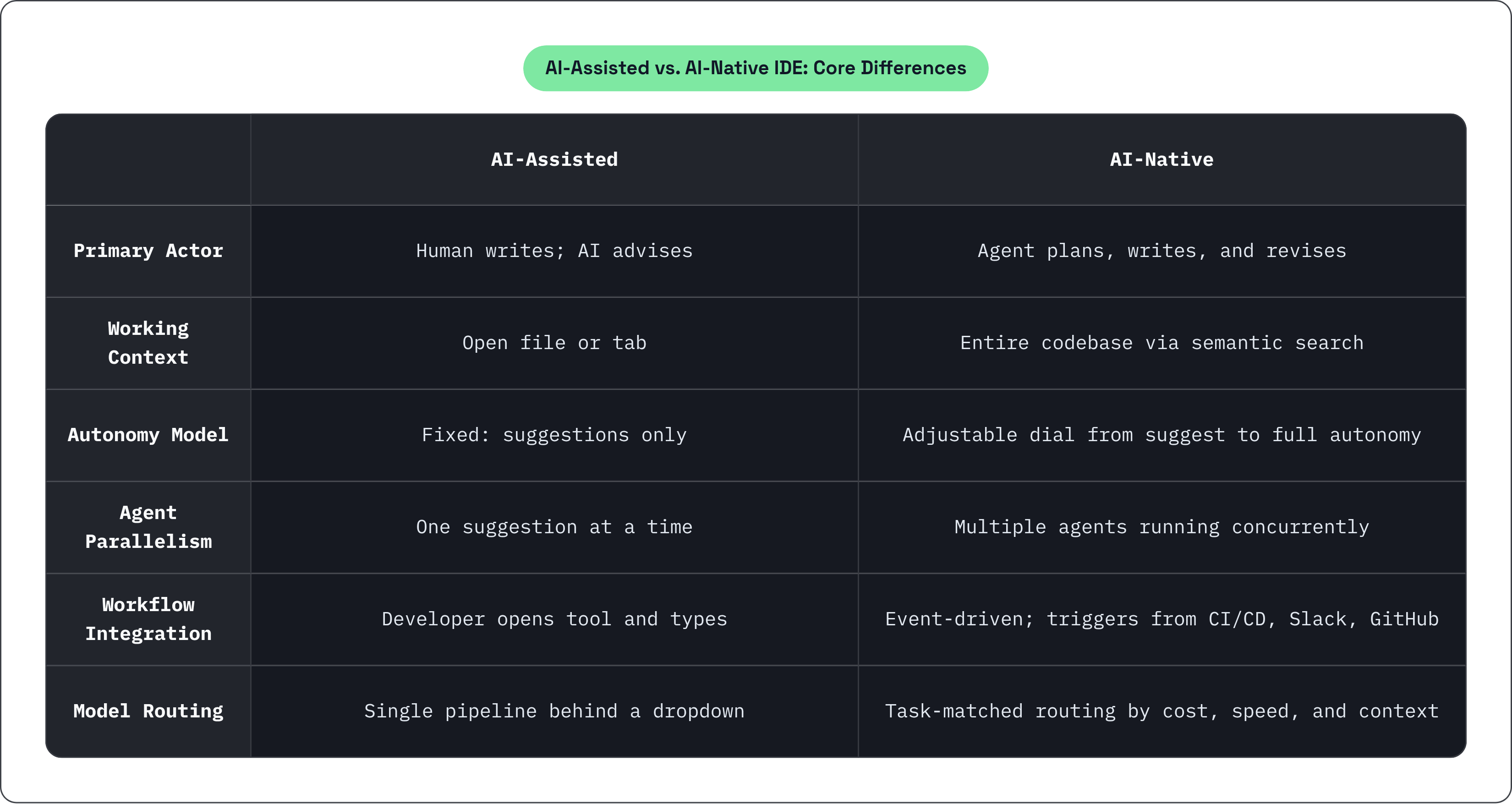
So what actually separates an AI-native IDE from an AI-assisted one? Here's my working definition: in an AI-native IDE, the AI is a first-class actor in the loop. Not a passenger. Not a helper riding shotgun.
Compare that to what most "AI-powered" editors actually give you:
- Autocomplete and inline suggestions: the AI nudges a human action. You're still driving.
- A chat panel bolted onto a traditional editor: the AI answers questions but doesn't run anything itself.
- AI-native: the agent plans, writes, tests, and revises across multiple files without someone steering every step.
That difference ripples into everything downstream: what the interface shows you, how context gets managed, where the real state of a project lives, how your day-to-day job gets framed. Design for AI as an actor instead of an assistant, and you're rebuilding the whole product. You're not slapping on a new layer.
Why should you care about this beyond the taxonomy? Because a team shopping off a checklist ("supports GPT-4, check, has a chat window, check") can walk away thinking they bought an AI-native tool when they actually bought an AI-assisted one. Six months later, they're wondering where the productivity gains went. Often the tool was never built to produce them in the first place.
Principle one: the agent must be able to act across the whole codebase, not just the open file
Traditional editors are file-centric. Whatever tab is open, that's the context. Suggestions are local, tied to wherever your cursor happens to be, blind to the other 400 files sitting in the repo.
Agent-scope design throws that out. The AI's working context becomes the whole codebase, not the open tab:
- Semantic search across files the developer hasn't even opened yet
- Multi-file refactors touching dozens of components in one sitting
- Dependency updates checked against the whole dependency graph, not just the one file that changed
- Full feature builds from a plain description, not a line-by-line prompt
Say a developer types something like "build an interactive research dashboard with real-time charts and Snowflake integration." A tool built for agent scope goes off, explores the codebase, reads the relevant docs, drafts a plan, writes across multiple files, runs the tests, and hands back something that mostly works. The developer's job becomes checking that work, not typing every line of it.
This is exactly where context window size stops being a spec-sheet number and turns into a real constraint. A model that loses track of half the codebase halfway through a session isn't doing agent-scope work, no matter what the marketing copy says. The indexing and search underneath all of this has to be built for an agent reading an entire repo, not a human scrolling through one file at a time.
Principle two: the autonomy level must be a developer-controlled dial, not a fixed setting
Here's the fear underneath all of this, and it's a fair one: handing execution over to an agent feels like losing your grip on your own codebase. An AI-native IDE has to deal with that fear, not wave it off with a reassuring blog post.
The wrong answer is a binary switch: fully manual, or fully autonomous, nothing in between. Many developers live in the middle, and a tool that skips the middle loses them.
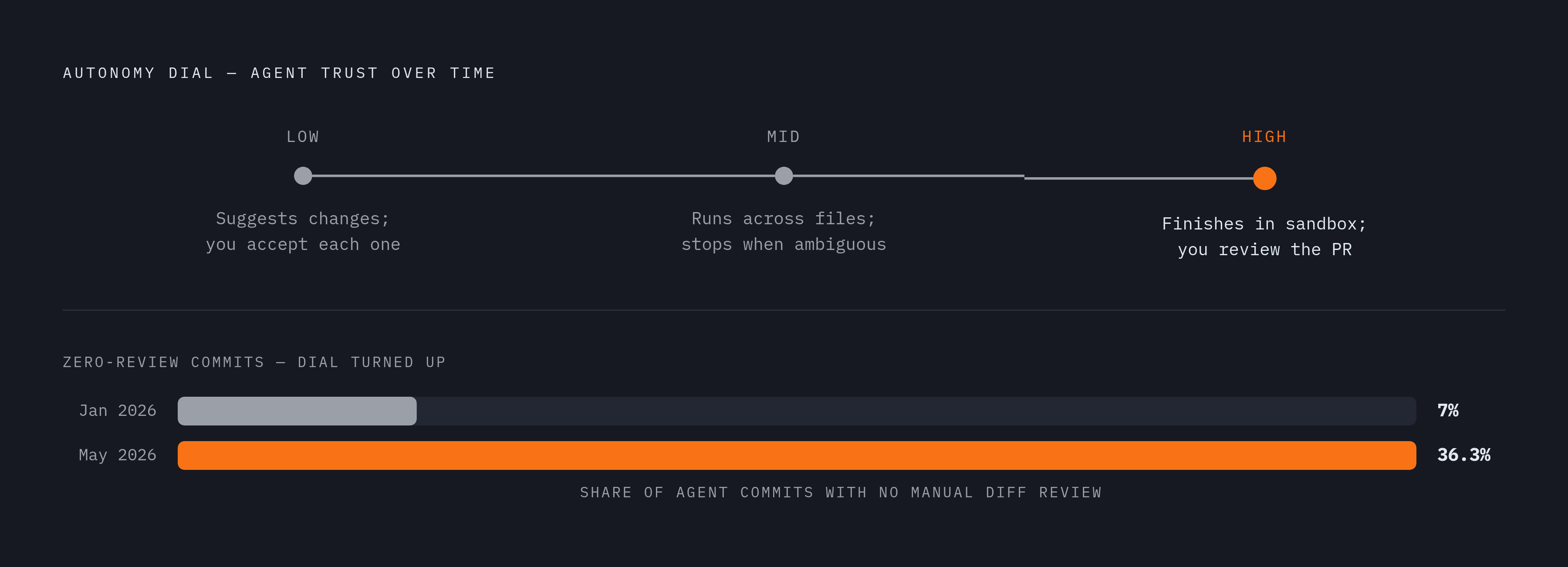
The better answer is a dial. Same tool, same system underneath, but the developer decides how much room the agent gets:
- Low autonomy: the agent suggests, you accept or reject each change yourself
- Mid autonomy: the agent runs across files on its own but stops to ask when something's ambiguous
- High autonomy: the agent finishes the whole task in a cloud sandbox, and you just review the pull request
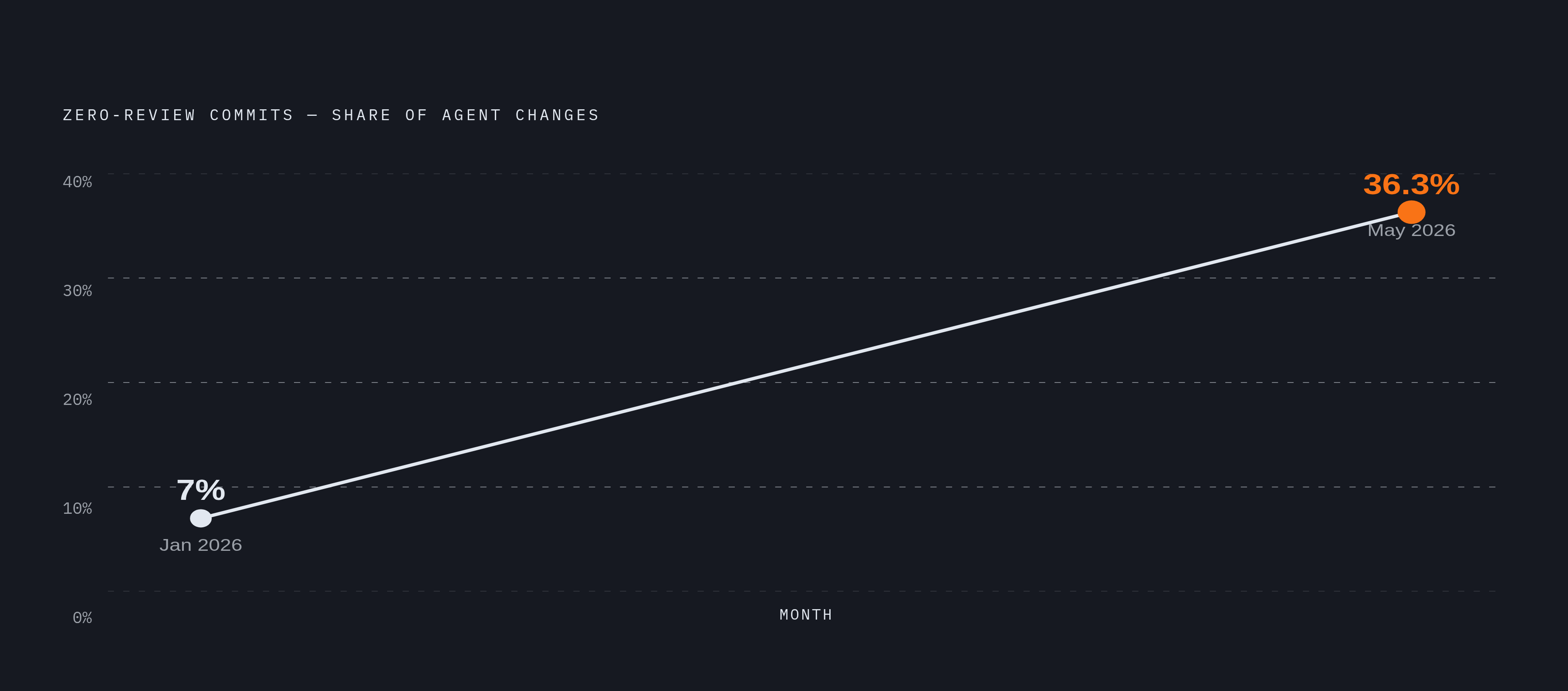
Here's a number that says more than it looks like it should: the share of agent changes that reached a commit with zero manual diff review climbed from 7% in January 2026 to 36.3% by May. Nobody flipped a switch to force that. Developers turned the dial up themselves, at their own pace, as their trust grew.
That tells you something real about how trust can work between a person and a machine doing their job for them. It often builds in small doses, earned one task at a time. Build an IDE around a single fixed autonomy setting, and you've built it on a guess about human behavior that the data doesn't support.
Principle three: parallel agents change the developer's role from writer to reviewer and director
One agent handing you one suggestion at a time doesn't change your job much. You're still the main author. The AI just sits next to you, a co-pilot at best.
Parallel agents are a different animal entirely. Picture one agent building a landing page, a second combing through usage data, a third sketching a new architecture, all at once. What's your job now?
It's not writing anymore. It's reviewing diffs. Checking screenshots of whatever a cloud agent produced while you were stuck in a meeting. Deciding which task goes to the cloud and which one you just knock out yourself. Managing a stack of pull requests instead of a stack of functions.
That's closer to engineering management than programming. Prioritizing, delegating, checking quality, feeding an agent enough context to succeed instead of writing the code yourself, line by line.
Once you see the pattern above, that acquisition stops looking random. When AI speeds up how fast code gets written, the bottleneck doesn't disappear, it just moves. It moves to review. A tool built for this world has to solve for the new bottleneck, not the old one it just inherited.
And the sessions themselves keep getting deeper. Mean tool calls per agent session jumped about 30% in two months, from 113.63 in March 2026 to 145.08 in May. Sessions are running longer and more independently, which means the interface for reviewing and directing all of it isn't some nice extra. It's the whole product now.
Principle four: event-driven agents eliminate the IDE as the required entry point
Every traditional IDE assumes the same thing: a developer opens the tool, types something, the tool responds. Little happens unless a human is sitting there, present, typing.
Event-driven agents break that assumption. The agent can trigger off something happening out in the world: a PagerDuty alert, a new pull request landing, a message in Slack, without anyone opening a window at all.
As of mid-2026, that means agents reviewing pull requests on their own, triaging incidents straight off a monitoring alert, posting summaries in Slack, assigning reviewers by time zone. Much of that happens without a single keystroke from a human being.
What does that tell you about design? An AI-native IDE has to live where the work already happens (the terminal, CI/CD pipelines, Slack, GitHub) instead of asking developers to funnel everything through one more window. It also moves where the value gets created: away from one developer's coding session, toward the whole organization's workflow. And that has real consequences for how these tools get priced and sold, not just how they get used day to day.
Principle five: model flexibility must be a structural feature, not a menu item
There's a shallow version of model choice: a dropdown with a few provider logos on it, all secretly routing to the same pipeline no matter what you asked. That's flexibility in name only, and you should be suspicious of it.
The real version matches the model to the task: cost, speed, how much context the job needs, what each model is actually good at.
- High-volume, low-stakes edits get routed to faster, cheaper in-house models
- Complex reasoning or huge-context tasks get routed to frontier models
That cost gap isn't small, either. The cost gap between a fast in-house model request and a frontier Opus-class request is substantial. That's the difference between a pricing model that survives contact with reality and one that doesn't.
Models aren't interchangeable, plain and simple. Benchmark scores, strength across different programming languages, context window size, raw speed, all of it varies a lot by provider. A well-built system shows you those tradeoffs instead of hiding everything behind one generic "AI" button. Context window is a good concrete example: holding an entire large codebase in a single context, without trimming anything out, takes both a big enough window and pricing that doesn't punish you for using it. Not every model gives you that. Not every setup even tries.
So the IDE needs to be model-agnostic at the infrastructure level, with routing logic built around what the developer is actually trying to do, not around locking everyone into one provider's roadmap.
Now, there's a real counterargument here, and it's worth taking seriously instead of waving off. An alternative design path goes the opposite direction entirely: vertical integration, training small task-specific models for autocomplete and separate ones for heavy agent work. That trades flexibility for speed and lower cost. Neither approach is obviously right. Both are reasonable bets on where this technology ends up.
What the productivity evidence actually shows about these principles working in practice
Here's the headline number: a University of Chicago analysis, looking at tens of thousands of developers across 1,000 organizations, found companies merged 39% more pull requests after agent-based coding became the default. That's a direct, organization-wide signal that multi-agent, high-autonomy design produces more finished work, not just more motion.
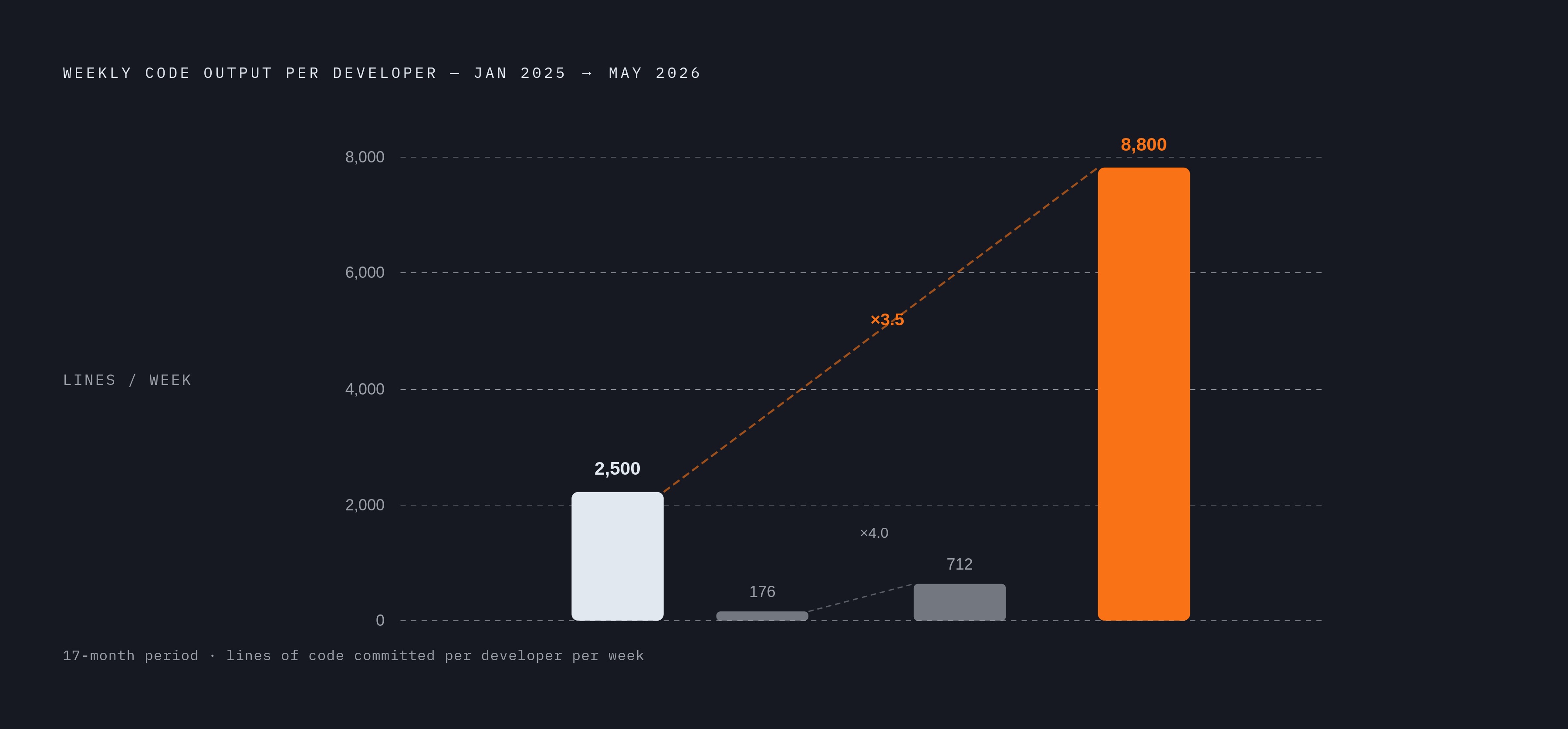
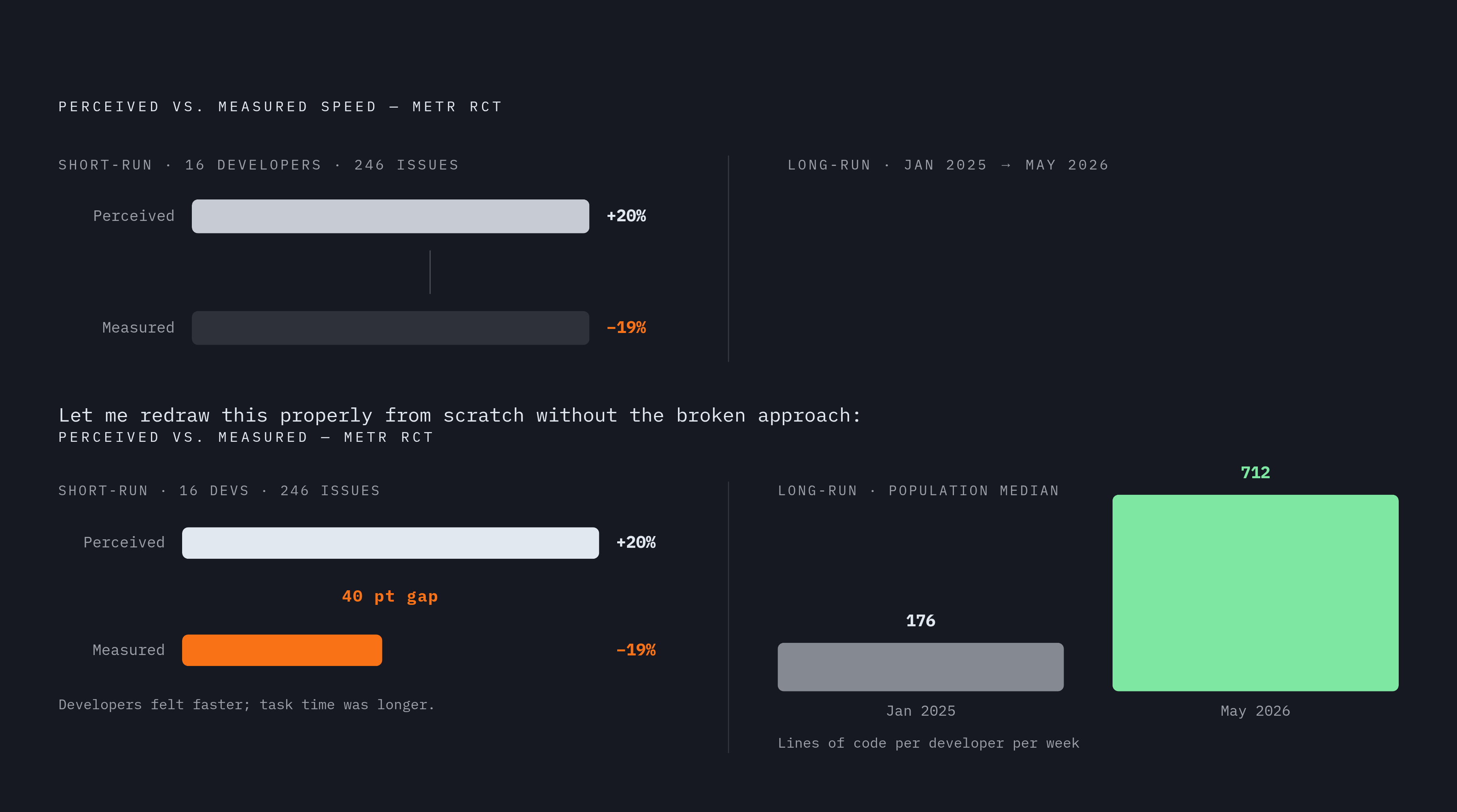
Other numbers point the same way. Median weekly code output per developer grew from 176 lines in January 2025 to 712.46 lines by May 2026. The 90th percentile went from 2.5K lines a week to 8.8K over the same stretch. Those are not small jumps.
But here's the wrinkle, and it's a real one. A randomized controlled trial from METR tells a very different story on the surface. Sixteen experienced developers worked through 246 real issues pulled from large open-source repositories, with AI use experimentally controlled across issues. The developers believed AI made them faster. Measured, actual performance told a different story, showing they were slower than expected. That's a 40-point gap between what people felt and what actually happened.
So which is it? Faster, or slower?
Probably both, depending on what you're measuring and over how long a window. The METR authors flag their own caveat: their developers had only used the tool for a few dozen hours. Learning effects that take longer to develop might not show up in a study that short. Meanwhile, the PR-velocity and code-output numbers come from huge populations tracked over many months. A short trial with sixteen people on codebases they'd never seen before, and a months-long dataset across a thousand companies, aren't necessarily contradicting each other. They might just be sitting at different points on the same learning curve.
One more wrinkle worth naming directly: usage of these tools is heavily lopsided. Gini scores of 0.77 for AI-written lines of code and 0.75 for AI spend mean the gains are stacking up in a smaller group of heavy users, not spreading evenly across a team. That's not a footnote you can skip. That's an adoption problem in its own right.
So where does that leave us? The principles behind these tools do seem to work. But the payoff shows up with sustained use, real buy-in across the organization, and developers actually putting in the hours to learn a different way of working. It's rarely automatic, and anyone promising otherwise is selling something.
Why these principles are hard to retrofit onto a traditional editor architecture
Traditional editors were built on assumptions that mostly fall apart once AI becomes the main actor instead of the assistant:
- State lives in open files on the developer's own machine, not in a cloud environment an agent can run in on its own
- The interface is built around human input (keystrokes, mouse clicks), not agent status updates and diff reviews
- Context management is sized for what a person can hold in their head, not for feeding a model the results of a codebase-wide search
- Plugins add features without ever changing who the primary actor in the system actually is
Slap a chat panel on top of that, and you get an AI-assisted tool. You do not get an AI-native one. Underneath, it still assumes the human does the work and the AI just offers opinions. Adding a real autonomy dial, parallel agent management, event-driven triggers, and actual model routing on top of that architecture means tearing out most of the plumbing, not bolting on a feature. That's a big part of why tools built from scratch, with AI as the actor from day one, have a head start that's hard to close.
There's a business-side data point that backs this up too. McKinsey's 2026 report found 77% of enterprises say they can't reliably measure ROI on their AI coding tools. Part of that is a tooling problem, not a mystery. When AI is purely advisory, its contribution is nearly impossible to separate from everything else happening around it. When the agent is doing the work and pull request velocity is the metric, that contribution becomes something you can actually count.
Which means the right question for a team evaluating tools isn't "does this support AI?" Nearly every vendor says yes to that one. The real question is whether the architecture was built around AI as the main actor, or bolted on after the fact.
What these design principles imply for developers and teams choosing or building on top of AI-native IDEs
For individual developers, a few things worth acting on:
- Start the autonomy dial wherever feels comfortable, and turn it up as trust builds. The data backs this: developers who ease in end up running far more of their work through agents over time than the ones who leave the dial untouched.
- Learn the review-and-direct skills parallel agent work demands. These are not the same muscles as writing code. Being a strong programmer doesn't automatically make you good at this.
- Take model choice seriously. It's a real decision with real cost and quality tradeoffs baked in, and knowing which model fits which task is just part of the job now.
For engineering teams and organizations, a few more:
- Treat adoption as something that plays out over months, not a rollout you wrap up in a week. The METR findings are a warning here: short evaluation windows can miss the learning effects that only show up with sustained use.
- Measure at the level of pull requests and deployments, not keystrokes. Line-count metrics get misleading fast once agents are writing a lot of the code. Output-level metrics tell you far more.
- Don't treat workflow integration (CI/CD, Slack, GitHub) as optional polish. Event-driven agents that show up where the work already happens aren't a bonus feature. They're part of what makes a tool AI-native in the first place.
The bigger pattern underneath all of this: the gap between AI-native and AI-assisted tools isn't likely to shrink as agents get more capable. It's likely to widen. The early choices, whether AI was designed in as the actor or bolted on as an assistant, compound over time. A dropdown menu and a chat window can be added to almost anything, in an afternoon. An autonomy dial, a review interface built for parallel agents, and infrastructure that treats the model itself as swappable are much harder to bolt on after the fact. Those need to be there from the start, or they're not really there at all.