AI Root Cause Analysis for Production Failures
AI agents find root cause in logs and traces faster than humans ever could.
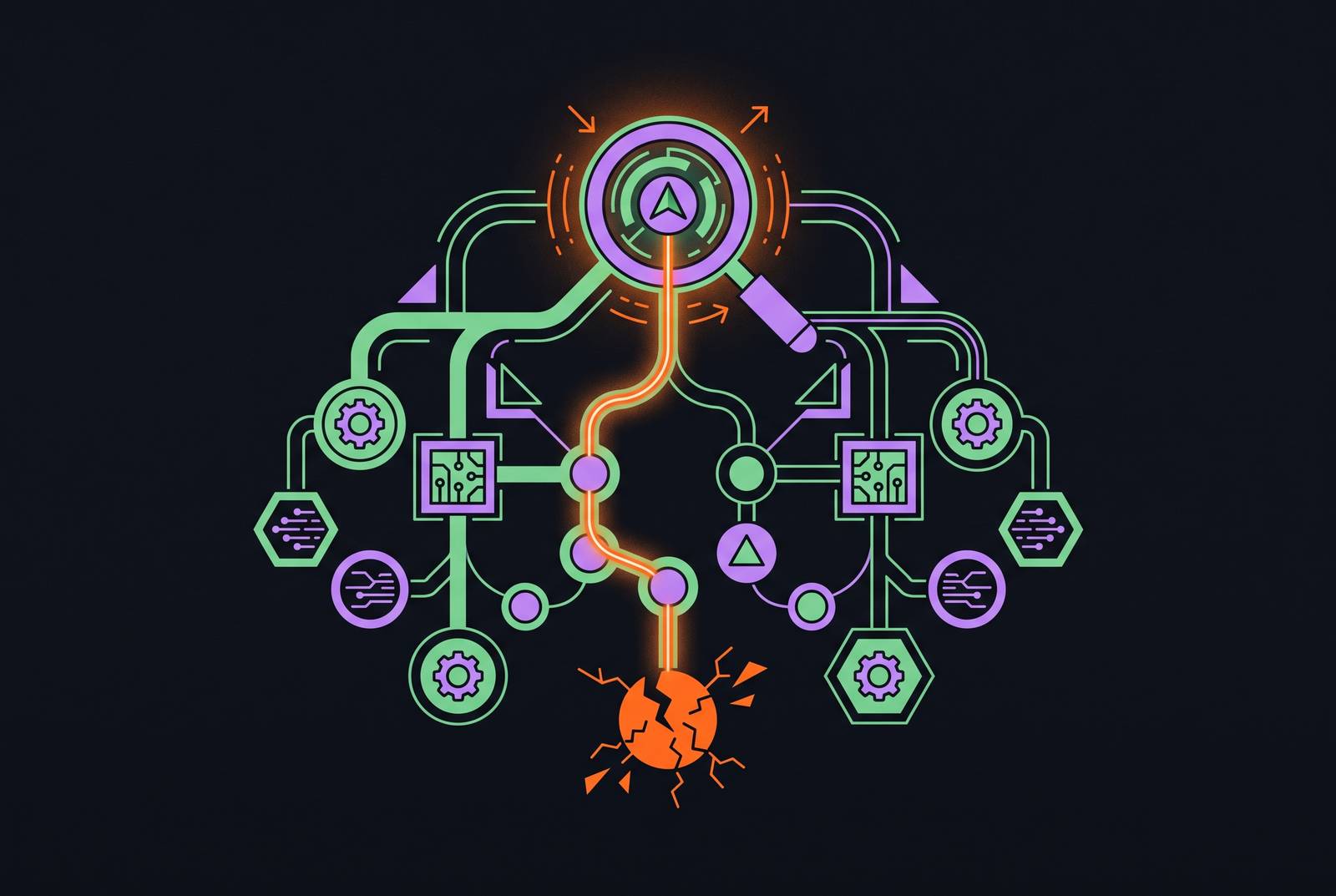
A production system today can fail in a dozen places at once, and finding out why usually means digging through logs by hand while customers watch a spinner. AI root cause analysis (RCA) is the attempt to fix that: agents that read logs, metrics, and traces together, find the actual cause, and hand engineers an answer instead of a haystack.
Why now? Microservices, serverless functions, and multi-cloud setups broke observability faster than most teams could patch it. A single user request can touch 8 to 12 services on its way to a response. Without distributed tracing, there's no way to walk that chain and see where it snapped. Engineers routinely juggle 21 different observability tools, each showing a slice of the same incident, none showing the whole thing.
The result: information overload, tribal knowledge stuck in one person's head, gut-call bias baked into every manual triage, long MTTR, the same root causes recurring, and wildly inconsistent quality depending on who's on call.
This was rarely a data problem. Companies have more telemetry than they know what to do with. The problem is correlating that data fast enough, at a scale no human on a keyboard can match. Correlation, done automatically and continuously, is what fixes that.
What AI root cause analysis actually does under the hood
Strip away the buzzwords and most production AI RCA systems rely on four techniques:
- Log clustering — grouping related events so patterns show up that get lost when you read logs one line at a time.
- Trace analysis — following a request across every service it touches, to rebuild the chain of cause and effect.
- Metric correlation — spotting which signals move together right before a failure, and how strongly.
- LLM synthesis — turning all of that into a plain-language report: what happened, when, and what to do about it, with each claim tied to the telemetry behind it.
The output is a ranked list of contributing factors, each scored by how strongly it relates to the failure — a confidence-scored evidence chain, not a hunch dressed up in nice formatting.
Picture a payment microservice leaking 2% of its memory every day. That's small enough to sit inside normal variance. No static threshold trips, and a human watching a dashboard would likely miss it too. A system tracking baselines over time catches the slow drift across a week and flags it before customers see an error.
That same pattern-matching cuts alert noise by grouping related pings into one alert instead of forty. On-call engineers get one notification that actually means something.
These models often use in-context learning, adjusting to live incident data without retraining. That keeps maintenance down and lets the system keep pace with failure patterns it hasn't seen before. But this only works if engineers can see the reasoning behind it. Every finding needs to trace back to real telemetry. Few people trust a black box that says "trust me" in the middle of an outage.
The data quality problem that determines how well any RCA model performs
Most teams shop for the model first and treat logging hygiene as cleanup work to do later, if there's time. There usually isn't, and the model underperforms for reasons that have nothing to do with the model.
AI RCA quality scales with how clean and structured the input signals are, not with which model a team bought. That's the whole ballgame.
OpenTelemetry traces are the glue holding this together. They let a model follow one request across every service boundary instead of piecing together isolated fragments of log text and guessing at the connections.
Runbooks matter too, but only if they're set up right. They need to live in a vector store, broken into chunks at the section level, tagged with metadata like service, severity, and the date they were last checked. A runbook nobody's touched in 90 days can be worse than useless: it drags down retrieval quality by feeding stale answers into the mix. A freshness gate that flags anything untouched for 90-plus days is basic hygiene, the same way a team would rarely ship code without a linter.
Fix the plumbing before buying the tool. It won't save you from bad pipes.
How multi-agent architectures push accuracy beyond what a single LLM can reach
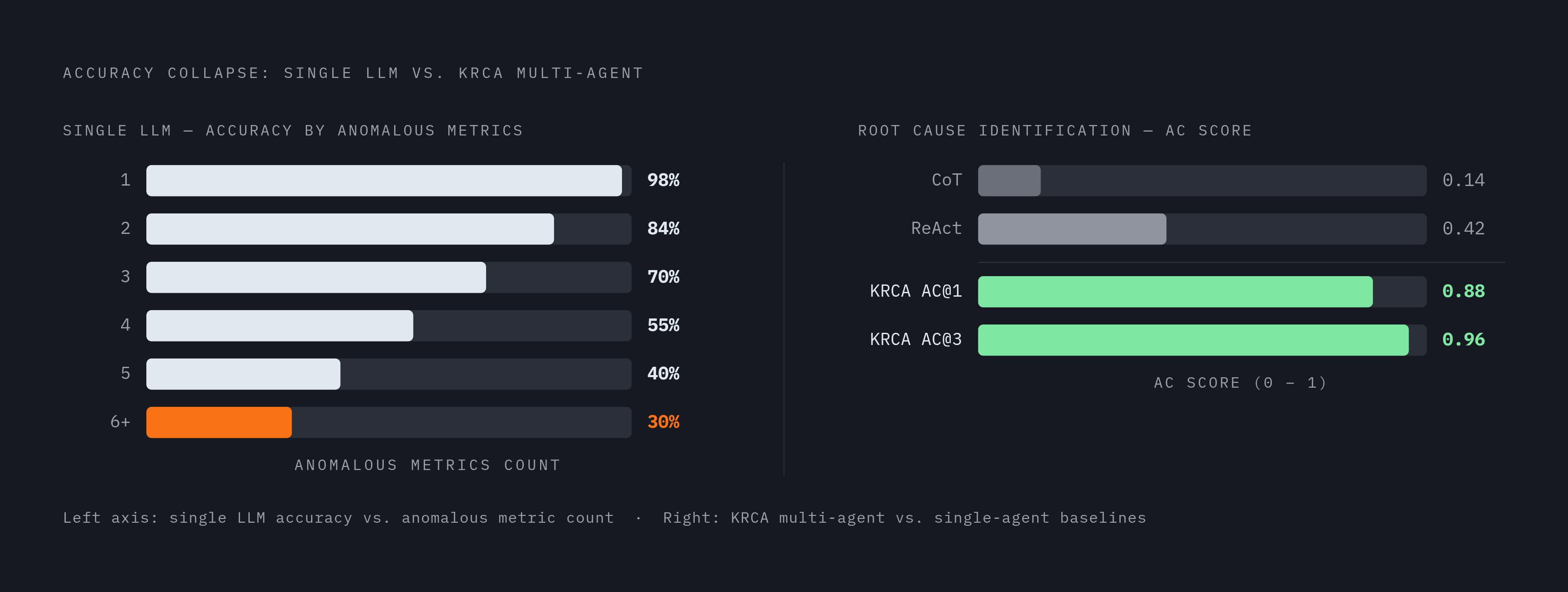
Single LLMs hit a wall, and it's a sharp one. When only a few metrics look anomalous, an unconstrained model can nail root cause with near-perfect accuracy. Add more anomalous metrics into the mix, and accuracy falls off a cliff, down toward 30%. The model gets overconfident and starts inventing causal links between things that aren't actually connected. It sounds confident while being wrong, which is worse than being obviously unsure.
That failure mode is the reason graph-guided, multi-agent systems exist — a fix for a measurable problem, not novelty for novelty's sake.
KRCA (arXiv:2607.01788, 2026) is a good example of what that fix looks like in practice, built for hyper-scale microservice environments in three stages:
- API-level drilldown narrows the full service topology down to a short list of suspects.
- A skeleton causal graph gets built from the anomalous metrics, acting as a structural guide with high recall.
- A memory-augmented multi-agent framework checks proposed causal links against that graph, so the model can't just invent connections that don't exist.
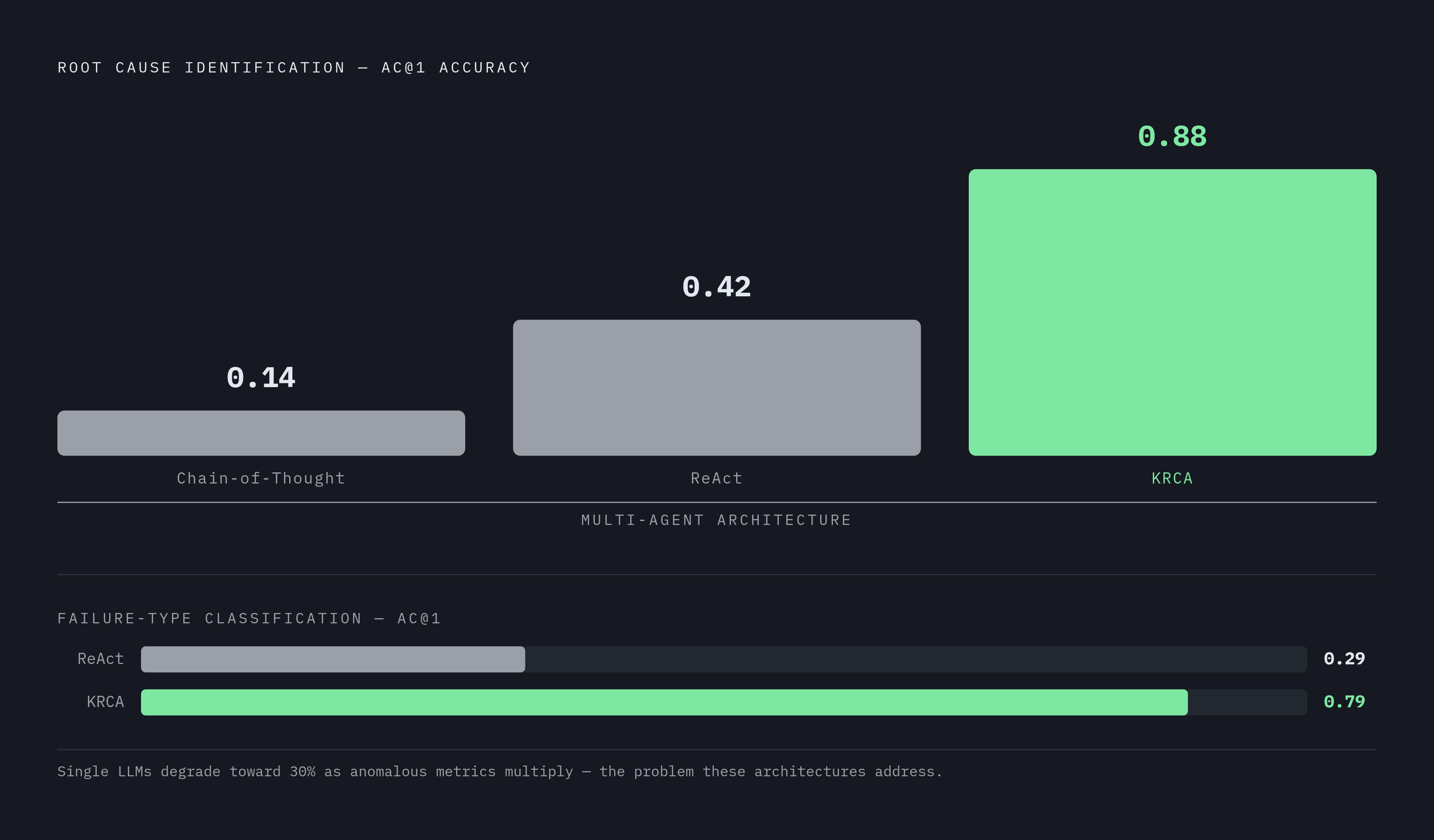
KRCA hits AC@1 of 0.88 and AC@3 of 0.96 for finding the root cause service, against 0.42 for ReAct and 0.14 for plain chain-of-thought. For classifying failure types, KRCA scores 0.79 versus 0.29 for ReAct. It does all this in about 146.59 seconds per case, fast enough to matter during a real incident and not just in a benchmark slide.
KRCA also has a self-reflection step: after every resolved alert, it pulls out both the case-specific details and the broader lessons, and stores them in memory. The system gets sharper with every incident it handles, not just faster at the one it just solved.
Other 2025 research chases the same idea from different angles. MicroRCA-Agent (arXiv:2509.15635) combines multiple data types, pairing log parsing with two layers of anomaly detection (Isolation Forest plus status code checks). Flow-of-Action, presented at the ACM Web Conference 2025, embeds standard operating procedures directly into the multi-agent reasoning chain to cut down on hallucination. TAMO (arXiv:2504.20462) gives agents a single context window holding logs, metrics, traces, and deployment metadata together.
The thread connecting all of it: constrain the model's reasoning with a graph or an SOP, and give it memory that builds over time. A single LLM, left alone with a complex incident, will often guess with confidence. That's the option worth ruling out.
What the MTTR numbers actually mean for engineering teams
According to the 2025 State of DevOps, average enterprise MTTR sits at 4 to 6 hours. Teams piloting LLM-driven triage are seeing that number drop by 40 to 70%.
Where does that time come from? AI takes over the slow, repetitive parts: correlating alerts, parsing logs, digging through runbooks. That frees engineers to spend time on the calls that actually need a human.
The loop looks something like this: root cause gets confirmed with a confidence score and an evidence chain behind it, corrective actions get suggested and tied to specific parameters, and prevention rules get written as monitoring thresholds that go live right away.
The human still owns the architectural calls, the decision to roll back versus patch forward, and whatever coordination has to happen across teams after something big breaks. AI RCA shortens the diagnosis; the decision still belongs to a person.
Several enterprise AIOps deployments report a significant drop in MTTR, which lines up closely with the pilot numbers above. That gap between lab results and what actually happens in production is smaller here than in a lot of other AI applications, and that says something about how mechanical this particular problem is. There's also a compounding effect worth watching: every incident that gets resolved and fed back into the system tends to make the next one a little faster to diagnose. The economics get better the longer a team runs it.
How AI RCA fits into the broader agentic development workflow
Right now, most AI RCA is reactive. It speeds up diagnosis after a human has already noticed something's wrong. Going looking for trouble on its own is still mostly out of reach.
But the direction of travel is clear. The direction of travel in agentic development points toward agents moving from assistants inside human-led workflows toward owning entire tasks end to end, from spec to deployment, with humans shifting from doing the work to specifying and checking it. Anthropic's 2026 agentic coding trends report frames the bigger picture: tasks that used to take weeks of cross-team back-and-forth are turning into single focused sessions.
AI RCA fits into that as a feedback loop, not a one-off tool. A diagnosis doesn't just end an incident. It turns into a playbook, a runbook update, or a new prevention rule that agents can act on the next time something similar happens.
The tightest point of integration is right after an incident: a post-incident review, written up by an LLM, turned into a structured runbook, and immediately indexed so it's ready to be pulled up the next time something looks similar.
Some causal discovery algorithms already report finding patterns with 95% accuracy across large datasets. At that level of reliability, the output stops being just a report for a human to read. It becomes a usable input for an agent tasked with writing a fix, updating a test, or adjusting a threshold.
That's the real shift: from "engineers diagnose, then decide what to fix" to "agents diagnose and propose the fix, engineers review and sign off." Same autonomy slider that's reshaping feature development, just pointed at incident response instead.
Integrating AI RCA into existing engineering infrastructure
AI RCA doesn't need a brand-new observability stack. It needs a correlation layer sitting on top of the logs, metrics, and traces already being collected.
OpenTelemetry is the standard that makes much of this possible. Structured, vendor-neutral traces are the prerequisite for correlating anything across multiple services. Teams still stuck on unstructured logging need to fix that before they look at anything else.
Where does this actually plug into daily work?
- CI/CD: patterns the AI flags can gate a pipeline or mark a PR that touches the code path involved in a past failure.
- GitHub: diagnostic findings and suggested fixes can show up right inside the PR, so context from a real production failure informs code review instead of getting buried in a Slack thread nobody scrolls back to.
- Slack and the terminal: alert summaries with confidence scores land where engineers already are, instead of forcing another dashboard into the rotation. Cursor, an agentic development environment for professional engineering teams, is one place that integration is already taking shape.
Agentic coding tools, including Claude Code, GitHub Copilot Workspace, Gemini Code Assist, OpenHands, and Aider, are increasingly where these findings end up getting acted on. Hand a coding agent a structured RCA report with a confidence score and a clear evidence chain, and it's in a good position to draft the fix itself.
A few things worth getting right before rolling this out:
- Data quality first. Standardize logging formats and get OpenTelemetry instrumented before picking a model.
- Runbook hygiene. Keep them in a vector store, with a 90-day freshness check built in.
- Transparency as a habit. Engineers need to see the evidence, not just a conclusion. Skip this and adoption stalls, regardless of how accurate the model is.
- Model flexibility. Log clustering, causal synthesis, and report writing may each call for a different model. Locking into one provider for everything leaves performance on the table.
The bigger organizational shift: the bottleneck stops being "how fast can someone read through logs" and becomes "how fast can someone review and act on what the AI already found." That's a different skill, worth training for on purpose.
Where AI RCA is still limited and what the next generation of systems is solving
None of this is a finished product, and anyone selling it as one is selling something. A few real limits are worth naming plainly:
- Overconfidence at scale. The drop from near-perfect accuracy down to around 30% as anomalous metrics pile up is a real production failure mode, not just something that shows up in a benchmark.
- Novel failures. Systems trained on past incidents struggle with something truly new. Memory systems like the one in KRCA help, but they only go so far.
- Data quality debt. The quality swing tied to logging format means AI RCA inherits whatever mess, or order, already exists in a team's observability setup. Garbage in, confident-sounding garbage out.
- Latency, for the fastest cases. At 146.59 seconds per case, KRCA is fast enough for most incidents. There are failure scenarios moving quicker than that, where a sharp engineer's gut still wins.
The research pushing past these limits is going in a few clear directions: constraining reasoning with graphs so models can't invent causal links out of thin air, fusing logs, metrics, traces, and deployment metadata into one context the way TAMO does, anchoring outputs to validated procedures the way Flow-of-Action does, and building memory that compounds, so each incident makes the next one easier.
Underneath all of it sits one question that won't go away: trust. Forrester's 2026 look at agentic software development points to trust as the real limit on how much autonomy gets handed over, and AI RCA is no exception. Evidence chains that engineers can actually check are what earns that trust, one incident at a time.
So where does that leave a team deciding whether to adopt this today? Use AI RCA now for the repetitive, high-volume triage work it already handles better than people can. Keep humans in charge of architecture calls and the rollback-versus-patch decision. And build, deliberately, toward the longer loop: diagnostic agent finds the cause, coding agent drafts the fix, CI/CD ships it, all as data quality and confidence in the outputs keep climbing.