DeepCode AI and Static Analysis in Agent Workflows
Static analysis must evolve to catch bugs agents write before humans ever see them.
AI-generated code now makes up a growing share of what ships to production, and the tools built to catch bugs in it were mostly designed for a world where a human sat down, wrote the code, and paused to think before hitting commit. This piece is about what happens to static analysis, tools like DeepCode AI in particular, when the thing writing the code is an agent that rarely pauses, skips second-guessing itself, and might run for eight hours straight overnight.
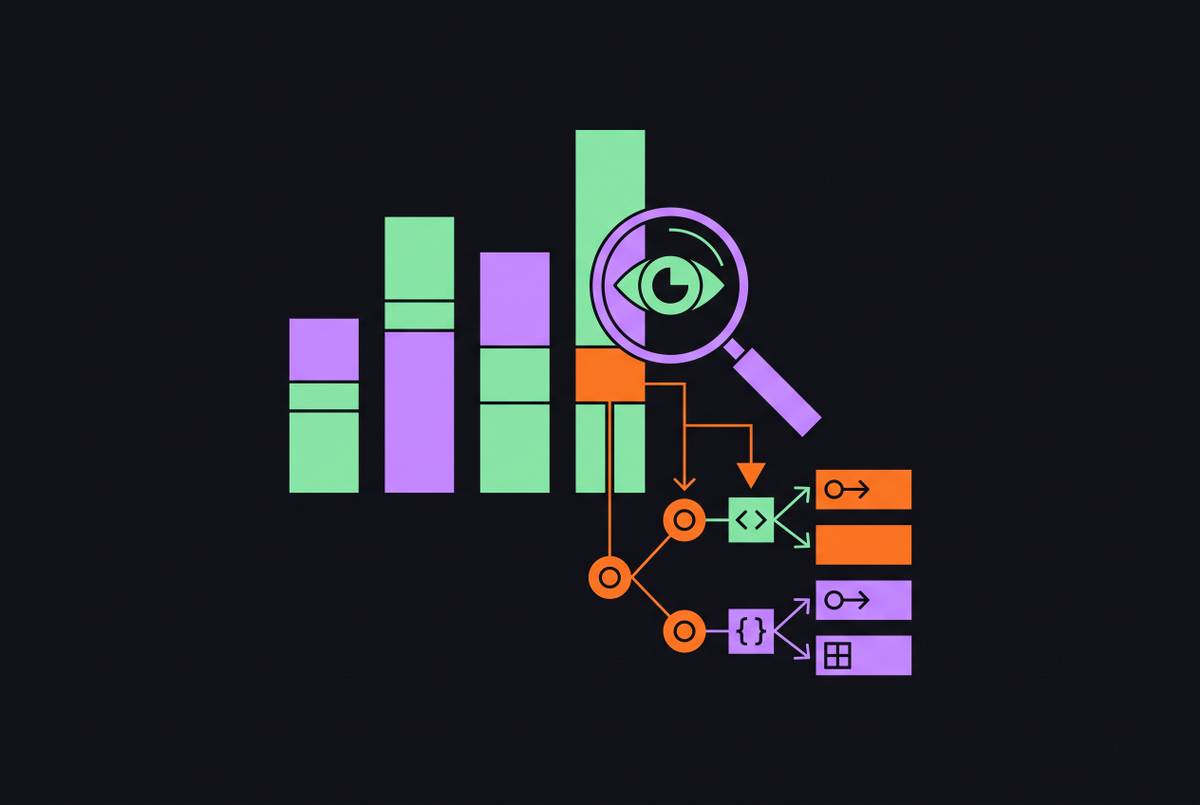
Recent data covering millions of developers puts AI-generated code at roughly 26.9% of all production code, up from 22% just one quarter earlier. Trust in AI accuracy dropped over the same stretch, from 40% down to 29% year over year, even though 80% of developers now use AI coding agents in their workflows. Static analysis is the obvious tool to close that gap, but running it the same way you did five years ago doesn't close it. It just moves the failure point later, from "code with a bug in it" to "code with a bug in it that already got merged while nobody was watching."
What DeepCode AI is and how it differs from traditional SAST
DeepCode AI is the machine-learning engine behind Snyk Code, now folded into what Snyk calls its AI Security Platform. Quick disambiguation: there's a second, unrelated project also named "DeepCode," an open-source agentic coding platform out of Hong Kong University (published on arXiv in late 2025). This section is about the Snyk engine; the open-source project gets its own section later.
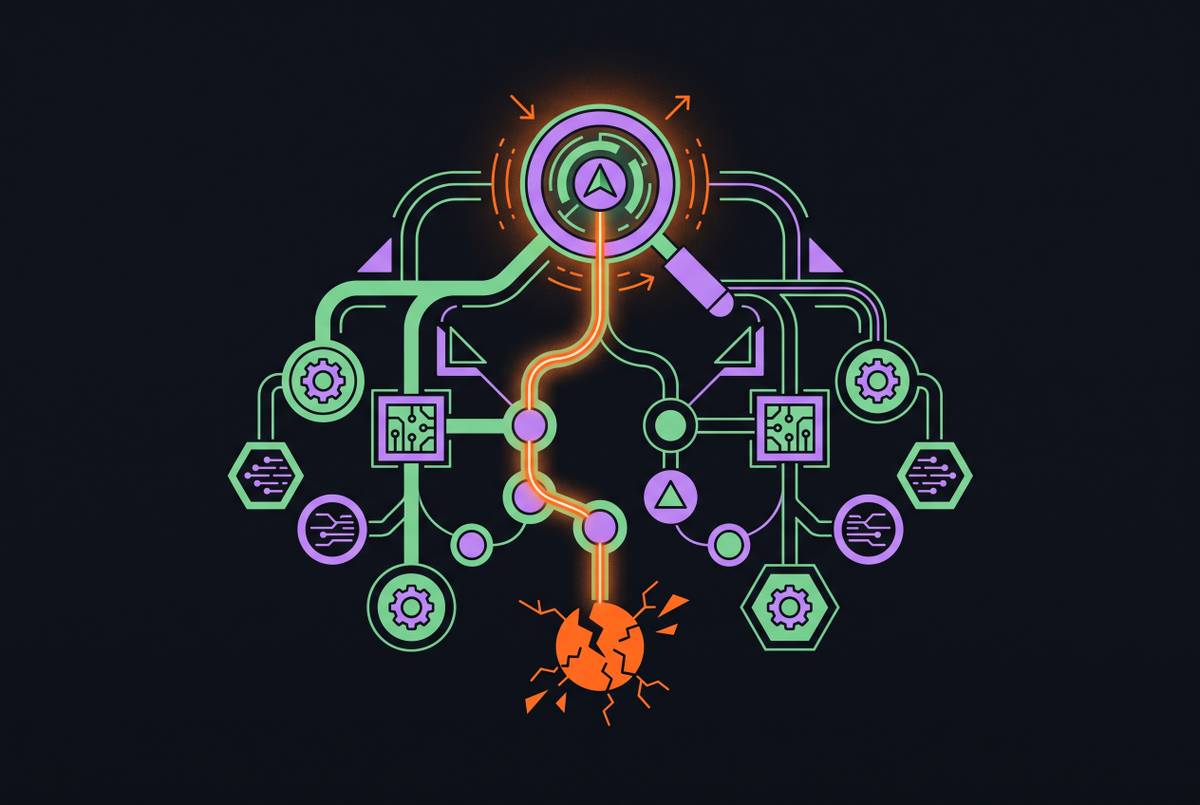
Detection and generation run in a fixed order. Symbolic AI, meaning AST analysis and data-flow tracing, does the detective work first, tracing how data moves through a codebase and flagging patterns that match known vulnerabilities, trained across more than 25 million data-flow cases. Only after something's flagged does the generative layer step in to propose a fix. Let a language model guess at vulnerabilities from scratch and it'll hallucinate problems that were never there, or worse, miss real ones with total confidence.
That ordering is also why DeepCode AI tends to post a lower false-positive rate than a lot of traditional SAST tools. A tool that cries wolf enough times trains developers to ignore it entirely, which defeats the point of running it at all. DeepCode AI was built around telling apart code that merely looks sketchy from code that's actually exploitable.
Snyk was named a Leader in the 2025 Gartner Magic Quadrant for Application Security Testing, and it integrates at the IDE level, so feedback shows up while someone (or something) is still writing code, well before it ever reaches a dashboard nobody opens.
The security risk that makes a feedback layer necessary in agentic workflows
Research suggests a substantial share of AI-generated code contains security vulnerabilities. Even conservative estimates put the figure close to half.
Among companies planning to deploy AI agents, a large majority have found their existing security tools were not built with autonomous code execution in mind. NIST's own guidance points toward runtime monitoring, input validation, and defense-in-depth as the answer, with static analysis as one layer among several, not the whole solution.
What makes agent-written code different from human-written code, security-wise? A few things:
- Agents loop. A single bad prompt or misunderstanding can spread the same vulnerability across dozens of files before a human ever looks at the output.
- Agents rarely hesitate. A developer writing code pauses, rereads the diff, second-guesses a line. An agent tends to skip all that unless something is built in to make it stop and check.
- Volume multiplies the damage. As AI-written code approaches a third of everything merged, one bad pattern doesn't cause one bug. It can cause the same bug, everywhere the agent touched.
Put those together and static analysis stops being a review step tacked onto the end of a workflow. It becomes something the agent itself has to read and act on, mid-loop, the same way it reads any other tool output.
How the agent-as-author shifts where and when static analysis runs
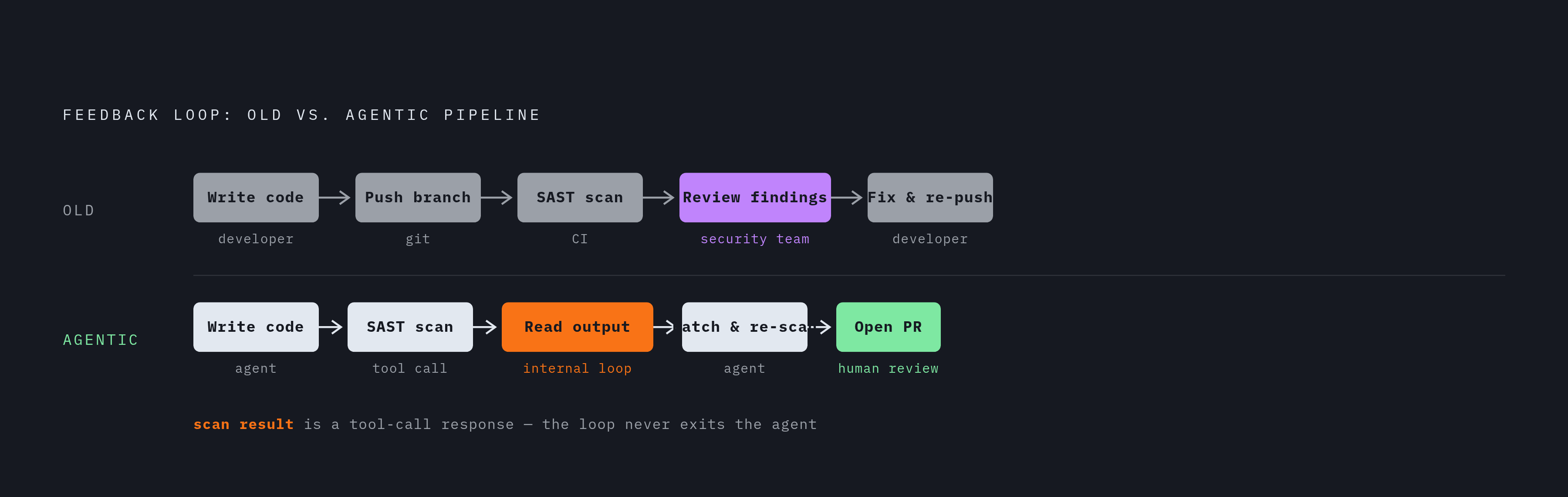
The old pipeline: a developer writes code, pushes a branch, CI kicks off a SAST scan, a security team reviews the findings, and the developer circles back to fix things. There's a delay built into every step, and it's usually fine, because the developer was already going to switch to something else while waiting.
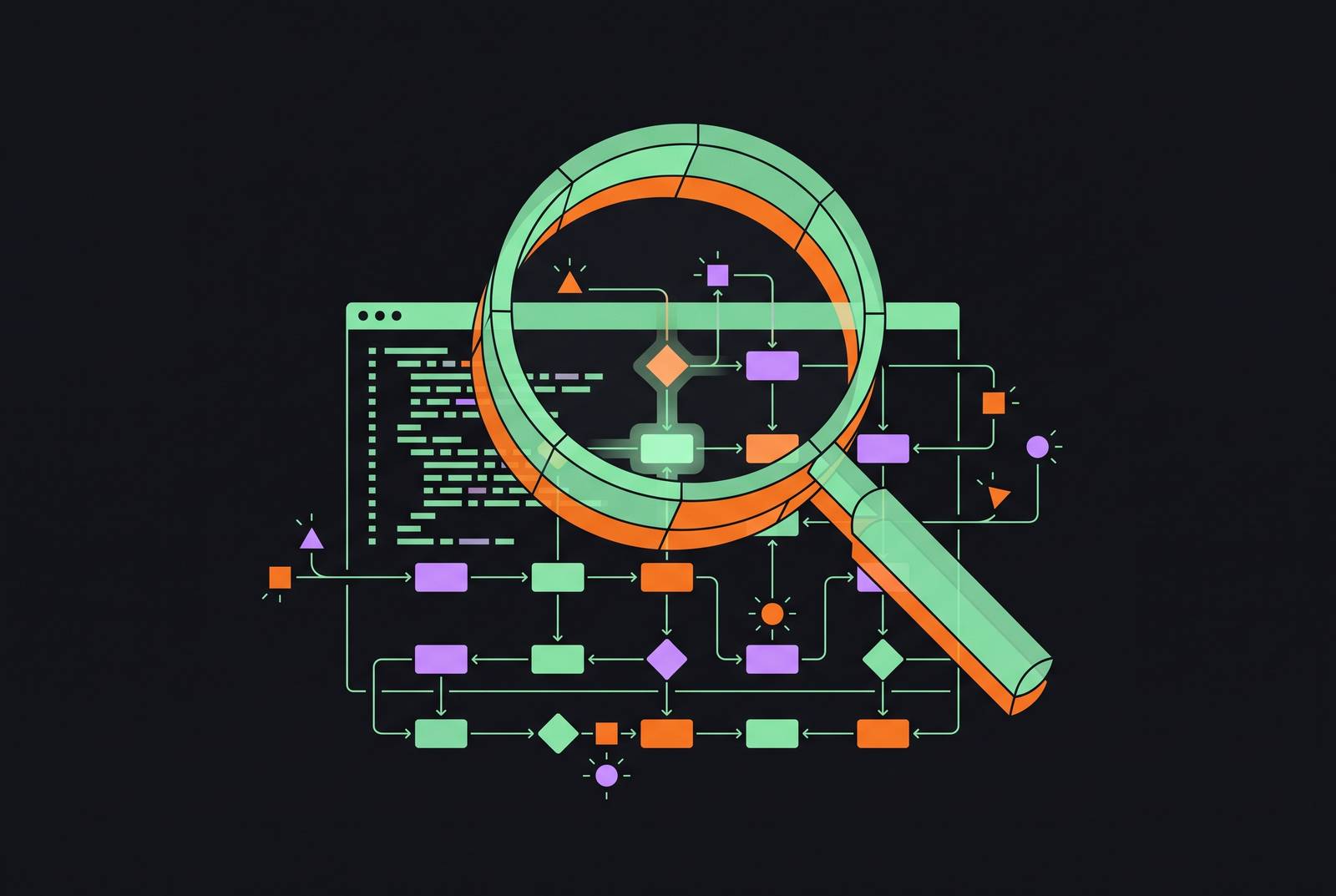
The agentic version: an agent writes code, reads the analysis output itself, patches the problem, re-runs the scan, and only then submits a pull request. The static analysis result isn't a message to a human anymore. It's a tool-call response the agent has to act on, in real time, without anyone tapping it on the shoulder.
In October 2025, GitHub's Copilot coding agent started running CodeQL, a static analysis tool, on its own generated code before finalizing a pull request. Nobody had to ask it to. That's the template for what "integrated" means once agents are the ones writing the code: not a gate that catches problems after the fact, but a step the agent takes on its own, before a human ever sees the work.
That template puts new demands on the tool itself. Most legacy SAST tools were built for a person reading a report, not a machine acting on one.
- Output has to be machine-readable. An agent can't parse an HTML report meant for a human's eyes.
- False positives have to stay low. A noisy signal makes an agent either over-correct, breaking code that was fine, or start ignoring the tool altogether.
- Speed matters more than ever. A scan that takes twenty minutes stalls the whole loop.
- Fixes, not just flags. A tool that only says "here's a problem" is less useful to an agent than one that says "here's a problem, and here's a proposed patch," which is exactly what DeepCode AI's generative layer does.
Even IDE-level integration matters here. Agents that work inside a development environment can get feedback the moment a file is written, well before someone finally commits.
Configuring static analysis inside a CI/CD pipeline built for autonomous agents
If analysis output is supposed to work as a signal an agent acts on, something has to enforce it. That's what YAML-defined quality gates do: they turn findings into a pass/fail signal that both the agent and the CI system read the same way.
A few configuration choices matter more than others:
- Mandatory status checks should block an agent-submitted PR outright on critical findings. The agent needs to be stopped from working around a serious problem just because it wants to move forward.
- Severity thresholds decide what the agent handles on its own versus what gets kicked up to a human. This isn't automatic. Someone has to write that rule down.
GitHub's Agentic Workflows, announced in technical preview in February 2026, points at where this is heading: agents run directly inside GitHub Actions, handling things like security reviews and issue triage from plain-language instructions. The design is described as "security-first," separating what the AI intends to do from what it's actually allowed to execute, using lockfiles and a mechanism called "Safe Outputs" to block writes that haven't been explicitly cleared.
Snyk Code's positioning fits the same logic. It bundles SAST, software composition analysis, container scanning, and infrastructure-as-code scanning under one vendor with one report. That matters more in agentic pipelines than in human ones, because an agent checking findings across multiple separate dashboards has to do coordination work a human would handle by switching between tools. Analysis also has to scale to whatever the agent can actually touch. In an enterprise monorepo, that might be a much bigger scope than the single PR diff a human would submit, so the analysis layer has to handle that scale too, using things like semantic dependency graphs to understand the codebase as a whole instead of file by file.
None of this is one-size-fits-all. A high-autonomy agent running for hours or overnight needs analysis on every commit, with findings fed back before any human ever looks at the work. A narrower, supervised agent making targeted edits can still work fine with analysis at the PR boundary, human review included, same as the traditional model. Match the setup to the leash length, or you've either built a bureaucracy for an agent that didn't need one, or handed a fast, unsupervised agent a rubber stamp.
Where Slack and asynchronous notification fit when agents work autonomously for hours
If an agent is running overnight, nobody's watching the CI output live. So how do findings reach the people who need them?
This is where a tool like Slack becomes part of the actual infrastructure, not just a nice-to-have. CI/CD status, static analysis results, deployment alerts, all of it can show up right in a conversation thread, where engineers already spend their day, instead of forcing someone to go dig up a dashboard nobody remembers the login for.
Nobody needs to approve every single step an agent takes. What they need is to know the moment something crosses a line the agent can't handle on its own. That means severity-routed alerts: a high-severity security finding the agent can't fix by itself should page a human right away. A minor style nit the agent resolved on its own can just log quietly, maybe in a channel nobody has to check urgently. This routing only happens if teams build it on purpose. Skip that step and you get one of two failure modes: a channel so noisy nobody reads it, or silence right up until the moment something's already broken in production.
Agentic tools that plug directly into Slack, alongside the IDE, the terminal, and GitHub, give engineers one clear view of what the agent's been doing, instead of forcing them to piece together the night's events from five different logs the next morning.
The open-source DeepCode agentic platform and what it shows about quality assurance in agent design
The DeepCode discussed here is the open-source agentic coding platform from HKUDS (Hong Kong University), published on arXiv in December 2025, distinct from the Snyk engine covered earlier. Its design choices make an argument about where this whole field is headed.
The system uses a multi-agent setup with one central orchestrating agent, and it treats the problem of building an entire repository the way you might treat a budgeting problem: how do you fit everything that matters into a limited context window? To pull that off, it uses blueprint distillation to boil source material down to its essentials, a stateful code memory system for structured indexing, retrieval-augmented generation to pull in outside knowledge when needed, and closed-loop error correction to catch its own mistakes.
Here's the detail worth sitting with: Quality Assurance Automation is a named, built-in capability of the system. Static analysis, unit test generation, documentation synthesis — these aren't downstream steps bolted onto the agent's output. They're part of the agent's own loop, built into how it works from the start. Most commercial pipelines still get this backwards, treating QA as a gate the finished work has to pass through rather than a habit the agent practices while it works.
The platform's other capabilities, things like generating code straight from a research paper (Paper2Code), or building a website or backend service from a plain-text description (Text2Web, Text2Backend), matter here mostly because of what they reveal about scope. At that level of autonomy, where an agent is generating an entire application from a paragraph of instructions, inline analysis isn't optional. It's structural. Which raises a fair question for anyone building commercial pipelines: if the research frontier already treats QA as a first-class part of the agent loop, what does it say that a lot of production pipelines still treat SAST as a gate that runs after the agent is finished?
How teams evaluate whether their static analysis setup is actually keeping pace with agentic output
If your SAST tool runs once per pull request, and findings land in a dashboard nobody opens until sprint review, it was built for a human author. It fails as a feedback layer for an agent, no matter how good the underlying detection is.
A short checklist worth running through:
- Is the output machine-readable, something an agent can actually parse and act on, or only readable by a person?
- Does the agent see findings before it submits a PR, or only after?
- Are severity thresholds clear enough that the agent knows what it can fix itself versus what needs a human?
- Is the false-positive rate low enough that it doesn't slowly poison the agent's decision-making over time?
- Do findings show up where engineers actually work (IDE, terminal, Slack), or are they stuck in a separate portal that's easy to forget about?
One useful measure here is mean time to remediation. If static analysis sits early in the agent's loop, remediation time should drop noticeably, because problems get caught and fixed before they ever reach a human's queue. When that's not happening, one of two things is likely going on: the tool is running too late, or its output isn't reaching the part of the system that can act on it.
As AI-written code keeps climbing as a share of what ships, the cost of getting this wrong climbs right along with it. A tool that catches a majority of vulnerabilities but only runs after the agent has already merged its own code is doing a fundamentally different job than a tool that catches the same share inside the loop, before anything ships. Same detection rate, different outcome. Teams often measure detection rate and stop there, when timing is the variable that actually decides whether the catch means anything.
The practical posture, then: treat static analysis setup as part of agent setup. Tune them together, not separately, and revisit both at once whenever the agent's scope or autonomy level changes.